Hiring engineers in 2026 is more challenging than ever, with a 3.2:1 demand-to-supply ratio for AI roles and 1.6 million unfilled positions globally. To succeed, companies must act fast - top candidates are hired within 10 days - and prioritize specialized skills like LLM fine-tuning, cybersecurity, and MLOps. Here's what you need to know:
- Speed Matters: 60-day hiring cycles lose top talent. Aim for 21–28 days.
- Specialized Skills: Focus on expertise in AI tools, Kubernetes, and DevSecOps over generalist abilities.
- Targeted Sourcing: Use AI tools to search platforms like GitHub and Stack Overflow, tapping into 6x larger talent pools.
- Competitive Offers: Senior engineers earn $165K–$250K base, with perks like equity, learning budgets, and remote flexibility.
- Efficient Interviews: Replace whiteboard tests with practical tasks like pair programming or debugging exercises.
- Retention: Strong onboarding and benefits - like remote work and professional development - reduce turnover and improve productivity.
Hiring success in 2026 is about precision, speed, and tailored strategies to attract and retain the best talent.
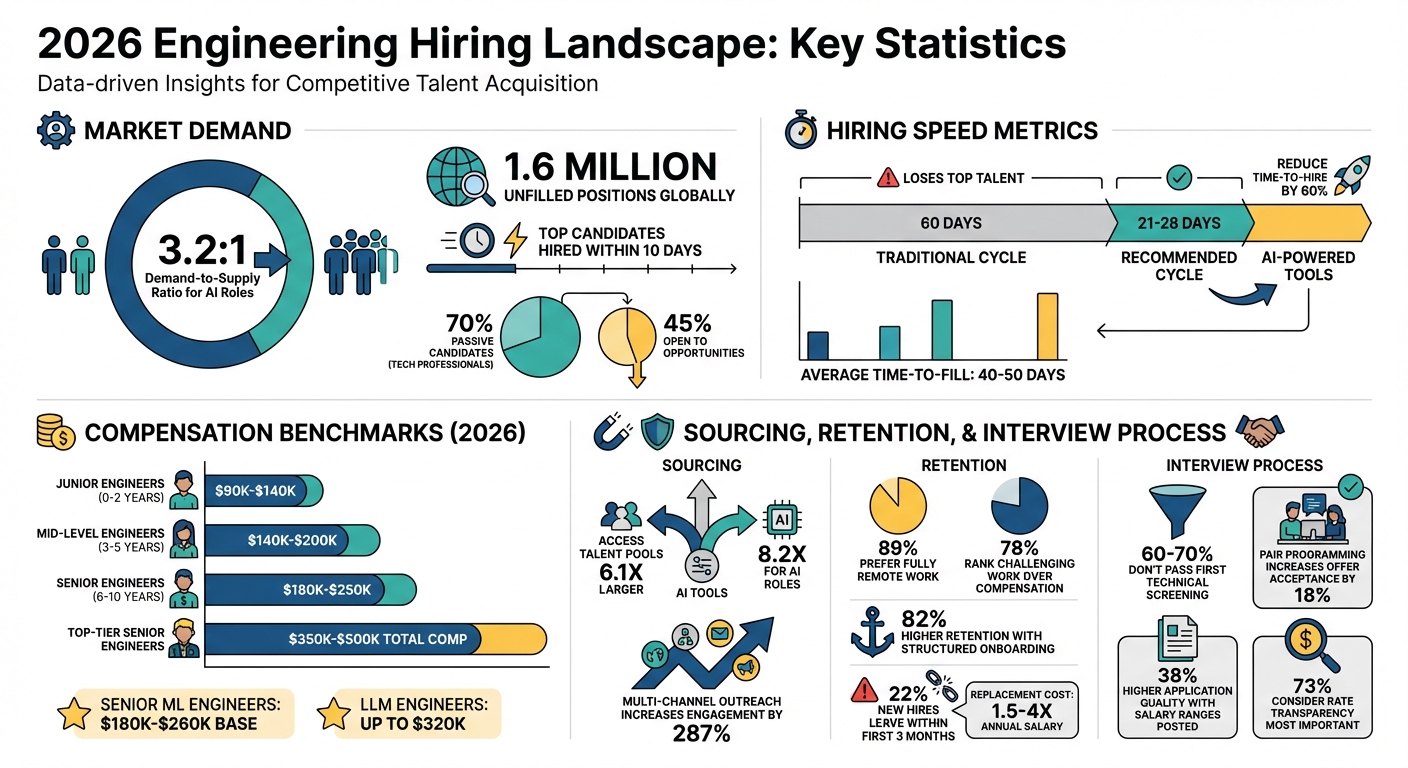
2026 Engineering Hiring Statistics: Demand, Salaries, and Time-to-Hire Benchmarks
How Software Engineer Hiring Is Changing in 2026-How to Prepare Now
sbb-itb-c53a83b
Identifying Your Engineering Talent Needs
Focus on the specific challenges an engineer will tackle instead of listing an overwhelming number of technologies. Targeted hiring should emphasize outcomes, like modernizing legacy systems, developing AI-powered features, or scaling infrastructure effectively.
The technical skills required will align with your business goals. For instance, if integrating AI into your product is the priority, look for engineers skilled in building production-ready systems using Large Language Model (LLM) application development and Retrieval-Augmented Generation (RAG) to customize models with your private data. If scaling infrastructure is the goal, prioritize expertise in Kubernetes, serverless architectures, and tools like Terraform for infrastructure-as-code. Additionally, as AI-generated code can introduce vulnerabilities, DevSecOps skills - such as secure API design, threat modeling, and ensuring data compliance - are becoming increasingly critical.
Defining Core Technical Skills
A baseline understanding of AI is now essential. By 2027, it's estimated that 80% of software engineers will need to enhance their skills in using AI-assisted development tools. However, this doesn't mean every role requires an AI specialist. Instead, seek engineers who can use AI tools effectively while maintaining the judgment to validate and refine AI-generated outputs.
"The engineers making the biggest impact in 2026 spend most of their hours: Translating business goals into technical decisions, designing systems that scale... and reviewing and validating AI-generated output."
– Damian Wasserman, Founder, BEON.tech
For senior roles, system design and architectural thinking stand out as key differentiators. If you're building AI-enabled products, modern data engineering skills are equally important. Proficiency with vector databases (e.g., Pinecone, Weaviate), real-time data pipelines, and feature stores is just as crucial as traditional backend expertise. The demand for these specialized skills is intense, with a global 3.2:1 demand-to-supply ratio for AI engineering roles and 1.6 million positions currently unfilled.
These technical priorities pave the way for assessing adaptability and soft skills in potential candidates.
Soft Skills and Adaptability
Beyond technical expertise, the ability to learn and adapt quickly is often more valuable than mastery of every specific framework. A candidate's history of embracing new tools and adjusting to changing requirements can provide insight into their learning agility.
Strong communication skills are equally essential, especially as 65% of companies now operate with remote or distributed teams. Engineers need to clearly explain technical tradeoffs to non-technical stakeholders and document their work for smooth asynchronous collaboration. The most effective engineers go beyond simply completing tasks; they consider user personas, business goals, and the broader impact of their work.
"Great engineering is not about writing more code. It is about removing bottlenecks that silently slow down growth."
– Ayan Mirza, Full Stack Developer, 8ration
Instead of compiling a lengthy list of technologies, create an Ideal Candidate Persona that focuses on the specific challenges the engineer will address and the outcomes they will help achieve. This approach ensures strategic hiring and supports long-term success.
Sourcing Top Engineering Talent
Finding the right engineering talent goes beyond matching technical skills to business needs - it requires effective sourcing strategies. While traditional job boards might seem like a go-to option, they’re not enough. Here’s why: 70% of tech professionals are passive candidates - they’re not actively job hunting. However, 45% of them are open to exciting opportunities when approached the right way. The key is to connect with them in the spaces they frequent and make your outreach stand out from the crowd of automated messages.
Using Technology for Recruitment
Cutting-edge recruitment tools are game-changers. Modern AI-powered platforms can scan over 30 different sites, such as GitHub, Stack Overflow, and Kaggle, to find engineers based on their actual work rather than relying on self-reported LinkedIn profiles. This approach opens up talent pools 6.1 times larger than searches based on job titles alone, with the multiplier jumping to 8.2 times for AI-related roles. Tools like LeadCognition even track GitHub activities - such as commits, pull requests, and code reviews - to pinpoint skilled professionals. These tools can significantly speed up the hiring process, cutting the average time-to-fill to just 14–28 days.
For outreach, a multi-channel approach is essential. Combining email, LinkedIn, and SMS can boost engagement rates by 287% compared to sticking with just one channel. That’s especially important since cold email response rates dropped to 5.1% in 2025. When contacting engineers on platforms like GitHub, referencing specific pull requests or commits can increase response rates by 3–5 times compared to generic messages. These tools and strategies help recruiters build meaningful connections in the tech community.
Engaging Specialized Communities
Technology is only part of the equation. To truly connect with top talent, recruiters need to dive into niche spaces where engineers gather and competition from other recruiters is minimal. For instance, Discord servers focused on programming languages like Rust and Go, subreddits such as r/experienceddevs, and forums like Hacker News are hubs for passionate specialists. GitHub contributors to prominent projects - like rust-lang/rust or kubernetes/kubernetes - are also excellent sources for finding expertise in hard-to-fill roles.
Engagement in these communities requires more than just job postings. Start by contributing to discussions and sharing content that’s relevant to their interests before introducing job opportunities. When reaching out, make it personal. Highlight their open-source contributions or recent technical talks. Instead of pushing for a 30-minute call right away, suggest a quick email exchange to show respect for their time and reduce barriers. Once you’ve established a connection, the next step is presenting an offer they can’t refuse.
Crafting Competitive Job Offers
Time is of the essence when hiring engineers - top candidates are often snapped up within 10–14 days. When crafting job offers, focus on the challenges they’ll tackle in the first 90 days rather than overwhelming them with a long list of required technologies. This approach has been shown to increase applications from qualified candidates by 42% and makes 38% of them more likely to accept the offer.
Compensation is another critical factor. Competitive packages should align with 2026 benchmarks, offering base salaries between $165,000 and $220,000 for senior engineers. Add equity or RSUs, perks such as annual learning budgets ($3,000–$10,000), home office stipends ($2,000–$5,000 one-time), and for AI specialists, access to dedicated GPU or compute resources. Including salary ranges in job postings can improve application quality by 38%. Finally, give candidates 5–7 days to make a decision rather than pressuring them with "exploding offers." This not only shows respect but also reduces the risk of early attrition.
Optimizing the Interview Process
An ineffective interview process can cost your company top talent, harm your reputation, and waste valuable time. As Aditya Sheth of Juicebox.ai aptly states:
"The goal isn't to see if someone can invert a binary tree on a whiteboard. It's to answer one simple question: Can this person actually build great software with our team?"
Structured Interview Techniques
To strike the right balance between speed and thorough evaluation, many successful hiring teams use a four-step approach. Here's how it works:
- Recruiter Screen (30 minutes): Confirm the basics like compensation expectations, motivation, and communication skills.
- Hiring Manager Call (45–60 minutes): Dive into past projects and measurable achievements.
- Practical Technical Assessment (60–90 minutes): Focus on solving real-world problems rather than abstract whiteboard exercises.
- Behavioral/Team Fit Round (45–60 minutes): Evaluate collaboration style and alignment with company values.
Before starting the interview process, create a scorecard with clear performance criteria - such as technical expertise, communication ability, and ownership skills. This prevents decisions based on gut feelings or groupthink. To further reduce bias, have each interviewer submit independent evaluations and hire/no-hire recommendations before group discussions.
A great example of this in action comes from the fintech company Ramp. In early 2026, they replaced traditional coding challenges with 60-minute pair-programming sessions. This change boosted offer acceptance rates by 18% in just one quarter because candidates felt the process better reflected the job. Paired with AI-driven sourcing, Ramp also cut its time-to-hire by 60% in three months.
This structured system ensures you can effectively assess candidates' technical skills and problem-solving abilities without unnecessary delays.
Assessing Technical and Problem-Solving Skills
Once the structure is in place, the focus shifts to evaluating candidates' real-world technical expertise. By 2026, technical expectations have evolved. While speed still matters, the ability to design scalable systems, manage technical debt, and validate AI-generated outputs has become just as critical. With over 84% of developers expected to use AI-assisted development tools by early 2026, these skills are now baseline requirements.
Instead of relying on outdated algorithm puzzles, center your assessments on tasks that mirror the actual job. For example, you might ask candidates to extend an existing API, debug a recurring 500 error, or design a system that can handle a security audit. During live sessions, encourage candidates to use AI tools like GitHub Copilot or Cursor, and pay attention to how they validate the results. Damian Wasserman, Founder of BEON.tech, captures this shift well:
"The right question isn't 'do you use AI tools?' - it's 'show me how you use them and where you don't trust them.'"
| Assessment Type | Primary Signal | Ideal For |
|---|---|---|
| System Design | Architectural trade-offs, scalability, security | Senior, Staff, and Principal roles |
| Pair Programming | Real-time collaboration, communication, code quality | All IC levels |
| Debugging Walkthrough | Systematic problem-solving, tool proficiency | Reliability and platform-focused roles |
| AI Fluency Test | Judgment, prompting skills, output validation | All levels (baseline for 2026) |
Keep technical assessments short - 30 to 45 minutes is ideal - to reduce candidate drop-off while still gathering meaningful insights. If you opt for take-home projects, limit them to two hours to respect candidates' time. Given that 60–70% of candidates typically don't make it past the first round of technical screening, an efficient and respectful process is key. Plus, a positive experience can make candidates 38% more likely to accept your offer.
Flexible Work Models and Their Impact
In 2026, selecting the right employment model has become a critical decision for engineering leaders. With each qualified engineering candidate facing three job openings and positions staying vacant for an average of 40–50 days, the competition for talent is fierce. Add to that the cost of replacing an experienced engineer - 1.5 to 4 times their annual salary when factoring in lost productivity and ramp-up time - and it’s clear why companies are rethinking their hiring strategies. The goal? To align employment models with both immediate project demands and long-term growth objectives.
Comparing Employment Models
Different employment models come with their own pros and cons, especially when it comes to cost, speed, and control. Here’s a closer look:
- Full-time hires offer stability, knowledge retention, and direct management but are expensive. A senior engineer in the U.S. can cost between $180,000 and $250,000 annually, including benefits, recruiting fees, and overhead.
- Contract engineers bring specialized skills on short notice without long-term commitments. As Octagon Group explains:
"Used well, contract engineers can stabilize projects, bring in specialist expertise quickly, and increase overall team productivity".
- Offshore staff augmentation provides significant savings - 50–70% lower costs compared to local senior hires, typically ranging from $4,000 to $10,000 per month. This model also boasts a 95% retention rate, much higher than the roughly 60% seen in some local tech hubs. Additionally, structured communication in distributed teams can improve productivity by 33%.
Here’s a quick comparison of these models:
| Factor | Full-Time Hire | Contract Engineer | Offshore Staff Augmentation |
|---|---|---|---|
| Cost | $180k–$250k total loaded | Medium (higher hourly, no benefits) | $4k–$10k/month |
| Speed to Hire | 40–50 days | Immediate availability | Often within 48 hours |
| Compliance | High employer liability | Vendor-managed | US-based contracts |
| Control | Maximum (direct management) | High (scope-based) | High (direct Slack/standup access) |
| Retention | Variable (~60% in tech hubs) | Project-specific | 95% reported |
To minimize the risk of a bad hire, consider a 1–2 week paid trial period where candidates work on real codebase tasks. This approach can lower bad hire rates by up to 80% while giving candidates a chance to experience your workflow firsthand.
Understanding these options helps you decide whether to focus on building your team internally or acquiring specialized external expertise.
Build vs. Buy Decisions
The "build or buy" dilemma - whether to develop talent internally or bring in outside expertise - has become more urgent than ever. With 20% of the engineering workforce expected to retire by 2026 and demand for engineering skills projected to grow by 13% through 2031, companies feel the pressure to act quickly. Ed Meindl, Regional Vice President at Addison Group, sums it up well:
"Companies increasingly prefer delaying hires until finding an ideal candidate rather than onboarding someone who requires extensive training".
A "buy" approach works best for roles requiring immediate expertise, such as AI implementation, cloud infrastructure, or semiconductor design. However, keeping positions vacant for too long can lead to higher costs and risk losing candidates to competitors. On the other hand, a "build" strategy focuses on upskilling your current team, making it ideal for proprietary technologies or when long-term alignment with company culture is a priority.
A balanced approach can also be effective. Maintaining a 1:3 ratio of senior to junior engineers allows for both rapid project completion and sustainable growth. Senior architects can drive progress with minimal oversight, especially in early-stage projects, while junior engineers can execute within established frameworks once systems stabilize. For urgent deadlines or recruitment bottlenecks, contract hires can fill gaps without sacrificing quality.
Ultimately, deciding whether to build or buy talent is about aligning your hiring strategy with your organization’s long-term goals and immediate needs.
Compensation and Retention Strategies
By 2026, engineers assess job offers based on the complete compensation package - not just the base salary. This includes equity, bonuses, and benefits, giving them a comprehensive financial view before making decisions. The days of comparing offers solely on base pay are long gone.
For companies, balancing costs and retaining talent is more critical than ever. Losing a senior developer can cost anywhere from $28,000 to $58,000 and take up to eight months to replace. With an 18.9% voluntary turnover rate in the tech industry, failing to regularly benchmark compensation could lead to losing top talent to faster-moving competitors.
2026 Salary Benchmarks
In 2026, compensation strategies focus on specialized skills rather than across-the-board raises tied to inflation. High-demand expertise, such as AI implementation, cloud architecture, and cybersecurity, commands the largest pay increases. Location still impacts pay - roles in the San Francisco Bay Area come with a 20% to 35% premium over remote positions, while New York City roles offer a 10% to 20% premium.
Base salaries vary significantly by experience:
- Junior engineers (0-2 years): $90,000 to $140,000
- Mid-level engineers (3-5 years): $140,000 to $200,000
- Senior engineers (6-10 years): $180,000 to $250,000
- Top-tier senior engineers: Total compensation can reach $350,000 to $500,000.
- Staff and Principal engineers at major tech firms: Total compensation can exceed $1,000,000.
AI and Machine Learning roles lead the pack. Senior ML Engineers earn $180,000 to $260,000 in base pay, while LLM Engineers can hit $320,000. Performance bonuses at large companies typically range from 10% to 20% of base salaries, and total compensation at public companies or well-funded startups often adds 30% to 60% on top of base pay.
Katie LaFranchi, an HR Consultant at Amplēo, emphasizes:
"You cannot out-bid Google. You cannot match the perks of a well-funded unicorn. But you can out-maneuver them with agility, purpose, and a hiring strategy that treats talent acquisition as a business function".
Transparency is also a major factor. 73% of developers consider rate transparency the most important aspect of a role. Additionally, 68% report wasting a median of 6.5 hours on interviews for roles with budgets far below their expectations. Publishing salary ranges in job descriptions isn’t just a courtesy - it’s a necessity to avoid alienating top candidates.
Building Complete Benefits Packages
Competitive salaries alone aren’t enough to keep engineers engaged. Well-rounded benefits packages are essential for retention. For example, 78% of developers rank "interesting and challenging technical work" as more important than compensation. Yet, engineers spend only 16% of their week writing code, even though 93% find it the most rewarding part of their job. This disconnect often leads to higher turnover.
Remote work and asynchronous flexibility are now non-negotiable. Fully remote work is preferred by 89% of engineers, and 67% favor async-first communication over real-time collaboration. Interestingly, 43% would turn down a role requiring daily synchronous standups outside their preferred hours. Yaseen Deen, Co-Founder of OctogleHire, notes:
"Developers are not asking for higher rates as much as they are asking to know the rate before they invest time in an interview process".
Professional development opportunities also play a major role in retention. Offering conference budgets, certification programs, learning stipends, and internal tech talks demonstrates a commitment to employee growth. Equity incentives are another key factor. At public companies, RSUs can add 30% to 60% to base salaries, while startup equity options typically range from 0.05% to 0.2% for senior roles. For startups, clear explanations of the cap table, liquidation preferences, and liquidity paths are essential.
Operational issues like scope creep, late payments, and micromanagement are major drivers of attrition, causing 62%, 51%, and 48% of departures, respectively. "Stay interviews" with current team members can help identify and address potential flight risks early. Standardized onboarding processes, including 90-day check-ins, ensure smoother integration for new hires.
One-time bonuses can be a smart way to address compensation gaps without permanently increasing salary structures. For example, in March 2026, Listen Technologies partnered with Amplēo HR to revamp their benefits and HR systems. By adopting a strategic "Total HR" model, they created scalable, compliant processes that improved offer acceptance rates among engineers - all without needing a large internal HR team.
Onboarding Engineers for Long-Term Success
The first three months are crucial for new engineers. During this time, they either evolve into high performers or join the 22% who leave within that window. Companies with a structured onboarding process see clear benefits: 82% higher retention rates and a 70% boost in productivity. On the flip side, replacing a developer can cost a company anywhere from 100% to 200% of their annual salary.
Streamlining Onboarding Processes
Pre-boarding makes a difference. Sending hardware a week before the start date and setting up accounts for tools like GitHub, Slack, Jira, and 1Password ensures a smooth Day 1. This allows new hires to focus on connecting with the team and learning the company culture instead of dealing with IT roadblocks. For instance, Moneysupermarket Group automated its onboarding system, achieving a 95.5% on-time rate for IT ticket submissions.
The buddy system is another game-changer, increasing productivity by 25%. Pair each new hire with a buddy who has at least six months of experience. This person can provide daily check-ins during the first week, gradually reducing to 30-minute sessions by Week 3. Shopify's "Code Lab" initiative in 2023 is a great example. Using their internal tool "shipit", they enabled new developers to deploy code on their very first day. Encourage every new hire to submit a Pull Request within their first week, even if it’s just a documentation update. This simple step builds confidence and introduces them to the deployment process.
An efficient environment setup can make a huge difference. Instead of relying on manual README instructions, consider using an Environment-as-Code approach with tools like Dev Containers or GitHub Codespaces. This can cut setup time from hours to just minutes. Maintain a single, continuously updated onboarding guide that includes architecture diagrams, data flows, and a FAQ section. New hires should be encouraged to contribute updates to this guide as they encounter outdated material.
Building a Collaborative Culture
Once the onboarding process is streamlined, the next step is to nurture a culture of collaboration. Engineers who understand the end-user perspective tend to write better code. To help them connect with the product and its users, schedule activities like product walkthroughs, customer feedback sessions, or support ticket reviews during their first month. Early exposure to cross-functional teams such as Product, Design, and Data is also important. These meetings help new hires see how their work fits into the larger picture.
For remote or distributed teams, collaboration needs extra effort. Virtual coffee chats, team social events, and Slack introductions can go a long way in building connections. Weekly one-on-one meetings with managers during the first month are a strong predictor of onboarding success. Additionally, set clear, outcome-focused goals for the 30-, 60-, and 90-day marks. These should outline specific business results the engineer will take ownership of within 6–12 months, rather than just listing tasks. This clarity prevents confusion and keeps productivity on track, reducing the risk of early turnover.
A structured onboarding process, much like targeted hiring and efficient interviews, is a cornerstone for long-term success in engineering teams.
Conclusion: Key Takeaways for Hiring Engineers in 2026
Hiring engineers in 2026 revolves around three key elements: clear planning, smart use of technology, and creating an engaging work environment. Start by crafting an Ideal Candidate Persona, supported by a detailed skills matrix that defines what success looks like in the first 90 days. This approach lays the groundwork for a focused and efficient hiring process.
Speed remains a top priority. Aiming for a 21–28-day hiring cycle can make all the difference. Leverage AI-powered tools to source talent from over 30 platforms - like GitHub and Stack Overflow - simultaneously. These tools can reduce time-to-hire by as much as 60%. For example, fintech company Ramp achieved this in late 2023, streamlining their process significantly. Additionally, replacing abstract coding challenges with practical assessments, such as pair programming sessions, can improve results. Ramp’s switch to this method boosted their offer acceptance rate by 18% in just one quarter.
"Winning the best talent hinges on three modern pillars: proactive multi-channel sourcing, hyper-personalized outreach, and an efficient interview process that respects the candidate's time." – Juicebox
Beyond technical skills, focus on alignment with team dynamics. Studies show that 89% of hiring failures stem from cultural mismatches rather than technical shortcomings. Seek candidates who bring diverse perspectives and complementary working styles to strengthen your team. Offering transparent and competitive compensation packages can also elevate the quality of applicants.
Finally, remember that hiring doesn’t end with an offer letter. A well-structured onboarding process - featuring pre-boarding activities, mentorship opportunities, and clear objectives - ensures new hires contribute effectively from the start. By combining thoughtful planning, advanced sourcing technologies, and robust onboarding, you can meet the demands of the ever-evolving hiring landscape.
FAQs
How do I decide which engineering skills matter most for my role?
To identify the key engineering skills you'll need in 2026, start by matching your technical expertise to the demands of your projects and the direction of market trends. Pay close attention to technical know-how, problem-solving skills, and the ability to keep up with rapidly changing technologies, such as AI. Focus on capabilities that enable growth and efficiency, like agile methodologies, security measures, and system architecture. At the same time, don’t overlook soft skills - strong communication and adaptability will be just as crucial for sustained success.
What’s the fastest way to reach strong engineers who aren’t job hunting?
To quickly connect with skilled engineers who aren’t actively job hunting, focus on proactive sourcing and multi-channel outreach. Leverage AI-powered tools to identify potential candidates and craft personalized messages that resonate with them. Another effective approach is implementing incentivized referral programs, encouraging your current team to recommend top engineers they know. By blending these tactics, you’ll have a better chance of reaching and engaging top-tier talent in 2026.
How can I evaluate AI tool usage without making interviews longer?
To make the most of AI tools in recruitment, rely on structured assessments paired with automated scoring. AI recruitment tools can rank candidates based on their skills while providing clear, evidence-based reasoning for their scores. This approach simplifies the pre-screening process and ensures consistency.
During interviews, shift the focus toward evaluating traits like adaptability and AI fluency instead of spending time on basic technical skills. This strategy not only saves time but also helps identify candidates who can thrive in AI-driven environments. Automated rankings and data-supported insights allow you to assess candidates effectively without adding unnecessary steps to the interview process.


