You have a portfolio company missing its revenue forecast by a wide margin, the VP of Sales left two months ago, and the next board meeting is six weeks out. The deal partner wants a credible plan for the pipeline, not another recruiter retainer that takes four months to produce a hire who then needs six more to ramp. This is the moment most operating partners reach for an interim revenue leader, and it is also the moment they make the most expensive buying mistakes. Choosing a provider for interim CRO work across portfolio companies is a commercial decision with a cost of delay attached, and the wrong call shows up in the quarter after next.
This guide is for the buyer who already has budget and a problem, not for someone deciding whether interim leadership is a real category. It covers what you actually need to decide before you sign, how to judge the provider and the individual separately, and how to structure the engagement so you keep the revenue machine rather than renting a dependency you cannot unwind.
1. Start with the revenue problem, not the title
Before you shortlist anyone, write down what is actually broken in one or two sentences a CFO would recognize. A stalled pipeline, a sales team with no governance, a pricing model that no longer matches the market, and a founder-led commercial function that does not scale are four different problems that each need a different person.
The commercial consequence sets the brief. If the company is six months from a confirmatory diligence process on an add-on, you need someone who can stabilize bookings and document the revenue engine so it survives a buyer's scrutiny. If you are in the first 100 days after close and the thesis depends on cross-sell, you need someone who can build the motion, not just manage the people already there.
Write the problem as a measurable gap. "Net new bookings are running 38 percent below plan and we have no forecast we trust" is a brief. "We need a CRO" is a job title. Bain's annual private equity work, tracked in its Global Private Equity Report, has made the point for years that value creation increasingly rests on commercial and operational levers rather than financial engineering, which is exactly why the revenue leader hire carries weight it did not a decade ago.
2. Decide whether you are buying a person or a provider
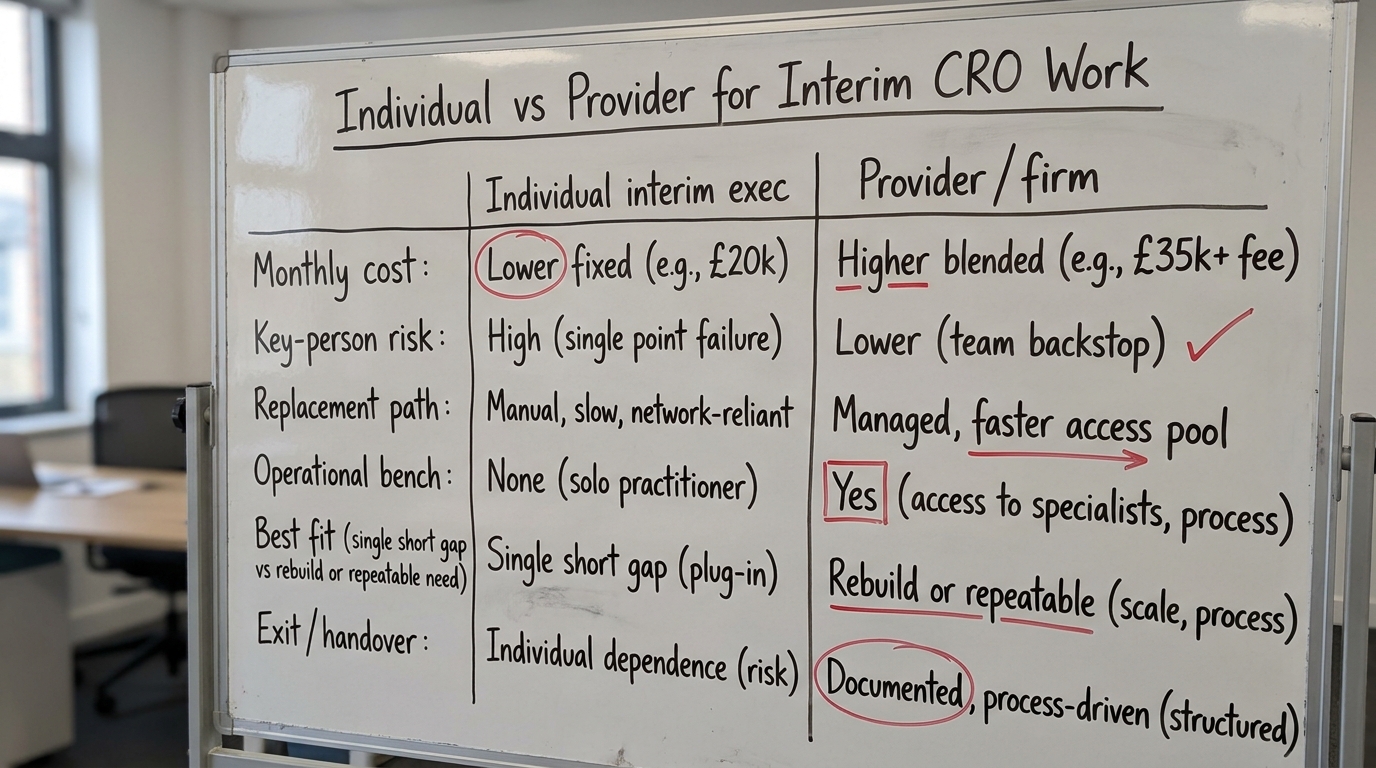
There are two different things on the market and they are priced and governed differently. The first is an individual interim executive, placed through a network or a search firm, who becomes a temporary employee or contractor of the portfolio company. The second is a provider that supplies the interim leader as part of a team, with a bench behind them, a methodology, and a firm standing behind the delivery.
The individual is cheaper on paper and carries more key-person risk. If that person gets sick, takes a better offer, or simply is not the right fit, you are back to square one with the clock still running. The provider costs more per month and gives you continuity, a replacement path, and usually the operational layer underneath the leader that a solo executive cannot bring.
For a single, well-defined, short gap, the individual often wins. For a repeatable need across several portfolio companies, or for a situation where the revenue function needs rebuilding and not just steering, the provider model usually pays for itself because you are buying the system and the operating capacity underneath it.
This is the same calculation GrowthShuttle lays out in its guide on RevOps as a service for private equity, which draws the line between what you rent for a defined period and what a portfolio company should eventually own.
3. Separate the three jobs an interim CRO is actually asked to do
Buyers blur three distinct jobs under one title and then wonder why the fit is wrong. Be explicit about which one you are buying, because very few people do all three equally well.
The stabilizer
This person steps into a team that has lost its leader, holds the forecast together, keeps the best reps from walking, and buys you time to run a permanent search. The measure of success is that bookings do not fall off a cliff and the board gets a number it can rely on.
The builder
This person installs the machine the company never had: CRM governance, a defined sales process, pricing discipline, and the reporting that lets you see the funnel. Success here is a revenue function that runs on a system rather than on one founder's relationships.
The repositioner
This person changes the commercial model itself, moving a company from one-off project sales to recurring revenue, or from direct to channel, or into a new segment the thesis depends on. This is the hardest job and the one where a cheap hire costs you the most.
A provider that claims the same person is equally strong at all three is selling, not diagnosing. Press them to tell you which of the three their proposed leader has done most recently, with a real company at a comparable stage.
4. Write the brief the way a diligence team would
The brief is where most engagements are won or lost, and a loose one guarantees a mismatch. Treat it the way you would treat a technology due diligence scope: name the decision it informs, the evidence that will tell you it worked, the owner, and the time box.
A usable brief for a provider of interim CRO work across portfolio companies covers five things. The revenue baseline today and the gap to plan. The specific motion or segment that needs fixing. The decision the board needs by a named date. The handover condition that ends the engagement. And the budget envelope and the term.
Leaving the handover condition out is the common error. Without it, an interim role drifts into a permanent one at an interim rate, and the operating partner loses the leverage to end it cleanly. Name the exit state in the brief. "Forecast accuracy within 10 percent for two consecutive quarters and a permanent CRO in seat" is an exit condition. "Until things improve" is not.
McKinsey's work on private capital, published across its research, has repeatedly found that the portfolio companies that outperform are the ones where the value-creation plan is specific and owned rather than aspirational, and the interim leader brief is a small version of that same discipline.
5. Judge the provider on evidence, not pedigree
A logo wall and a few impressive titles tell you where people have worked, not what they will do for you. Ask for evidence that maps to your three jobs and your stage.
- A named engagement at a company of similar size and model, with the revenue problem described and the actual change in bookings, pipeline, or forecast accuracy.
- The method they use in the first 30 days, in enough detail that you can tell it is a repeatable process and not improvisation.
- How they staff the layer beneath the leader, because a CRO without RevOps support spends their first month building spreadsheets instead of leading.
- What they leave behind when they go, as artifacts the permanent team can run without them.
- A reference from an operating partner who hired them for the same job you are describing, not a portco CEO who is contractually grateful.
Be wary of any provider that applies a SaaS playbook to a distributor, a project-delivery firm, or a services business that barely runs campaigns. The motion is different, the metrics are different, and a template built for one will mislead the board in the other. GrowthShuttle's note on hiring commercial due diligence you can actually use makes the same point about buying analysis built for a business model that is not yours.
6. Price it against the cost of delay, not an hourly rate
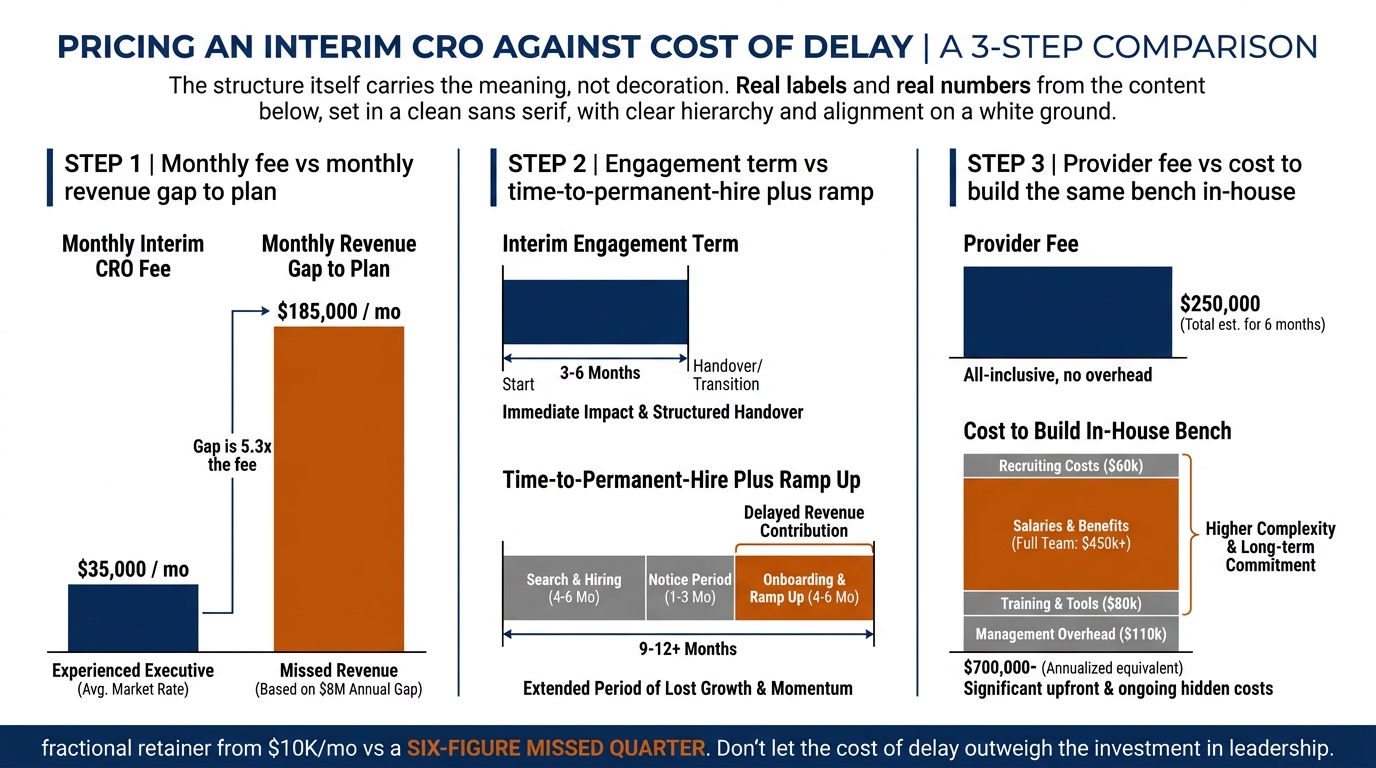
The instinct is to benchmark the monthly fee against a full-time salary and declare the interim leader expensive. That comparison misses the point. The relevant number is the cost of the revenue gap staying open for another quarter.
If a portfolio company is running millions below plan on net new bookings, the monthly fee for a capable provider is small against the enterprise value at risk when the next forecast misses and the board's confidence in the plan erodes. The expensive outcome is a cheap hire who steadies nothing and hands you a worse number in three months.
Benchmark three things instead. The fee against the monthly revenue gap it is meant to close. The term against the time to a permanent hire plus ramp. And the provider's fee against what it would cost you to build the same operational bench in-house, which for a temporary need almost never makes sense. A fractional retainer that starts around ten thousand a month for a senior operator is cheap against a six-figure quarter of missed bookings, and that is the comparison the deal partner cares about.
S&P Global Market Intelligence and PitchBook both track holding periods and exit timing across the industry, and S&P's market data is a reminder that every month a revenue problem persists is a month of hold you may not get back at exit.
7. Structure the engagement so you can end it cleanly
The provider you want is the one willing to design their own exit. Build the structure around three checkpoints and a handover, not an open-ended retainer.
A diagnostic first, then a plan
Start with a short, fixed-scope diagnostic, two to four weeks, that produces a real view of the revenue engine and a plan the board can read. This is also how you test fit at low risk before committing to months. A provider that resists a scoped diagnostic and insists on a long minimum term is protecting their revenue, not yours.
Milestones the board can see
Tie the engagement to milestones that show up in the board pack: forecast accuracy, pipeline coverage, the specific motion being fixed, and the permanent-hire search progressing in parallel. The interim leader's job includes making themselves replaceable, and the milestones should reflect that.
A handover that leaves artifacts
The end state is a revenue function the permanent CRO inherits with the process documented, the CRM governed, and the reporting running. If the interim leader leaves and the funnel goes dark, you bought a person, not a system. GrowthShuttle's post-merger integration checklist for add-ons applies the same handover discipline to integration work, and the logic carries straight across.
8. Decide who owns the role across multiple portfolio companies
If you are an operating partner with several companies that will each need commercial leadership at different points, the buying decision changes. You are no longer hiring for one gap; you are choosing whether to standardize on a provider you can deploy repeatedly.
A repeatable relationship with a single provider gives you faster deployment, because the provider already knows your firm's standards and reporting, and a consistent diagnostic across the portfolio that lets you compare revenue engines on the same axes. It also concentrates risk, so insist on continuity provisions and a bench that does not depend on one individual.
The alternative, sourcing a fresh individual for each company through a network, gives you a tailored fit each time at the cost of a cold start every time. For a portfolio of three or more companies with recurring commercial leadership needs, the standardized provider usually wins on total cost and speed, which is the same conclusion GrowthShuttle reaches in its guide on buying a value creation office as a service for functions you only need part-time.
9. Match the leader to the company's actual model
The single most common mismatch is a revenue leader whose instincts were formed in a business model unlike the one in front of them. A CRO who scaled a product-led SaaS company will reach for playbooks that do not fit a distributor, an engineering services firm, or a clinic group, and the board will act on metrics that mean something different in that context.
For an engineering or project-delivery business, the revenue motion runs on relationships, backlog, and margin discipline rather than marketing-sourced pipeline, and the interim leader needs to have lived in that world. GrowthShuttle's piece on private equity buyers for engineering companies is a useful lens on how different that commercial reality is from a software company.
Ask the provider to name the two or three business models their proposed leader knows cold, and treat a vague answer as a warning. A leader who needs the company explained to them twice is a leader the operating partner will spend their own time correcting, which defeats the purpose of hiring one.
10. Make the data foundation part of the mandate
An interim CRO inherits whatever visibility the company has, and in a lot of mid-market portfolio companies that means the business runs on disconnected systems and a pile of spreadsheets. If the CRM is not governed and the numbers are not trustworthy, the interim leader's first month goes to building a view of the funnel rather than improving it.
Decide upfront whether fixing the data foundation is inside the mandate or a parallel workstream. If the provider owns it, they need the operational capacity to do CRM hygiene and reporting in addition to executive leadership. If a different owner runs the data foundation in parallel, name that owner and the dependency in the risk register so the two efforts arrive in a sequence the board can use.
This is where the line between an interim CRO and a fractional CIO engagement matters, because the revenue leader needs the data to lead and someone has to own getting it there. The AICPA and CIMA's work on finance and data, published through AICPA and CIMA, underlines how much forecast reliability depends on the underlying systems being in order.
11. Run the governance the way the board expects
The interim leader reports into the portfolio company, but the operating partner and the deal team want visibility they can act on. Set the governance before the engagement starts so the first board meeting is a status update and not a surprise.
Agree the cadence, the metrics that appear in every board pack, and the decision rights, so everyone knows what the interim leader can decide alone and what needs the board. The Harvard Law School Forum on Corporate Governance publishes extensively on board oversight in private-equity-backed companies through its corporate governance forum, and the recurring theme is that clear decision rights prevent the drift that kills these engagements.
Keep two reporting formats. Finance wants the numbers in the same spreadsheet model they already run, and the board wants a visual view with the exceptions flagged. A provider that can serve both without rebuilding the data each month is doing the job properly. Harvard Business Review's coverage of mergers and acquisitions has repeatedly made the case that integration and value capture fail more often on governance and communication than on strategy, and the interim leadership engagement is no exception.
12. The buyer's checklist before you sign
Run this list before committing to a provider for interim CRO work across portfolio companies. If you cannot answer most of it cleanly, the brief is not ready.
- The revenue gap is written as a measurable number against plan, with the decision it informs and the date the board needs it.
- You have decided which of the three jobs you are buying: stabilizer, builder, or repositioner.
- You know whether you want an individual or a provider with a bench, and why.
- The provider has shown a named engagement at a comparable company and model, with real before-and-after numbers.
- The leader's business-model experience matches the company in front of them, confirmed by naming the models they know cold.
- The engagement starts with a scoped diagnostic that lets you test fit at low risk.
- The exit condition and handover artifacts are written into the agreement at signing.
- The data foundation is either in the mandate or named as a parallel workstream with an owner.
- Governance, cadence, metrics, and decision rights are agreed before the start.
- The fee is benchmarked against the cost of the gap staying open for another quarter.
Two of these matter more than the rest. The written exit condition keeps an interim role from quietly becoming a permanent one at an interim rate, and the model-match question keeps you from hiring a leader the operating partner has to correct. For how the same discipline applies to the integration work that often runs alongside a revenue rebuild, GrowthShuttle's 100-day digital plan is worth reading next.
The broader context behind all of this is that private equity returns now lean on commercial execution inside the portfolio rather than on leverage and multiple expansion, a shift documented across the industry by BCG's principal investors work and in the data that firms like Preqin and Private Equity International track. The interim CRO decision is one of the places that execution gap is widest and the cost of getting it wrong is most visible at the next board meeting.
If you are weighing an interim revenue leader for one portfolio company or structuring a repeatable relationship across several, see how the DevriX and GrowthShuttle private equity team scopes interim and fractional revenue leadership, starting with a low-risk diagnostic rather than a long-term retainer.