You are three weeks past close on a platform that runs its finance on one ERP instance, its two largest customers on a second, and most of its real decisions on a shared drive full of spreadsheets. The investment case anticipated a data-led cross-sell inside eighteen months. Nobody on the management team owns the systems that cross-sell would run on, and the last IT lead left before the deal signed. Hiring a full-time CIO at this stage would take four to six months and commit the company to a cost it may not need at run-rate. This is the gap that fractional CIO services are meant to fill, and the decision in front of you is whether to fill it that way and how to judge the person you bring in.
This guide is written for the operating partner, the deal team member, or the portfolio company CEO who has budget and a problem, not for someone deciding whether technology leadership matters. It covers what to scope, what to pay, how to measure the engagement, and when a fractional arrangement is the wrong answer.
1. What you are actually buying, and what you are not
A fractional CIO is a senior technology executive who works across your portfolio company on a part-time, defined-outcome basis, usually one to three days a week, for a fixed term. You are buying decision authority and a small number of outcomes, not a body in a chair. The distinction matters commercially because the two cost very different amounts and solve different problems.
When operating partners describe what they need here, the language is rarely about technology for its own sake. It is closer to "we cannot see our own numbers," or "nobody owns the stack and the next acquisition is coming." Those are the problems a fractional CIO should be scoped against. If the engagement is scoped against activity (tickets closed, a migration run, a vendor managed), you have bought contract IT management and should pay accordingly.
The useful version of this role carries three things: a decision right over the technology roadmap, ownership of a defined set of outcomes tied to the value creation plan, and enough standing with the management team that the CEO treats the recommendation as a plan rather than a memo. A fractional CIO who cannot get decisions made is an expensive advisor.
Bain's annual Global Private Equity Report has tracked for several years how much of the return now has to come from operational improvement rather than multiple expansion, which is the backdrop that makes this role worth scoping carefully rather than filling by reflex.
2. The five problems a fractional CIO is a reasonable answer to
Before you write a scope, decide which problem you are actually solving. The common ones cluster into five.
Data visibility
The business runs on disconnected systems and Excel. The ERP, CRM, and any marketing tools do not talk to each other, and leadership gets numbers late and inconsistently. A fractional CIO here owns getting to a unified view and the first few dashboards, usually in weeks, not quarters.
RevOps and system hygiene
The foundations are weak: no CRM governance, inconsistent data capture, reports that measure the wrong thing. Nothing clever can be built until this is fixed, and a fractional CIO is a reasonable owner for fixing it before you fund automation on top.
Integration capacity for an add-on
You are buying a bolt-on and need someone who can plan and run the systems side of the merge. The post-merger integration checklist for add-ons gives a sense of the surface area here, and most of it needs a named owner rather than a committee.
The capability question
Management does not know whether to hire a permanent CTO, contract one, or rent the function, nor which stack to standardize on. A fractional CIO can make that recommendation and run the interim while you execute it, which avoids a six-figure hire made under pressure.
Covering a gap before a permanent hire
The permanent leader is coming but has not landed, and the company cannot sit idle through a search. This is prevention work: hold the roadmap steady and hand over cleanly.
If your situation does not fit any of these, be honest about that. Several of these problems are better solved by a specialist than by a generalist CIO, and scoping the wrong role wastes the first quarter you do not have.
3. Scope the engagement against outcomes the deal team recognizes
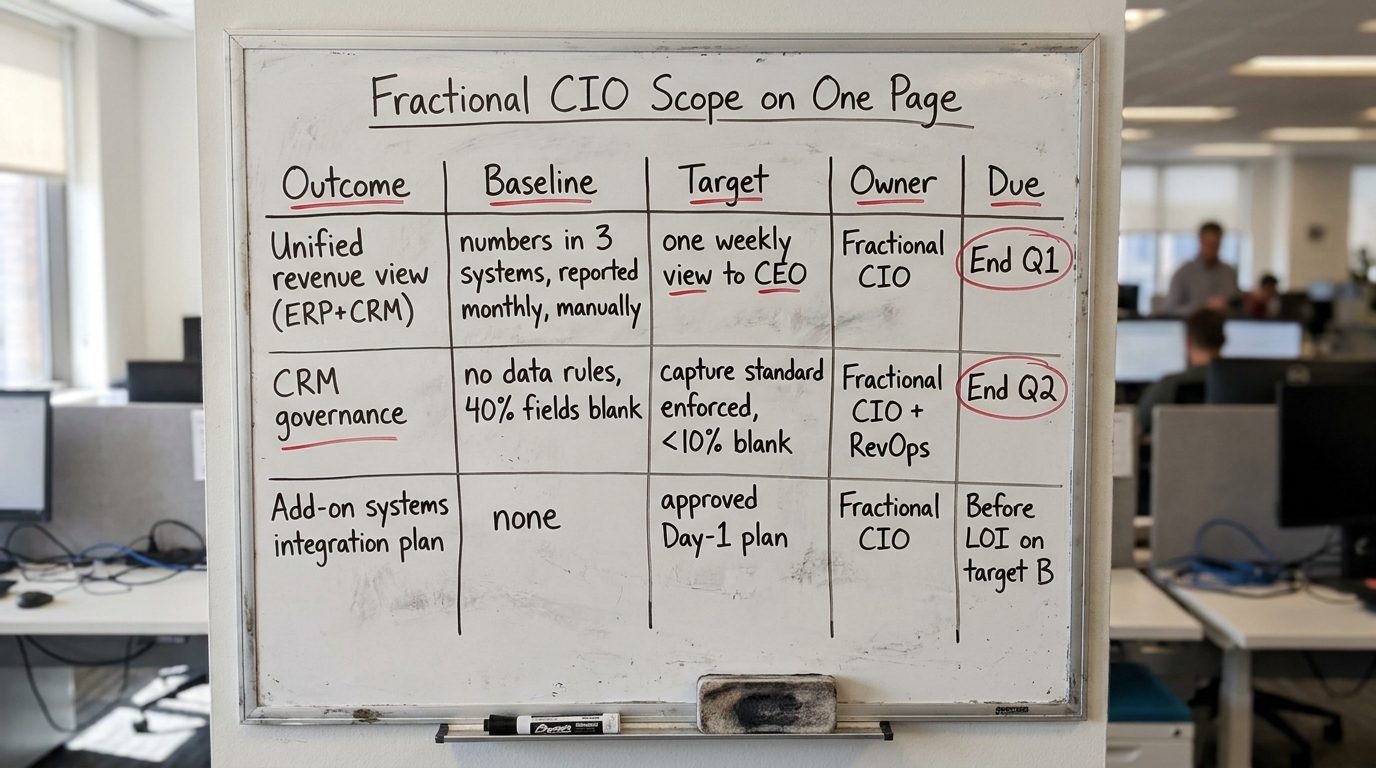
The scoping document is where most of these engagements succeed or fail. A fractional CIO scope that lists responsibilities ("oversee IT, manage vendors, advise leadership") commits you to paying for presence. A scope that lists outcomes with baselines and dates commits the person to results you can judge.
Write the scope so a deal partner who never attends a technology meeting can read it and see the connection to the value creation plan. Three or four outcomes is the right number for a part-time engagement. More than that and you are describing a full-time job you are underpaying for.
For each outcome, record the current state (the baseline), the target, the owner, and the date it is due. "A single revenue view across the ERP and CRM, available to the CEO weekly, by end of Q1" is scopeable. "Improve data maturity" is not. The discipline here is the same one that makes technology due diligence useful rather than decorative: tie every finding to a number and a decision.
4. What fractional CIO services should cost in 2026
There is no single market rate, but there are ranges that let you judge a quote. Fractional CIO engagements are usually priced one of three ways: a monthly retainer for a set number of days, a day rate, or a fixed fee against a defined project. For a portfolio company, a monthly retainer tied to a quarter or two is the most common and the easiest to govern.
Quotes are increasingly benchmarked against what the same outcome costs to build now, with current tooling, rather than against what a full-time salary would have cost. Entry-level scoped work on data visibility or RevOps hygiene should land in the tens of thousands over a quarter, not the hundreds of thousands a six-month time-and-materials project used to carry. If a quote starts at six figures for discovery, ask what you are getting that a two-week paid diagnostic would not give you first.
Three things justify a higher number: real decision authority (the person is accountable, not advisory), prior portfolio company experience at your scale, and the ability to run the work, not just recommend it. Three things do not justify it: a famous logo on the CV, a long list of certifications, and a day rate anchored to what the person earned as a full-time CIO at a far larger company. For context on how firms are spending against value creation plans generally, McKinsey's private capital research and BCG's work on principal investors are both reasonable references.
If you want a cleaner read on how to price interim functions without overpaying for a role you need part-time, the companion piece on buying a value creation office as a service works through the same trade-off for a broader function.
5. How to judge the person before you sign
The interview for a fractional CIO should not look like a hire. You are not testing whether they could run your IT for five years. You are testing whether they can walk in, diagnose fast, and own three outcomes without constant correction.
The fastest signal is whether they arrive with something built for your business model. A distributor, a project-delivery firm, and a clinic group have different revenue engines, and a candidate who talks about them in generic SaaS terms will need correcting on every call. The guide to judging fit before you sign with engineering-company buyers makes the same point from the other side of the table: fluency with the specific model beats a polished general pitch.
Ask for a scoped diagnostic you can see before you commit to the full engagement. Many strong fractional operators will do a short, low-risk assessment under an NDA for a modest fee or free, because it demonstrates capability. If a candidate refuses any form of paid trial, that is information.
Questions that separate the real operators from the advisors:
- What are the first three things you would check in our stack, and what would each tell you?
- Where have you held a decision right rather than made a recommendation, and what did you decide?
- Walk me through a migration or integration you ran, not advised on, and what broke.
- How would you report to me and to the board in two different formats?
That last one matters more than it sounds. Finance wants the numbers in Excel on the same underlying data. Leadership and the board want a visual view with the insight flagged. A fractional CIO who can only produce one of those will frustrate half your stakeholders.
6. The first 100 days, and what "on plan" looks like
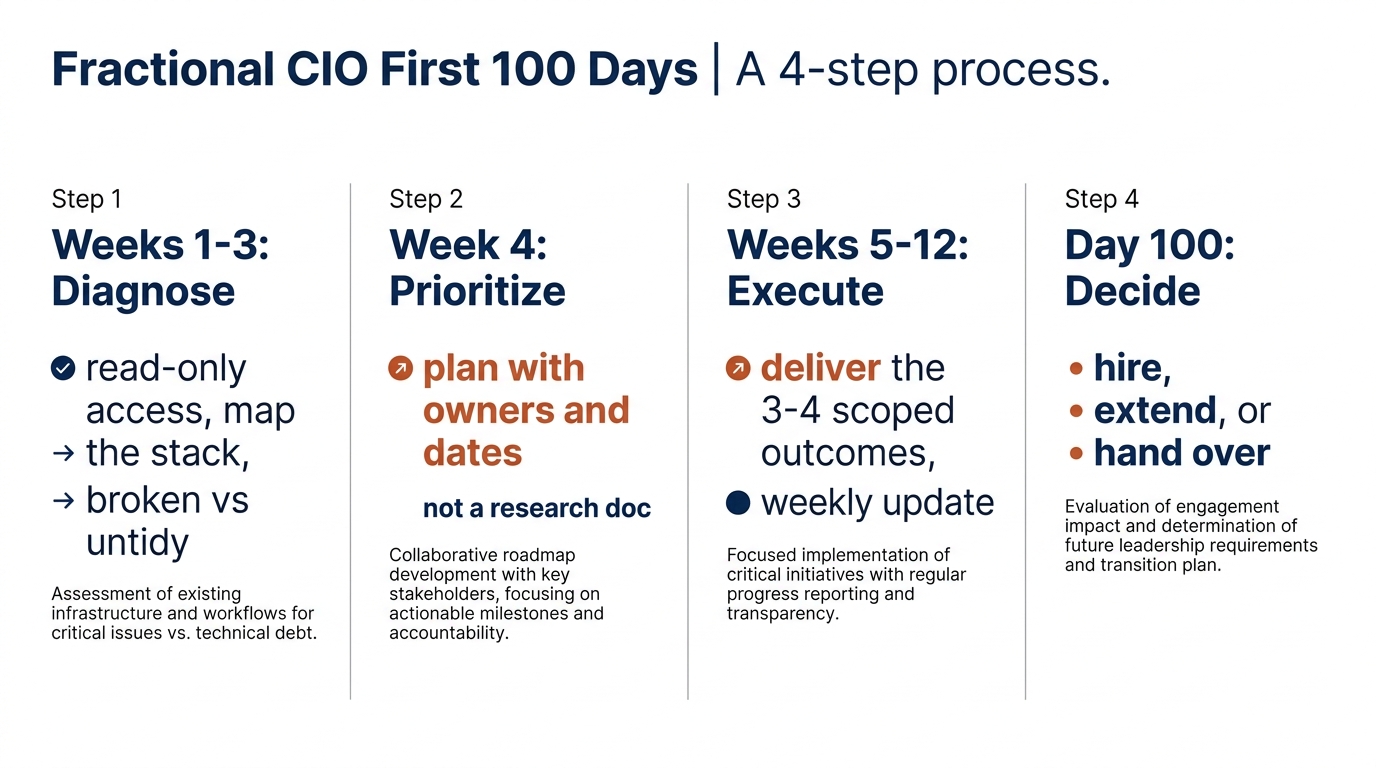
A fractional CIO who is useful in the first quarter follows a recognizable arc, and you should see it reflected in the scope. The first 100 days after close are when the systems picture becomes clear or stays fogged, and the engagement should be structured to make it clear quickly.
In the first two to three weeks the work is diagnosis: read-only access to the core systems, a map of what connects to what, and an honest statement of what is broken versus what is merely untidy. Within four weeks you should have a prioritized plan with owners and dates. From there the work is execution against the three or four outcomes in the scope, with a weekly update you can actually read.
The signal that the engagement is working is that the CEO starts referring to the fractional CIO's plan as the plan. If you are two months in and the output is still analysis, the engagement is drifting, and that is a board-meeting conversation.
7. Govern it like a workstream, not a contractor relationship
The mistake that quietly costs the most is treating a fractional CIO as a vendor to be managed by whoever has time, rather than as an owned workstream with a single reporting line. Decide before Day 1 who the person reports to (usually the CEO, sometimes the operating partner directly), who holds the budget, and which decisions sit with the fractional CIO versus which come to the board.
Put the three or four outcomes on the same risk register as everything else in the value creation plan. A technology outcome that slips is an integration dependency that slips, and it should be visible to the deal team in the same review as revenue and cash. The reporting discipline here is the same one that makes a portfolio operations advisor useful: outcomes on the plan, owners named, actual versus plan every month.
One governance rule saves more trouble than any other. The fractional CIO should not also be the vendor selling you the build. If the same party scopes the work, recommends the tool, and then sells you the tool, you have lost the independence that made the role worth buying. Separate the judgment from the supply, or at minimum make the conflict explicit and priced.
8. When a fractional CIO is the wrong answer
Three situations call for something other than a fractional CIO, and recognizing them saves a wasted quarter.
If the company has a genuine, permanent, full-time technology leadership need at run-rate, use a fractional arrangement to stabilize and to specify the permanent hire, then make the hire. Stretching a one-day-a-week engagement across a job that needs five is how roadmaps stall.
If the problem is narrow and specialist (a single ERP migration, a security remediation, a data warehouse build) you often want the specialist directly, not a generalist CIO who will subcontract it anyway. Pay for the specific work. The guide to what a portfolio company audit should cost applies the same logic to a different scope: match the engagement to the actual problem rather than buying a title.
If the real issue is that leadership cannot see the numbers and nothing more, you may need data and RevOps work rather than a CIO. That can be bought as a service, scoped tightly, and delivered faster than a leadership search. The work on digital marketing due diligence shows how specific that visibility problem can get on the revenue side alone.
9. How fractional CIO services connect to the exit
Everything a fractional CIO does should ladder up to one of the levers that moves enterprise value: revenue growth, EBITDA expansion, faster integration, reduced operating risk, or better management visibility. If an outcome cannot be connected to one of those, it is probably not worth paying senior money for.
The technology story also shows up in confirmatory diligence when you sell. A buyer's technology diligence will find disconnected systems, unowned data, and undocumented decisions, and those findings move the price you get. Getting the stack into a defensible state during the hold is the difference between a clean diligence and a discount. The Harvard Law School Forum on Corporate Governance publishes regularly on how operational and governance quality factor into deal outcomes, and Harvard Business Review's M&A coverage is a reasonable reference for how integration execution shows up in results.
For the data behind how operational work is being valued across the asset class, PitchBook, Preqin, and S&P Global Market Intelligence all track the shift toward value creation as the primary return driver, which is the commercial reason this role exists at all.
10. A checklist before you sign
Run the engagement through this before you commit budget. If you cannot answer most of it, the scope is not ready.
- Which of the five problems is this engagement solving, described as a deal partner would recognize it?
- Does the scope list three or four outcomes with baselines, targets, owners, and dates, rather than responsibilities?
- Can every outcome be tied to revenue, EBITDA, integration speed, risk, or visibility?
- Is the quote benchmarked against what the outcome costs to build now?
- Did the candidate arrive fluent in your business model, or did they need correcting on it?
- Is there a low-risk paid diagnostic you can see before the full engagement?
- Does the person hold a decision right, or only an advisory one?
- Can they report in both formats: Excel for finance, a visual view for the board?
- Is there a single reporting line, a named budget owner, and the work on the risk register?
- Is the judgment separated from the supply, so the CIO is not selling you the build?
- Is this a bridge to a permanent hire, a specialist job in disguise, or genuinely a part-time leadership role?
The arrangements that work are the ones where the operating partner could hand the scope to a new board member and have them understand exactly what is being bought, by when, and how it will be judged. The arrangements that drift are the ones scoped as "senior technology help" and paid by the day.
For the broader toolkit on running interim functions and systems work across a hold, the companion guides on hiring a working capital optimization consultant and on a 100-day digital integration plan apply the same scoping discipline to adjacent problems, as does the brand capital diagnostic on the commercial side. For how procurement work gets judged before it is funded, see the piece on procurement value creation.
If you want help scoping a fractional CIO engagement against your value creation plan, or a technology diagnostic you can show the deal team before you commit, see how DevriX works with private equity firms and their portfolio companies.


