Disclosure: some links in this article are affiliate links. If you sign up through one, we may earn a commission at no extra cost to you.
You are three weeks from close on a lower-middle-market services business, and the growth model in the investment committee deck assumes the company can raise prices nine percent over the hold and hold churn flat. That assumption rests entirely on brand strength, and nobody on the deal team has measured it. The confirmatory diligence covered financials, the tech stack, and the sales pipeline. The brand sits in the model as an unpriced input, which means the price increase line, the win-rate line, and the customer retention line all carry a risk the risk register does not name.
A brand capital diagnostic for pe portfolio companies closes that gap. It converts a soft noun into something an operating partner can decide against: whether the brand supports the pricing in the plan, where it is leaking demand, and what it would cost to fix. This article names the framework, walks its tiers, shows an applied example, and tells you how to judge the work before you fund it.
1. Why brand shows up as risk, not as an asset, in most deals
In diligence, brand tends to be handled as a line of color in the CIM rather than a measured variable. The seller describes the brand as strong, points to a logo wall of logos, and the deal team moves on to working capital. That is a reasonable allocation of diligence hours in many deals, but it becomes a problem the moment the value-creation plan leans on the brand to do commercial work.
Bain's annual private equity report has tracked for years how much of the return in the current environment has to come from operating improvement rather than multiple expansion or leverage, and pricing is one of the most direct operating levers available. You can read the thesis in Bain's Global Private Equity Report. If pricing power is one of the inputs carrying that assumption, the brand is carrying part of it, and an unmeasured assumption is a risk with no owner.
The decision the diagnostic informs is narrow and commercial. Can this company raise prices without losing the accounts that fund the base case, and if not, what has to change first. That is a question you want answered before the first board meeting, not discovered in the second year when the price increase goes out and three anchor accounts put the contract up for rebid.
2. What a brand capital diagnostic for pe portfolio companies measures
The term brand capital is doing specific work here: the accumulated ability of the brand to change commercial outcomes. It wins a deal the competitor would otherwise win, holds a price the market would otherwise discount, and keeps a customer who could switch at low cost. Each of those is observable in the company's own data if you know where to look.
A diagnostic that earns the Portfolio Audit budget measures four things, and it measures them against the specific business model in front of you rather than a template built for a SaaS company and applied to a distributor or a clinic group.
- Pricing power. Does the brand let the company hold or raise price relative to named competitors, and in which segments does that power break down.
- Demand capture. Where buyers in this market now shortlist, including AI assistants and search, does the brand appear, and against whom.
- Retention and expansion. How much of the revenue base is held by relationship and brand rather than by switching cost or contract lock-in.
- Trust and proof. Whether the evidence a buyer needs to choose this company exists, is current, and is findable.
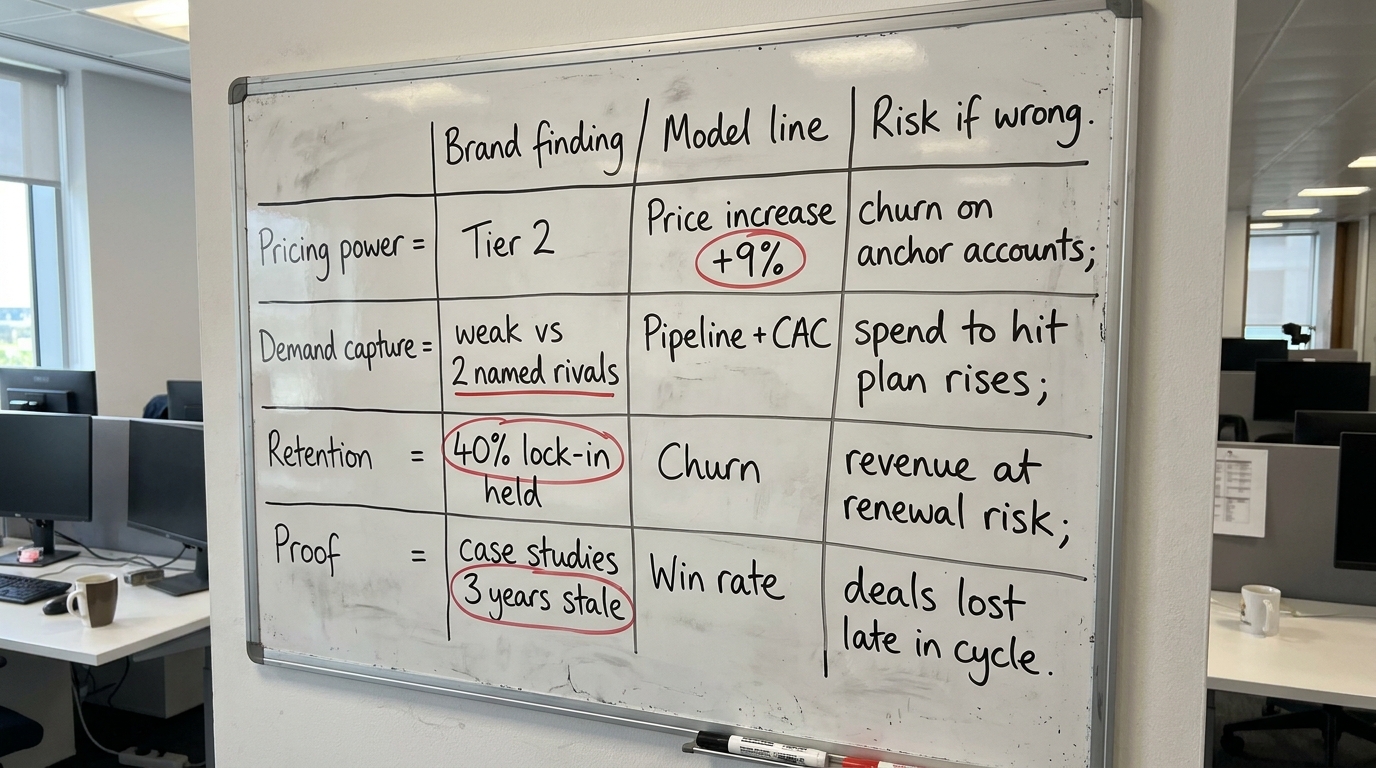
Those four map directly to lines in the model. Pricing power sits under the price increase assumption. Demand capture sits under pipeline and CAC. Retention sits under churn. Trust sits under win rate. That mapping is what makes a brand diagnostic a diligence artifact rather than a marketing deliverable.
3. The four tiers of brand capital, from weakest to strongest
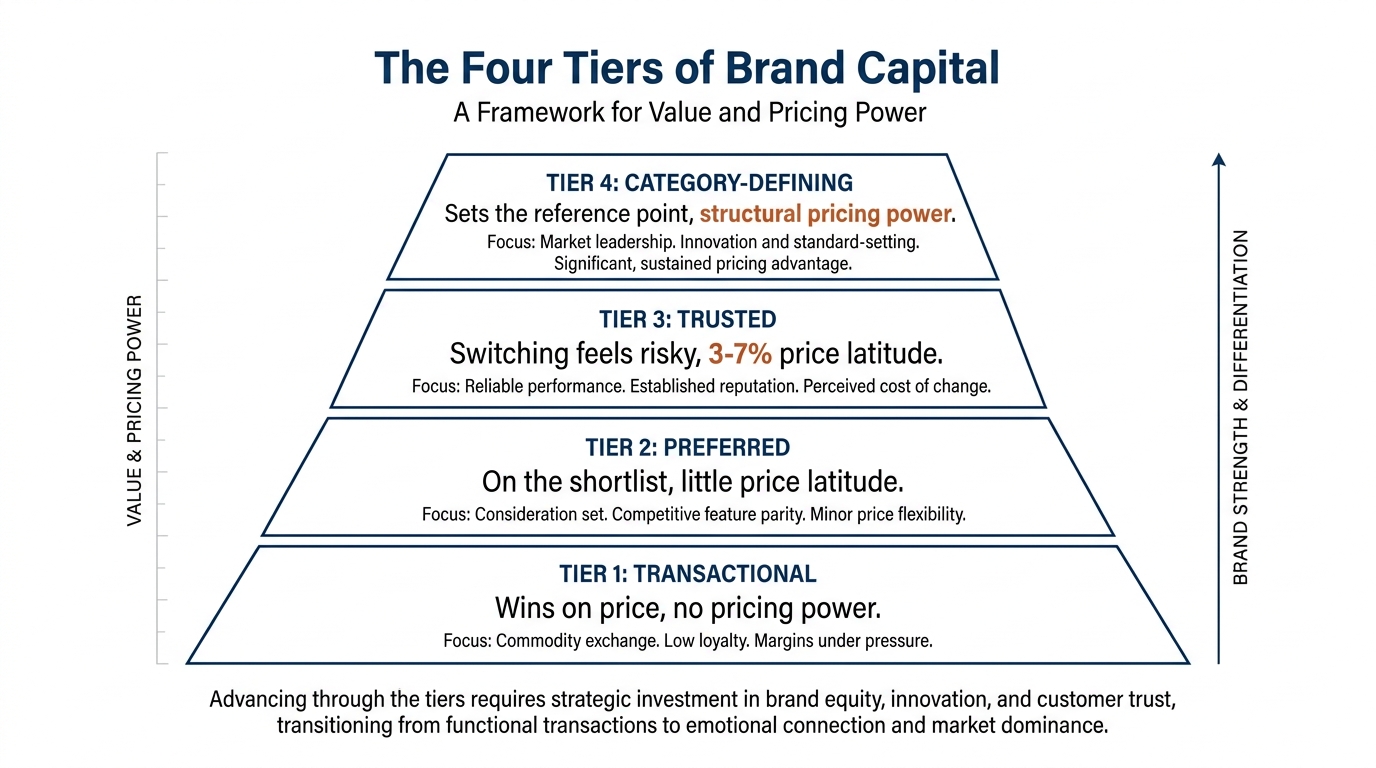
I grade brand capital on four tiers. A tier gives you what the brand can and cannot be asked to do in the plan, and it sets the realistic ceiling on the pricing and retention assumptions you underwrite.
Tier 1: Transactional
The company wins on price, availability, or an existing relationship with a specific buyer who may leave. The brand does not change the purchase decision. Raising price here loses volume close to one-for-one. If your plan assumes pricing power on a Tier 1 brand, the plan is wrong and you want to know that before close, not after.
Tier 2: Preferred
The company is on the shortlist and wins its fair share, but the brand is not a reason to pay more. There is some pricing latitude in service and convenience, little in headline rate. Retention is decent but vulnerable to a credible challenger. Most lower-middle-market companies sit here.
Tier 3: Trusted
Buyers choose the company partly because switching feels risky and the brand reduces that perceived risk. There is real pricing latitude, often three to seven percent above the challenger, and retention is strong because the relationship and the proof are hard to replace. A Tier 3 brand supports a modest, defensible price increase in the plan.
Tier 4: Category-defining
The brand sets the reference point buyers measure others against. Pricing power is structural, and the company can lose a feature comparison and still win the deal. Few portfolio companies are genuinely here, and the ones that are usually command a multiple that already prices it in.
4. The evidence the diagnostic runs on, and where it comes from
A brand tier is only as good as the evidence under it, and the evidence an operating partner should accept is almost all first-party and verifiable. Opinion surveys have a place, but they are the weakest input and the easiest to game, so they should never carry the grade alone.
The strongest evidence sits in the company's own systems. Win-loss records in the CRM show whether deals are lost on price or lost on fit. Pricing history shows whether past increases stuck or triggered churn. Cohort retention shows which customers stay and which leave when a competitor calls. Harvard Business Review's library on mergers and acquisitions is a reasonable orientation for how brand and customer evidence intersect with deal theses, though the work here is specific to one company's data.
The second source is the market. Where buyers in this category now begin their search, whether that is a web search, a peer referral, or a question put to an AI assistant, the company either appears with credible proof or it does not. That is measurable against named competitors rather than in the abstract. We pull Semrush keyword and competitor data for the 60+ domains we track, which is the same kind of visibility check a diagnostic runs for a portfolio company against its named rivals.
The third source is the proof itself: the case studies, references, certifications, and third-party ratings a buyer needs to justify the choice internally. If that proof is missing, stale, or impossible to find, demand capture breaks even when the underlying product is strong. McKinsey's private capital research and BCG's work on principal investors and private equity both treat commercial excellence as a repeatable value lever, and proof is the part of brand that most directly drives win rate.
5. How the diagnostic connects to the model, line by line
The reason to run this during diligence or the first 100 days rather than later is that the output changes numbers in the base case, and changing them early is cheaper than discovering them. Here is the mapping I use so the diagnostic lands as a finance artifact, not a brand opinion.
- Price increase line. The brand tier sets the defensible ceiling. A Tier 2 brand priced in the plan for a Tier 3 increase is a flagged risk with a number attached.
- Churn line. Cohort evidence tells you how much retention is brand versus lock-in. Brand-held revenue is more durable; lock-in-held revenue is at risk when the contract renews.
- Win rate and CAC. Demand capture and proof tell you whether the pipeline assumption is achievable at the assumed acquisition cost or requires more spend to hit.
- Exit narrative. A brand moved from Tier 2 to Tier 3 over the hold is a documented, buyer-credible part of the equity story at exit.
This is the same discipline you would apply to any operating input. The portfolio company value creation diagnostic that tells an operating partner where to spend the first 90 days treats brand as one of several levers to triage, and the brand diagnostic is the deeper read you commission when brand turns out to be material to the thesis.
6. An applied example, labeled illustrative
The following is an illustrative scenario, not a client result, to show how the tiers and the evidence resolve into a decision.
A sponsor is acquiring a regional commercial services company with roughly forty million in revenue. The base case assumes a nine percent cumulative price increase over the hold and flat churn. The seller describes the brand as the most recognized name in its region, and the CIM leans on thirty years of operating history.
The diagnostic pulls win-loss data from the CRM for the trailing two years. It finds that the company wins roughly half its competitive deals, and that losses cluster on price in two of its five service lines. Pricing history shows the last across-the-board increase, three years earlier, held in three service lines and triggered measurable churn in the other two. Cohort retention shows that the top twenty accounts stay for relationship reasons, while the long tail churns at a rate consistent with a commodity purchase.
Against named regional competitors, the company appears in search and in AI-assistant answers for its two strongest service lines and is absent for the two weakest. Its case studies are current for the strong lines and three years stale for the weak ones.
The grade is Tier 3 in two service lines and Tier 1 in two, with the fifth line straddling Tier 2. The decision that follows is not abstract. The nine percent blended increase is only defensible if it is applied unevenly: concentrated in the Tier 3 lines, held flat or near flat in the Tier 1 lines, with the weak lines treated as a volume business rather than a brand business. The plan that assumed a flat nine percent across all five lines would have lost volume in two of them and missed the revenue number while believing the brand would carry it.
That is the output an operating partner can act on in the first board meeting: a revised, segment-specific pricing plan with the risk named and priced, rather than a single blended assumption that quietly averages a strong brand and a weak one into a number that is wrong for both.
7. When to run it, tied to real triggers
The diagnostic has three natural windows, and the value differs in each.
Confirmatory diligence, before close
Run it here when the thesis depends on pricing power or retention, which is to say most buy-and-build and most services deals. The output can change the price you pay or the covenants you accept, and it feeds the technology due diligence workstream where the CRM and pricing data live. This is the highest-leverage window because the finding can still move the deal terms.
The first 100 days, after close
If you did not run it in diligence, the first 100 days is the next window, because the value-creation plan is still being set and a brand finding can redirect where the early effort goes. Our view on the private equity operating cadence is that brand belongs in the opening triage alongside RevOps and pricing, not deferred to a later marketing review.
Before a pricing action or an add-on
Run a focused version before a planned price increase or before integrating an add-on, because in both cases you are about to act on an assumption the brand either supports or does not. An add-on in particular can dilute a strong parent brand or inherit a weak one, and that is cheaper to assess before the integration than after.
8. How to judge the work and the quote
This sits in the Portfolio Audit range of roughly fifteen to twenty-five thousand dollars, and at that price you are buying a decision artifact, not a research project. The judging criteria are specific. A quote that reads as a six-figure, multi-month study is scoped wrong for what an operating partner needs, and a one-off survey with no model mapping is too thin to fund.
- Evidence is first-party and named. The grade rests on the company's own CRM, pricing, and retention data, and on visibility against competitors named out loud (rather than a generic sentiment survey).
- Every finding maps to a model line. If the deliverable does not tell you which assumption to change and by how much, it is a marketing audit wearing a diligence label.
- It respects the business model. A distributor, a clinic group, and a project-delivery firm do not share a brand playbook, and a template applied across them is a tell that the provider did not do the outside-in work.
- It moves in days. The AICPA and CIMA standards on evidence quality, available through AICPA and CIMA, are a useful bar for rigor, and the diagnostic itself should deliver inside the diligence or 100-day clock.
For the full pricing logic across the audit cluster, what a portfolio company audit should cost, and how to judge the quote you get is the companion piece, and it applies directly here.
9. How brand fits the rest of the operating work
A brand diagnostic is not a standalone engagement for most portfolio companies. It shares inputs with the revenue and data workstreams, and it is cheaper and faster when it runs alongside them rather than as a separate exercise months later.
The CRM you grade for brand evidence is the same system you fix for pipeline reliability, which is why RevOps for PE-backed companies and the three things you fix before touching pipeline is a natural neighbor to this work. If the win-loss data is not being captured, the brand grade is weaker and so is every pipeline forecast built on the same records.
The pricing finding also feeds the value-creation plan, and brand is one of the levers that should be re-read more often than once a year. The case for refreshing the value-creation plan every quarter rather than every board cycle applies to brand because pricing power shifts as competitors move and as the company's own proof ages.
And if the finding is that the brand needs sustained work rather than a one-time fix, the question of whether to build or rent that capability is the same one covered in how to buy a value creation office as a service without overpaying for a function you only need part-time.
10. Who owns the finding, and the decision rights
A diagnostic without a named owner tends to sit in a shared drive. The brand grade needs a decision right attached, and in most structures that is the operating partner for the commercial lever, working with the portfolio company CEO or revenue leader who owns the pricing action.
The CFO owns the model lines the finding touches, so the CFO has to agree the revised pricing and churn assumptions, or the finding does not change the forecast. Harvard Law School's Forum on Corporate Governance publishes regularly on how value-creation accountability is structured at the board level, which is the layer where a brand finding either becomes a tracked commitment or quietly disappears.
The practical rule is that the diagnostic produces one number the board tracks: the defensible blended price increase, segment by segment, with the tier grade behind it. That number has an owner, a baseline, and a review date, which is what separates a diagnostic from a slide.
11. What the research actually says about brand and returns
Be careful with the evidence here, because brand-and-returns claims are frequently overstated. The defensible position, supported by the way the major data providers frame commercial value creation, is narrower: brand is one input into pricing power and retention, and pricing power and retention are measurable drivers of EBITDA and exit multiple.
PitchBook's research and data and S&P Global's Market Intelligence both track how operating improvement has carried a larger share of returns as multiple expansion has become harder to rely on. Preqin's alternative assets data and Private Equity International's coverage track the same shift in LP expectations toward demonstrable value creation. None of these sources assigns a universal number to brand, and neither should you. The honest claim is that an unmeasured brand assumption is an unmanaged risk to the pricing and retention lines, and that a diagnostic converts it into a managed one.
If you want the primary-source view of how brand and intangibles are treated in disclosure and valuation, the U.S. Securities and Exchange Commission's filings and guidance are the reference point, though the operating decision here is commercial rather than an accounting one.
12. A checklist before you commission the work
Run this list before you fund a brand capital diagnostic, so the engagement is scoped to produce a decision rather than a report.
- The thesis depends on pricing power, retention, or win rate, so the brand is doing commercial work in the model.
- You can name which model lines the finding is meant to change, and by roughly what magnitude a change would matter.
- The company's CRM, pricing history, and cohort retention data are accessible, or the first deliverable is getting them accessible.
- The provider is grading against named competitors and the specific business model (templates do not account for the differences that matter).
- Every finding maps to a tier and to a model line, and the output is a number the board can track with an owner and a review date.
- The timing lines up with a real trigger: confirmatory diligence, the first 100 days, or a planned pricing action or add-on.
- The quote is scoped to deliver inside the diligence or 100-day clock, at Portfolio Audit range, because a six-figure study moves too slowly for the decision it informs.
This work pairs naturally with the broader audit cluster, including post-merger integration consulting and a 100-day digital plan that survives the real systems, where brand and the systems that evidence it have to be reconciled across the combined entity.
Brand questions PE buyers ask that the diagnostic does not cover on its own
The diagnostic measures brand capital and prices the pricing assumption. The questions below sit next to it: positioning, firm-level brand strategy, and when to bring in outside help.
What is brand positioning for private equity, and how is it different from a marketing exercise?
Brand positioning for a PE-backed company is the decision about which buyers the company is for and why it wins them, scoped to the commercial result the hold depends on. It differs from a general marketing exercise because the test is narrow: does the position support the price increase and the retention assumption in the model, or does it leave the company competing on availability. In a portfolio company you run positioning as a prerequisite for pricing power, not as a creative deliverable. If the position cannot justify the price, you fix the position before you push the price.
Do PE firms need a brand strategy at the firm level, or only at the portfolio-company level?
Most of the commercial return from brand work happens at the portfolio-company level, where pricing, win rate and retention live. A firm-level brand matters for sourcing and for recruiting management teams, but it rarely moves EBITDA inside a single company. The practical sequence is to run the brand capital diagnostic on the asset first, connect the finding to the value-creation plan, and treat firm-level brand as a separate deal-flow question owned by the partnership rather than the operating team.
What signals that brand work needs an outside specialist?
Bring in outside help when the plan leans on the brand to raise prices or hold churn and no one internally has measured whether it can. An internal team can run the pricing action. What it usually cannot do is produce an independent read on brand capital before the increase goes out. That read is what a deal team can underwrite against. Use an outside diagnostic at confirmatory diligence or in the first hundred days. Keep the scope to the pricing and retention question. Keep the decision rights with the operating partner.
If the brand is carrying a material assumption in your model and nobody has priced it, the next step is a scoped brand capital diagnostic that grades the tier, maps each finding to a model line, and hands the board one number to track. To run that on a portfolio company, see the DevriX private equity offer and request a scoped Portfolio Audit.