You have an operating partner recommending a diagnostic on a newly acquired company, a quote in front of you that ranges from $8,000 to $120,000 depending on who you called, and a board meeting in six weeks where someone will ask what the money bought. The portfolio company audit cost question is rarely about the number alone. It is about whether the spend produces a decision you can act on, or a slide deck that sits in a shared drive until the exit memo. This guide is for the buyer with budget and a short window.
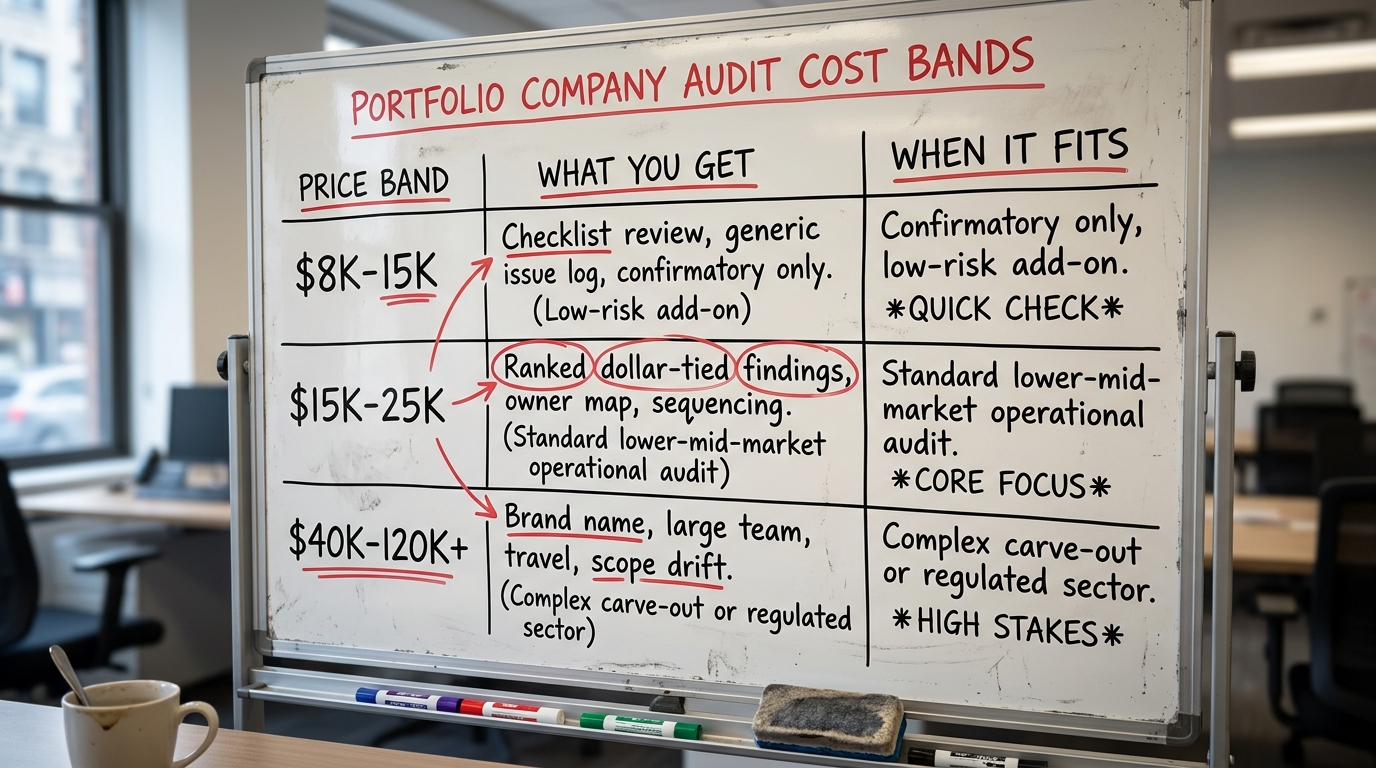
The commercial reality is simple. A tightly scoped operational audit of a lower-middle-market portfolio company usually lands between $15,000 and $25,000. Above that, you are often paying for a brand, a travel line, or a scope that drifted. Below it, you are usually buying an audit that skips the parts that would have changed your mind. The job here is to tell those apart before you sign.
1. Start with the decision the audit is supposed to inform
Every audit quote should trace back to a decision you are about to make. If you cannot name the decision, you are buying activity, and activity is the thing that fills invoices without moving enterprise value. The most common decisions an operational audit feeds are these: whether the value-creation plan holds up against the actual state of the business, where to spend the first tranche of operating budget, whether a specific function (revenue, finance, delivery, technology) carries a risk large enough to reset the thesis, and whether the management team can execute the plan you underwrote.
Each of those decisions has a different natural scope, and therefore a different cost. An audit that confirms the value-creation plan is lighter than one asked to find the hidden risk that killed last quarter's forecast. When a vendor quotes you a single flat number before asking which decision you need, treat that as a signal that the scope was chosen for their convenience.
Bain's annual private equity report has tracked for years how hold periods have lengthened and how value creation has shifted from financial engineering toward operational improvement, which is exactly why the diagnostic that opens the hold period matters more than it did a decade ago. You can follow that trend line in the Bain & Company Global Private Equity Report, and McKinsey's private capital research makes a similar case about where returns now come from.
2. What the $15K to $25K band actually buys
The band exists because a competent operational audit of a company doing $10M to $75M in revenue takes a known amount of senior time. A diagnostic that reviews revenue operations, finance and reporting hygiene, delivery or production capacity, the technology stack, and the management team's ability to run the plan is roughly three to five weeks of work for one senior operator plus supporting analysis. That is the shape of the number.
Here is what should be inside the band, stated plainly so you can check a quote against it.
- A baseline of the actual business against the deal model, not against the pitch the prior owner gave you.
- A ranked list of findings, each tied to a dollar consequence or a named risk. Owner and decision-right mapping for the three or four things that matter most in the first 100 days.
- A short, usable artifact the management team and the deal team both read, not two separate documents that contradict each other.
- A view on sequencing: what to fix first, what to leave, and why.
If a quote in this band omits the ranked, dollar-tied findings, it is cheaper for a reason, and the reason is that the hard analytical work got cut. A good diagnostic tells you what to fix first, which is the part that justifies the fee.
3. Why the cheap quotes are cheap, and the expensive ones are expensive
Below $15,000, two things usually explain the price. Either the work is a template applied to your company with the names changed, or it is a junior analyst running a standard checklist with light senior review. Templates built for a SaaS business and dropped onto a distributor, a project-delivery firm, or a multi-site services group produce findings that sound plausible and miss the thing that actually constrains the business. You pay less and learn less.
Above $40,000, the premium is rarely more analysis. It is a larger team, a recognizable logo on the cover, travel and on-site time, and a scope that expanded because no one held it. There are cases where the premium is justified, which I come to below. But in the common case of a single operating company with a clear thesis, the band between $15K and $25K buys the same decision-useful output without the overhead. McKinsey, BCG, and the large advisory firms do excellent work at the top of the market; their principal investors and private equity practice is built for complexity that a straightforward operating company does not have.
4. When the higher number is the right number
Three situations genuinely move the cost above the standard band, and it helps to name them so you are not talked into the premium when none applies.
Carve-outs and newly separated entities
When the company is being carved out of a parent, the audit has to assess transition service agreements, stranded costs, and systems that were never standalone. That is more work and more specialized work. The cost rises for a real reason.
Regulated or technically heavy businesses
Healthcare, financial services, and software-heavy businesses carry diligence risk that needs specialist eyes. A proper technology due diligence pass on a company whose product is the software is not a line item you want to compress. The U.S. Securities and Exchange Commission filings and the governance literature on the Harvard Law School Forum on Corporate Governance both document how often undetected compliance and control gaps surface after close, which is the cost the cheaper audit quietly leaves on your books.
Platform deals with add-ons already in view
If the company is a platform and you expect to bolt on acquisitions within the hold period, the audit needs to assess integration readiness, not just current state. That is a wider lens and a larger number. The reporting and systems work that makes integration across a portfolio company work is exactly the kind of thing worth scoping up front.
5. How to read a quote line by line
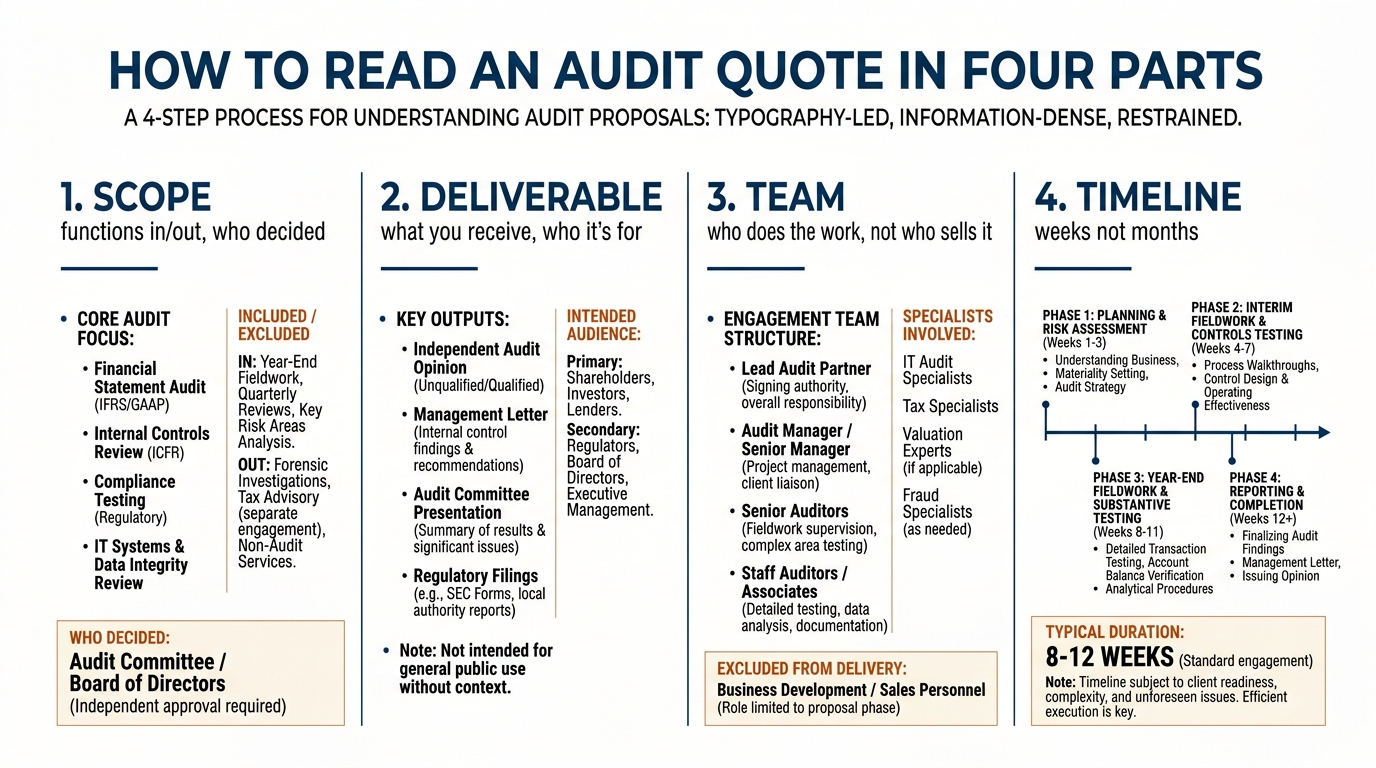
A quote you can judge has a scope section, a deliverable section, a team section, and a timeline. A quote you cannot judge has a price and a paragraph. Ask the vendor to break the number into these parts, and read each against the decision you named in section one.
- Scope: which functions are in, which are explicitly out, and who decided. If sales, finance, delivery, and technology are all "included" for $12,000, something is a skim.
- Deliverable: what you physically receive, in what format, and who it is written for. Finance wants the numbers in a workbook they can keep using; the board wants a short visual read. A vendor that produces only one of those has not understood the audience.
- Team: Senior-led analysis is the thing you are paying for. If the proposal names partners and the work is done by analysts, the band should reflect the actual delivery team.
- Timeline: A diagnostic that runs a quarter has stopped being a diagnostic and become a project, and the price should not pretend otherwise.
PitchBook and Preqin both publish data on deal timelines and hold periods that make the point: time is the scarce input in the first months of ownership. You can see the pattern in PitchBook research and data and in Preqin alternative assets data. An audit that eats a month of that window has a cost beyond its invoice.
6. The deliverable test, because this is where value leaks
Most of the disappointment with audit spend comes from the deliverable, not the price. A common failure is the beautiful document that no one uses because it was written for the vendor's portfolio, not for your deal team and your management. I have seen audits where the findings were correct and the report was unreadable at the altitude a sponsor operates at.
Insist on two formats from the same underlying work. Finance and the operating team keep a workbook with the baseline and the numbers they can update themselves. The deal team and the board get a short read they can absorb in a single sitting. The discipline of producing the one deck a sponsor reads in under five minutes is the same discipline that makes an audit worth its fee.
Ask one more question before you accept the deliverable: will anyone revisit this? The audit that becomes the backbone of the value-creation plan earns its cost many times over. The one that gets filed is the one described in the piece on the value-creation plan nobody reviews until the exit memo. The difference is usually in how the deliverable was built.
7. What the audit should connect to next
A diagnostic that ends at findings is half-finished. The findings have to connect to the first 100 days and to whoever owns the fixes. When the audit is scoped by a firm that also runs the execution, the handoff is cleaner, and you avoid paying twice for the same baseline to be rebuilt.
The audit should tell you which findings go into the first 100 days and which can wait. Attempting to fix everything at once usually consumes the operating budget before the board sees progress. The broader discipline of operational value creation across a portfolio company sits inside private equity operating work, and the audit is the entry point to it.
8. Common ways the cost goes wrong
A few patterns show up repeatedly, and each one is avoidable once you know to look for it.
Paying for a one-off audit with no plan attached
The one-off audit that produces a list and stops is the weakest version of this purchase. It tells you what is wrong and leaves you to figure out the order and the owner. If the quote has no sequencing and no handoff, the real cost is higher than the invoice, because you pay again to make the findings usable.
Buying a spend-cut audit when you needed a growth diagnostic
Some audits are really cost-cutting exercises wearing a diagnostic's clothes. They find savings, and some of those savings break delivery. The piece on how to hire a cost optimization consultant without buying a spend cut that breaks delivery walks through the distinction. Make sure the audit you are buying matches the thesis you underwrote.
Letting the scope drift during the engagement
Scope drift is the single most common reason a $20,000 audit becomes a $55,000 one. Someone asks for "just one more function" three times, and the number moves without a decision point. Fix the scope at signing, and treat every expansion as a new, priced decision.
Confusing the audit with a financial statement audit
An operational diagnostic is not a financial statement audit or a quality-of-earnings review. Those are separate, regulated work products. The AICPA & CIMA standards govern the financial audit; the operational audit discussed here is a commercial and operating assessment. Buyers sometimes expect one price to cover both, and it never does. Keep them separate in the quote and in your head.
9. How to judge the firm before you give it the company
The quote tells you less than the firm behind it. A firm that arrives having already done the outside-in work on your company, with a point of view built for your business model, is worth more than one that needs constant correction to understand what the company does. If the first meeting is spent explaining your own business to the vendor, the audit will be shallow no matter what it costs.
The same judgment applies to anyone you bring in for operational work. The frameworks in how to choose an operational value creation firm and in how to judge a margin expansion consultant apply directly to the audit vendor. Ask for a working artifact built on something they could learn about you from the outside, before you sign. That single request separates the firms that do the thinking from the firms that run the template.
Harvard Business Review's coverage of mergers and acquisitions and the deal commentary on Private Equity International, Buyouts, and PE Hub are useful for keeping the market context in view, but the firm-level judgment is yours to make on the evidence they put in front of you.
10. A checklist for signing off on the cost
Before you approve the spend, run the quote against this list. If it fails more than two of these, renegotiate the scope or the vendor.
- The audit traces to a named decision you are about to make.
- The price sits in the $15K to $25K band, or there is a specific, defensible reason it does not (carve-out, regulated sector, platform with add-ons in view).
- Findings are ranked and tied to a dollar consequence or a risk.
- The deliverable comes in two formats: a workbook finance keeps and a short read the board absorbs in one sitting.
- Senior operators do the analysis, and the proposal names them.
- The timeline is weeks, and the scope is fixed at signing with expansions priced separately.
- The findings connect to the first 100 days and name owners.
- The firm arrived understanding your business model.
Two of the external sources above are worth revisiting once you own the findings. S&P Global's market intelligence and the governance literature put the diagnostic in context, and you can keep both on hand through S&P Global Market Intelligence. Context does not change the decision, but it keeps you honest about what the audit can and cannot tell you.
11. Where the cost pays back
The audit earns its fee when it changes a decision you would otherwise have made wrong. That might be delaying a hire until a finding is confirmed, redirecting the first operating budget toward the constraint rather than the obvious problem, or resetting a forecast before the board hears the old one. A $20,000 diagnostic that reorders $2M of operating spend around the right constraint has paid for itself many times, and that is the frame to hold when the number feels large.
The audit that does not pay back is the one that confirmed what everyone already believed and told no one anything they could act on. You can usually predict which you are buying from the quote, the deliverable format, and the firm's grasp of your business before a dollar is spent. Judge it on those three, and the cost question answers itself.
12. Summary
A standard operational portfolio company audit cost sits between $15,000 and $25,000, and the price is a function of senior time, scope, and the decision it informs. Cheaper usually means a template or junior work; more expensive usually means a brand, a carve-out, or scope that drifted. The output you are paying for is a ranked set of dollar-tied findings, in two formats, that connect to the first 100 days and name owners. Judge the firm on whether it understood your business before the first meeting, fix the scope at signing, and make sure the audit traces to a decision you are actually about to make.
If you want an operational audit scoped to one decision, delivered in weeks, and built to hand straight into the value-creation plan, review the DevriX and GrowthShuttle portfolio company audit offer and start with a single engagement before committing to the broader operating work.


