You are three months into the hold, the value creation plan promised 400 basis points of margin, and the monthly pack shows revenue tracking to plan while EBITDA drifts below it. The deal partner wants an answer at the next board meeting, and the management team is telling you the cost base is already lean. This is the moment most sponsors decide to bring in outside help, and it is also the moment the wrong choice of help costs you a quarter you cannot get back.
A margin expansion consultant private equity teams hire well is not a generalist strategy shop. The buyer here is an operating partner, a CFO carrying a covenant, or a portfolio company CEO who has been told to defend the plan. This guide is for that buyer, someone with budget and a live problem, not for someone reading up on the category. It walks through what the engagement should actually decide, how to scope it against a real trigger, and how to judge whether the person in front of you can move a P&L rather than describe one.
1. Name the margin problem before you name the consultant
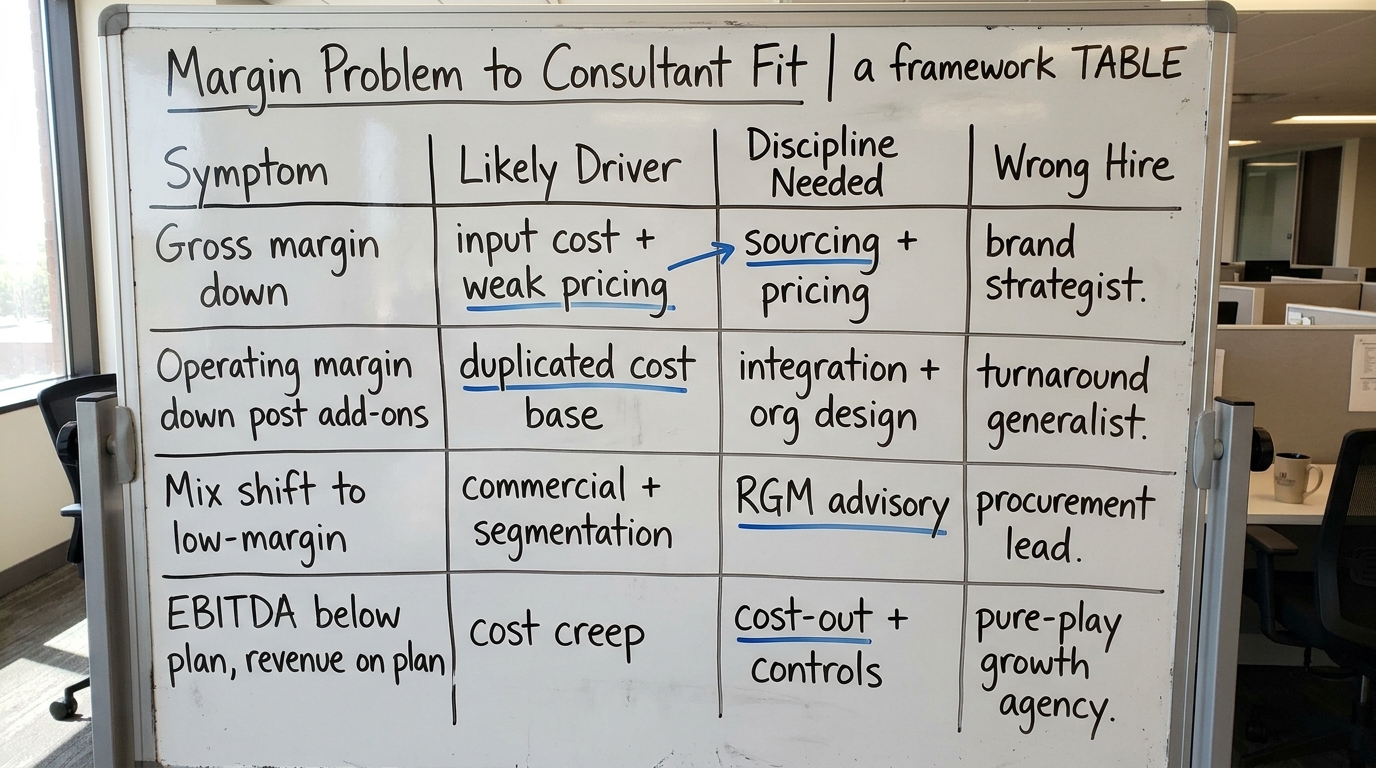
Margin compression rarely has one cause, and the label you attach to it decides who you should hire. Gross margin erosion from input cost inflation is a procurement and pricing problem. Operating margin erosion from a bloated cost base after a series of add-ons is an integration and org-design problem. A mix shift toward lower-margin customers is a commercial problem that requires the sales organization to change what it sells and to whom.
The mistake I see repeated is treating all three as the same engagement. A consultant who is genuinely strong at strategic sourcing will produce a competent-looking deck on pricing and never touch the actual driver. Before you take a single meeting, write down which line of the P&L is moving, by how much against plan, and over what period. That one paragraph filters out most of the field.
If the compression is commercial rather than cost-driven, the discipline you want is closer to revenue growth management advisory than to classic cost-out work, and the consultant profile changes accordingly.
2. Tie the engagement to a real trigger, not a calendar
Margin work bought on a vague sense that "we should be more efficient" tends to produce a savings register that nobody owns and nothing that hits the P&L. The engagements that land are attached to a specific moment in the deal lifecycle.
Confirmatory diligence is one trigger, where you need a defensible view of margin upside before you sign and want it stress-tested rather than assumed. The first 100 days is another, where the value creation plan converts into workstreams with owners and baselines. A covenant conversation is a third, where the CFO needs a credible path to a coverage ratio and the board needs to see it before the lender does. A failing forecast, the situation that opened this guide, is the fourth and the most common.
Each trigger implies a different scope, a different reporting cadence, and a different definition of done. A consultant who does not ask which one you are in is selling a template.
3. Decide what the engagement must actually produce
The deliverable is where most of the disappointment lives. A polished opportunity assessment tells you where margin could expand if a set of conditions hold. What you are buying is a set of decisions the business can act on, each with a number attached, an owner named, and a date by which the number should show up in the pack.
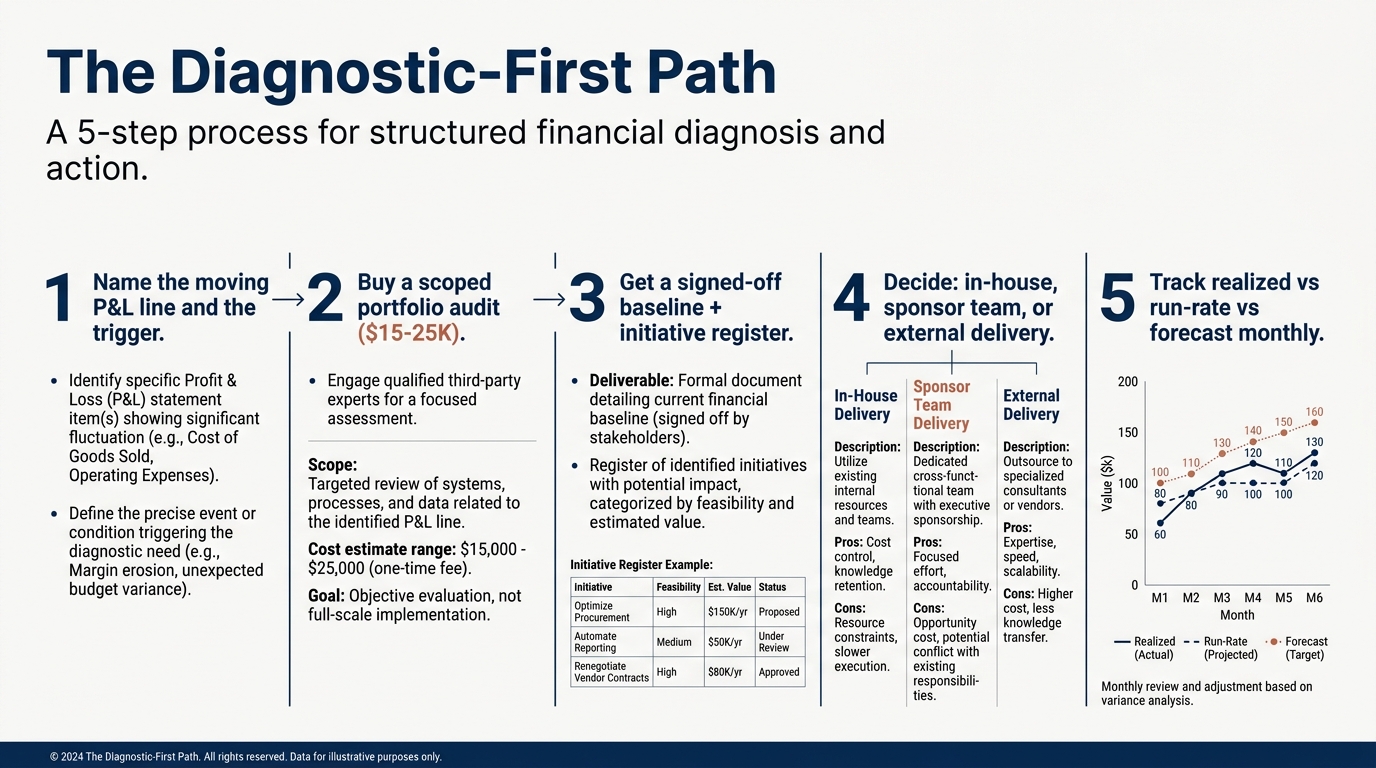
Insist on three artifacts. First, a baseline the CFO signs off on, because a saving is only real relative to an agreed starting point. Second, an initiative register where each line is classified as realized, run-rate, or forecast, so that nobody confuses a signed supplier contract with a projected one. Third, an owner map that assigns each initiative to a named person inside the business, not to the consultant.
If the proposed output is a report and a readout, you are buying analysis. If it is a set of tracked initiatives with owners and a monthly true-up, you are buying execution. The standard for what operational due diligence should deliver before you sign applies here too: know the artifact before you agree the fee.
4. Separate the diagnostic from the delivery
The strongest way to control risk on this spend is to buy the diagnostic first and the delivery second, as two decisions rather than one commitment. A focused portfolio audit in the $15,000 to $25,000 range gives you a graded view of where margin actually sits, which initiatives are real, and how much internal capacity the business has to execute. You come out of it able to decide whether to run the work in-house, staff it with the sponsor's operating team, or bring in delivery muscle.
This matters because delivery engagements are far more expensive and far harder to unwind. Buying a diagnostic that is scoped to inform the delivery decision, and then holding the option, is cheaper than committing to a six-month program on the strength of a pitch. Bain's annual private equity work, tracked in its Global Private Equity Report, has documented for years how much of the industry's return now depends on operational improvement rather than multiple expansion, which is precisely why the diagnostic that tells you where the operating levers are is worth paying for on its own.
5. Judge the consultant on evidence, not on logos
A credentials page tells you where someone has been, not what they can move. Push past it with questions that a genuine operator answers easily and a slide-maker struggles with.
Ask how they build a baseline
The answer should involve the general ledger, the trial balance, and a reconciliation to the reported EBITDA the deal was priced on. If the answer is "we work from management's numbers," the baseline will not survive the first board challenge. The Association of International Certified Professional Accountants, through AICPA and CIMA, publishes guidance on quality-of-earnings work that sets the bar for what a defensible baseline looks like.
Ask how they classify a saving
You want to hear the distinction between realized, run-rate, and forecast without prompting. A consultant who blends a signed contract with a pipeline of ideas into one headline number is either careless or optimistic, and both cost you credibility with the lender.
Ask who owns the initiative after they leave
The honest answer names a role inside the business and describes how the consultant transfers it. The evasive answer is some version of "we stay engaged," which usually means the savings depend on the invoice continuing.
McKinsey's private capital research and BCG's work with principal investors both consistently point to ownership and adoption inside the portfolio company as the difference between a plan that lands and one that decorates a data room.
6. Check the commercial side, not just the cost side
Cost-out is the reflex when margin slips, and it is often the smaller half of the opportunity. Pricing discipline, discount governance, and customer mix frequently carry more margin than a procurement sweep, and they do it without the morale hit that comes from cutting the cost base.
A consultant who only looks at the cost side is working with one hand. Ask whether the scope includes a review of realized pricing versus list, discount leakage through the quote process, and margin by customer segment. Weak quote-to-cash controls quietly give away margin at the point of sale, and tightening them is often faster than any sourcing initiative. The mechanics of that are covered well in this guide to quote-to-cash optimization in a portfolio company.
If the business runs on any kind of demand planning, the quality of its forecasting also touches margin through inventory, service levels, and markdowns, which is why a disciplined approach to sales forecasting often surfaces margin that a pure cost review misses.
7. Insist on a data foundation you can trust
Every margin number you will present to a board rests on the systems that produce it. If the portfolio company runs on a general ledger that has not been reconciled in months, three overlapping CRMs from prior add-ons, and a spreadsheet that finance treats as the source of truth, then the margin baseline is a guess dressed as a fact.
This is where a margin engagement and a technology assessment overlap. Before you accept a savings target, you need confidence the underlying data supports it, which is one reason serious sponsors run technology due diligence alongside the commercial work rather than after it. A consultant who treats the data quality question as somebody else's problem will hand you a number you cannot defend under scrutiny.
The Harvard Law School Forum on Corporate Governance has published extensively on the reporting and controls expectations that come with institutional ownership, and those expectations apply directly to how margin improvement gets measured and disclosed.
8. Set the reporting cadence before work starts
The single most useful control on a margin engagement is a monthly true-up that compares realized savings against the plan, line by line, in the same format as the board pack. Agree it before the work starts and you convert a consulting relationship into an accountable one.
The cadence should show three things every month: which initiatives moved from forecast to run-rate to realized, which ones slipped and why, and what the cumulative impact is against the value creation plan. This is the same actual-versus-plan discipline that governs a good first 100 days integration, applied to margin. When the number that shows up in the pack matches the number the consultant promised, you have a partner. When it does not, you find out in month two rather than month six.
9. Match the delivery model to the internal capacity
Once the diagnostic tells you the size and shape of the opportunity, you decide how to deliver it. There are three viable models, and the right one depends on how much executional capacity the business already has.
Sponsor operating team
If your firm carries operating partners with real functional depth, they may run the work directly, using the consultant only for the diagnostic and periodic challenge. This is the cheapest model and the one that builds the most institutional knowledge, provided the operating team has the bandwidth.
Embedded delivery
When the portfolio company lacks the internal capacity to execute, an embedded team that sits inside the business and works the initiative register is often the fastest route to realized savings. The trade-off between a fractional lead and an embedded team is laid out clearly in this piece on the kill-line between a fractional CMO and an embedded team, and the same logic governs operational delivery.
Advisory only
The lightest model gives you a plan and a monthly review, with all execution owned inside the business. It works only when the management team is strong and has time, which in a compression scenario is often exactly what they lack.
PitchBook's research and data and S&P Global's market intelligence both track how holding periods have lengthened, which raises the premium on delivery models that build durable capability inside the company rather than renting it indefinitely.
10. Price the engagement against the value at stake
Fee is the easiest thing to negotiate and the worst thing to lead with. Anchor instead on the margin at stake. If the value creation plan calls for 400 basis points on a business doing $80 million in revenue, the annual EBITDA difference is substantial, and a $15,000 to $25,000 diagnostic that de-risks the delivery decision is a rounding error against it.
Be wary of engagements priced purely on a share of savings, because they create an incentive to inflate the forecast column and to classify aggressively. A fixed fee for the diagnostic, followed by a delivery arrangement with a modest success component tied to realized and independently verified savings, aligns the consultant with the number that actually reaches the pack. The framing in this guide to hiring an EBITDA growth consultant for a PE-backed business extends the same principle across the broader value creation spend.
11. Watch for the failure modes that survive a good pitch
Some problems only show up after the engagement letter is signed, so screen for them in advance.
- The activity report. Weekly updates full of workshops held and interviews conducted, with no line connecting the activity to a number in the pack. Activity is not outcome, and a register of hours is not a register of savings.
- The moving baseline. When results slip, the baseline quietly gets re-cut so the percentage still looks good. A baseline the CFO signed once and cannot be changed without a documented reason prevents this.
- The forecast dressed as realized. Headline savings that turn out, on inspection, to be run-rate or forecast rather than money that has hit the P&L. Ask for the classification on every line, every month.
- The dependency trap. Savings that only persist while the consultant is engaged, because the capability was never transferred to a named owner inside the business.
The way sophisticated sponsors screen against these before signing is covered in detail in this look at how PE firms vet a commercial due diligence partner, and the same instincts apply to margin work.
12. A decision checklist before you sign
Run the engagement through this list before the letter goes out. If you cannot answer yes to most of it, you are not ready to buy delivery yet, and a scoped diagnostic is the right next step.
- Have you named the specific P&L line that is moving and quantified it against plan?
- Have you tied the engagement to a real trigger: diligence, first 100 days, a covenant, or a failing forecast?
- Is the deliverable a set of owned, tracked initiatives rather than a report and a readout?
- Will the CFO sign off on the baseline before any saving is claimed against it?
- Is every initiative classified as realized, run-rate, or forecast, and reported that way monthly?
- Does each initiative have an owner named inside the business, not the consultant?
- Does the scope cover the commercial levers (pricing, discount leakage, mix) as well as cost?
- Have you confirmed the data foundation can actually support the numbers you will present?
- Have you agreed a monthly true-up in the same format as the board pack?
- Have you matched the delivery model to the internal capacity, and priced against the margin at stake rather than the fee?
For the wider context of what a portfolio company of this size actually buys when it engages value creation help, this breakdown of equity value creation advisory for a $30M to $500M portfolio company is worth reading alongside this guide, and it connects margin work to the broader private equity value creation agenda.
13. Where to start
If the forecast is drifting and the board meeting is close, the fastest way to regain control is a scoped Portfolio Audit that gives you a signed-off baseline, a graded view of which margin initiatives are real, and a clear read on whether to deliver in-house or bring in help. From there, every decision that follows rests on evidence rather than a pitch.
Scope a Portfolio Audit with the DevriX private equity team to get the baseline and the initiative register your next board pack will need.


