When a sponsor commits capital on a specific EBITDA growth assumption and exit multiple, the value creation work that follows should state which number in that original underwriting it is meant to move, by how much, and when the delta will show up in cash flow rather than only as a forecast line. A deck that outlines revenue initiatives, cost consolidation, pricing optimization, and digital transformation without connecting each initiative to a line in the original investment model leaves the board unable to track whether the plan is working or whether the assumptions that justified the purchase price were correct.
Equity value creation advisory for companies operating at the $30M to $500M scale is purchased to bridge that gap. The buyer is not acquiring a strategic plan. The buyer is acquiring capacity to translate the investment thesis into measurable enterprise value improvement, and the accountability to distinguish value that has been realized from value that has been enabled or forecast but not yet delivered.
What the Sponsor Underwrote: The Four Levers That Determine Enterprise Value
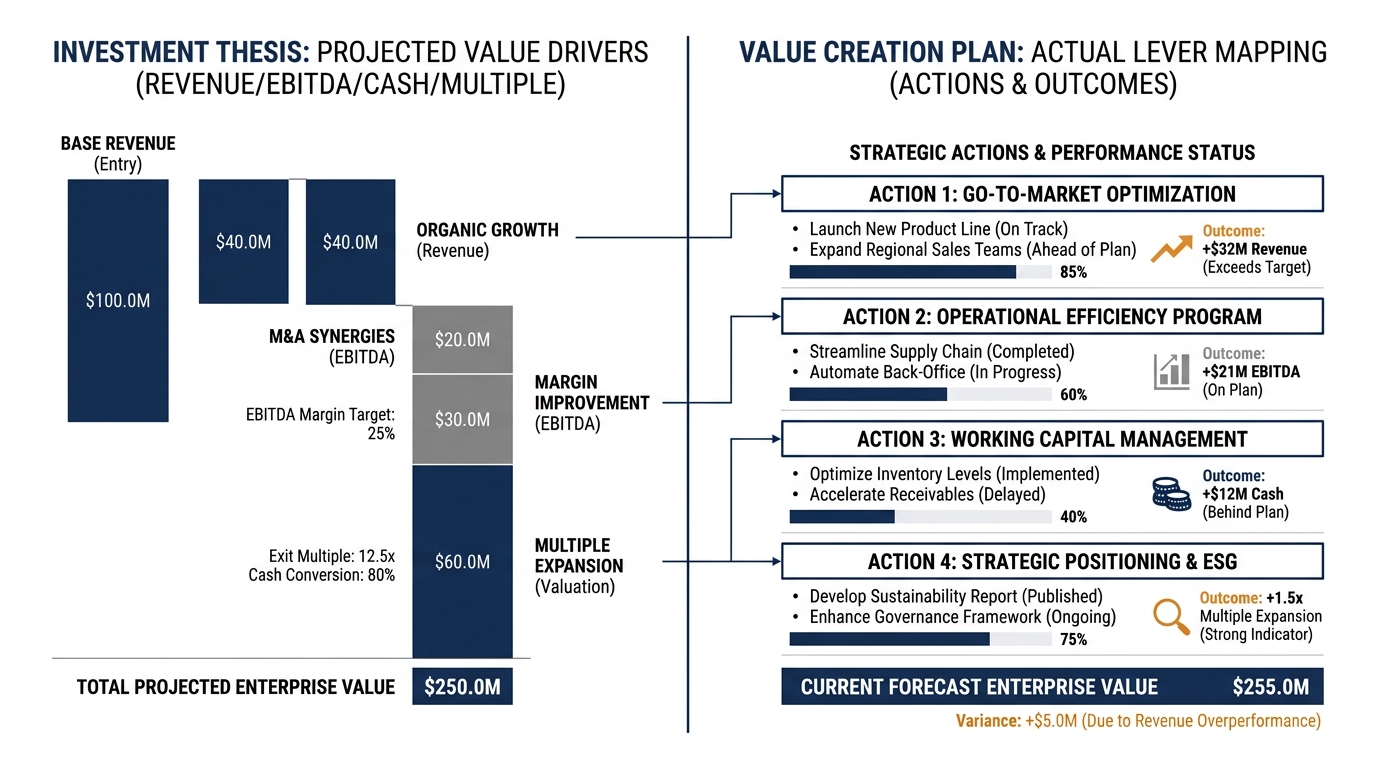
Every private equity investment case reduces to four mechanics, and every dollar of return comes from one of them. Revenue growth drives top-line expansion. EBITDA margin improvement converts that revenue into earnings. Cash-flow timing determines when operating profit becomes distributable cash and how much debt can be paid down. Multiple expansion captures the premium a buyer will pay at exit, driven by growth rate, predictability, market position, and risk profile.
The original underwriting assigned a contribution to each lever. Revenue might have been modeled at 12% compounded annual growth. EBITDA margin might have been expected to expand 300 basis points through procurement savings and labor optimization. Debt paydown might have been scheduled to reduce leverage from 5.2x to 3.8x over 36 months. The exit multiple might have been held flat at 8.5x or expanded to 9.2x based on scale, recurring revenue mix, or customer concentration improvements.
A value creation advisor's first accountability is knowing which lever the sponsor bet on and which initiatives are meant to move it. That requires reading the investment memo, the lender presentation, and the board-approved value creation plan, not inferring strategy from a kickoff call. Operating executives running $50M to $300M portfolio companies report that fewer than half of the advisors they have worked with ask to see the original underwriting before proposing work.
Revenue Growth: Where Forecast Value Appears First and Realized Value Comes Last
Revenue initiatives produce forecast value the day they are modeled and realized value only when the cash hits the bank and the transaction closes. A go-to-market expansion into a new vertical, a pricing increase across the installed base, a cross-sell motion that attaches a second product to 40% of customers, all of these create a revenue forecast the moment they are approved. None of them create enterprise value until the incremental revenue is booked, collected, recognized in EBITDA, and reflected in a trailing twelve-month figure a buyer will underwrite.
The distance between forecast and realization is where most advisory value leaks. An advisor proposes a demand generation buildout that will add $8M in ARR over 18 months. The operating partner approves the budget. The finance team updates the model. The board deck shows $8M in new ARR as a value creation outcome. What it does not show is that six months in, the pipeline is behind plan, win rates are lower than assumed, and sales cycle length is 40% longer than modeled, which means the $8M lands in month 27, not month 18, and the exit happens in month 24.
Realized value is cash that has been collected and shows up in audited financials. Run-rate value is revenue or cost reduction that is repeating on a monthly basis and will continue forward. Forecast value is a model output that depends on assumptions holding. Enabled value is capability that has been built, a CRM that can now support a larger sales team, a pricing structure that can accommodate tiered packaging, but has not yet been activated. A value creation advisor who does not label the category when presenting an outcome is presenting forecast as though it were realized, and the gap compounds through every subsequent initiative.
EBITDA Expansion: The Margin Work That Closes Faster Than Revenue
EBITDA improvement is the lever where value creation advisory most often delivers measurable impact within the first twelve months, because cost and efficiency initiatives clear faster than revenue growth. Procurement consolidation across three acquired entities, workforce optimization that reduces contractor spend, SaaS rationalization that eliminates redundant tools, these produce run-rate savings within 90 to 120 days if they are sequenced correctly.
A portfolio company operating at $85M in revenue with 22% EBITDA margin and $18.7M in earnings hired an advisor to lead post-merger integration across two bolt-on acquisitions. The value creation plan targeted 400 basis points of margin expansion over 24 months, which would add $3.4M to EBITDA at constant revenue. The advisor identified $1.8M in duplicate software spend, $900K in overlapping back-office headcount, and $600K in freight and logistics waste. All three were implemented within six months, delivering $3.3M in run-rate savings and moving EBITDA margin from 22% to 26% ahead of the plan timeline.
The distinction that mattered was run-rate versus one-time. The duplicate SaaS licenses were a recurring monthly cost, so eliminating them produced a run-rate benefit that would compound through every future month. The back-office optimization required severance, which was a one-time cash outflow that reduced EBITDA in the quarter it was recognized but cleared the way for ongoing savings. The freight consolidation required a new logistics partner and a 90-day transition, which meant the benefit lagged the decision by a quarter. The advisor's role was not only to identify the savings but to sequence the cuts so that one-time costs did not obscure run-rate gains in the same reporting period.
According to a 2024 study published by EY, value creation levers resulted in a 15% increase in EBITDA across a sample of recent transactions, and 41% of PE firms lacked the data granularity needed to substantiate their equity stories during diligence. The EBITDA bridge that a buyer underwrites at exit depends on being able to separate recurring operational improvement from one-time adjustments, and advisors who do not maintain that separation create risk in the quality of earnings review.
Cash Flow Timing: When EBITDA Does Not Equal Cash and Why It Matters
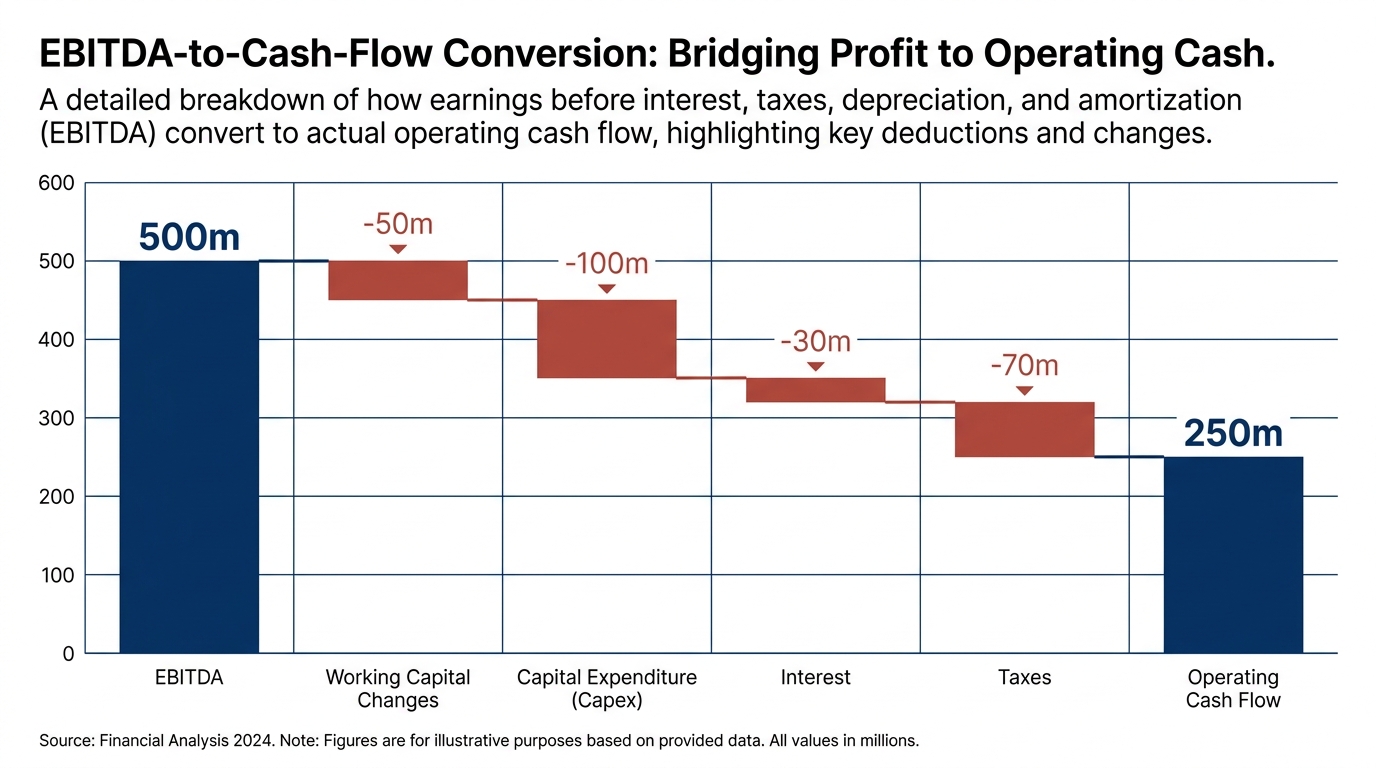
EBITDA is an accounting construct, and cash flow is what pays down debt and funds distributions. A portfolio company can report $12M in EBITDA and generate $8M in operating cash flow in the same period because of working capital absorption, capex requirements, or timing mismatches between revenue recognition and collections. The difference shows up in covenant compliance, distribution capacity, and the amount of cash available to delever.
Operating cash flow can diverge from EBITDA growth when working capital assumptions change post-acquisition. A business that grows EBITDA from $28M to $32M as planned can still generate $18M in operating cash flow instead of the projected $24M if days sales outstanding increases from 45 to 62 days as the sales team pushes volume into new accounts with longer payment terms. That cash-flow shortfall delays debt paydown, which pushes the exit window and reduces the effective IRR even when the EBITDA bridge is on track.
A value creation advisor operating at this level does not only track EBITDA growth, they track the cash conversion cycle and the spread between EBITDA and levered free cash flow. They identify where revenue growth is being funded by working capital expansion, where capex is running ahead of depreciation, and where one-time costs are being amortized in a way that distorts the cash-flow forecast. Marketing leaders in B2B growth businesses often propose demand programs that accelerate customer acquisition but extend payment terms or increase inventory requirements, and the cash-flow consequence does not surface until the CFO runs a 13-week cash forecast six months later.
Multiple Expansion: The Exit Lever That Cannot Be Engineered Backward
A higher exit multiple is the most valuable lever in a private equity return model because it applies to the entire enterprise value, not just the incremental change. A company that exits at 9.5x EBITDA instead of 8.5x generates an additional 1.0x of value on every dollar of earnings, which on a $30M EBITDA business is $30M of additional enterprise value with no operational change required. The problem is that multiples are assigned by buyers, not by operators, and the factors that drive them, growth rate, customer concentration, recurring revenue mix, competitive position, management depth, are structural characteristics that take years to change.
An advisor who presents multiple expansion as a near-term value creation output is either misunderstanding the mechanic or overselling the engagement. Multiple expansion happens when a company that was subscale, founder-dependent, or concentrated in a single geography becomes larger, more predictable, and more diversified. That transformation does not happen in a single planning cycle, and it cannot be modeled as a linear outcome of discrete initiatives.
What an advisor can do is identify the attributes a buyer will underwrite at exit and sequence the initiatives that build them. A $60M SaaS business with 85% customer concentration in healthcare and 40% churn might trade at 6.5x ARR. The same business with three verticals, 15% churn, and net revenue retention above 110% might trade at 8.5x to 9.0x. The work to get there is multi-year: vertical expansion, customer success buildout, product investment, and pricing redesign. The advisor's role is to map those initiatives to the multiple drivers, communicate the timeline honestly, and ensure the operating team understands that multiple expansion is a lagging outcome of structural improvement, not a forecasted benefit of a 90-day project.
What Realized, Run-Rate, Forecast, and Enabled Actually Mean in a Value Creation Report
Every value creation deck presented to a board or a sponsor should classify each outcome as realized, run-rate, forecast, or enabled. Realized value is cash that has been collected and shows up in audited financials. A pricing increase that added $1.2M to trailing twelve-month revenue and has been recognized in the income statement is realized. Run-rate value is a repeating benefit that will continue forward. A SaaS consolidation that saves $40K per month and has been in place for three months is run-rate. Forecast value is a model output that depends on assumptions holding. A demand generation program that is expected to add $5M in pipeline over the next two quarters is forecast. Enabled value is capability that has been built but not yet activated. A CRM migration that can now support a 50-person sales team but currently supports 18 is enabled.
The distinction matters because realized and run-rate value can be underwrit at exit, forecast value is discounted or ignored depending on evidence and timeline, and enabled value is not valued at all unless it is tied to a near-term activation plan. An advisor who reports '$12M in value created' without clarifying the mix is conflating four categories that a buyer will treat completely differently during diligence.
According to research published by Bain & Company in 2024, today's private equity deals demand faster EBITDA growth, with twelve months being the new five-year plan. That compression increases the importance of distinguishing run-rate outcomes, which compound through every future period, from one-time gains, which add value in a single reporting cycle but do not recurr. Content strategists building thought leadership in specialized verticals see similar dynamics when positioning case studies, where the difference between a repeatable client outcome and a one-time project success determines whether the case is credible or promotional.
The Advisory Model That Aligns Incentives With Enterprise Value
Most value creation advisors are compensated on a time-and-materials basis, monthly retainers or project fees that are disconnected from the value delivered. That model works when the engagement is scoped as a defined body of work, a post-merger integration, a carve-out preparation, a specific system implementation, but it misaligns when the objective is enterprise value improvement over a multi-year hold period.
A better structure ties a portion of advisor compensation to realized value, measured at defined checkpoints and validated through audited financials or third-party QoE reports. A portfolio company operating at $95M in revenue might engage an advisor on a $15K monthly retainer plus 8% of incremental EBITDA delivered above the baseline plan, payable quarterly in arrears and subject to audit. That structure ensures the advisor is accountable for outcomes that show up in the income statement, not just initiatives that are approved and funded.
The alignment works in both directions. The operating partner gets a partner who is motivated to sequence work for cash-flow impact and distinguish forecast from realization. The advisor gets paid for value that can be underwrit at exit, not for producing decks. The model does not work for every engagement, diagnostic work, technical assessments, and interim leadership roles are better suited to fixed fees, but for multi-year value creation partnerships where the objective is EBITDA growth and margin expansion, linking compensation to realized outcomes is the structure that removes the incentive to oversell forecast value.
What a Portfolio Company Should Expect From a Value Creation Advisor in the First 90 Days
The first three months of a value creation engagement should produce three deliverables, not a hundred-slide strategy deck. First, a reconciliation of the investment thesis with current operating reality, which means reading the original underwriting, comparing it to trailing financials, and identifying where assumptions have diverged from actuals. Second, a sequenced initiative roadmap that maps each project to the four value levers, labels the value category, and provides a timeline for when run-rate benefits begin and when realized value can be measured. Third, a measurement framework that defines how each outcome will be tracked, who is accountable, and what the validation method is.
An advisor brought in six months post-acquisition to accelerate a value creation plan should reconcile actuals against the investment memo and the lender presentation, not only against the operating budget. Revenue tracking 8% behind the underwriting, gross margin compressing 150 basis points due to unanticipated input cost increases, and customer churn running 12% higher than modeled are thesis variances that will not appear in a board deck if the variance reporting compares actuals only to the budget the operating team set rather than to the assumptions the sponsor underwrote.
The second deliverable was a roadmap that reprioritized initiatives based on cash-flow impact and timeline. The original plan had sequenced a pricing optimization project after a product line expansion, but the advisor reversed the order because pricing could deliver run-rate EBITDA improvement within 90 days, while the product expansion required nine months of development and would not generate revenue until month twelve. The resequencing moved $2.1M in margin improvement forward by two quarters, which improved covenant compliance and freed capital for the product investment.
The third deliverable was a measurement framework that classified every initiative as realized, run-rate, forecast, or enabled, and assigned accountability for tracking each one. Pricing increases were measured in monthly invoice data and validated through the billing system. Cost reductions were measured in the general ledger and reconciled to budget variance reports. Revenue initiatives were measured in CRM pipeline data and conversion rates, with realized value recognized only when cash was collected and the transaction closed. The framework was reviewed in every monthly operating review, which kept the team accountable to outcomes rather than activity.
Growth Shuttle: Equity Value Creation Advisory Built for the Mid-Market PE Operator
Growth Shuttle provides fractional value creation advisory for private equity sponsors and portfolio company leadership operating at the $30M to $500M scale. The engagement model is built around the four levers that determine enterprise value: revenue growth, EBITDA expansion, cash-flow timing, and defensible multiple at exit. Every initiative is mapped to the investment thesis, classified by value category, and measured against audited financials or third-party validation.
The typical engagement begins with a 30-day diagnostic that reconciles the original underwriting with current operating performance, followed by a sequenced roadmap that prioritizes initiatives based on cash-flow impact and realization timeline. Compensation is structured as a base retainer plus a performance component tied to incremental EBITDA delivered above the baseline plan, payable quarterly in arrears and subject to audit.
If you are an operating partner, portfolio CEO, or CFO managing a value creation plan that needs to distinguish forecast from realization and translate thesis into measurable enterprise value improvement, start a conversation. The first call is a working session, not a sales pitch, and it will clarify whether the engagement is a fit.
Growth Shuttle's advisory layer connects strategy to the operational systems that deliver it. For portfolio companies running WordPress infrastructure, DevriX provides the technical execution: enterprise performance optimization, HubSpot lifecycle automation, integration engineering, and the data architecture required to measure attribution and conversion across multi-location or multi-language properties. The combination gives PE sponsors a single accountable partner for both the strategic roadmap and the technical capacity to execute it, which reduces vendor fragmentation and keeps the timeline on track.
Most value creation plans fail in the gap between what the board approves and what the operating team can actually deliver. Growth Shuttle closes that gap by embedding advisory capacity at the executive level while DevriX builds the infrastructure that makes the plan measurable. The work is priced as a retainer, structured around quarterly milestones, and validated against the same metrics the sponsor uses to track portfolio performance.
Three Lessons From Value Creation Plans That Cleared the Audit
The first lesson is that activity does not survive diligence. Hours logged, campaigns launched, and features shipped are inputs, not outcomes. The only claims that hold up under audit are those tied to a baseline, a measurement method, and a reconciliation path to the general ledger or a third-party data source. If the value cannot be verified by someone who was not in the room when it was created, it will be challenged during exit preparation.
The second lesson is that forecast value and realized value are not interchangeable. A CRM pipeline that shows $3.8M in qualified opportunities is not $3.8M in enterprise value until the contracts are signed, the revenue is recognized, and the cash is collected. Exit buyers discount forecast heavily, which means the timing of realization matters as much as the size of the initiative. A $1.2M margin improvement delivered in month six is worth more to the exit multiple than a $2M revenue initiative that will not close until month fourteen.
The third lesson is that the thesis determines which initiatives create value and which ones create cost. A sponsor underwriting a roll-up strategy will assign value to acquisition infrastructure, integration playbooks, and centralized reporting, even if those initiatives reduce short-term EBITDA. A sponsor underwriting organic growth will assign value to sales capacity, customer retention, and product expansion, even if those initiatives increase operating expense. The same initiative can be value-creating in one thesis and value-destroying in another, which is why the sequencing has to start with what was underwritten, not with what the operating team prefers to build.
When the Plan Needs an Operator Who Has Built One Before
The value creation plans that survive exit diligence are built by people who have reconciled one before. They know which assumptions hold up under audit, which timelines are realistic given the capacity constraints, and which measurement methods will satisfy a third-party buyer who was not part of the original underwriting. That knowledge does not come from frameworks or templates. It comes from having delivered incremental EBITDA that was verified, measured, and paid out.
If your portfolio company is managing a value creation plan where the gap between forecast and realization is growing, or if the exit timeline is compressing and the plan has not been reconciled to audited financials, Growth Shuttle provides the advisory layer that connects thesis to execution. The work starts with a diagnostic that maps every initiative to the investment thesis and classifies it by value category, followed by a sequenced roadmap that prioritizes based on cash-flow impact and realization timeline. The first call is a working session that will clarify whether the engagement is a fit. Start the conversation here.


