Disclosure: some links in this article are affiliate links. If you sign up through one, we may earn a commission at no extra cost to you.
HubSpot laid off 12% of its workforce in February 2025, roughly 840 people, and a disproportionate number came from revenue operations, customer success, and support. If the company that sells the CRM cannot justify the internal RevOps headcount at scale, a $60M portco holding onto a full-time RevOps manager plus two analysts is not making a defensible capital allocation decision. It is carrying a liability it cannot afford and does not need.
The capability question operating partners ask is always the same: hire a RevOps lead, contract one, standardise on which stack, and who runs the tool change when the acquired company is still on Salesforce and we are standardising on HubSpot? The answer for a lean mid-market portco is simpler than the internal-versus-external debate makes it sound: rent the function, fix the foundation, do not lock yourself in, and never hire for work that happens in bursts.
The Foundation Is Broken If You Are Still Looking at Last-Touch Attribution
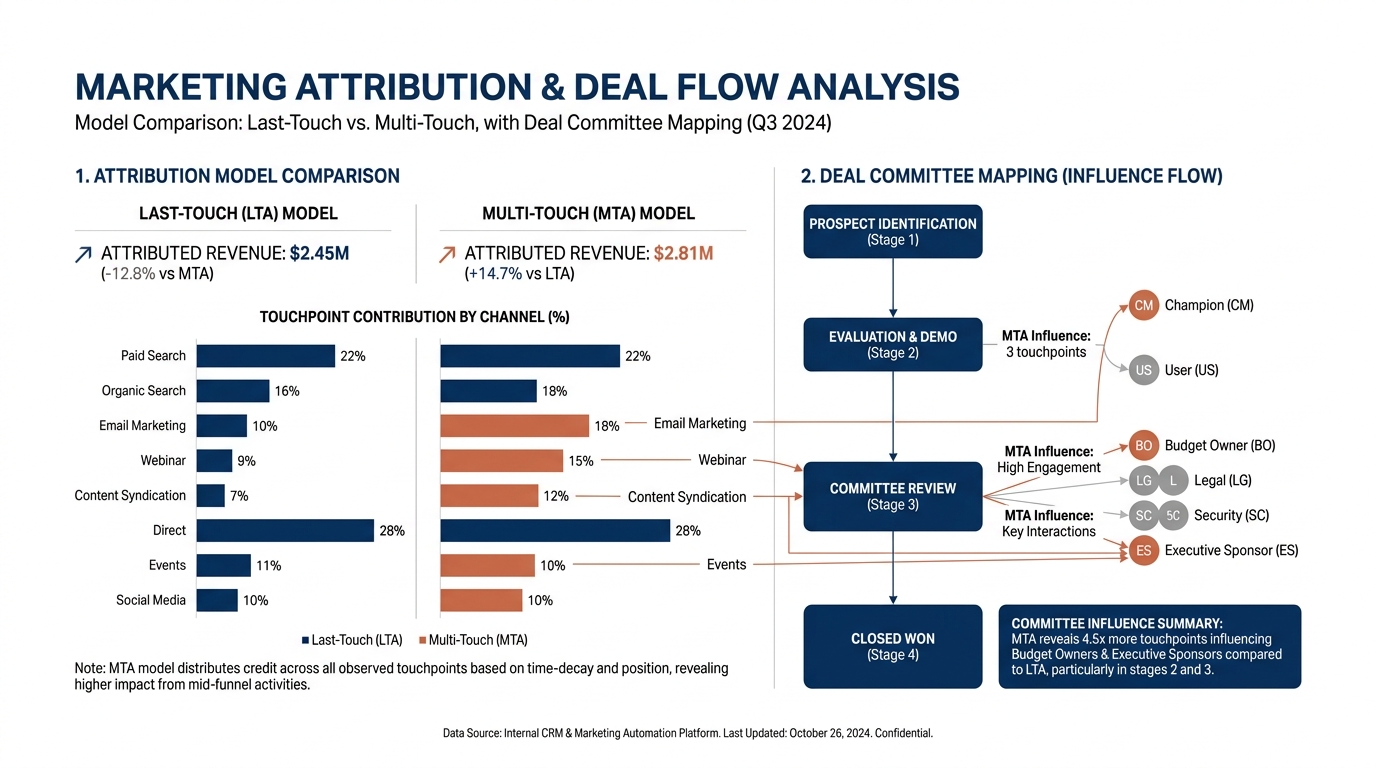
Last-touch attribution credits the demo request to whichever campaign got the last click before the form was submitted, and if the deal closes six months later credited to a different campaign because somebody clicked a retargeting ad the week before close, the business cannot see which channel actually started the conversation. The portco operator asking whether they are looking at the right reports and capturing the right data already knows the answer: no, and the CRM was set up by the implementation consultant the previous owner paid in 2019 and nobody has looked at it since.
Revenue operations hygiene means CRM governance, consistent data capture, multi-touch attribution that reflects an actual buying committee, and stage definitions that match how the business closes deals. A $90M services business does not have the same pipeline as a $40M SaaS company, and a standard HubSpot implementation does not account for that difference unless somebody maps the business model into the system. The foundation work is boring, it does not show up in a keynote, and it is the only thing that prevents every downstream automation from producing garbage.
The gap between what the portco thinks it is tracking and what the CRM actually captures shows up the first time an operating partner asks for a cohort retention analysis and the team discovers contact creation date was never set correctly, deal sources were free-text, and nobody can reconstruct which accounts came from the acquisition versus organic. Fixing that means re-architecting the data model, backfilling four years of records, writing the validation rules, training the team on new picklists, and running parallel reporting until finance signs off. That work does not justify a permanent headcount, and the wrong contractor will burn sixty thousand dollars before you realize the data is still broken.
What You Rent: The Bursts, the Integrations, and the Buildouts
Revenue operations work happens in bursts: the CRM migration after an acquisition, the HubSpot-to-Salesforce handoff when the portco standardises post-close, the enrichment stack when the team needs account-level intent data and buying committee mapping, the reporting layer when the sponsor asks for a pipeline forecast model finance can defend at the board meeting. A full-time RevOps manager costs $120K to $160K loaded in a major market, the work is uneven across quarters, and the capability ages out every eighteen months because the stack changes and nobody internally is keeping up with it.
Renting the function means you pay for the bursts and the technical builds and you do not carry overhead between them. The CRM governance audit, data model redesign, stage-gate rebuild, attribution fix, and dashboard buildout happen in weeks with a team that has done it thirty times across ten different business models. The engagement ends, the retainer steps down to maintenance and monitoring, and the portco is not paying benefits and career development for someone who will leave in fourteen months when a SaaS company offers equity.
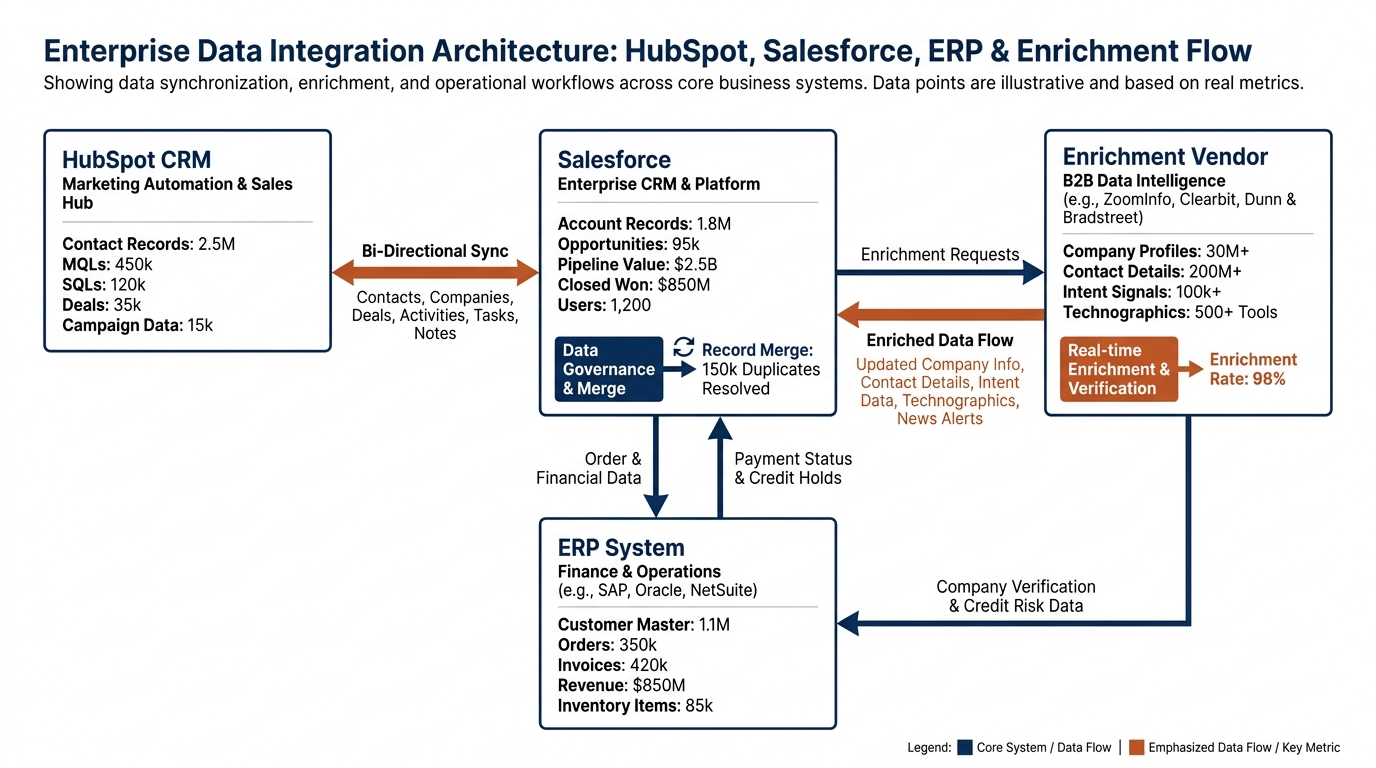
The integrations are where in-house hires lose. Connecting HubSpot to NetSuite for revenue recognition, Salesforce to a commission system that was acquired with the business, a prospect enrichment vendor to a CRM instance that has seventeen custom objects and no documentation, that is contractor work. It requires knowing the APIs, the error states, the field-mapping edge cases, and how to write the validation rules so finance does not discover a sync failure three months later when reconciliation breaks. A RevOps manager hired from a SaaS background will learn this on your time and budget. A team that has wired these stacks for portfolio companies in distribution, services, and manufacturing already has the runbooks.
What Your Portco Should Never Hire For
Do not hire for work that only happens after an acquisition, a platform change, or a financing event. The CRM migration, the tech stack consolidation, the integration between the acquired company's Salesforce instance and your HubSpot standard, those are one-time technical builds that a contractor completes in six weeks and an in-house hire stretches to four months while learning the tools. The operating partner who approves that headcount is paying someone $140K a year to do three months of high-intensity work annually and spend the rest of the time in vendor demos, optimisation projects that never ship, and Slack.
The same logic applies to advanced automation and AI tooling. A portco that does not have CRM governance, consistent pipeline definitions, and clean data capture should not be hiring someone to build a co-pilot that writes follow-up emails, scores leads with a custom model, or auto-generates account plans. The foundation does not exist, the automation will institutionalise broken processes, and the first board meeting where the forecast is wrong by 30% will surface that nobody validated the data going into the model. Fix the hygiene, rent the buildout, and promote the capability in-house only when the volume and complexity justify it.
Portfolio companies below $100M in revenue almost never have enough RevOps volume to keep a senior full-time hire productive. The reporting cadence is monthly or quarterly, the CRM changes happen twice a year, and the integration work clusters around acquisitions and system changes. A fractional RevOps partner at 20-40 hours a month covers monitoring, light optimisation, ad-hoc requests, and scales up for the buildout work when it happens. The portco pays $8K to $15K monthly instead of $160K loaded annually, avoids the recruiting lag and the onboarding overhead, and does not lose the capability when the hire leaves for a growth-stage startup.
The Stack Question: HubSpot, Salesforce, or Wait
Operating partners inheriting a portco with Salesforce want to know whether to rip it out and standardise on HubSpot, keep Salesforce and layer HubSpot Marketing on top, or wait until the next acquisition and consolidate then. The answer depends on three things: contract lock-in, integration complexity, and how much of Salesforce the business actually uses.
If the portco has two years left on a Salesforce contract, the instance is wired into NetSuite and a custom commission system, and the sales team uses Salesforce's CPQ and territory management, migration is a twelve-month technical program that will break commission calculations, revenue recognition, and pipeline reporting if it is rushed. The correct answer is to leave Salesforce in place, connect HubSpot Marketing for lead nurture and campaign tracking, sync the two through native connectors or a middleware layer, and plan the migration for the next platform refresh or acquisition integration.
If the portco is on Salesforce but only uses it as a contact database and a deal tracker, has no complex workflows, and the contract renews in six months, the migration case is stronger. HubSpot's all-in-one model collapses CRM, marketing automation, and basic service ticketing into one platform at a third of the licensing cost, the user interface is easier to adopt for teams that are not Salesforce-native, and the integration ecosystem is broad enough that most mid-market needs are covered without custom development. The risk is underestimating what breaks in the move: custom fields that do not map, reports that were built in Salesforce dashboards and have to be rebuilt, and APIs that called Salesforce objects and now need to be rewritten.
The wait-and-consolidate approach makes sense when the sponsor has another acquisition planned in the next eighteen months and both targets are on different systems. Forcing a migration now and then doing it again post-acquisition doubles the cost and the risk. The better path is to stabilise both instances, document what each system does, and plan a single consolidated migration that happens after close when you know the full technical landscape.
Why AI-Era Build Costs Broke the Old Model
The hourly-rate RevOps consultant who charges $250 an hour and takes sixteen weeks to rebuild a CRM data model is competing with AI-assisted contractors who can deliver the same result in four weeks at $15K fixed price. The capability has not commoditised, the tools have, and the cost curve has collapsed. An operating partner benchmarking a RevOps proposal in 2026 is comparing it to what a competent contractor with Cursor, HubSpot's API documentation, and a library of prior migrations can build in days, not what a traditional consultancy scoped as a six-month engagement in 2022.
This has downstream consequences for hiring. A RevOps manager who was hired to manage vendor relationships, own the CRM roadmap, and coordinate with IT is now expected to ship technical work themselves because the AI-assisted tooling has made it feasible. The person who could delegate the Salesforce-to-HubSpot sync buildout to an implementation partner in 2023 is being asked to write the integration scripts in 2026, and if they cannot, the role does not justify the cost. The capability bar has moved, the salary expectations have not, and portfolio companies are discovering that the $140K hire does not have the skills the market now requires at that price point.
For operating partners, this changes the rent-versus-hire calculation. The technical builds that used to require a senior full-time RevOps lead are now contractor work that ships faster and cheaper with a team that has AI-native workflows. The strategic oversight, the business-model translation, the alignment with finance and the go-to-market team, those still require judgment and internal context. The answer is not to hire for the whole stack. It is to rent the builds, keep a light internal owner for prioritisation and vendor management, and bring the capability fully in-house only when the complexity and volume make a senior permanent hire defensible to the deal team.
What a RevOps Retainer Should Deliver in the First 90 Days
A revenue operations engagement for a portfolio company should ship visible value in the first month, not the first quarter. The discovery phase is one week: CRM audit, data quality review, attribution model check, pipeline definitions, reporting infrastructure, integration map. The second week is the fix list: the broken workflows, the missing validation rules, the attribution that credits everything to the last click, the custom fields that were created as free-text and need to be picklists, the stage definitions that do not match how deals actually close. Week three starts execution: data model cleanup, backfill scripts, stage-gate rebuild, multi-touch attribution configuration, and dashboard prototypes that show what the business will be able to see once the foundation is in place.
By day 30, the operating partner should have a working dashboard that shows pipeline by source, stage conversion rates, velocity by deal size, and a forecast model that finance can validate. The CRM should have governance rules that prevent bad data from getting entered, the sales team should have clarity on what stage definitions mean and what needs to happen for a deal to move forward, and marketing should be able to see which campaigns are generating qualified pipeline instead of last-click vanity metrics. That is the foundation, and it is the only thing that makes the next sixty days productive.
Months two and three are integration, automation, and scale. Connect the CRM to the ERP so revenue recognition happens automatically, wire in the prospect enrichment vendor so account data updates without manual uploads, build the lead routing rules so inbound gets to the right rep within five minutes, set up lifecycle automation so nurture happens without manual intervention, and layer in the buying committee tracking so the business knows which accounts have multiple stakeholders engaged. The buildout work is technical, it requires knowing the APIs and the edge cases, and it is exactly the kind of project that an in-house hire will spend four months on while a contractor with a prior runbook completes it in four weeks.
At the end of 90 days, the engagement should step down to a monitoring and optimisation retainer unless there is another major buildout on the roadmap. The portco is paying for someone to watch the data quality, catch the integration failures, tune the attribution model as the business evolves, and scale back up when the next acquisition or platform change happens. That is the model that works for a $60M portco that does not have the RevOps volume to justify a $140K full-time hire and cannot afford to carry the overhead between bursts.
The No-Lock-In Rule and Why It Matters
Operating partners correctly distrust vendors who insist on proprietary platforms, custom-built tools that only they can maintain, and contracts that make it expensive to leave. A RevOps partner that builds everything inside their own middleware layer, uses a proprietary data model that does not export cleanly, or writes integrations in a way that requires their team to touch every future change has created lock-in by design. The correct model is the opposite: build everything in the client's own HubSpot instance, Salesforce org, or data warehouse, use native features and standard APIs wherever possible, document every custom script and integration, and make it trivial for the client to take over or move to a different vendor when the engagement ends.
A portfolio company that can leave easily is a portfolio company that chooses to stay because the work is good and the economics make sense, and switching costs are low enough that the decision is a genuine one. The partner that builds lock-in is betting that the client will not have better options in eighteen months, and the partner that makes it easy to leave is betting that their work will be good enough that the client does not want to. The second is a defensible long-term relationship and the operating partner will force the first out at the next value-creation planning cycle.
When to Bring RevOps In-House
Revenue operations becomes a defensible full-time hire when the portco crosses $100M in revenue, operates in multiple regions or verticals with different go-to-market motions, has ongoing integration work from serial acquisitions, or the CRM and data infrastructure is complex enough that a senior full-time owner can stay productive year-round. Below that threshold, the math does not work. A $60M services business with one CRM instance, two integrations, and quarterly reporting does not have 2,000 hours a year of RevOps work, and paying someone $140K to do 800 hours of productive work while filling the rest of the time with optimisation projects, vendor research, and internal meetings is a cost the deal team will not defend.
The transition point is when the contracted hours consistently exceed what a fractional engagement can absorb and the work has become continuous rather than bursty. If the portco is spending $12K a month on a RevOps retainer, scaling up to 60-80 hours monthly for buildout work, and that pattern holds for two consecutive quarters, the in-house hire starts to pencil. The calculation includes salary, benefits, recruiting lag, onboarding time, the productivity gap while the hire learns the business, and the risk that they leave in eighteen months when the market is hot. A $15K monthly retainer that delivers senior-level work immediately, scales up and down with the workload, and does not require backfill when someone leaves is often the better answer even at higher monthly costs than a full-time hire would run.
What matters more than the revenue threshold is the operator's honest assessment of whether the volume, complexity, and continuity of the work justify a permanent seat. If the answer depends on squinting at the roadmap and imagining projects that might happen, the hire is premature. If the current contractor is already overbooked and the backlog is growing every month, the hire is overdue.
Getting Started
Portfolio companies that need RevOps infrastructure built, CRM hygiene fixed, or a data foundation that supports real forecasting should start with a diagnostic week: CRM audit, data quality review, attribution check, integration map, and a prioritised fix list with time and cost estimates for each item. That diagnostic is cheap, it surfaces the gaps that are costing the business visibility and velocity, and it gives the operating partner enough information to decide whether to rent the buildout, hire in-house, or wait.
The portco operators who get this right treat RevOps as a capability they rent until the volume justifies ownership, fix the foundation before anything clever gets built on it, and never lock themselves into a vendor relationship that makes it expensive to leave. The ones who get it wrong hire too early, pay for overhead they do not need, and discover eighteen months later that the person they hired does not have the skills the AI-native market now requires. The HubSpot layoffs settled the question: if the company selling the CRM cannot justify the headcount, your $60M portco should not be carrying it either.
Need a CRM audit, attribution fix, or integration buildout? DevriX's RevOps retainer starts with a one-week diagnostic, ships a working data foundation in 30 days, and scales with your portfolio company's growth. No proprietary platforms, no lock-in, and no paying for overhead between buildouts. Reach out for a scoping call.
The Talent Arbitrage Nobody Talks About
The hiring conversation around RevOps misses a structural advantage that makes the rent-versus-own decision starker than it looks on a spreadsheet. The RevOps market is bifurcating: senior practitioners who stayed ahead of the AI curve (data modeling, SQL, Python, API orchestration, LLM-native workflows) command $160K-$200K and are selective about where they land, while the mid-tier pool (CRM admins who learned Zapier, HubSpot certification holders, marketing ops people who moved sideways) is being compressed by tooling that eliminates 60% of what they used to do manually. The portco that hires today is hiring into the middle of that shift, paying for a skill set that may be partially obsolete by the time the person finishes onboarding.
A retained engagement with a senior RevOps partner gets you the top-tier skill set without the top-tier salary commitment, because the contractor is amortizing their rate across multiple clients and staying current on tooling as a survival requirement. The person you hire full-time at $140K is betting their career on your company and will optimize for stability and internal credibility, not for staying at the bleeding edge of what AI can now automate. Eighteen months from now, when you need someone who can build custom GPT actions, write database queries, and orchestrate multi-system workflows, the contractor is already doing it for three other portcos and the hire is still managing HubSpot lists.
When the Deal Team Should Step In
Operating partners own the execution, but the deal team should force the rent-versus-own question during two windows: at the 100-day plan and again at the twelve-month mark. The 100-day checkpoint catches the portcos that are about to hire a RevOps head because it feels like the next professional step, without a clear workload analysis. The twelve-month review catches the engagements that have become permanent dependencies, where the retainer has been running for a year, the monthly spend is consistent, and nobody has asked whether converting to an in-house role would lower the run rate or increase the risk.
The question the deal team should ask is whether the hire makes the business more or less flexible when the market changes, the integration roadmap shifts, or the next platform migration lands. A $140K RevOps lead who needs six months to learn the business, another six to be productive, and then leaves because a SaaS company offered equity is a $300K mistake when you include recruiting, onboarding, and the work that did not get done. A $15K monthly retainer that you can pause, scale, or terminate in thirty days is expensive on a per-hour basis and cheap on a risk-adjusted basis.
The Real Decision
Rent the capability when the work is intermittent, the roadmap is uncertain, the skill requirements are changing faster than you can hire for them, or the portco is below the scale where a full-time senior owner stays productive year-round. Hire when the volume is continuous, the complexity justifies dedicated attention, the business has reached the threshold where contracted hours consistently exceed what a retainer can absorb, and you are confident the in-house person will stay current on tooling without becoming a fixed cost liability.
The threshold is the honest operator answer to whether this is 2,000 hours a year of real work or 800 hours of productive work plus 1,200 hours of invented projects to justify the headcount. Most $60M-$80M portcos fall into the second category, and the ones that admit it early save themselves a year of overhead and a messy separation conversation when the deal team finally asks why RevOps is a permanent seat.
What This Means for the Operating Partner
The operating partner who recommends the hire without running the workload math is creating a fixed cost the portco will carry through the next downturn, the next integration, and the next time the deal team asks why EBITDA margins compressed. The operating partner who recommends the retainer and then monitors it quarterly, asks whether the scope has stabilized, checks whether the contractor is still delivering new capability or just maintaining old infrastructure, and forces the conversion question when the data supports it, is doing the job the LP expects.
The contractors who survive in this market tell you when the engagement should convert, when the volume justifies the hire, and when keeping them on retainer past that point is a decision you are making for convenience rather than economics. A contractor who recommends hiring their replacement when the workload crosses the threshold is worth keeping on file for the next portco, because they understand that the value to the sponsor is in the flexibility.
Most portco CEOs will default to hiring because it feels like building a team, because they are used to hiring their way out of capability gaps, and because a retainer reads as incomplete or temporary. The operating partner's job is to reframe it: you are not renting because you cannot afford to hire, you are renting because the capability you need today may not be the capability you need in eighteen months, and locking in a permanent seat now means paying severance later when the roadmap changes or the tooling makes the role redundant.
How to Structure the Retainer
The retainer that works for a $60M-$80M portco is a defined scope with a monthly ceiling, a quarterly review checkpoint, and a clear conversion trigger written into the statement of work. The scope should list the deliverables (pipeline reporting, attribution model, lifecycle automation, dashboard builds, platform integrations), the exclusions (ad-hoc requests that fall outside the roadmap, internal training for roles that should already exist, work that belongs to a finance or IT function), and the threshold at which the engagement converts to a hire recommendation.
The conversion trigger is typically hours. If the contracted work consistently exceeds 120 hours per month for two consecutive quarters, and the scope has stabilized enough that you can write a job description that covers 80% of the ongoing work without requiring constant re-scoping, the engagement should convert. If the hours stay below 100 per month and the scope is still shifting every quarter because the business model is evolving, the integration roadmap is uncertain, or the platform stack has not settled, the retainer stays in place.
The quarterly review is a workload and roadmap checkpoint: what shipped, what is queued, what capability was added, what old work was automated out, and whether the business has crossed the threshold where an in-house owner would stay fully utilized. The operating partner should run that review with the portco CFO and the contractor together, because the CFO owns the budget decision and the contractor has the cleanest view of whether the work is growing, plateauing, or automating itself away.
The Automation Layer That Changes the Calculation
Eighteen months ago, a RevOps function at a $75M portco needed someone to build reports, manage integrations, clean data, maintain workflows, and answer internal questions about pipeline coverage and forecast accuracy. Today, the report-building is mostly automated (custom GPTs can write SQL, generate charts, and surface insights from natural-language prompts), the data-cleaning runs on scheduled scripts rather than manual audits, and the internal questions get answered by an AI assistant trained on the company's CRM and financial data before they reach a human.
The work that remains is the work that requires business-context decisions: which attribution model to use when the buyer journey spans six months and three product lines, how to structure lifecycle stages when the sales process involves multiple stakeholders and a long post-sale onboarding, where to draw the line between marketing-qualified and sales-accepted when the handoff is murky, and how to instrument tracking when the product has both self-serve and enterprise motions running in parallel. That work is high-judgment, intermittent, and sensitive to business-model changes, which makes it exactly the kind of work that does not fill a full-time role at a $60M company.
The portco that hires a full-time RevOps lead today is paying for 2,000 hours and getting 600 hours of high-judgment work, 400 hours of maintenance that will be automated within a year, and 1,000 hours of work the person invents to justify the seat. The portco that retains a senior contractor for 80-100 hours per month is paying for the 600 high-judgment hours and letting the automation handle the rest, without carrying the overhead or the separation risk when the role compresses further.