You are an operating partner or a portfolio company CEO who has to close a finance leadership gap, and you have a budget but not a clear decision. The old controller cannot build a board package. The forecast missed two quarters running, and the deal team wants to know why. You do not need a full-time CFO at a full-time salary for a company this size, but you cannot run the next twelve months on a bookkeeper plus a spreadsheet either. The decision in front of you is whether to hire a fractional CFO for portfolio companies in your book, and if so, how to judge one so you do not pay senior day rates for junior work.
This guide is for the buyer who already knows what a CFO does. It is about the decision, the scope, and the evidence you should demand before you sign. The commercial stakes are direct: finance leadership that cannot produce a forecast you trust slows every other decision in the hold, from covenant headroom to the add-on model to the exit narrative.
1. Name the gap before you name the hire
The mistake I see most often is treating "we need a CFO" as a single problem when it is usually three or four problems bundled together. A fractional engagement only works if you scope it to the actual gap, because a fractional leader bills for a slice of the week and cannot cover everything a full-time CFO would.
Separate the needs out loud. One company cannot see its own numbers because the ERP, the billing system and the CRM never got connected, so finance runs on exported Excel. A second company sees its numbers fine but has no one who can build a defensible forecast or walk a board through it. A third has a competent controller who closes the books cleanly but needs senior cover for a financing event, a carve-out, or an add-on integration. These are different hires with different price points.
If the real problem is that the data is trapped in spreadsheets, a CFO title will not fix it on its own, and you may be better served pairing a lighter fractional finance lead with a RevOps and data function you rent rather than build. Decide what is a finance-leadership gap and what is a systems gap before you write the role.
2. Decide whether fractional is the right shape at all
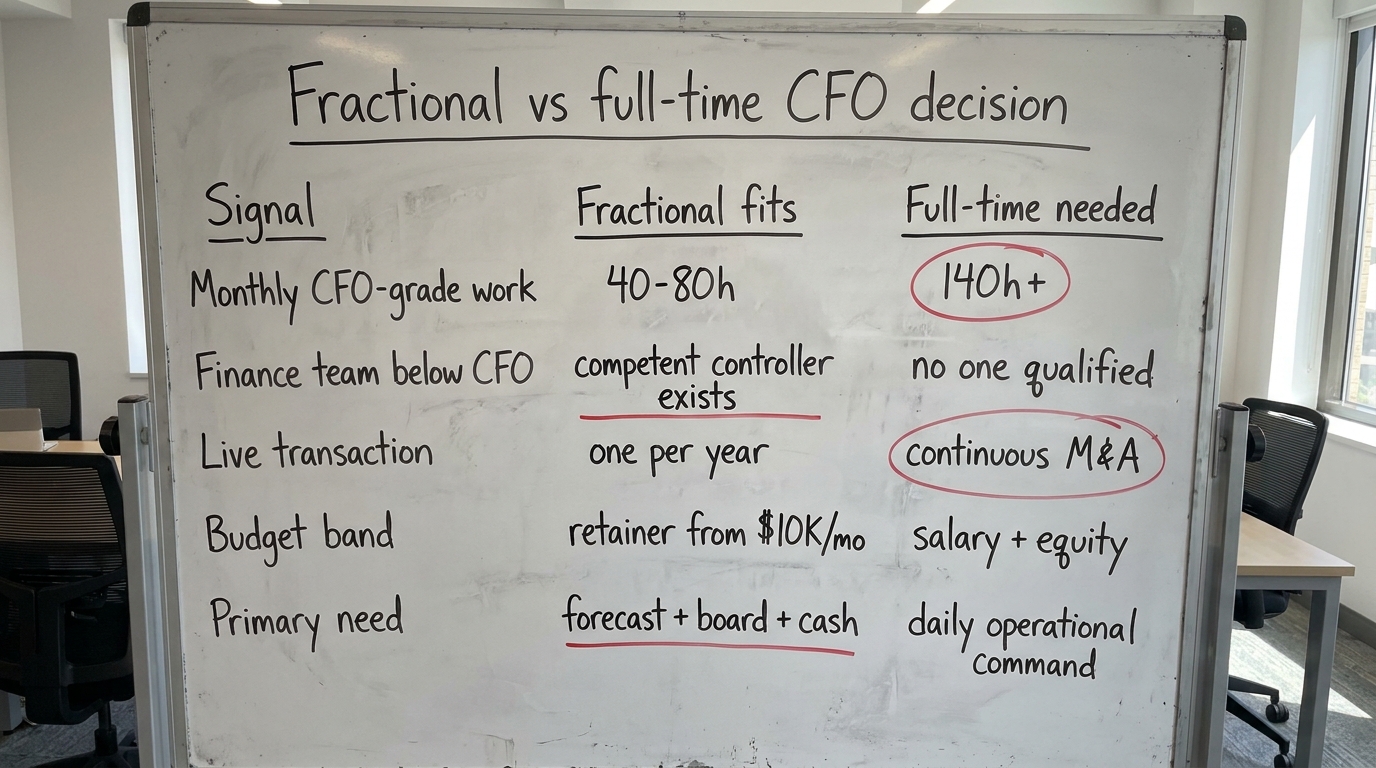
Fractional finance leadership fits a specific band of situations. It works when the company needs experienced finance leadership on a predictable cadence (monthly close review, board prep, forecast ownership, lender relationship) but does not generate enough full-time CFO work to justify a six-figure salary plus equity. It works less well when the role is a daily firefight, when the finance team below the CFO is thin or absent, or when a live transaction will consume forty hours a week for a quarter.
Bain's annual private equity report has tracked how much of the return now has to come from operational improvement rather than multiple expansion, which puts real weight on forecast reliability and cash discipline inside the portfolio. You can read the pattern in Bain's Global Private Equity Report. The practical read for you: if finance leadership is the thing standing between the company and a credible plan, underinvesting in it is expensive even when the company is small.
A useful filter is to ask how many hours of genuine CFO-grade work the company produces in a normal month. If the honest answer is forty to eighty, a fractional arrangement at one to two days a week is a clean fit. If it is closer to full-time and will stay there, you are hiring a permanent CFO and should budget for it.
When a transaction is on the calendar
A financing round, a refinancing, a bolt-on, or an exit changes the math. During those windows the finance workload spikes well past what a two-day-a-week retainer covers. The right move is usually a fractional CFO on a higher temporary allocation, or a fractional lead supported by a separate diligence team, so the retainer does not quietly blow its scope. Decide the surge arrangement before the transaction starts, not three weeks in.
3. Write the scope as a short list of owned outcomes
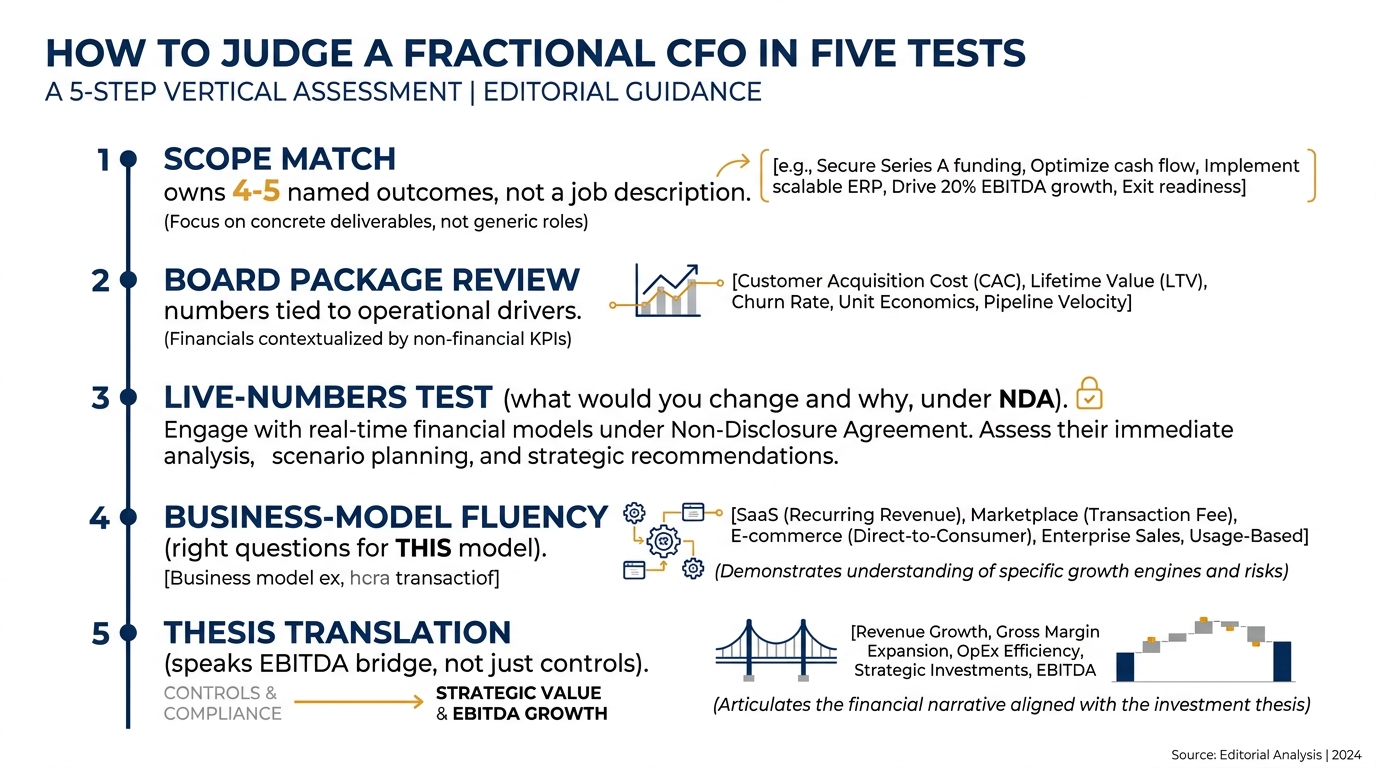
The cleanest fractional engagements I have seen are written as four or five outcomes the person owns, not a job description copied from a full-time posting. Vague scope is how you end up paying senior rates for someone attending meetings. Specific scope is how you judge the hire in ninety days.
For a typical lower-mid-market portfolio company, a defensible scope looks like this:
- Own the monthly close calendar and sign off on the numbers before they reach the board.
- Own the 13-week cash forecast and the annual operating plan, including variance analysis against plan.
- Own the board finance package and present it, so the CEO is not improvising the finance section.
- Own the lender relationship and covenant monitoring.
- Build or fix the reporting layer so the operating partner sees the same numbers finance sees.
Notice what is not on that list: running day-to-day AP and AR, managing payroll mechanics, or being the first responder for every billing question. Those belong to a controller or an outsourced function. If you load them onto a fractional CFO, you pay the premium rate for clerical hours and crowd out the work you actually hired for.
4. Set the price against what the work is worth, not against a title
A fractional CFO retainer for a portfolio company in this band generally runs from around $10K a month at the lighter end, scaling with hours and transaction intensity. The figure matters less than what you get inside it. The question to ask is not "what is the day rate" but "what outcomes does this retainer own, and what happens to price when the workload surges for a deal."
Benchmark the cost against the cost of getting it wrong. A forecast that misses by fifteen percent two quarters in a row damages your credibility with the lender and the board, and it can delay or reprice a financing event. Set against that, the difference between a $10K and a $20K monthly retainer is noise. PitchBook and S&P Global Market Intelligence both publish data on deal activity and financing conditions that bear on how much forecast discipline is worth in the current market; see PitchBook research and S&P Global Market Intelligence.
Where you should push back hard is on time-and-materials arrangements with no outcome attached, and on quotes that read like a full-time salary divided by a fraction with no change in what is actually owned. You are buying a defined result on a cadence, and the contract should say so.
5. Judge the candidate on evidence, not on the logo trail
A strong resume of CFO titles at bigger companies tells you the person has sat in the seat. It does not tell you they can build a forecast for a $30M distributor with a messy ERP and a two-person finance team. Judge the fit on artifacts and on how they reason about your specific business.
Ask for a sample board package
Ask any serious candidate to walk you through a board finance package they built, redacted as needed. You are looking for whether the numbers are tied to operational drivers, whether the variance analysis is honest, and whether a non-finance board member could follow it. A package that is all GAAP statements and no commentary is a tell.
Give them your actual numbers and watch them work
Under an NDA, hand over a recent management report and a forecast, and ask them what they would change and why. Business-model fluency shows up fast here. A good fractional CFO for a project-delivery firm will ask about revenue recognition and work-in-progress; a good one for a clinic group will ask about payer mix and days in AR. A candidate who applies a generic SaaS template to a business that does not sell software is the wrong hire, and the test surfaces it in one conversation.
Check that they will connect finance to the operating thesis
The best fractional CFOs in a PE context translate finance into the language the deal team uses: EBITDA bridges, cash conversion, the levers in the value creation plan. If a candidate talks only about controls and compliance, you want a finance partner who connects the numbers to the operating thesis and the value plan. This is the same discipline you apply when you buy fractional CIO services without overpaying for a title: the title is cheap, the judgment is what you are paying for.
6. Line up the finance hire with diligence and the first 100 days
Timing changes who you hire and how fast. If you are still pre-close, the finance picture is a diligence output, and a fractional CFO engaged early can read the quality-of-earnings work and the forecast with an operator's eye rather than an auditor's. That connects directly to how you commission the rest of the diligence stack, including commercial due diligence you can actually use and the technology due diligence that tells you whether the finance systems will survive the hold.
The AICPA and CIMA publish guidance on quality-of-earnings work and finance function design that is worth knowing before you scope the role; see AICPA and CIMA. The point here is to hire a finance leader who can read the diligence and tell you what it means for the plan.
If you are at or just past close, the finance hire belongs on the first 100 days plan with a named owner and a dated deliverable, usually a clean 13-week cash forecast and a rebuilt board package by the first board meeting. A finance leader who shows up on Day 1 with no mandate and no target drifts, and the first quarter is gone before anyone notices.
7. Fit the fractional CFO into the rest of the operating layer
A fractional CFO is one seat in a portfolio company's leadership, and the engagement works better when you have decided how it meets the other seats. Finance, operations, and the commercial function share data, and if the finance leader owns the forecast while no one owns the pipeline data feeding it, the forecast is guesswork dressed as rigor.
This is where the earlier scoping call pays off. If the company's numbers live in disconnected systems, the fractional CFO should not be the one wiring up integrations in the evenings; that is a data and RevOps job. Pair the finance hire with the function that fixes the data layer so each does what it is good at. Some operating partners buy this as a bundle, closer to a value creation office you only need part-time, rather than stitching separate retainers together.
For a working-capital-heavy business, the fractional CFO and a working capital optimization consultant often work the same cash levers, and you want to decide upfront who owns which. Overlapping mandates waste money and produce finger-pointing when the cash number moves the wrong way.
8. Handle the add-on and integration case deliberately
Portfolio companies that are buying add-ons put a different demand on finance. Every bolt-on means a new chart of accounts to map, a close calendar to merge, and a reporting consolidation that the board expects to see cleanly within a quarter or two. A fractional CFO who has run integrations is worth more than one who has only run steady-state finance.
When you scope the role for a buy-and-build platform, write integration into the outcomes and fund the surge hours. The finance workstream in an integration is one of the longest poles, and it maps directly onto the broader post-merger integration checklist for add-ons. If you are running a digital or systems integration alongside the finance consolidation, the sequencing matters, and a 100-day integration plan built around the real systems keeps the finance consolidation from stalling on a half-migrated ERP.
McKinsey and BCG both publish on the operational demands of buy-and-build and integration in private capital; see McKinsey's private capital research and BCG on principal investors and private equity. The recurring lesson is that integration failures are usually execution failures, and finance consolidation sits near the center of the execution risk.
9. Write the engagement so you can judge it at ninety days
The contract should let you check progress before you are locked in for a year. I favor a short initial term with a clear review point, a named set of deliverables, and the surge terms written down in advance. That gives both sides room to confirm the fit without an awkward exit.
Build the review around artifacts, not activity. At ninety days you should be able to point to a board package that reads cleanly, a 13-week cash forecast the lender accepts, a variance report that explains the last quarter honestly, and a reporting layer the operating partner can open without asking finance to re-export it. If those exist, the engagement is working. If what you have instead is a stack of meeting notes and a promise, you scoped activity, not outcomes.
The Harvard Law School Forum on Corporate Governance regularly covers board reporting expectations and governance discipline in sponsor-backed companies, which is useful context for what your board package should carry; see the Harvard Law School Forum on Corporate Governance. For the broader M&A and finance-leadership context, Harvard Business Review's M&A coverage is a reasonable starting point.
10. A decision checklist before you sign
Run this list before you commit to a fractional CFO for any company in the book. It is short on purpose, because the failure modes are consistent.
- Gap named. You can state whether this is a finance-leadership gap, a systems gap, or a transaction surge, and you are hiring for the right one.
- Shape confirmed. The monthly CFO-grade workload genuinely fits a one-to-two-day retainer, and you have decided what happens during a deal.
- Scope written as outcomes. Four or five owned deliverables, not a full-time job description, with clerical work assigned elsewhere.
- Price tied to outcomes. The retainer owns named results on a cadence, surge terms are in writing, and you are not paying senior rates for AP processing.
- Evidence demanded. You have seen a real board package and watched the candidate reason about your actual numbers under NDA.
- Business-model fluency confirmed. The candidate asks questions specific to this company's model rather than applying a generic template.
- Timing aligned. The role sits on the diligence or first-100-days plan with a dated deliverable and a named owner.
- Operating layer mapped. You have decided how finance meets data, RevOps, and any working-capital or integration work, so mandates do not overlap.
- Review built in. A short initial term with a ninety-day artifact-based review before you are locked in.
Get those nine right and the hire mostly takes care of itself. Get the first three wrong and no candidate, however strong, will rescue the engagement.
11. Where this sits in the broader portfolio operating decision
A fractional CFO is one of several part-time senior functions operating partners now rent rather than build, alongside fractional technology leadership and commercial diligence. The common thread is that you are buying a defined outcome at a fraction of a full-time cost, and the whole thing lives or dies on scoping and evidence rather than on the title. If finance leadership is the gap that is slowing your plan, scope it tightly, price it against the cost of getting it wrong, and judge it on artifacts at ninety days.
If you want help scoping the finance and operating-leadership gap across a portfolio and putting the right fractional functions in place, see how DevriX works with private equity firms and their portfolio companies on the operating decisions that move enterprise value.