You are three months past close, the revolver is drawn further than the model said it would be, and the cash conversion cycle you underwrote at diligence looks nothing like what the ERP is actually reporting. Someone on the deal team has floated bringing in a working capital optimization consultant for private equity work, and now you have to decide whether that is the right spend, what good looks like, and how to tell a credible firm from one that will hand you a receivables aging report you could have run yourself.
This guide is for the operating partner, portfolio CFO, or portco CEO who already has budget and a mandate. It skips the definitions and goes straight to the decision: what the engagement should produce, how to scope it, and how to judge the quote before you sign.
1. The problem you are actually trying to solve
Working capital is the cheapest capital in the business, and in most lower-mid-market companies it is also the most mismanaged. Cash sits trapped in receivables that nobody chases, inventory that the line keeps "just in case," and payables that get paid early for no commercial reason. In a leveraged structure, every dollar freed from the cycle is a dollar that goes to debt paydown or reinvestment without a new financing event.
The commercial consequence is direct. A business doing $80M in revenue with a 70-day cash conversion cycle has roughly $15M tied up in the cycle. Pulling that to 55 days releases cash in the low millions, and it does so without touching price, volume, or headcount. Bain's annual Global Private Equity Report has tracked for years how holding periods have stretched and how operational value creation, not multiple arbitrage, now carries most of the return. Cash released from working capital is some of the lowest-risk operational value a sponsor can capture.
So the real question is not "should we optimize working capital." It is "do we have the internal capacity and the evidence to do it well, and if not, who do we bring in, at what cost, to produce a plan we will actually execute."
2. When this spend is worth making
Bringing in outside help is justified by a trigger, not by a general sense that the balance sheet could be tighter. The triggers that reliably make this a good spend:
- The cash forecast has started missing. Actuals are diverging from the 13-week forecast and the CFO cannot cleanly explain whether it is a timing issue or a structural one.
- You are approaching a covenant test and need demonstrable cash improvement before the next measurement date.
- You just closed an add-on and now have two sets of terms, two ERPs, and two sets of supplier relationships that nobody has rationalized.
- You are 12 to 18 months from a planned exit and want the cycle tightened and documented before a quality of earnings review and a buyer's own diligence picks it apart.
- The diligence thesis assumed a working capital improvement that the deal team penciled in but nobody has owned since Day 1.
If none of those apply, you may be better served folding this into a broader portfolio company diagnostic that tells you what to fix first rather than commissioning a standalone working capital project. The cycle is rarely the only thing worth fixing, and a narrow engagement can miss the operational root cause sitting one system over.
3. What a working capital optimization consultant for private equity should actually deliver
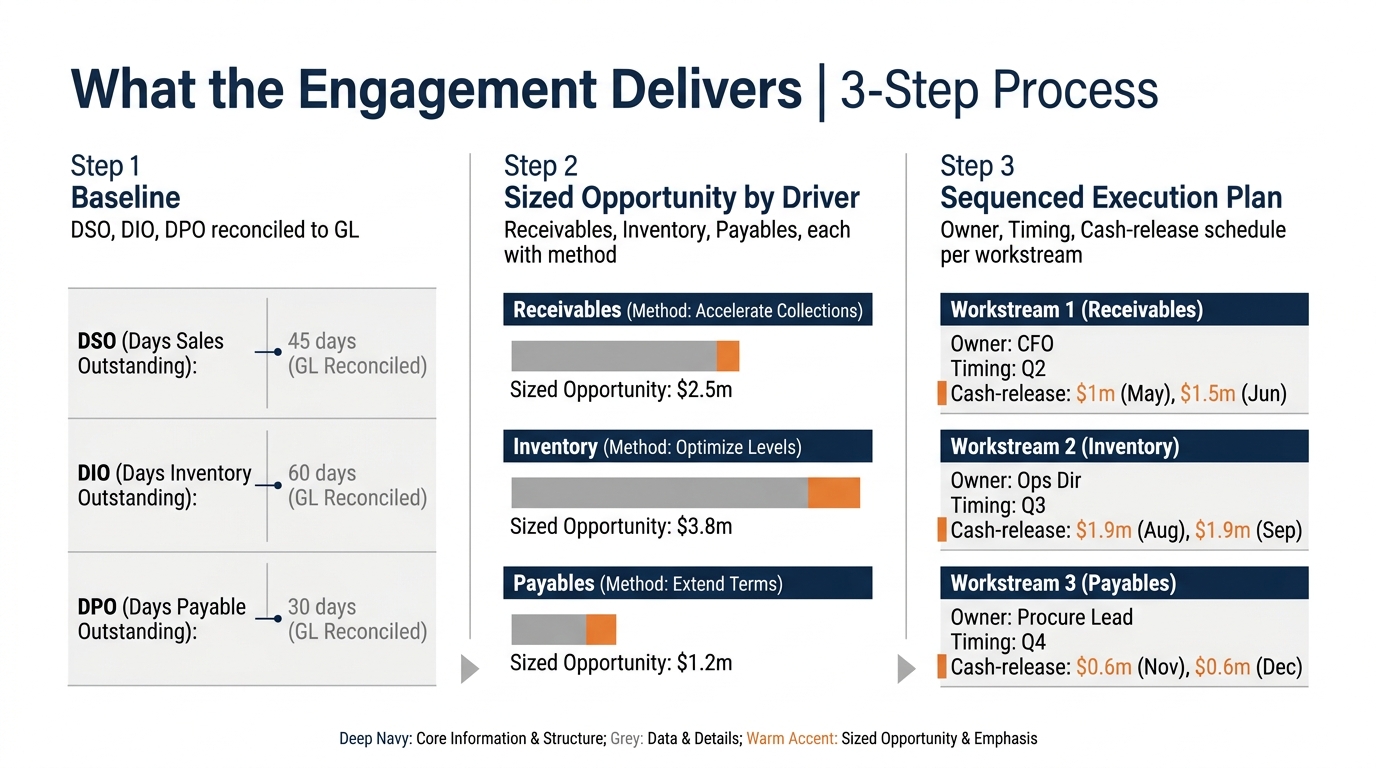
A credible engagement produces three things, in order, and you should be able to see each one before you pay for the next.
A baseline you can defend
The first deliverable is a measured current state: days sales outstanding, days inventory outstanding, and days payable outstanding, computed from the actual transactional data in the ERP and reconciled to the general ledger, not to a management summary. If the firm cannot pull subledger detail and tie it back to the trial balance, the baseline is an estimate, and you cannot measure improvement against an estimate.
A sized opportunity by driver
The second is a quantified opportunity broken down by lever: how much cash is releasable from receivables through faster collections and tighter terms, how much from inventory through SKU rationalization and reorder discipline, and how much from payables through term renegotiation. Each number needs a method attached. "We think there's $4M in inventory" is not a finding. "SKUs below 2 turns per year hold $2.1M at standard cost, of which $1.3M is addressable in nine months without stocking out on A-items" is a finding.
A sequenced execution plan with owners
The third is a plan that names who does what, in what order, by when, and what each action is worth. This is where most consulting engagements stop short. A good one hands you an owner for each workstream and a cash-release schedule you can drop into the forecast. If the deliverable is a diagnostic with no execution path, you have a thorough analysis and no plan to act on it. The portfolio operations advisor your deal actually needs is the one who stays through the doing, not the one who leaves after the deck.
4. How to scope the engagement so you can judge it later
Scope the work in phases with a go/no-go between diagnosis and execution. The reason is practical: you want to see the sized opportunity before you commit to the implementation fee, and a firm confident in its findings will happily structure it that way.
A clean phase structure looks like this:
- Phase 1, diagnosis (2 to 4 weeks): data pull, baseline, sized opportunity, draft execution plan. Fixed fee.
- Phase 2, execution support (8 to 16 weeks): the consultant works alongside your controller, collections lead, and procurement to run the plan. Fee tied to milestones or to measured cash release.
- Phase 3, handover (defined end date): the discipline is embedded in your month-end close and the reporting cadence, and the consultant exits.
Insist on a defined end to Phase 3. A working capital engagement that never ends has stopped being optimization and become a dependency you are funding indefinitely. The goal is to leave your finance function running the cycle on its own.
5. Where a Portfolio Audit fits versus a full optimization project
For most lower-mid-market portfolio companies, the right first move is a scoped audit rather than a six-figure transformation program. A portfolio company audit in the $15K to $25K range gives you the baseline, the sized opportunity, and the sequenced plan, so you know what the prize is and whether it justifies a larger execution engagement.
This matters because the cost benchmark has moved. McKinsey's private capital research and the broader data from PitchBook both document how operational value creation has become the dominant return driver in a higher-rate environment, which has pushed sponsors toward faster, cheaper diagnostics that produce a decision rather than a long study. A working capital audit priced against current build costs should cost tens of thousands and deliver in weeks, not run for a quarter at six figures.
The audit answers the question you actually have right now: is there enough trapped cash here to justify an execution team, and where is it? If the sized opportunity is $400K on an $80M business, you handle it internally. If it is $4M, you fund the project.
6. The six questions that separate a real firm from a report mill
Ask these in the first conversation. The answers tell you more than any credentials page.
Can you pull and reconcile our transactional data yourself?
A firm that needs your team to extract and clean every dataset is going to charge you for its learning curve and move at your controller's pace. One that can connect to common ERPs and build the baseline from source data is doing the work you are paying for. This same capability shows up in technology due diligence, where the ability to read the systems directly separates a real assessment from a questionnaire.
How do you size inventory opportunity without starving the line?
Anyone can tell you to cut inventory. The hard part is cutting the right inventory without creating stockouts on the items that drive revenue. The answer should involve SKU-level turns analysis, service-level targets, and a distinction between obsolete stock and safety stock.
What is your method for payables, and does it respect supplier relationships?
Stretching payables unilaterally damages supply relationships and often costs you more in lost early-payment discounts and strained terms than it releases. A disciplined approach to procurement value creation negotiates terms against volume, on-time payment history, and reliable ordering patterns.
Who owns execution, your people or mine?
The honest answer is "yours, with our support." A firm that proposes to run your collections function in perpetuity is building a dependency. A firm that embeds the discipline and leaves is building your enterprise value.
How will you report progress to the board?
You need a cash-release number the sponsor can read in under a minute, tracked against the plan. If the firm has no view on how this rolls into board reporting a sponsor reads in under five minutes, it is thinking about the project and not about your governance.
What does a realistic timeline look like, and how do you classify the cash you release?
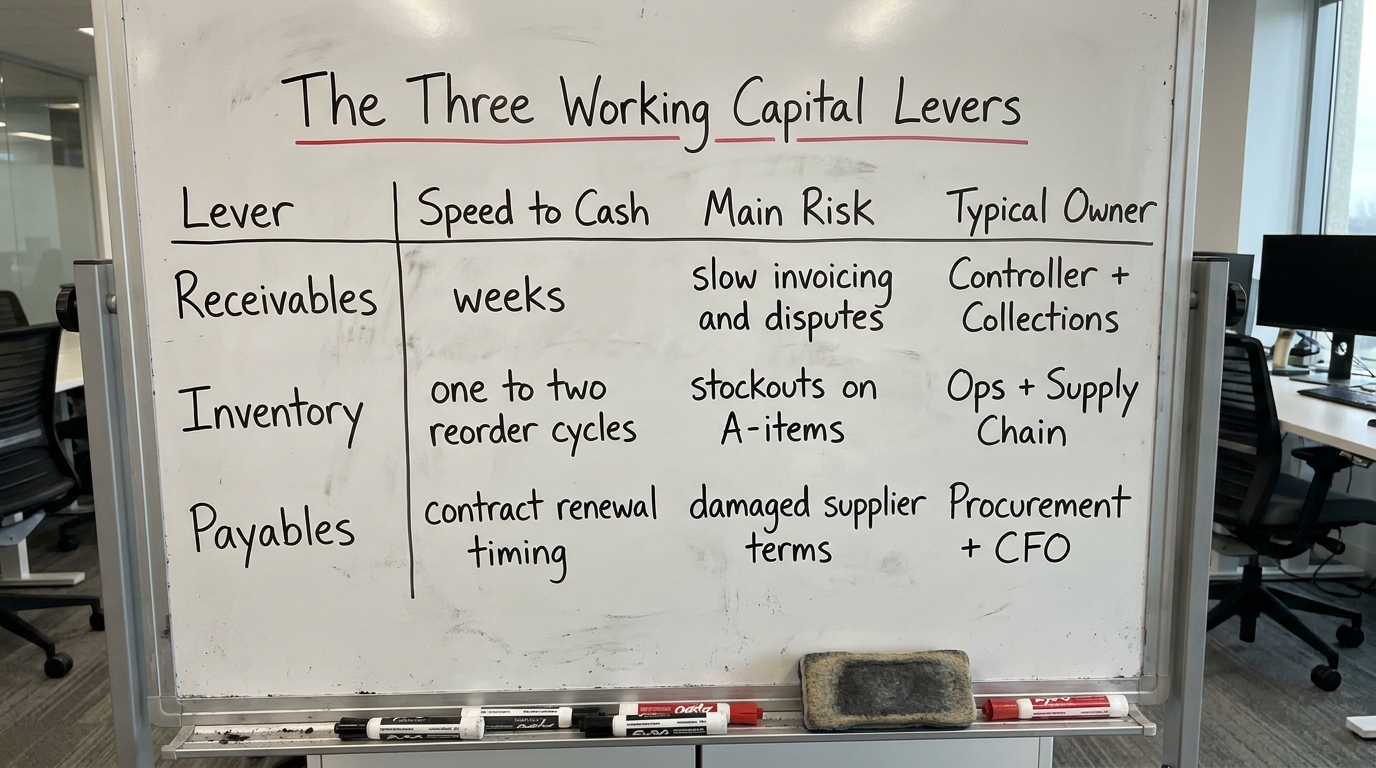
Receivables improvements land in weeks. Inventory takes a full reorder cycle or two. Payables depend on contract renewal dates. A firm that promises all of it in 30 days is telling you what you want to hear. A good one classifies each lever as realized, run-rate, or forecast, so you never report pipeline cash as money in the account.
7. The cash conversion cycle, lever by lever
Judge any plan against the three levers and the trade-offs each one carries.
Receivables
The fastest cash, usually. The work is unglamorous: a disciplined collections cadence, dispute resolution that actually closes, credit terms that match customer risk, and invoicing that goes out clean the first time. Most companies lose days here not to bad debt but to slow and inaccurate invoicing that gives customers a reason to delay.
Inventory
The largest pool in distribution, manufacturing, and anything with physical goods, and the one that most rewards rigor. The lever is matching stock to actual demand signal rather than to historical ordering habits, and the risk is cutting into the inventory that protects revenue. This is where a firm that understands the specific business model earns its fee, because the right answer for a distributor is not the right answer for a project-delivery firm.
Payables
The most relationship-sensitive. Real improvement comes from renegotiating terms as part of a broader procurement conversation, consolidating spend to earn better terms, and capturing early-payment discounts where the implied return beats your cost of capital. The Harvard Law School Forum on Corporate Governance has published extensively on how sponsors weigh these operational levers against covenant and governance constraints, which is worth reading before you let anyone stretch terms in a leveraged structure.
8. Common ways these engagements go wrong
Knowing the failure modes helps you write a sharper scope.
The audit with no execution path
You get a thorough diagnosis, a sized opportunity, and then nothing happens because nobody was assigned to act on it. The fix is to require named owners and a cash-release schedule as part of the baseline deliverable.
The SaaS template applied to a physical business
A firm that built its playbook on software companies will under-weight inventory and over-weight receivables metrics that barely move the cycle for a distributor. Ask what the firm has done in a business shaped like yours before you let it near your balance sheet.
The payables stretch that costs more than it saves
Pushing suppliers to net-90 looks great on the DPO line and quietly raises your input costs, loses your discounts, and damages reliability. A clean engagement models the all-in cost, not just the days.
The improvement that evaporates after handover
Cash releases, the consultant leaves, and six months later the cycle has crept back because the discipline was never embedded in the close process and the incentives. Working capital improvement that is not built into monthly reporting and management KPIs is a one-time event, not a structural gain. The same principle holds for the broader plan: a value-creation plan you refresh every quarter keeps the cycle honest in a way that an annual review never will.
9. How this connects to the first 100 days and the value-creation plan
Working capital is one of the few value levers you can pull in the first 100 days without needing a new strategy, new systems, or new hires. The data already exists, the levers are internal, and the cash lands fast. That makes it a natural early workstream in the first 100 days plan, where the sponsor is looking for proof that the operating thesis is real.
It also feeds the forecast reliability the CFO is judged on. When the cycle is understood and under control, the 13-week cash forecast tightens, covenant headroom becomes predictable, and the board stops asking why actuals keep diverging. The data visibility that makes this possible, the ability to see DSO, DIO, and DPO from source rather than from a spreadsheet someone maintains by hand, is the same foundation that a sound RevOps setup for a PE-backed company depends on. Finance and revenue are reading the same underlying data; if either runs on a disconnected spreadsheet, both are flying blind.
10. What good looks like in the numbers
You do not need a benchmark report to judge the result. You need three things to be true after the engagement.
- The cash conversion cycle has moved, and you can tie the movement to specific actions. If DSO dropped, you can point to the collections cadence and invoicing fix that caused it.
- The released cash shows up in the actuals. Realized cash is in the account or against the revolver. Forecast cash is a plan, and you report it as one.
- The discipline is running without the consultant. Month-end close reports the metrics, owners are tracking them, and the improvement holds a quarter after handover.
For context on how sponsors frame and measure these operational gains across their portfolios, the research from BCG's principal investors and private equity practice and the coverage in Private Equity International are both worth tracking. On the accounting discipline behind defensible baselines and the reconciliation standards your firm should meet, AICPA and CIMA publish the relevant guidance. And when the improvement needs to survive an exit, remember that a buyer's quality of earnings review and the diligence posture the SEC expects of registrants both reward cash improvements that are documented and repeatable rather than one-time working capital pulls dressed up as structural gains.
11. A checklist before you sign
Run the quote and the scope against this list. If a firm fails three or more, keep looking.
- The engagement is phased, with a go/no-go between diagnosis and execution.
- The baseline is reconciled to the general ledger, not to a management summary.
- Each sized opportunity has a method attached.
- The deliverable names owners and a cash-release schedule.
- The firm can pull your transactional data itself.
- Inventory work is SKU-level and respects service levels.
- Payables work models all-in cost.
- There is a defined handover and end date.
- Progress rolls into board reporting with a single cash number.
- Each lever is classified as realized, run-rate, or forecast.
- The price fits the prize: a diagnostic in the low tens of thousands, not a six-figure study, for a lower-mid-market company.
For the wider economics of what these engagements should cost and how the market is pricing operational work in the current rate environment, the data hubs at S&P Global Market Intelligence and Preqin are the sources I would check before accepting any firm's claim about what is standard.
12. The decision, stated plainly
Working capital optimization is one of the highest-return, lowest-risk moves available to a sponsor in the early part of a hold, and it is also one of the easiest to buy badly. The difference between a report mill and a firm worth its fee is whether you walk away with cash in the account and a discipline your finance team runs on its own, or with a well-formatted diagnosis that nobody acts on.
Scope it in phases, require a defensible baseline and named owners, fit the price to the prize, and insist on a clean exit. Do that, and the engagement pays for itself before the next covenant test. For how this sits inside the broader operating relationship with a sponsor, the way an operating partner works through the portfolio over a hold is covered in the private equity practice overview.
If you want a scoped working capital and operations audit that produces a defensible baseline, a sized opportunity by driver, and a sequenced execution plan with owners, in weeks rather than a quarter, see how the GrowthShuttle and DevriX Portfolio Audit works and request a scope for your portfolio company.


