The CRM you inherit after a private-equity close is usually two Salesforce instances merged with conflicting lead stages, duplicate opportunity records, and no instrumentation below the form-submit event. Before you forecast pipeline or present a weekly number to the board, you fix routing logic, deduplicate the contact base, and instrument event-level tracking. Skip any of those three and the pipeline figure you present in month two will be missing 20 to 30 percent of the actual activity. The revenue miss surfaces six months later.
This is the reality of RevOps for PE-backed companies at Day 1. The sponsor bought two businesses, IT merged the systems over a weekend, and the operating partner inherits a CRM that can receive a form but cannot tell you where the lead stalled, which rep should own it, or whether the same person submitted twice. The work is not strategic, and it is not visible to the board. It is the instrumentation layer that makes forecasting possible, and most portcos skip it because nobody explained the sequence.
What You Inherit: Two Instances, One Namespace, No Event Layer
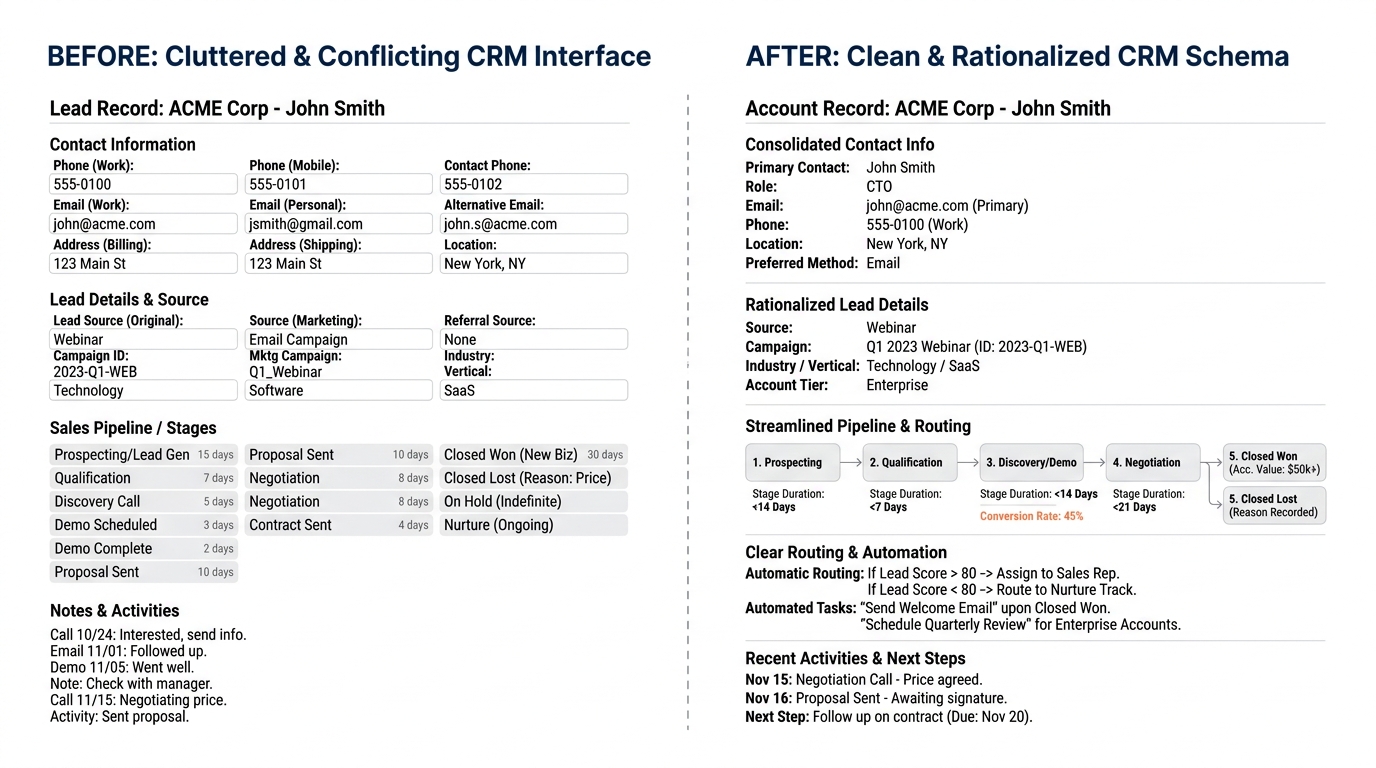
A typical mid-market acquisition closes with two Salesforce or HubSpot instances that ran independently for years. Company A tracked leads in a seven-stage funnel with custom fields for product interest. Company B used a four-stage model with region-based assignment rules. The IT handoff merges both into a single org, maps the stages to a new combined schema, and declares the system unified.
What actually happens is that the new schema preserves both old stage names as picklist values, routing rules fire in the wrong order because nobody documented the original logic, and duplicate contact records proliferate because the merge used email as the match key and ignored phone, company domain, and lead source. The result is a CRM that accepts inbound volume but cannot answer three operator questions: which rep owns this lead, is this contact already in the system, and where did this opportunity stall.
The event layer is worse. Most acquired companies instrument only the form-submit event, the moment a lead clicks the final CTA and fires a conversion tag. Nobody tracked form-start, field-level abandonment, or mid-funnel page visits, so the CRM shows you 1,000 form submissions but cannot tell you how many people opened the form and left, which fields caused drop-off, or whether a lead visited the pricing page three times before converting. You are flying on lagging indicators with no visibility into the behavior that predicts conversion, and the first time you discover the gap is when the pipeline number comes in 25 percent below forecast and nobody can explain why.
Fix One: Routing Logic, Documented and Tested
Lead routing is the first failure point because the merged CRM inherits two conflicting assignment rules that fire in sequence without coordination. Company A routed by region, Company B by product line, and the new system runs both rules in an order nobody documented. The outcome is that a lead from the Northeast interested in Product X gets assigned to the West region rep because the region rule fired first, and the product-based reassignment never triggered because the lead was already owned.
Fixing routing means auditing every assignment rule in the system, mapping the logic to a decision tree, and testing the outcome for every lead profile the business expects. That means a lead from each region, each product interest, each lead source, and each account size, submitted through the CRM and verified for correct ownership. The test matrix for a business with four regions, three products, and two lead sources is 24 test cases, and most portcos skip this step because it feels like IT work rather than revenue work. The cost shows up three months later when Sales complains that half the inbound leads are unassigned or routed to the wrong rep, and the VP of Sales presents a pipeline number that excludes every lead that fell through the gap.
Document the final routing tree in a shared wiki or process map that the RevOps team, Sales leadership, and IT all reference. Write down the routing logic so that a new operator or consultant can read and validate it without logging into Salesforce. When the next acquisition happens and a third instance merges in, the documented tree is the foundation you extend rather than reverse-engineering the system from scratch.
Fix Two: Deduplicate the Contact Base, Then Enforce Match Rules
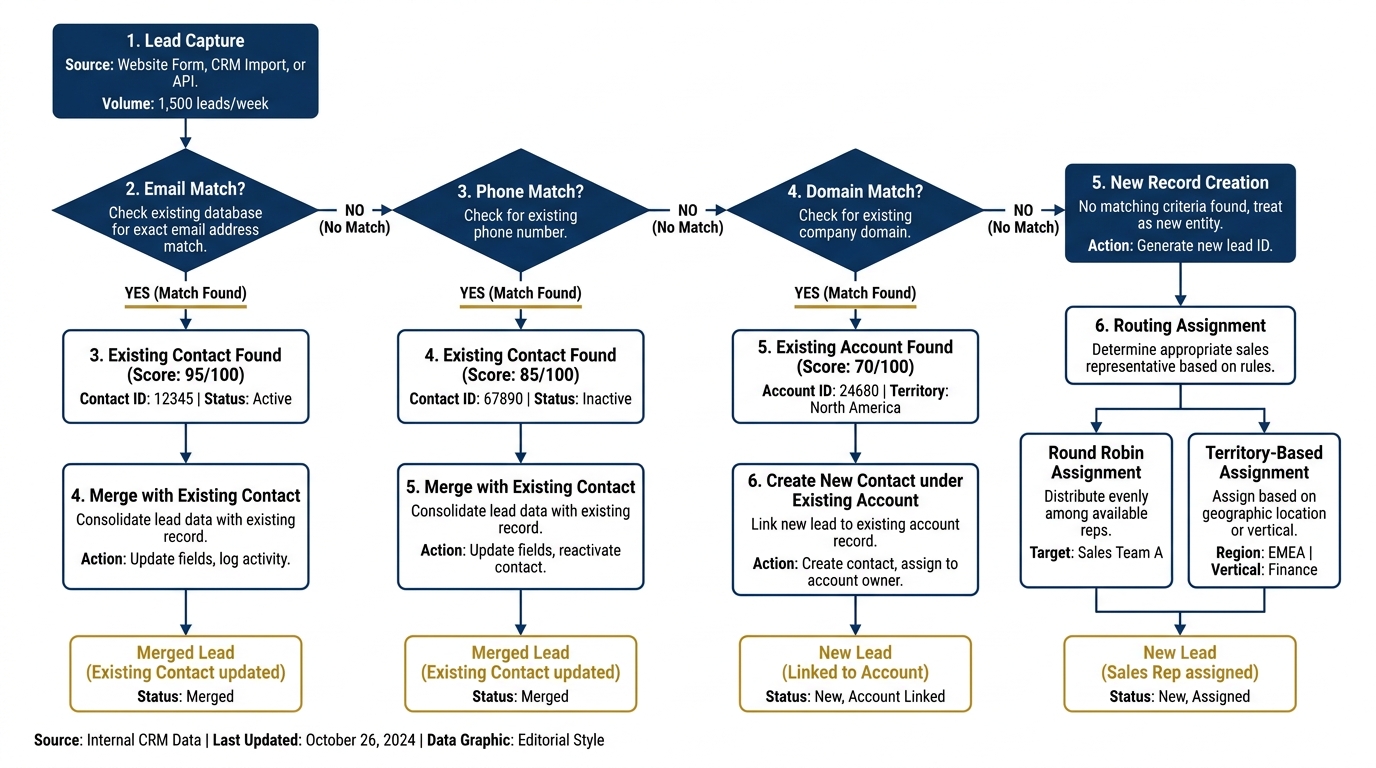
The merged CRM usually contains 15 to 25 percent duplicate contact records because the migration used a single match key, typically email address, and ignored every other identifier. A contact who changed jobs, updated their email, or submitted a form from a personal address creates a new record, and the system now tracks two or three versions of the same buyer with no parent linkage. Opportunity records split across the duplicates, activity history fragments, and the pipeline report undercounts because it sees three $50,000 opportunities instead of one $150,000 deal.
Deduplication starts with a multi-field match algorithm that scores contact similarity on email, phone, company domain, LinkedIn profile, and lead source. A tool like Clearbit, ZoomInfo, or a custom Python script running against the CRM export identifies candidate duplicates with a confidence score, and a human reviewer merges the records with the most complete activity history preserved as the master. The first pass typically surfaces 3,000 to 5,000 duplicate pairs in a CRM with 20,000 contacts, and the manual merge workload is about 40 hours for a RevOps analyst.
Enforcement is the step most portcos skip. After the initial dedupe, the CRM needs a real-time duplicate prevention rule that blocks new record creation when a match exists on any of the key fields. Salesforce and HubSpot both support duplicate rules, but the default configuration only checks email, and most administrators never enable the stricter logic because it requires custom field mapping and occasionally blocks a legitimate new contact. The result is that the CRM re-duplicates at a rate of 200 to 300 new duplicates per quarter, and within a year the contact base is back to the pre-dedupe state. Enforce the rule at form submission, lead import, and manual record creation, and accept the occasional false positive as the cost of a clean database.
Fix Three: Event-Level Instrumentation, Not Just Form Submits
The inherited CRM tracks form submissions, the final conversion event, and nothing upstream. You know a lead filled out the contact form, but you do not know whether they started the form and abandoned it, which field caused the drop-off, whether they visited the pricing page first, or how many sessions it took before they converted. The event layer is missing, and the consequence is that pipeline forecasting relies on lagging indicators with no predictive signal.
Event-level tracking means instrumenting every meaningful user action that predicts conversion: form start, field interaction, pricing page view, demo video play, case study download, and calculator interaction. Each event fires a tag to Google Analytics, HubSpot, or Segment, and the CRM ingests the event stream as custom activity records linked to the contact. The instrumentation workload is about 20 to 30 hours for a front-end developer and a marketing-ops analyst, and the payoff is that you can now identify high-intent behavior before the lead converts and route those contacts to Sales with context.
The reporting change is immediate. Instead of a pipeline report that shows 1,000 form submissions and a 15 percent close rate, you now see 3,500 form starts with a 28 percent completion rate, 1,200 pricing-page visitors with a 35 percent form-start rate, and 400 demo-video viewers with a 60 percent conversion rate. The funnel is suddenly visible, and the operating partner can answer the question every sponsor asks in month three: where is the conversion breaking, and what do we fix to move the number. Without event-level data, the only answer is to wait for more form submissions and hope the close rate improves, which is not a plan a PE firm will fund for long.
Implement event tracking with a tag-management layer like Google Tag Manager rather than hard-coding tags into the site, so that the marketing team can add or modify events without a developer. The flexibility matters because the high-intent signals you instrument in month one will change as the business learns which behaviors actually predict revenue, and a rigid implementation that requires engineering tickets for every tag update will bottleneck the iteration cycle. For more on balancing technical implementation with marketing agility, operators running content-driven funnels face the same trade-off between speed and control.
The Sequence: Why Routing, Dedupe, and Events Must Happen in Order
These three fixes run in sequence because each depends on the output of the prior step. Routing logic cannot assign leads correctly when duplicate contact records exist, because the system does not know which version of the contact to route to, and the assignment rule picks arbitrarily or fails. Deduplication cannot merge contact records accurately when routing is broken, because the merge decision depends on knowing which rep currently owns each version, and conflicting ownership blocks the merge. Event tracking cannot surface high-intent behavior when the contact base is duplicated, because the same person's activity splits across three records and no single contact accumulates enough event history to cross the intent threshold.
Run the sequence out of order and the downstream step either fails or produces incorrect output. Instrument events before fixing routing, and you will track form starts and pricing-page visits that route to the wrong rep or sit unassigned, which means the high-intent signal never reaches Sales. Deduplicate before documenting routing, and the merge process will consolidate contacts that should have routed differently, and you will lose the ability to test routing logic against historical lead behavior. The correct order is routing, dedupe, events, and the full cycle takes about 60 to 80 hours of RevOps and engineering time spread over four to six weeks. Most portcos try to run all three in parallel to save time, discover the dependencies halfway through, and restart the work after two months of wasted effort.
What This Looks Like in Practice: A $90M Portco Example
A sponsor acquired two B2B SaaS businesses in adjacent verticals, combined revenue of $90 million, and merged the Salesforce instances over a long weekend. The new VP of Revenue Operations inherited a CRM with 18,000 contacts, 4,200 open opportunities, and two sets of lead stages that both appeared in the Stage picklist. Routing rules assigned leads by region for one company's contacts and by product for the other's, with no documentation of execution order. The sponsor expected a weekly pipeline report starting in week two. The VP spent the first month reconstructing the routing logic from Salesforce logs and interviewing the sales teams from both legacy businesses.
The VP ran the three-fix sequence. Week one, she audited and documented the routing logic, identified six conflicts where leads could route to either of two reps depending on field order, and rebuilt the assignment rules with a single prioritized decision tree. Week two, a RevOps analyst exported the contact base, ran a multi-field duplicate detection script, and identified 3,200 candidate duplicate pairs. The VP spot-checked 50 pairs, confirmed 92 percent match accuracy, and merged the full set over three days. Week three, a front-end developer instrumented form-start events, pricing-page visits, and demo-request clicks, and the CRM began ingesting event-level activity.
By week four, the VP delivered the first accurate pipeline report, and the number was 22 percent lower than the preliminary figure from week two because the earlier count had included duplicate opportunities and unrouted leads that were never real pipeline. The sponsor was not happy with the lower number, but the VP walked through the methodology, showed the event-level data that explained where leads were dropping off, and proposed three changes to the form design and one to the pricing-page layout that historical event data suggested would improve conversion. The changes shipped in week six, form-start-to-submit conversion improved from 28 percent to 34 percent, and pipeline growth resumed. The sponsor funded a second portco integration using the same playbook.
Why Most Portcos Skip This Work
The three fixes are not strategic, they do not appear in the 100-day plan, and they do not generate revenue in the current quarter. Routing logic, deduplication, and event tracking are infrastructure, and infrastructure work is invisible to the board until it fails. The operating partner sees a list of value-creation priorities, CRM instrumentation is not on it, and the pressure to show pipeline growth in month two means the team skips the foundational work and starts running campaigns on a broken system.
The failure mode is predictable. Marketing generates inbound volume, Sales complains that leads are unrouted or duplicated, the pipeline number fluctuates by 30 percent week to week because duplicate opportunities appear and disappear, and nobody can explain why high-intent leads are not converting because the CRM does not track the behavior that predicts intent. The sponsor loses confidence in the forecast, the operating partner replaces the VP of Revenue Operations, and the new VP starts the instrumentation work that should have happened in month one. The delay costs six months of runway and about $200,000 in wasted marketing spend targeting a funnel the team could not measure. Companies committed to scalable demand generation recognize that campaign performance depends entirely on the reliability of the underlying instrumentation.
Getting Started: The Week-One Checklist
An operating partner walking into a newly closed portco can validate CRM readiness in the first week with a short checklist. Export the contact base and run a duplicate detection script, spot-check 20 pairs, and if more than 10 percent are true duplicates, deduplication is the first priority. Submit a test lead through every form on the site and verify correct routing, if any lead routes incorrectly or sits unassigned, routing logic is broken. Check Google Analytics or the CRM activity log for form-start events and pricing-page-view events, if those events do not exist, event tracking is missing.
The decision tree is simple. If routing is broken, fix routing first. If routing is correct but duplicates exceed 10 percent, deduplicate next. If both are clean, instrument event tracking. The full sequence takes four to six weeks, and the output is a CRM that can produce an accurate weekly pipeline number and surface the behavioral signals that predict conversion. That is the foundation every other RevOps initiative depends on, and it is the work that should happen before the first board meeting, not after the first revenue miss.
Conclusion
The CRM you inherit at close is a merged system with conflicting logic, duplicate records, and no event-level visibility. Before you forecast pipeline or present a growth plan, you fix routing, deduplicate the contact base, and instrument the behavior that predicts conversion. The sequence takes about 60 hours of RevOps and engineering time, and the payoff is a pipeline number you can trust and a forecast the board will fund. Skip the work, and the number you present in month two will be wrong by 20 to 30 percent, and you will spend the next six months explaining why the forecast missed and the leads did not convert.
Most portcos skip this step because instrumentation is not strategic and does not appear in the 100-day plan. The cost shows up later, in missed forecasts, wasted marketing spend, and a sponsor who loses confidence in the operating team. The alternative is to treat CRM instrumentation as the first value-creation priority, run the three-fix sequence in the first month, and deliver a pipeline report the board can use to make allocation decisions. That is how you turn a merged CRM into a revenue engine, and it is the work that separates a functioning RevOps function from one that is still trying to figure out why the numbers do not add up.
Need help auditing your CRM and building event-level tracking for a PE-backed portfolio company? DevriX's Demand Engine service builds the instrumentation layer that makes pipeline forecasting accurate, from routing logic and deduplication to event tracking and funnel analytics. We work with mid-market portcos that need a technical partner who understands both the RevOps stack and the PE value-creation timeline.
Common Objections and Why They Cost More Than the Fix
The most common pushback is that deduplication and event tracking can wait until after the first quarter, once the integration is settled and the team has time to focus on optimization. That logic fails because the first quarter is when the sponsor expects a credible pipeline forecast, and without clean data and event visibility, the forecast is built on guesswork. A portco that defers instrumentation to month four will present a Q2 forecast in month three that misses by 25 percent, and the miss will be attributed to weak execution rather than to the unmeasured funnel that produced the number.
The second objection is that the CRM vendor or the incumbent marketing agency should handle the technical work, and the operating team should focus on strategy. That delegation fails because agencies optimize for campaign volume and vendor support teams optimize for platform adoption, neither optimizes for the forecast accuracy a PE sponsor requires. The routing logic an agency builds will route leads to the wrong rep because the agency does not know the territory assignments, and the event schema a vendor recommends will track page views but not the pricing-page interaction that predicts a qualified opportunity. The work requires someone who understands both the CRM platform and the revenue model, and that person is rarely the vendor or the agency.
The third objection is cost. A full CRM audit and instrumentation build costs $15,000 to $25,000 in RevOps and engineering time, and portcos with tight budgets treat that as discretionary spend. Deferred instrumentation typically wastes $150,000 to $300,000 in marketing spend over six months, plus the opportunity cost of delayed pipeline visibility, which compounds across every downstream decision the operating team makes. Spending $20,000 in month one to avoid a $200,000 waste in month six is underwriting discipline.
What Good Looks Like: The Instrumented CRM Standard
A well-instrumented CRM produces three outputs that a newly closed portco should be able to deliver by day 90. First, a weekly pipeline report that segments open opportunities by stage, source, and expected close date, with conversion rates at each stage that are stable enough to forecast against. Second, a lead-to-opportunity conversion analysis that isolates the behavioral signals that predict qualification, such as pricing-page views, demo requests, and email engagement, so the marketing team knows which campaigns are producing qualified demand. Third, a forecast accuracy metric that tracks the variance between projected and actual closed revenue, so the operating partner can identify where the forecast model breaks and adjust it before the next board meeting.
Those three outputs depend on the same foundation: routing that assigns every lead correctly, deduplication that prevents double-counting, and event tracking that surfaces the interactions that matter. A portco that builds that foundation in the first 60 days will enter month three with a pipeline number the sponsor can use to allocate budget, and a forecast model that improves with every closed deal. A portco that skips the foundation will enter month six still trying to explain why the dashboard does not match the revenue actuals, and the sponsor will start looking for an operator who can deliver a number that holds up under scrutiny.
Implementation: The 60-Day Build Sequence
The work breaks into three phases that run sequentially over eight weeks, starting the week the deal closes. Phase one is data remediation, a two-week sprint that deduplicates the existing contact and company records, standardizes field formats, and flags incomplete or conflicting entries. A CRM with 40,000 contacts and 12 percent duplication will misroute 4,800 leads, and every misrouted lead creates a gap in the pipeline analysis that compounds downstream. The remediation team exports the full contact list, runs a matching algorithm that flags duplicates by email, domain, and name similarity, merges the matched records, and rebuilds the contact associations so every interaction ties to a single canonical record. This remediation is the precondition for accurate routing and attribution in the phases that follow.
Phase two is routing logic, a three-week build that maps every inbound channel to the correct rep, queue, or workflow. The logic accounts for territory assignments, product lines, deal size, and lead source, so a demo request from a mid-market prospect in the Northeast routes to the enterprise rep who owns that region, and a free-trial signup from a small business routes to the SMB team. The routing rules go into the CRM as automation workflows, with conditional branches that handle edge cases such as existing customers, partner referrals, and cross-sell opportunities. The team tests the logic by running historical leads through the updated rules and checking that the assignments match the intended distribution, then monitors the first two weeks of live routing to catch mismatches before they accumulate.
Phase three is event instrumentation, a three-week build that wires behavioral signals into the CRM so the operating team can see which interactions predict conversion. The instrumentation captures pricing-page views, product demo requests, feature clicks, PDF downloads, email opens, and webinar attendance, and writes each event as a timestamped record attached to the contact who triggered it. The event data feeds into lead scoring, so a contact who views the pricing page three times and downloads the product comparison guide scores higher than a contact who only opens the welcome email, and into attribution analysis, so the marketing team knows which campaigns drive the qualified leads that turn into closed revenue. The instrumentation requires front-end tracking code on the website, middleware that pushes the events to the CRM, and a schema that defines which events matter and how to store them.
The Operating Partner's Role: Specification, Not Execution
The operating partner does not build the instrumentation, but owns the specification that determines what gets built. That specification has four components. First, the revenue model, which defines the pipeline stages, the conversion thresholds at each stage, and the deal sizes that segment into different workflows. A portco with a two-tier product line and regional sales teams will need routing logic that handles both product and geography, while a portco with a single national sales team and a freemium model will need scoring rules that distinguish trial users from qualified buyers.
Second, the attribution framework, which names the touchpoints and channels the marketing team will measure. A sponsor that wants to track ROI by campaign will need event tracking that ties every closed deal back to the first-touch source and the sequence of interactions that followed, while a sponsor that only cares about aggregate pipeline growth can manage with lighter instrumentation that tracks lead source and conversion rate. The operating partner decides how much attribution granularity the sponsor requires, and the RevOps team builds the tracking to match.
Third, the forecast cadence, which sets the reporting rhythm and the accuracy standard the sponsor expects. A portco that reports pipeline weekly needs automation that updates the forecast every Monday, while a portco that reports monthly can batch the updates and run the forecast refresh mid-month. The cadence determines the latency the instrumentation can tolerate, because a weekly forecast that uses data from three weeks ago will miss the close-date shifts and stage changes that move the number.
Fourth, the deduplication and data-quality standard, which defines how clean the CRM needs to be before routing and attribution can run reliably. A sponsor that will accept a 5 percent error rate in the pipeline report can live with partial deduplication, while a sponsor that expects the forecast to hold within 10 percent needs full remediation before the instrumentation goes live. The operating partner sets the standard, and the RevOps team builds to it.
Where This Breaks: The Three Failure Modes
The first failure mode is deferral. The portco treats instrumentation as a month-six project, runs the first three quarters on legacy tracking, and discovers in month nine that the pipeline analysis cannot explain why revenue missed the forecast. By that point, the missing event data cannot be reconstructed, the routing errors have propagated across thousands of leads, and the operating team is rebuilding the foundation while trying to hit the year-two growth target. Deferral does not save time, it converts a controllable eight-week build into a twelve-month recovery.
The second failure mode is vendor dependence. The portco delegates the instrumentation to the CRM platform's professional services team or to the incumbent marketing agency, and receives a configuration that optimizes for platform adoption rather than forecast accuracy. The vendor builds a dashboard that tracks aggregate metrics such as total leads and overall conversion rate, but does not segment by source, stage, or behavioral signal, so the operating team cannot identify which campaigns produce qualified pipeline. The agency builds scoring rules that prioritize engagement over intent, so contacts who open emails and click links score higher than contacts who view pricing and request demos, and the sales team wastes time on warm leads that will never close.
The third failure mode is incomplete specification. The operating partner approves the instrumentation build without defining the revenue model, the attribution framework, or the forecast standard, and the RevOps team delivers technically correct work that does not answer the questions the sponsor will ask. The CRM tracks lead source but not the interaction sequence that predicts qualification, so the marketing team knows which channel delivered the lead but not which touchpoint moved it to opportunity. The routing logic assigns leads by geography but not by deal size, so enterprise prospects route to the SMB team and stall. The forecast updates monthly but does not flag the deals that slipped from one month to the next, so the operating partner cannot explain why the projected close date does not match the actuals.
All three failures trace to the same root cause, the assumption that instrumentation is a technical detail rather than a strategic input. The portco that treats CRM work as IT infrastructure will defer it, delegate it, or under-specify it, and will spend the next six quarters trying to forecast revenue from a system that was never built to produce a credible number. The portco that treats instrumentation as a Day-1 operating priority will finish the build by month three, and will enter the first board meeting with a pipeline report the sponsor can use to allocate capital and a forecast model that improves every quarter.


