You are three weeks past close on a lower-middle-market add-on, the integration plan is a slide and a spreadsheet, and the CFO cannot tell you whether the forecast is holding because the two companies run on different charts of accounts. You have budget to bring in outside help. The question is whether you need a staffed consulting engagement, a fractional operator, or something narrower that answers one commercial question fast. That decision is what a portfolio operations advisor for private equity is for, and getting it wrong costs you the first two quarters of the hold.
This guide is for the buyer with the budget and the decision right, not for someone learning the vocabulary. The commercial fit here is specific: a fixed-scope portfolio company audit in the $15,000 to $25,000 range that tells you where the enterprise-value risk sits, followed by an async operating advisor who stays close enough to keep the plan honest. Below is how to decide what you need and how to judge what you get.
1. Start with the decision, not the role
The title "operating partner" and the title "portfolio operations advisor" cover a wide span of work, and most of the confusion in the market comes from treating them as interchangeable. The useful question is not "do I want an advisor," it is "what decision am I trying to inform, and by when."
In the first hundred days the decision is usually about sequencing: which fix comes first, which workstream has an integration dependency that blocks the others, and which number in the model is least supported by evidence. Later in the hold the decision shifts toward margin and exit readiness. An advisor who is right for one is often wrong for the other, and the firms that market themselves as able to do all of it across the full hold are describing capacity, not fit.
Bain's annual Global Private Equity Report has tracked for years how much of the industry's return now has to come from operational improvement rather than multiple expansion and leverage. That shift is the whole reason this role exists, and it also sets the bar for judging it: the advisor has to connect to a number you can see move.
2. Separate the three things people call an operating advisor
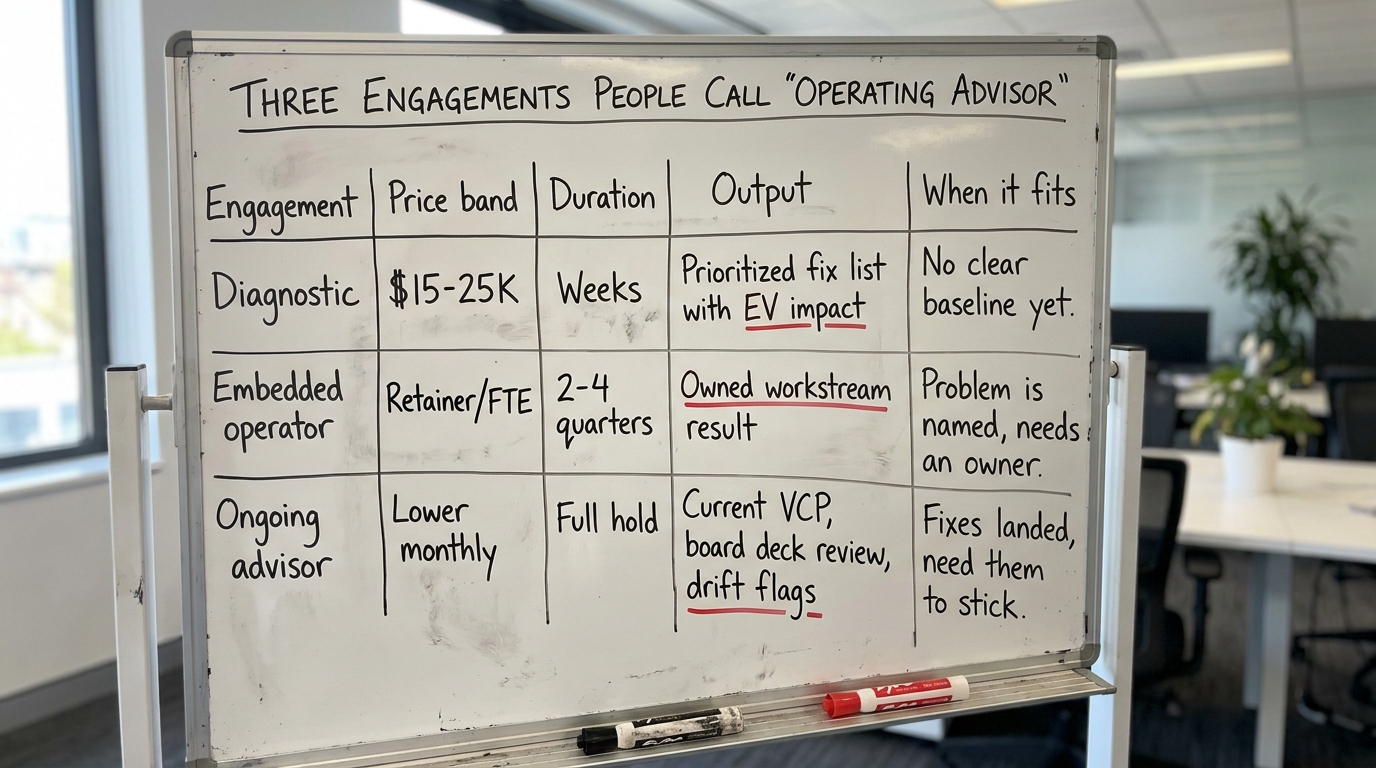
When a sponsor says they want an operating advisor, they usually mean one of three different engagements, and the price, the deliverable and the right person differ for each.
The diagnostic
A fixed-scope read of the business that produces a prioritized list of what to fix and what it is worth. This is the $15,000 to $25,000 band, it runs in weeks not quarters, and the output is a document a deal team can act on. If you do not have a clear baseline of where enterprise-value risk sits, this is almost always the right first spend. Our own portfolio company diagnostic that tells you what to fix first is built around exactly this sequencing problem.
The embedded operator
A person who takes a workstream and owns it, part-time or full-time, for a defined window. This is the right call when the diagnostic has already named the problem and you need someone accountable for closing it, not someone to study it again.
The ongoing advisor
A lighter, async relationship that keeps the value-creation plan current, reviews the board deck before it goes out, and flags drift between actual and plan before it reaches the quarterly meeting. This is cheaper than an embedded operator and more durable than a one-off diagnostic, and it is where most of the recurring value sits once the first fixes land.
The common mistake is buying the embedded operator when you needed the diagnostic, then discovering six weeks in that the person is solving the wrong problem well.
3. What a diagnostic should put on the table
A diagnostic earns its fee by narrowing your attention. The deliverable you should expect is a ranked list of findings where each one names the evidence behind it, the owner who would fix it, and a rough sense of whether the impact is realized, run-rate, forecast, or risk avoided. A finding with no owner and no number attached is an observation, and you are paying for decisions.
Watch for the audit that reads as a feature inventory of the business. Hours logged, tickets open, campaigns running and traffic trends are the vendor register. What you want is the translation into cash and EBITDA, because that is what the sponsor is actually underwriting. McKinsey's private capital research and BCG's work on principal investors and private equity both make the same point in different words: the value-creation work that holds up is the work tied to a measurable financial outcome.
If the diagnostic touches the technology stack, and in most mid-market deals it has to, it should connect to diligence risk rather than describe architecture for its own sake. That is the same discipline behind proper technology due diligence: the question is never how the system is built, it is what the build costs you in integration time and operating risk.
4. How to judge the advisor before you hire one
The strongest signal is whether the advisor can describe your business model back to you before the engagement starts. A distributor, a project-delivery firm and a multi-site clinic group have almost nothing in common operationally, and an advisor who brings a SaaS template to a distributor will spend your money learning what you already knew.
Ask for the shape of a past deliverable. You are looking for whether the output was a decision or a description. Ask who on their side actually does the work, because the partner who sells is frequently not the person who shows up on week two.
Ask how they handle the case where their finding contradicts the deal thesis. An advisor who only ever confirms what the deal team already believes adds comfort rather than evidence. The Harvard Law School Forum on Corporate Governance publishes a steady stream of work on board oversight and incentive design that is worth reading for how independent judgment is supposed to function inside a sponsored business.
5. Time the engagement to a real trigger
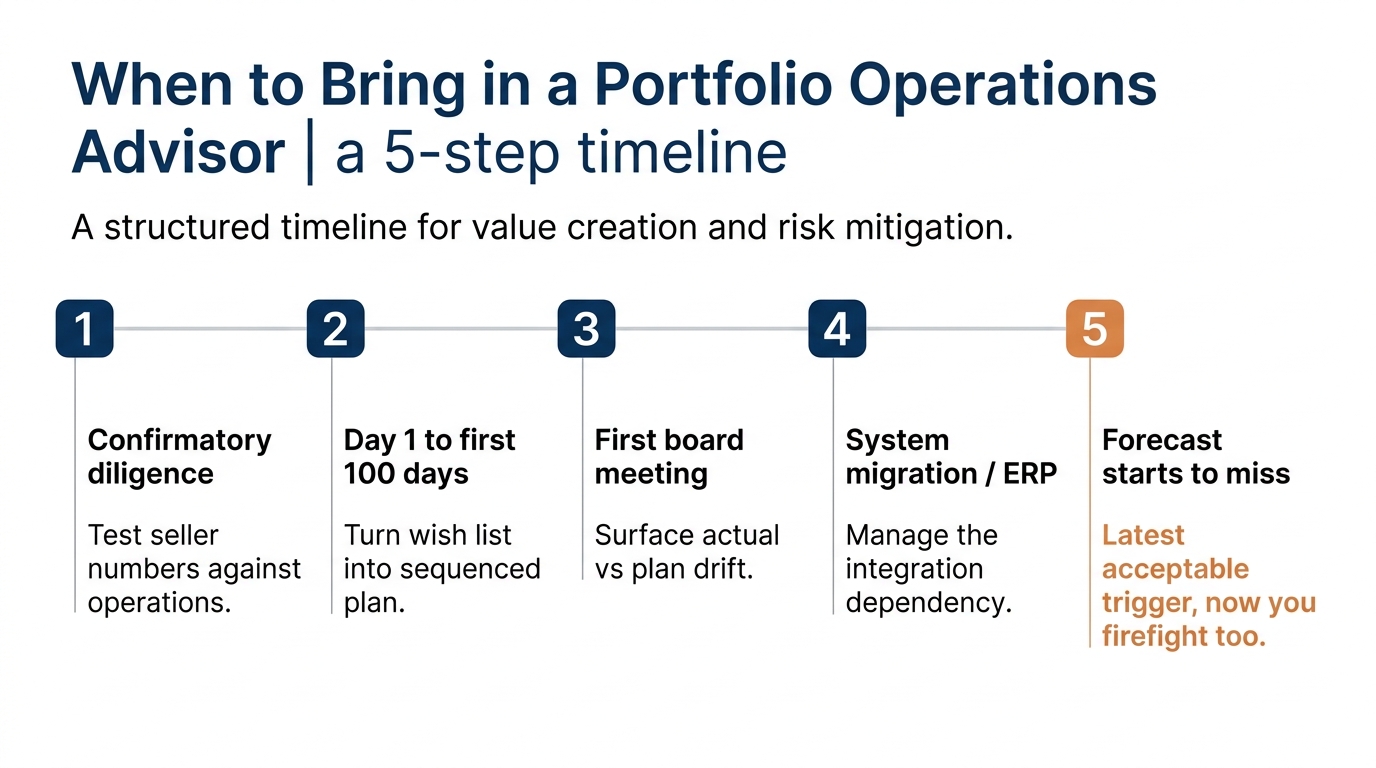
The reason to buy a diagnostic is rarely "we should probably look at this." It is a dated event that makes the question urgent, and matching the engagement to the trigger keeps the scope honest.
- Confirmatory diligence is where a focused operating read catches the gap between what the seller's numbers say and what the operation can actually sustain.
- Day 1 and the first hundred days is where sequencing matters most, and where a diagnostic turns a wish list into an ordered plan. Our view on structuring that window is in the first 100 days work.
- The first board meeting is when drift between actual and plan becomes visible to the sponsor, and when an advisor who has kept the plan current earns the relationship.
- A system migration or ERP consolidation is a hard integration dependency that quietly gates half the other workstreams, and it is usually underweighted in the model.
- A forecast that has started to miss is the latest a sponsor should wait, because by then you are diagnosing and firefighting at the same time.
The best engagements prevent the fire. The expensive ones fight it. PitchBook's research and data and S&P Global Market Intelligence both document how hold periods have stretched, which means the cost of a mistimed operating read compounds over more quarters than it used to.
6. The handoff from audit to ongoing advisor
A diagnostic that ends with a document and no follow-through is a report that no one reads twice. The commercial logic of this model is that the audit produces the plan and the async advisor keeps it alive, because the gap between a good plan and a realized number is almost entirely about whether anyone maintains it.
This is the problem we have written about directly in the value-creation plan nobody reviews until the exit memo. A plan that sits untouched from close until exit becomes a historical artifact rather than a working document, and the sponsor discovers the drift at the worst possible moment.
The async advisor's job between board meetings is narrow and specific: keep the VCP current against actuals, review the board deck for anything that would surprise the sponsor, and raise the one or two risks that have moved since the last review. That cadence is cheaper than an embedded operator and far more useful than an annual re-audit.
7. Make the board reporting carry the work
The clearest test of whether an advisor is adding value is the board deck. If the sponsor can read it in five minutes and know what moved, what is at risk, and what decision is in front of them, the operating work underneath it is probably sound. If the deck is thirty slides of activity, the work underneath it probably is not.
We laid out the standard for this in board reporting for a PE portfolio company. The principle an advisor should enforce is that every number in the deck ties to the value-creation plan and is labeled honestly as realized, run-rate or forecast. The AICPA and CIMA's guidance on financial reporting is a reasonable anchor for what defensible numbers look like when the deck has to survive scrutiny.
8. What good looks like on the operating metrics
Below the financial statements, an advisor should be able to show you the operating metrics that lead the financials rather than lag them. For a services or support-heavy business, that often means the throughput and quality measures that predict churn and margin before they show up in revenue. Our piece on the best help desk metrics for team productivity is a concrete example of the leading-indicator discipline, even though the specific metrics vary by business model.
For a people-heavy business, the advisor should be honest about where the organizational risk sits, which is usually not where the org chart suggests. The common failures in reading that risk are catalogued in our look at 360-degree feedback mistakes SMEs make, and a careless read of team capability is one of the faster ways to break delivery during integration.
9. Cost work without breaking delivery
Margin is where sponsors expect the advisor to earn out, and it is also where the most damage gets done. A spend cut that looks clean in the model and quietly removes the capacity the business needs to deliver is a false economy that shows up two quarters later as missed revenue.
The discipline here is to separate structural cost from the cost that funds delivery, and to classify every proposed cut by what it actually does to run-rate. We go deeper on this in how to hire a cost optimization consultant without buying a spend cut that breaks delivery and in how to judge a margin expansion consultant.
Technology spend is a specific case worth isolating, because it is both an easy line to cut and an easy one to cut wrong. Our view on getting that balance right is in IT cost optimization in private equity, and the short version is that the cuts that stick are the ones tied to a measured reduction in operating risk rather than a round-number target.
10. How this differs from a staffed consulting engagement
A large consulting firm can field a team across every workstream at once, and for the right deal that breadth is worth the price. For a lower-middle-market portfolio company it frequently is not, because the cost structure assumes a problem larger than the one you have, and the people doing the work are often junior to the problem.
The model this guide describes is the opposite trade: a narrow, senior, fixed-scope read that costs tens of thousands rather than hundreds, moves in weeks, and hands off to a durable async relationship. Harvard Business Review's coverage of mergers and acquisitions and the deal reporting in PE Hub both reflect how much mid-market value creation now runs through smaller, faster operating interventions rather than large transformation programs.
If you are weighing the broader category of firms that do this, our guide to how to choose an operational value creation firm for a portfolio company sets out the selection criteria in more detail than fits here.
11. A checklist before you commit the budget
Run through this before you sign anything. If more than a couple of answers are weak, you are buying the wrong engagement or buying it from the wrong firm.
- Can the advisor describe your business model back to you accurately before any access is granted?
- Is the deliverable a ranked set of decisions with owners and EV impact, or a description of the business?
- Is each finding classified honestly as realized, run-rate, forecast or risk avoided?
- Is the engagement timed to a real trigger: diligence, Day 1, a board meeting, a migration, or a slipping forecast?
- Is there a defined handoff from the diagnostic to someone who keeps the plan current?
- Does the person who sold the work also do the work?
- Will the output make your board deck shorter and clearer?
- Does any proposed cost cut separate structural cost from the cost that funds delivery?
- Is the price in the AI-era band, tens of thousands for the entry read, rather than a six-figure time-and-materials project that runs for quarters?
- Does the advisor tell you when a finding contradicts the deal thesis?
12. Where this fits in the hold
The sequence that works for most lower-middle-market deals is simple to state and harder to execute. Buy the fixed-scope diagnostic early, tied to Day 1 or confirmatory diligence, so you have a baseline and an ordered plan instead of a slide. Act on the top findings with whoever owns each one. Then keep a light async advisor in place to maintain the value-creation plan, review the board deck, and flag drift before the sponsor sees it. That is the full arc of a portfolio operations advisor for private equity done well, and each step is cheap relative to the quarter of hold it protects.
The research hubs worth keeping in your own reading, beyond the ones linked above, include Preqin for alternative-assets data, Private Equity International and Buyouts for deal and firm coverage, and the SEC for the regulatory backdrop that increasingly shapes how sponsors report value creation. None of them replace an operating read of your specific business, but they set the context for what good looks like across the market.
13. The next step
If you have a portfolio company where the baseline is unclear and a trigger is already on the calendar, the smallest useful move is the fixed-scope audit that tells you what to fix first and what it is worth, before you commit to anything larger. You can see how we structure that engagement and the operating advisory that follows it on the private equity practice page.


