You are three weeks past close, the hundred-day plan on paper assumes the management team can execute six workstreams at once, and the first board meeting is on the calendar. The company runs, revenue is roughly on plan, and yet nobody on your side can tell you which three things, fixed in the next two quarters, actually move EBITDA or de-risk the exit. That gap is what a portfolio company diagnostic in private equity is supposed to close, and most of the ones commissioned at this stage produce a long list instead of a ranked decision.
This is a framework for running that diagnostic so it returns something you can act on: a short ordered set of interventions, each tied to a financial consequence, each with an owner and a cost. It is written for an operating partner or a portfolio company CEO with budget and a mandate, not for someone learning what a value creation plan is.
1. Why most portfolio company diagnostics fail to inform a decision
The common failure is that the diagnostic describes the business instead of ranking what to change. A thorough team maps the org chart, inventories the systems, interviews the leadership, and hands back a 60-page report where everything is amber. That document is accurate and nearly useless, because it does not tell the operating partner where the next euro of effort returns the most enterprise value.
A diagnostic that informs a decision does three things the descriptive version does not. It establishes a baseline you can measure later, it attaches a financial magnitude to each finding, and it forces a ranking so the first board meeting debates two or three bets rather than forty observations.
Bain's annual private equity report has tracked for years how much of the industry's return now depends on operational improvement rather than multiple expansion or leverage, which is exactly the work a diagnostic is meant to scope. You can follow that thread in the Bain & Company Global Private Equity Report. The implication for the diagnostic is direct: if operating improvement carries the return, the diagnostic that scopes it has to be good enough to bet on.
The decision the diagnostic informs is not "is this a good company." You already decided that at the letter of intent. The decision is "of everything we could do in the first year, what goes first, what waits, and what we do not touch."
2. The four tiers the diagnostic has to separate
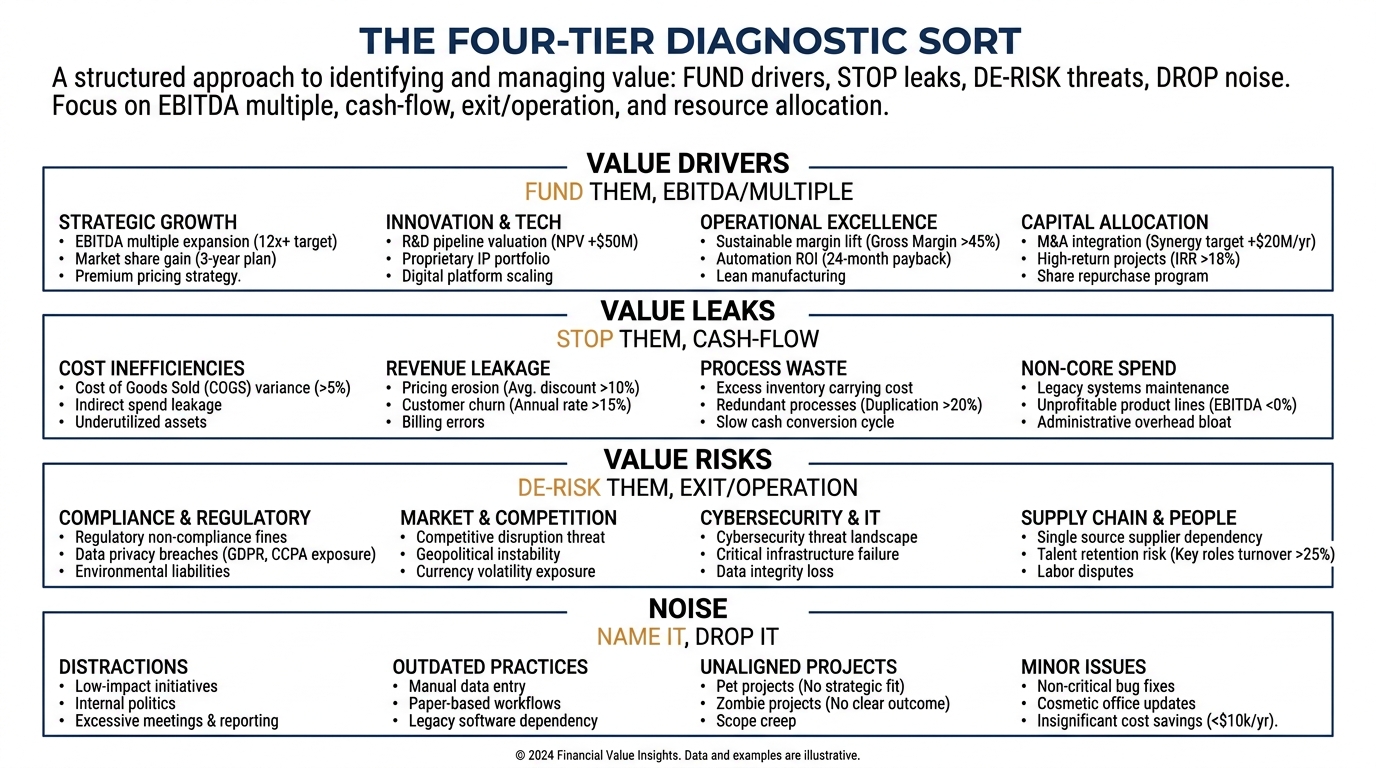
Every finding a diagnostic surfaces belongs in one of four tiers, and the value of the exercise comes from sorting findings into them rather than listing them flat. I use four: value drivers, value leaks, value risks, and noise. The point of the tiers is that they carry different decision rights and different urgency.
Value drivers are the few changes that expand EBITDA or the exit multiple if you fund them. Pricing discipline, a sales motion that is not yet built, a product line with margin the current team has never pushed. These justify investment and usually belong on the hundred-day plan.
Value leaks are recurring losses you can stop without a growth bet. Overlapping software contracts, a help desk absorbing volume a knowledge base would deflect, a discounting pattern nobody authorized. These are cash-flow improvements, often fast, often cheap.
Value risks are the conditions that could cost you at exit or in operation: a single key-person dependency in engineering, a customer concentration nobody flagged, a data estate a buyer's technical diligence will mark down. These rarely show up in the current month's numbers, which is why they get missed.
Noise is everything real but immaterial. A dated intranet, a disliked expense tool, a process that annoys people but costs nothing measurable. Naming it noise is a service, because it removes it from the board conversation.
3. Set the baseline before you judge anything
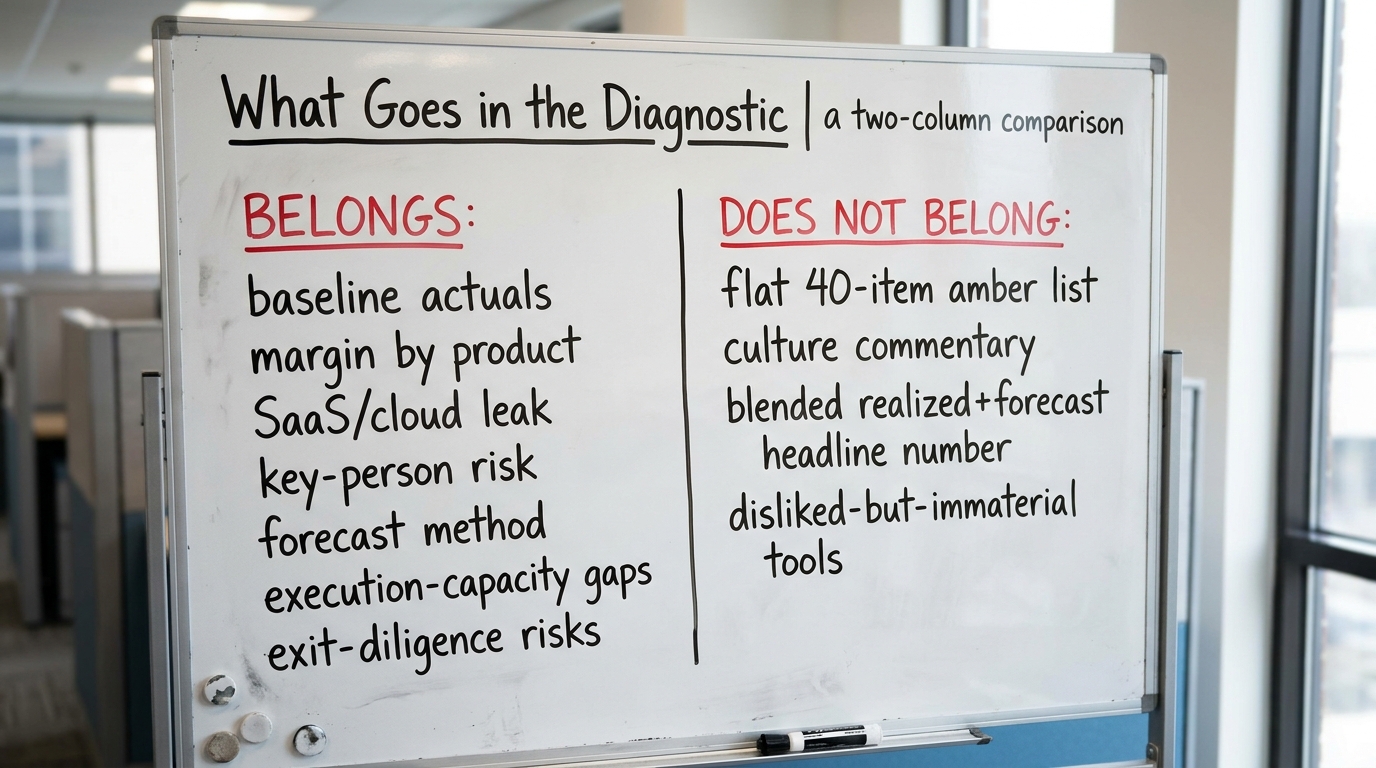
You cannot rank interventions against a company you have not measured. Before the diagnostic forms an opinion, it has to pin down the actuals: revenue by segment and by cohort, gross margin by product line, the real cost of the technology estate, the delivery or utilization numbers if this is a services business, and the forecast the prior owner handed you with its assumptions exposed.
The baseline matters most because every claim the diagnostic later makes about improvement will be measured against it. If you cannot state where delivery utilization sits today, you cannot prove you moved it in two quarters, and the board will not credit you for a number you cannot defend.
This is also where forecast reliability gets tested. McKinsey's private capital research has repeatedly made the point that the quality of a portfolio company's management reporting predicts how well the value creation plan survives contact with reality; you can browse that material through McKinsey's private capital research. A company that cannot produce a clean margin-by-product view is already telling you something about its reporting, and that finding belongs in the diagnostic.
4. How to attach a number to each finding
A finding without a magnitude cannot be ranked. "Pricing is undisciplined" is an observation; "undisciplined pricing is costing roughly 180 to 240 basis points of gross margin, worth about €600K to €800K a year at current volume" is a finding you can sequence against others.
The magnitude does not have to be precise. It has to be defensible and labeled. I classify each number by what it represents, because an operating partner needs to know the difference between money already being lost and money a future initiative might create.
- Realized today: a loss happening every month now, so stopping it improves cash flow immediately.
- Run-rate: the annualized effect once a change is fully in place.
- Forecast: an improvement that depends on an initiative working as planned, so it carries execution risk.
- Risk avoided: a loss that has not happened but would hurt at exit or under stress.
Keeping these separate stops the diagnostic from presenting a hopeful forecast as money in the bank. When a report sums realized savings and speculative growth into one headline number, it has stopped being useful for decisions. BCG's work on principal investors covers how value creation plans get built and where they slip; it is worth reviewing through BCG's principal investors and private equity practice if you want the broader shape of how firms structure these plans.
5. Where the technology estate hides both leaks and risks
In a lot of mid-market businesses the technology estate is the single area the deal team understood least during confirmatory diligence, which makes it where a diagnostic earns its fee. The software stack, the data, the engineering dependency, and the customer-facing systems all carry findings that rarely appear in a monthly P&L but show up sharply at exit.
On the leak side, overlapping SaaS contracts and unmanaged cloud spend are common and often immediate. We have written about where that money sits in IT cost optimization in private equity, and it tends to be the fastest cash-flow improvement a diagnostic can name because it requires no growth and no customer involvement.
On the risk side, the questions are harder and more valuable. Is there a key-person dependency in the codebase. Will the data estate survive a buyer's technology due diligence at exit, or will it be marked down the way you may have marked down the asset you just bought. The diagnostic should treat the next buyer's diligence as a known future event and find the problems now, while you have years to fix them rather than weeks to disclose them.
Harvard Law School's Forum on Corporate Governance regularly publishes practitioner analysis on diligence and portfolio oversight that frames these as governance obligations, not just technical housekeeping; the Harvard Law School Forum on Corporate Governance is a reasonable place to calibrate how boards are expected to treat them.
6. Reading the revenue engine without taking the CEO's word for it
The revenue section of a diagnostic fails when it accepts the management narrative. The CEO tells you the sales team is strong and the pipeline is healthy, and a weak diagnostic writes that down. A useful one checks the claim against the baseline: win rates by segment, sales cycle length, the actual contribution of the top three reps, and whether the pipeline math supports the forecast or merely decorates it.
This is where the line between a value driver and noise gets drawn carefully. A genuinely under-built sales motion is a value driver worth funding. A sales team that is fine but under-equipped is a different and cheaper problem. We have set out what the second one actually requires in what a sales enablement consultant should deliver inside a PE portfolio company, and the distinction changes what you fund and in what order.
Retail and consumer businesses add a forecasting dimension the diagnostic has to grade, because the forecast you inherited is only as good as the method behind it. Our retail sales forecasting guide covers the common ways SME forecasts mislead, and a diagnostic that leaves the forecast method unexamined has skipped the number everything else depends on.
7. The people findings that belong in the diagnostic and the ones that do not
Management assessment inside a diagnostic is legitimate when it bears on execution risk and overreaches when it drifts into culture commentary the board cannot act on. The question that belongs in the diagnostic is narrow: can this team execute the value drivers you are about to fund, and where are the gaps that put the plan at risk.
That question is about capability and capacity. A capable CFO who cannot produce margin-by-product reporting is a finding. A capable CEO with no one ready to run a workstream they are not personally driving is a finding, because it caps how many bets the company can carry at once.
Be careful with the instruments here. Feedback tools misapplied create noise that looks like signal, and we have catalogued the common errors in 7 360-degree feedback mistakes SMEs make. The diagnostic should use people findings to size execution risk against the plan, and leave the broader organizational development work to its own project with its own mandate.
8. Turning findings into a ranked hundred-day decision
The diagnostic's output is a ranking, and the ranking has a logic. Sequence by two axes: financial magnitude and execution cost, with risk timing as a tiebreaker. A large value leak that costs almost nothing to stop outranks a large value driver that needs six months and a hire, because the leak funds the driver.
The ranking also has to respect the company's real capacity. If the management assessment says the team can carry three workstreams without breaking delivery, the hundred-day plan gets three, not the eight the deal model would like. Loading more than the team can execute is how a good thesis dies in month four, which is the stage the first 100 days plan exists to prevent.
A workable output for the first board meeting is short:
- Do now: two or three leaks and one driver, each with an owner, a cost, and a measured baseline.
- Stage next: findings that depend on the first wave finishing or on a hire landing.
- Watch: value risks that are not urgent but must be fixed before you run the exit.
- Drop: the noise, named explicitly so it stops consuming attention.
9. An illustrative example of the framework applied
The following is an illustrative scenario, not a client outcome, and the numbers are chosen to show the method rather than to report a result.
Take a €40M-revenue B2B services business bought at close. The baseline pass finds gross margin at 48%, delivery utilization the company cannot cleanly report, and a technology estate running four overlapping project and CRM tools. The diagnostic sorts the findings.
Value leak, realized today: the four overlapping tools and some unmanaged cloud spend total roughly €220K a year, stoppable within a quarter with no customer impact. This is the first thing you do, because it needs no growth bet and funds the rest.
Value driver, forecast: pricing analysis shows the business discounts its strongest service line by habit, worth an estimated 200 basis points of margin, call it €600K run-rate, but capturing it requires a pricing discipline the sales team has never had. This is the main first-wave bet, with execution risk flagged.
Value risk, risk avoided: one engineer holds the integration logic no one else understands, and the delivery data lives in spreadsheets a buyer's diligence will question. Neither hurts this month's P&L; both would cost real multiple at exit. These go on the watch list with a fix scheduled well before a sale process.
Noise, dropped: an unpopular expense tool and a dated internal wiki, named and set aside so they stop appearing in board discussion.
The hundred-day decision writes itself from the sort: stop the €220K leak now, fund the pricing driver with a named owner, schedule the two risks before exit, and ignore the noise. That is a decision an operating partner can defend at the first board meeting, which is the whole point.
10. How to judge the diagnostic you commission
Since you are buying this work rather than doing it, the harder question is how to tell a diagnostic that will inform a decision from one that will produce a report. A few tests separate them before you sign.
Does it commit to a baseline. A provider who will not pin down current actuals cannot later prove improvement. If the proposal is all interviews and no numbers, it will hand you narrative.
Does it attach magnitudes and label them. Ask for a sample finding. If it reads "pricing is a concern" rather than "roughly €X at this confidence," the output will be ordered observations rather than a sequenced set of bets you can defend.
Does it rank, and will it defend the ranking. The deliverable you want is a sequenced short list with the logic shown. A provider who ranks is taking a position you can argue with, which is what you are paying for.
The same discipline applies when you judge the people who do the follow-on work. We have written separately on how to vet the specialists a diagnostic hands off to, in how to judge an EBITDA improvement consultant for a PE-backed business and in how to judge a margin expansion consultant before you give one a portfolio company. The through-line is the same: a provider who commits to baselines and magnitudes is one you can hold to account later.
If you are weighing a full operational partner rather than a scoped diagnostic, our guide to choosing an operational value creation firm for a portfolio company covers how that selection differs from commissioning a single piece of work.
11. When this diagnostic actually matters
The timing is not arbitrary. The highest-value window is the first weeks after close, before the hundred-day plan hardens and before the management team sets its own priorities by default. Run it then and the ranking shapes the plan; run it in month six and you are reordering work already in flight.
There are three other triggers worth naming. A forecast that has started missing is one, because the diagnostic finds whether the miss is a leak, a weak driver, or a reporting problem. An add-on acquisition is another, because integration dependencies and overlapping systems are exactly the findings the four-tier sort is built to catch. And the run-up to an exit is the last, when the value risks you could have fixed in two years become disclosures you manage in two weeks.
Industry data vendors track how deal pace and holding periods shift, which affects how long you have to act on what a diagnostic finds; PitchBook, Preqin, and S&P Global Market Intelligence all publish the market context that tells you whether your holding window is widening or compressing. A shorter window raises the premium on getting the ranking right the first time.
12. A short checklist before you commission
Use this to decide whether the diagnostic in front of you will return a decision or a document.
- It commits to a measured baseline of actuals, not just interviews.
- Every material finding carries a labeled magnitude: realized, run-rate, forecast, or risk avoided.
- Findings are sorted into drivers, leaks, risks, and noise, not listed flat.
- The output is a ranked hundred-day decision sized to the team's real capacity.
- The technology estate is examined for both immediate leaks and exit-diligence risk.
- People findings are scoped to execution risk against the plan, not culture commentary.
- Noise is named and dropped so it stops consuming board attention.
- The provider will defend its ranking and be measured against its baseline later.
Trade and practitioner publications are a useful external check on how firms structure this work and what good looks like across the market. Private Equity International, Buyouts, and Harvard Business Review's coverage of mergers and acquisitions each carry recurring analysis on portfolio operations and value creation that is worth reading alongside your own diagnostic output.
A diagnostic built this way does one job well: it turns a company you now own into a short, ordered, defensible list of what to fix first, each item tied to a number and an owner. That is what lets the first board meeting debate two or three bets instead of forty observations, and it is the difference between a value creation plan the team can execute and one the deal model wished for.
If you want this run on a specific portfolio company, our private equity team delivers the Portfolio Audit as a scoped engagement that returns the ranked hundred-day decision described here, with baselines and magnitudes you can defend at the board. Review the Portfolio Audit scope and request it for your asset.


