The sales enablement line item usually shows up on a value-creation plan a few weeks after close, right when the deal partner asks why the pipeline coverage in the model does not match what the CRM reports. Someone proposes hiring a sales enablement consultant for the private equity portfolio company, a number gets pencilled in, and the operating partner is left deciding whether this is a real EBITDA lever or a training expense dressed up as one. If you are the operating partner or the portfolio CEO holding that decision, this guide is about how to scope the work, what to demand from the engagement, and how to tell in the first 60 days whether it is moving revenue or just moving slides.
I am writing this for a buyer with budget who has already run a few of these engagements and been disappointed by at least one. The question is not what sales enablement is. The question is what it has to produce to justify the spend against your hold period.
1. Why the enablement question shows up right after close
In the first weeks after a deal signs, the commercial forecast that underwrote the price meets the systems that are supposed to deliver it, and the two rarely agree. Bain's annual private equity report has tracked for years how much of the modern return story rests on operational improvement rather than multiple expansion, which puts pressure on revenue functions that were run loosely under founder ownership. You can read Bain's ongoing work on this in its Global Private Equity Report.
Sales enablement gets nominated because it looks like the fastest way to lift win rates without adding headcount. Sometimes that is true. More often the real problem sits upstream in data, routing, and forecast discipline, and enablement content is treated as the fix for a pipeline that was never measured properly. Before you fund a sales enablement consultant private equity engagement, decide whether you are buying seller productivity or buying a repair to the revenue operating model, because those are different scopes with different owners.
The first 100 days are when this gets decided by default if you do not decide it on purpose. If the enablement workstream launches before anyone has baselined pipeline conversion by stage, it will optimize the wrong thing for a quarter.
2. Separate seller enablement from the revenue operating model
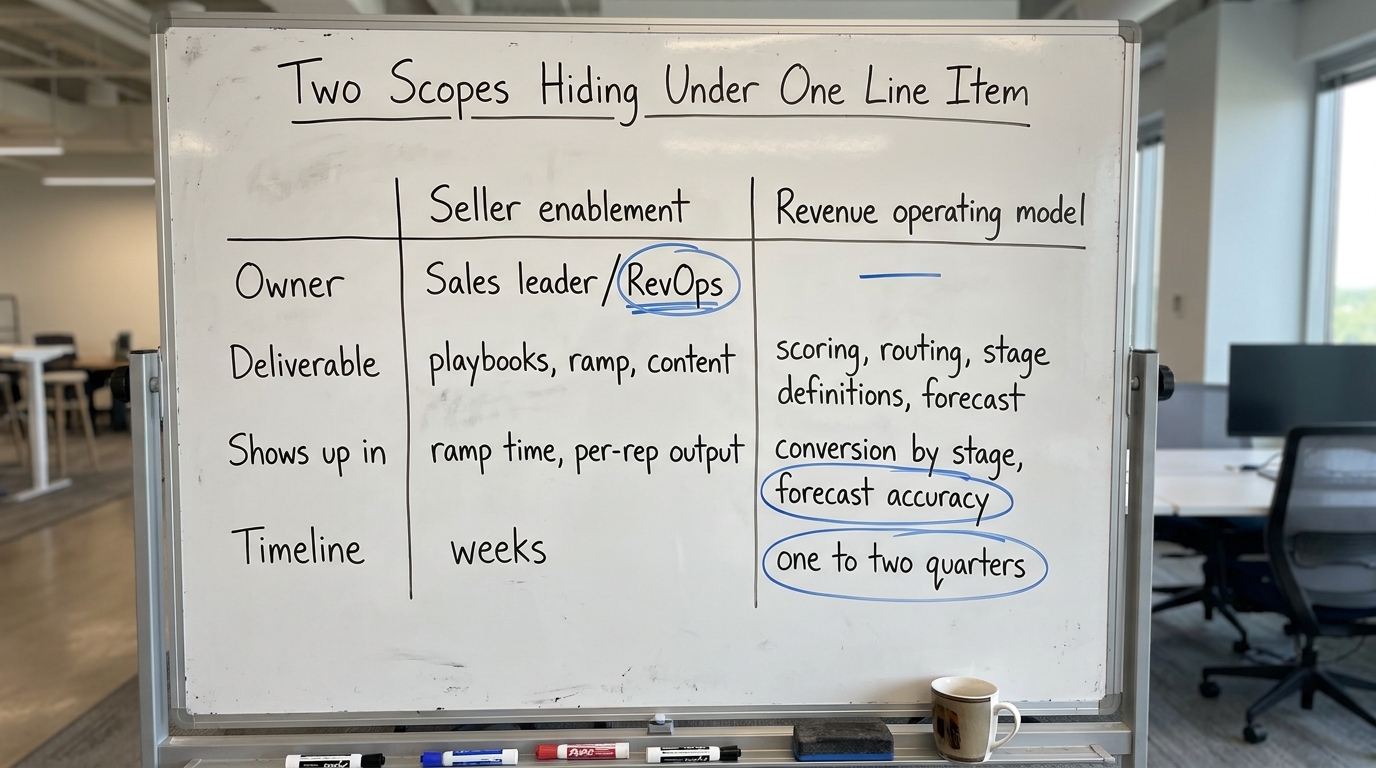
Enablement work splits into two categories that get confused in scoping conversations, and the confusion is expensive because they carry different owners and different timelines.
The first is seller-facing enablement: playbooks, call frameworks, objection handling, onboarding ramp for new reps, and the content library that supports a deal cycle. This lifts individual seller output and shows up in ramp time and per-rep productivity.
The second is the revenue operating model: how leads are scored and routed, how stages are defined, how the CRM enforces those definitions, and how the numbers roll up into a forecast the board can trust. This is closer to RevOps than to training, and it is usually where the return actually lives. We wrote about why that pipeline math breaks on a bad handoff in RevOps Consulting for PE-Backed Companies, and the same fault lines apply here.
A consultant who only offers the first without touching the second will produce polished materials that sit on top of a system nobody trusts. Insist on knowing which category you are funding, and if the answer is only category one, ask who owns category two, because the forecast reliability the CFO needs comes from there.
3. Anchor the engagement to a number in the model
A PE-backed buyer is purchasing a measurable movement in enterprise value, and enablement has to connect to one of a short list: revenue growth, EBITDA expansion, faster ramp that lets you hit the plan with fewer heads, or a more reliable forecast that protects the covenant conversation.
Before the engagement starts, write down which line in the value-creation plan this work is supposed to move, and by how much, over what period. If the consultant cannot help you draw that line, then you are funding activity with no clear return. McKinsey's private capital and commercial-excellence research is a useful external reference for how sponsors frame these levers, available through McKinsey's insights.
Classify the impact honestly. A shorter ramp for new reps is enabled value until the reps are actually hired and producing. A win-rate lift is forecast value until it shows up in closed-won. Do not let a slide that says "projected 4-point win-rate improvement" get reported to the board as if it were realized. That distinction is the difference between an operating partner who trusts the workstream and one who quietly writes it off.
4. Baseline before you buy anything
You cannot judge an enablement engagement without a baseline, and most portfolio companies do not have a clean one at close. The consultant's first deliverable should be a measured picture of the current state, with conversion rates by stage, ramp time for recent cohorts, win rates by segment and rep, forecast accuracy over the last three to four quarters, and the proportion of deals that skip stages or close without required fields populated.
What the baseline has to contain
- Conversion rate by pipeline stage, with the definitions each stage actually uses in the CRM today.
- Ramp time to full productivity for the last two cohorts of new sellers.
- Win rate by segment and by rep, so you can see whether the problem is the process or a few underperformers.
- Forecast accuracy over the last three to four quarters, actual versus what was called.
- The proportion of deals that skip stages or close without the required fields populated, which tells you how much the reported numbers can be trusted at all.
If the systems cannot produce these without a week of manual work, that itself is the finding, and it usually reroutes the engagement toward the operating model. This is the same discipline that operational due diligence consulting should deliver before you sign, carried into the hold period. Where possible, the enablement baseline should reuse whatever the technology due diligence already surfaced about the CRM and data quality, so you are not paying twice to learn the same thing.
5. Judge the consultant on their diagnostic, not their deck
The sales cycle in most vendor pitches runs on case studies and a methodology diagram. Those tell you very little about whether this person can move your number. What tells you is how they diagnose your specific engine before they have sold you anything.
Questions that separate operators from presenters
- Ask them to critique your current stage definitions after 30 minutes with your pipeline export. A real practitioner will find the fields that are unenforced and the stages that are actually the same stage.
- Ask what they would refuse to do. Someone who will build 40 playbook pages before the CRM data is trustworthy is optimizing the wrong layer.
- Ask how they measure their own impact and how they would hand the work back to your team. An engagement with no exit is a dependency, and dependency erodes the multiple you are building toward.
- Ask what they need from your systems on day one. Vague answers here predict a slow start.
The framing overlaps heavily with how we described hiring an EBITDA growth consultant for a PE-backed business: the person who leads with a diagnosis you can check is nearly always a better bet than the one who leads with a logo wall.
6. Decide the model: fractional, embedded, or project
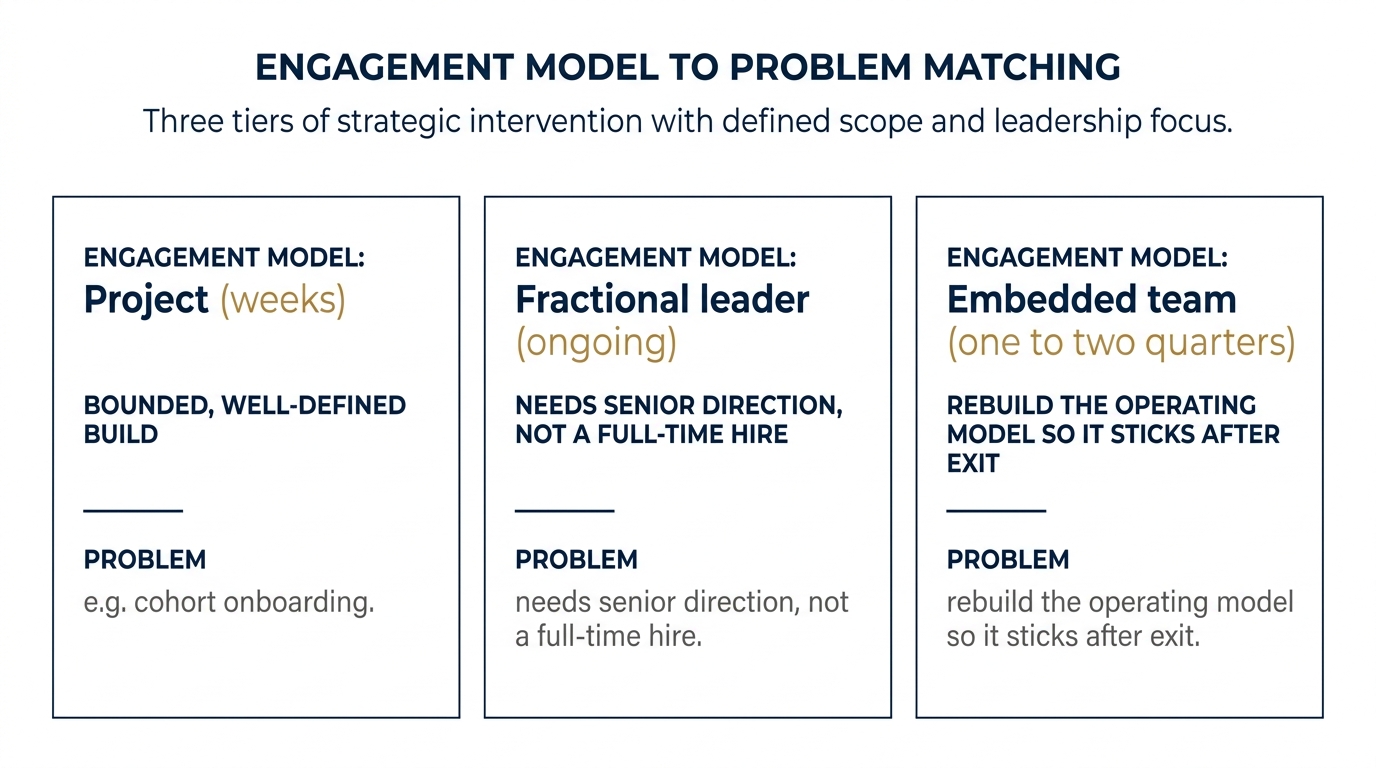
How you engage matters as much as who you engage. The three common shapes each fit a different situation, and picking the wrong one wastes a quarter.
A short project engagement fits when the problem is well defined and bounded, for example rebuilding onboarding for a specific rep cohort. A fractional leader fits when the portfolio company needs senior direction but not a full-time hire yet. An embedded team fits when the operating model itself needs rebuilding and the change has to stick after the consultant leaves.
We laid out where the line falls between a fractional leader and an embedded team in Fractional CMO vs Embedded Team for Portfolio Companies, and the reasoning transfers directly to sales enablement. The test is whether the work is a one-time build or a change to how the company operates. If it is the latter, a purely advisory engagement will not hold once the invoice stops.
7. Build the CRM and data foundation first
Enablement content sits on top of a data layer, and if that layer is unreliable, the content cannot be measured and the forecast cannot be trusted. Across a portfolio, this becomes a standardization decision that most sponsors underestimate.
Standardizing the CRM across several portfolio companies is a data question before it is a software question, which we argued in Portfolio-Wide HubSpot Standardization. The same holds at a single company. If two sales teams inside one business define "qualified" differently, no enablement program can produce a comparable win rate, and the roll-up the CFO sends to the board will be wrong in ways nobody can trace.
Sequence this before the seller-facing work. Get stage definitions enforced, get the required fields validated, and get the reporting to reconcile with the finance view. Only then does a playbook change produce a signal you can read. Bain and McKinsey both document the commercial-excellence gap in software and mid-market businesses; Bain's report notes that portfolio companies routinely leave monetization and go-to-market discipline on the table, which is exactly the gap a data-first enablement effort closes.
8. Set the reporting so the board and the operator see the same thing
The most common failure in an enablement engagement is not that the work is bad. It is that the numbers the consultant reports and the numbers the sponsor sees diverge, and by the second board meeting nobody trusts either. We covered why the sponsor pack and the operator's dashboard disagree in this piece on board reporting, and enablement metrics are a frequent source of that divergence.
Agree up front on the three or four metrics this engagement will be judged on, agree on their exact definitions, and agree on where they are pulled from. If ramp time is a metric, define "full productivity" in a way the CRM can measure without human interpretation. If win rate is a metric, define the denominator. This is unglamorous, and it is the difference between a workstream that survives to the next board meeting and one that gets defunded because the numbers moved around every time someone recalculated them.
The reporting problem is also a people problem. When the monthly pack takes six people and still ships wrong numbers, adding an enablement scoreboard on top makes it worse unless the underlying data is fixed first.
9. Time the work against the hold period, not the calendar year
An enablement investment that pays back in month 30 of a five-year hold is fine. One that pays back in month 30 of a hold you expect to exit in month 36 is close to worthless, because a buyer's diligence will not credit gains that have not yet shown up in the numbers.
Map the expected payback against where you are in the hold. Early in the hold, a full operating-model rebuild is defensible because there is time for the change to compound. Closer to exit, the priority shifts to demonstrable, already-realized improvements that a buyer's value acceleration team and quality-of-earnings review will accept. The AICPA and CIMA provide the professional framing that quality-of-earnings work tends to follow, published through the AICPA & CIMA, and it is worth remembering that a QoE credits realized and durable improvement, not projected uplift.
PitchBook and Preqin data on hold periods and exit timing, available through PitchBook and Preqin, are useful for sanity-checking whether your enablement payback window fits the realistic exit window for your fund's vintage.
10. Watch for the failure modes that predict a wasted engagement
A few patterns reliably precede a disappointing outcome, and you can spot most of them in the first weeks.
- The engagement leads with content production before any baseline exists. You will get a library nobody adopts.
- Adoption is not measured. If no one can tell you what percentage of reps actually use the new playbook in live deals, the program is decorative.
- The consultant reports activity, hours delivered, sessions run, pages written. Movement in conversion or ramp goes unreported. Activity is the vendor register, not the outcome.
- There is no handoff plan, so the knowledge leaves when the consultant does and you are buying the same engagement again next year.
- The work never touches the CRM, which means it cannot fix the forecast and cannot be measured against the model.
BCG and the Harvard Law School Forum on Corporate Governance both publish on operational value creation and governance in sponsored companies; BCG's principal investors practice is at BCG, and the governance forum is at the Harvard Law School Forum on Corporate Governance. Harvard Business Review's ongoing coverage of post-merger integration, collected under HBR's M&A topic, is a good external check on why integration-era revenue programs stall.
11. A short checklist before you sign
Run the proposed engagement against this list before the money moves. If more than a couple of these are unanswered, push the start date back until they are.
- The engagement is tied to a specific line in the value-creation plan, with a number and a period.
- A measured baseline is the first deliverable, before any content or training.
- The scope names whether it is seller enablement, operating-model repair, or both, and who owns each.
- The engagement model, project, fractional, or embedded, matches whether the work is a build or a lasting change.
- The CRM and data foundation is sequenced ahead of seller-facing content.
- Three or four judged metrics are defined precisely and reconcile with the finance view.
- The payback window fits your realistic hold and would survive a buyer's quality-of-earnings review.
- There is an explicit handoff plan so the capability stays after the consultant leaves.
- Adoption is measured.
For a wider view of how enablement fits alongside the other early commercial workstreams, our go-to-market timeline for the first 90 days puts the sequencing in context, and if the underlying revenue operating model is the real gap, that is a RevOps engagement rather than a training one.
12. Where this sits in the broader value-creation plan
Sales enablement is one input into commercial value creation, and it works only when the revenue operating model underneath it is sound. Treat it as a component of the wider private equity value plan rather than a standalone fix, and staff it against the specific gap your baseline reveals. If your reporting still relies on manual reconciliation, if stage definitions differ across teams, or if the forecast has missed for three quarters running, the enablement content is not your first problem, and buying it first will not help.
Public-market and transaction data from S&P Global Market Intelligence and disclosure guidance from the U.S. Securities and Exchange Commission are worth keeping close when the improvements you are claiming will eventually have to hold up in an exit process. The gains a consultant helps you produce are only worth what a buyer will credit at the other end.
If you want the revenue operating model fixed so that enablement, forecasting, and board reporting all read from the same numbers, a focused RevOps engagement is where to start. See how the DevriX and GrowthShuttle PE offer scopes that work against your value-creation plan.


