Most supplier carbon reporting fails for a simple reason: the data is not ready for reporting. If a key field drops below 80% completeness, reporting can stop. And even when fields are filled in, mismatched units, unclear scope boundaries, old factor versions, and weak ownership can make the numbers hard to compare or defend.
Here’s the short version: I’d treat this as a process problem, not just a supplier problem. The fix is to set one rulebook, ask for a short list of required fields, use one fallback order for estimates, and review data on a set schedule.
What matters most:
- Separate the gaps: missing, incomplete, and inconsistent data are different issues
- Set gating fields: if a blank field makes a record unusable, block it
- Standardize inputs: same units, same 12-month period, same scope rules
- Require source support: invoices, meter data, contracts, worksheets, and factor versions
- Use one estimate order: supplier data → hybrid → activity average → proxy → spend-based
- Track uncertainty: log the method, source, assumptions, and uncertainty band for each estimate
- Start with top suppliers: focus first on the 10–20 suppliers tied to the most emissions, spend, or reporting risk
- Assign owners: Finance, Procurement, Operations, and IT each need a named role
A few points stand out to me. First, blank data and bad data are not the same thing. Second, a lower reported footprint may come from a rule change, not an actual drop in emissions. Third, supplier carbon reporting gets better when it becomes part of normal finance and procurement reviews instead of a once-a-year scramble.
If I were reducing these gaps, I’d keep the goal simple: build a controlled reporting process that improves each cycle.
Set a Standard Rulebook Before Collecting More Data
The answer isn’t sending more supplier requests. It’s setting a tighter reporting standard first.
Put the minimum fields, definitions, and acceptance rules in place before the next request goes out. That standard becomes the baseline for every supplier submission and every fallback estimate.
Define the Minimum Data Fields to Request From Suppliers
Start lean. A short list of clearly defined required fields works better than a long form that suppliers complete in different ways.
For each purchased good or service, the minimum set should include:
- activity volume
- the reporting period
- a unique supplier and facility ID
- emissions by scope
- the calculation method used
- factor source and version
If leaving a field blank makes the whole record unusable for reporting, that field is a gating field. Treat it as a reporting blocker, not a small gap.
Once the required fields are locked in, the next job is making units, boundaries, and evidence line up.
Standardize Units, Boundaries, and Supporting Evidence
Set clear conventions from the start: use consistent units for activity data, require one 12-month reporting year, whether calendar or fiscal, and define boundaries and scopes for each record in plain terms.
Just stating the rule matters. If definitions are left open, suppliers will use different boundaries, different emissions factor versions, and different time windows. That makes reconciliation messy and slow.
The table below links each core reporting field to the evidence required, where submissions usually fall apart, and what to check before accepting the data.
| Reporting Field | Required Evidence | Typical Breakdowns | Validation Checks |
|---|---|---|---|
| Activity Volume | Invoices, utility bills, or meter readings | Unit mismatches; typos | Cross-reference against supplier invoices or billing records |
| Reporting Period | Date-stamped records or service contracts | Overlapping periods; fiscal vs. calendar year drift | Check for 12-month continuity without gaps |
| Supplier / Facility ID | Unique ID from ERP or internal master record | Duplicate records inflating totals; missing parent-child hierarchy | Run duplicate detection on names and addresses |
| Emissions by Scope | Calculation worksheets or third-party certifications | Double-counting across scopes; incorrect boundary definitions | Cross-field reconciliation; scope boundary audit |
| Calculation Method | Methodology document or software log | Inconsistent formulas; outdated emissions factors | Formula audit; version control check on factors |
| Factor Source and Version | Database name and version | Using outdated or geographically irrelevant factors | Verify factor source matches the activity region |
Once those rules are set, apply a fixed order for estimating the records that still come back blank.
sbb-itb-c53a83b
Use a Clear Estimation Order for Missing Emissions
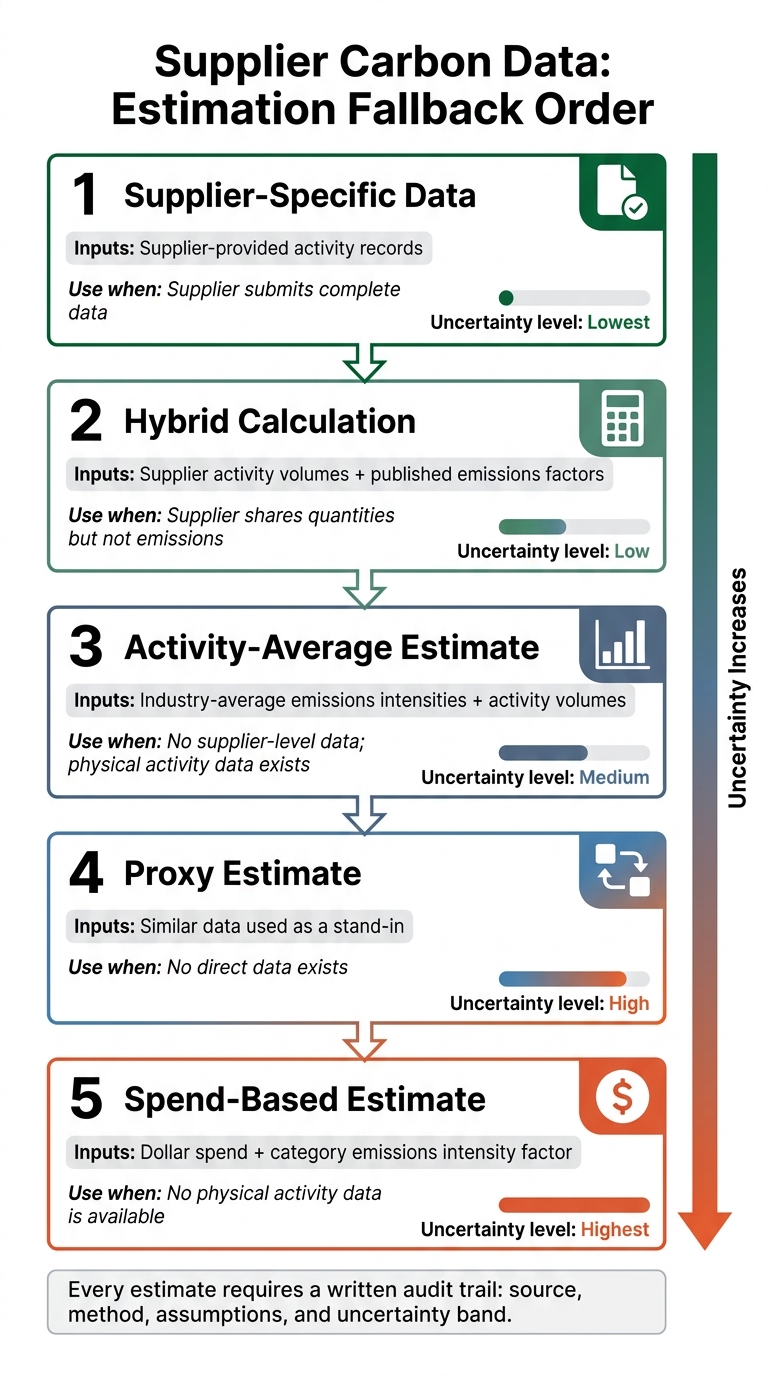
Supplier Carbon Data: 5-Step Estimation Fallback Order
When suppliers miss data, use a fixed fallback order. Ad hoc estimates make reporting messy and can wreck year-over-year comparisons. Stick with the same supplier IDs, reporting periods, units, and boundary rules set by the reporting standard.
As you move down the fallback order, uncertainty goes up. That’s why every estimate needs a written audit trail. And estimated figures should be reported separately from measured data.
Apply the Right Estimation Method in the Right Order
Use the fallback only after a record fails the minimum data test. Then work through the sequence based on the data you actually have. If one method can’t be used, move to the next one.
| Estimation Method | Inputs | Use When |
|---|---|---|
| Supplier-Specific Data | Supplier-provided activity records | Supplier submits complete data |
| Hybrid Calculation | Supplier activity volumes + published emissions factors | Supplier shares quantities but not emissions |
| Activity-Average Estimate | Industry-average emissions intensities + activity volumes | No supplier-level data; physical activity data exists |
| Proxy Estimate | Similar data used as a stand-in | No direct data exists |
| Spend-Based Estimate | Dollar spend + category emissions intensity factor | No physical activity data is available |
This order matters. It keeps your process consistent and helps stop teams from jumping straight to rougher methods just because they’re easier.
Record Assumptions and Uncertainty for Every Estimate
Every estimate needs a written audit trail. Without it, you can’t check the number later, update it when better data comes in, or explain it to a stakeholder who questions it. For each estimate, record:
- the source
- the method
- the assumptions
- the uncertainty band
That paper trail is what makes the estimate usable. It lets you trace the number, review it, and swap it out when supplier data gets better.
Improve Data Quality Through Process, Governance, and Supplier Follow-Up
Once you have a rule for estimating missing data, the next step is making sure those gaps don't keep showing up.
Start With High-Impact Suppliers and Categories
Start where the risk is highest. Focus remediation on the suppliers that drive most of your footprint and reporting risk. A supplier concentration review can help you rank the top 10–20 suppliers by emissions, spend, and reporting risk. From there, segment them by emissions materiality, spend volume, and current data quality.
If a high-spend, high-emissions supplier is missing data, that's not just a reporting headache. It's a business risk.
Track Progress With Recurring Reporting Cycles
Don't wait until annual disclosure season to find out your data is incomplete. Set fixed deadlines, like quarterly reviews, and give each cycle a short correction window before data is locked.
Track field completeness and the share of supplier-provided data over time. That trend tells you a lot. If the share of supplier-provided data keeps rising quarter over quarter, your process is moving in the right direction. If it stalls, it's time to revisit supplier outreach and the way data is collected.
The table below links common data quality issues to the actions, owners, and review cadence that help keep work on track:
| Data Quality Indicator | Corrective Action | Owner | Review Frequency |
|---|---|---|---|
| Low field completeness | Data enrichment or supplier follow-up | Procurement | Monthly |
| Unexplained year-over-year variance | Documented reconciliation memo | Finance | Quarterly |
| Stale data (older than 12 months) | Supplier re-engagement and data scrub | Procurement | Annual |
| Duplicate supplier records | Run detection and merge protocol | IT / Data Operations | Monthly |
When reported emissions change from one cycle to the next, document why. A lower footprint caused by a revised estimation method is not the same thing as a real drop in supplier emissions.
Assign Clear Ownership Across Procurement, Finance, Operations, and IT
Data quality issues tend to stick around when ownership is fuzzy. Set clear roles before the next reporting cycle begins:
| Role | Responsibility | Key Deliverable |
|---|---|---|
| Finance (CFO) | Governance and reconciliation to financial statements | Definitions document; financial tie-ins |
| Procurement | Supplier outreach and evidence verification | Data collection; completeness audits |
| Operations | Data integrity and audit trail | Remediation log; deduplication |
| IT | System infrastructure and data pipelines | Pipeline uptime; duplicate detection tools |
A shared data dictionary, owned by Finance, should spell out how each metric is calculated, where it comes from, and how it ties back to your final disclosure. Without that, Procurement and Finance can end up reporting different numbers from the same dataset.
It also helps to pair the data dictionary with a remediation log. That log should track each gap, who owns it, how it will be fixed, and when it's due.
Conclusion: Build a Controlled Process, Not a Perfect Spreadsheet
Supplier carbon data is almost never complete at the start. That’s normal. The answer isn’t to wait for perfect data. It’s to set up a process that reports well before the data is perfect. The target is not full coverage on day one. The target is a repeatable reporting process that gets better with each cycle.
Key Points to Take Forward
Focus first on the fields that matter most for your highest-emissions suppliers. If any critical field drops below 80% completeness, treat it as a reporting blocker.
Standardize your requests, units, and evidence so each submission can be compared like-for-like. Without written definitions, reporting gets messy fast, and trust starts to slip.
Use one documented fallback order and disclose the assumptions behind every estimate. That gives you a traceable, auditable record - not just a neat-looking number that no one can explain later.
Build carbon reporting into routine procurement, finance, and operations reviews. When it becomes part of normal workflows, data quality tends to improve with each reporting cycle.
A controlled process can turn incomplete supplier data into reporting you can stand behind. Start with control, then keep improving each cycle.
FAQs
Why does supplier carbon data stay incomplete?
Supplier carbon data often ends up incomplete or inconsistent for a simple reason: many companies still depend on manual work that doesn’t scale. Teams pull data from emails, spreadsheets, PDFs, and separate tools, which makes it hard to keep records aligned. On top of that, limited real-time visibility across the supply chain leaves clear information gaps.
Data quality takes another hit when collection methods vary from supplier to supplier. Documentation may be uneven, key details may be missing, and teams often lack context on how the data was collected or how it should be used. Without a single digital system to bring everything together, it’s tough to keep records accurate and transparent for consistent emissions reporting.
What counts as a gating field?
Gating fields are the specific data points you need to build reports that guide business decisions. That includes things like pipeline by segment, bookings by territory, revenue by product line, and customer count by industry.
These fields matter because when the data is incomplete, reporting starts to break down. In practice, any field with less than 80% completeness is treated as a reporting blocker, since it makes the insights less reliable.
When should spend-based estimates be used?
Spend-based estimates are best used when supplier primary data is missing, patchy, or doesn’t line up. They fill data gaps by using financial records to estimate emissions.
Think of them as a practical backup when direct measurement isn’t possible yet. Over time, businesses should improve data quality by moving toward more precise, activity-based reporting.


