You are three weeks past close, the value creation plan reads like a wish list, and the board wants a number attached to it by the first meeting. That is the moment private equity value acceleration stops being a slide and becomes a set of decisions with owners, budgets and dates. The commercial consequence of getting it wrong is not abstract. If the revenue workstreams slip two quarters, the EBITDA build that underwrote your entry multiple slips with them, and the exit story you sketched at investment committee gets harder to tell.
This guide is for the operating partner or the portfolio company executive who has budget and a mandate. The question is which levers you commit to, who owns each one, and how you will know in 90 days whether they are working.
1. Start with the gap between the plan you bought and the plan you can run
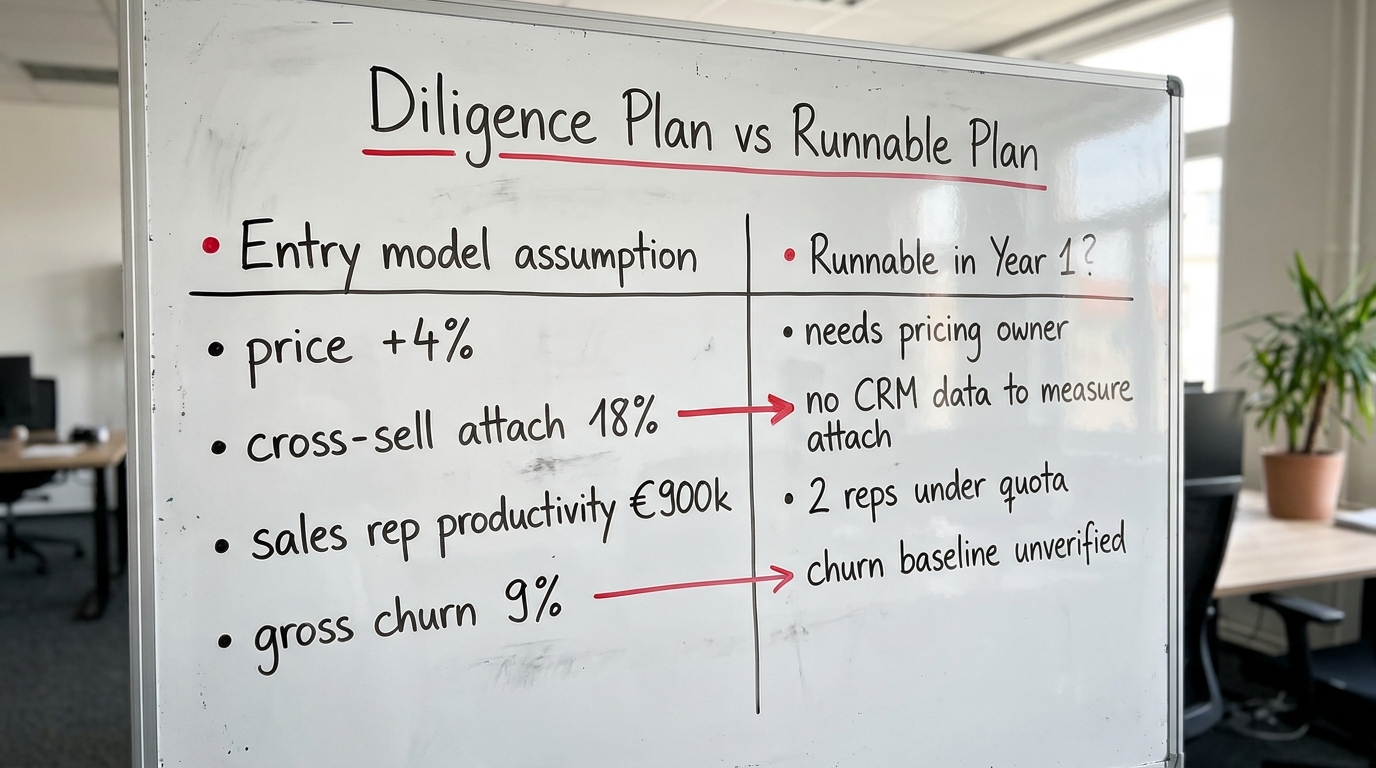
The value creation plan written during diligence and the plan the company can actually execute in the first year are rarely the same document. Diligence plans are built on a small number of interviews, a data room, and a lot of pattern matching from the deal team's prior experience. They are directionally useful and operationally incomplete.
Your first job is to reconcile the two. Take the entry model, pull out every assumption that drives the EBITDA build, and ask which ones the management team has ever actually delivered against. Price increases, cross-sell attach rates, sales headcount productivity, churn reduction: each is a line in the model and each needs an owner who believes the number and a baseline that proves where you start.
Bain's annual private equity report has tracked for years how much of the industry's return now depends on operational improvement rather than multiple expansion or leverage. That shift is why the reconciliation matters. If the return came from buying cheap and selling dear, this exercise would be optional. It is not. You can review the current state of that thesis in Bain & Company's Global Private Equity Report.
2. Decide which levers you own and which the company owns
Value acceleration fails most often on ambiguous decision rights, not on strategy. Someone assumes the operating partner will drive pricing; the CEO assumes it is their call; six weeks pass and the price increase that was worth two turns of EBITDA has not gone out.
Write down every material lever and assign a single accountable owner. Not a committee. The operating partner should own a short list of cross-portfolio levers where the sponsor adds genuine leverage: procurement pooling, banking relationships, senior hires, shared vendor rates. The management team owns everything that touches customers and operations day to day. When you blur that line, you slow both sides down.
The three questions that settle a decision right
- Who is accountable if this number misses at the next board meeting?
- Who signs the spend required to move it?
- Who has the operational context to know if the plan is realistic?
When all three answers point to the same person, you have a clean owner. When they split, you have a governance problem to fix before you launch the workstream, not after.
3. Separate revenue acceleration from cost work, and sequence them
Cost and revenue levers do not move at the same speed and they do not carry the same risk. Cost work tends to be faster to realize and more certain: a renegotiated contract shows up in cash within a quarter. Revenue work is slower, less certain, and usually where the larger upside sits.
McKinsey's private capital research has consistently found that the value creation programs that hold up at exit lead with commercial growth rather than relying on cost cutting to carry the plan. You can review that body of work through McKinsey's private capital research. The practical implication for sequencing is that you take the certain cost wins early to fund the riskier revenue bets, and you do not let the easy cost quarter fool you into thinking the plan is on track when the revenue engine has not turned over.
For a mid-market business, the revenue engine usually means the go-to-market system: how leads become pipeline, how pipeline becomes closed revenue, and how existing customers expand. That is the cluster where diligence assumptions most often break contact with reality, and it is where the RevOps work lives. If your entry model assumed cross-sell attach rates or improved conversion, read how the pipeline math falls apart at a bad handoff before you commit to those numbers.
4. Build the baseline before you build the target
You cannot manage a value creation plan against numbers you cannot measure. Most mid-market companies coming out of a founder-led or family-owned history have weaker instrumentation than the deal team assumed. The CRM is half-populated, the finance close takes three weeks, and nobody can tell you conversion rate by lead source without a manual export.
Before you set targets, establish what the current state actually is, with a defensible method behind each number. A target of "improve win rate to 30%" is meaningless if you do not know today's win rate and cannot agree on how it is counted. This is unglamorous work and it is the difference between a plan you can hold people to and a plan that dissolves into argument at every board meeting.
The instrumentation problem is also a reporting problem. When the sponsor pack and the operator's own dashboard show different numbers, you lose weeks reconciling them instead of acting. That failure is common enough to be predictable, and it is worth understanding early. Read why the sponsor pack and the operator's dashboard disagree and fix the definitions before the first board cycle rather than during it.
What a usable baseline covers
- Revenue by segment, product and channel, with a definition you can defend.
- Pipeline coverage and stage conversion, pulled from the system rather than reconstructed.
- Gross and net retention, with churn counted the same way every month.
- Sales capacity: how many reps, what quota, what actual attainment.
- Unit economics that survive a second look, not blended averages that hide the mix.
5. Read the diligence work as an operating asset, not a closed file
The technology, commercial and customer diligence produced before close is the most concentrated view of the business you will ever have, and most teams file it after signing and never open it again. That is a mistake. The findings in those reports are your risk register and your first-100-days input list.
The technology due diligence read tells you which systems can carry the growth plan and which will break under it. If the diligence flagged a CRM migration or a data model that cannot report on the metrics your value plan depends on, that is an integration dependency you schedule now, not a surprise you discover in month five. For a sense of what a thorough read produces, see what a five-day technical read actually covers.
The same applies on the commercial side. The customer and market diligence gives you the demand picture your revenue targets rest on. If you did the diligence well, or want to judge whether it was done well, the standard for judging a commercial diligence consultant is worth revisiting, because the same standard applies to the work you now have to execute against.
6. Commit to a first-100-days plan with owners and dollars, not themes
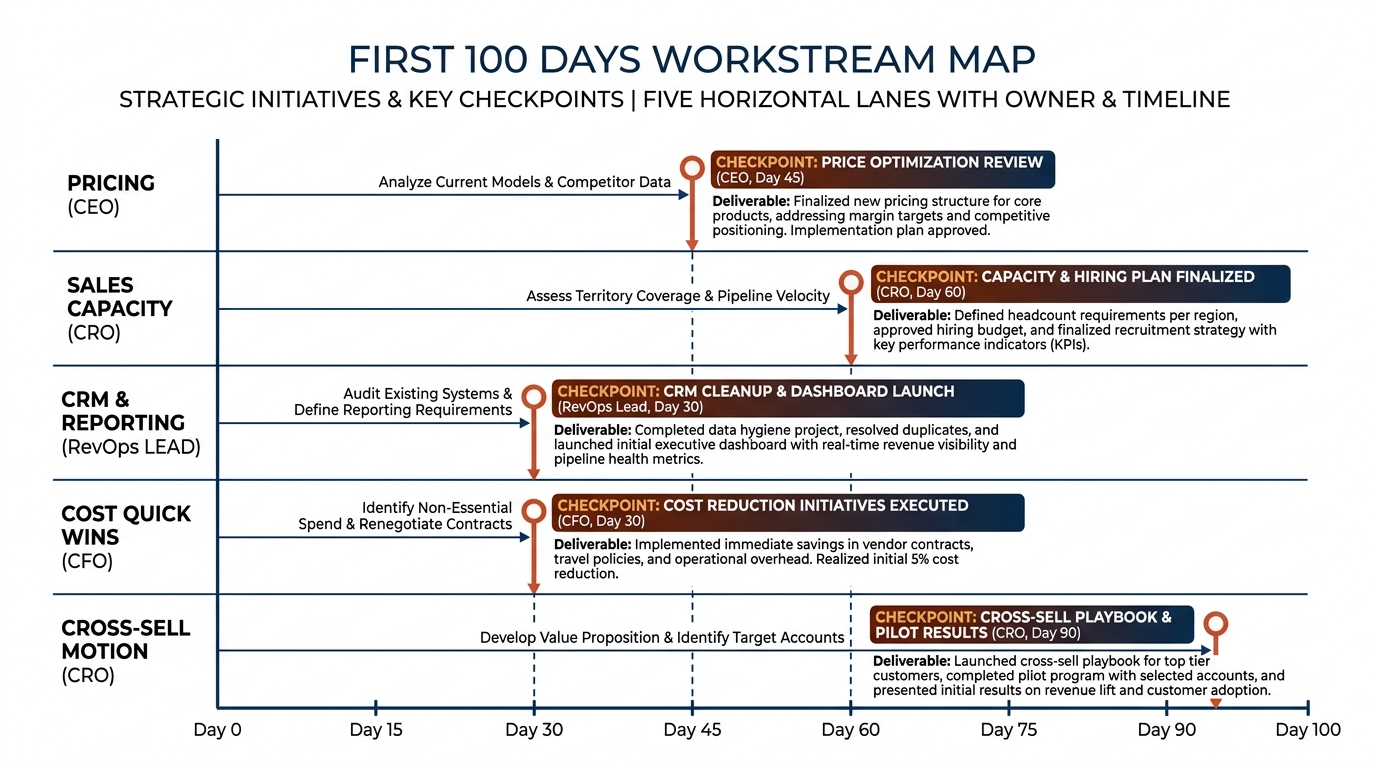
The first 100 days set the pace for the whole hold. A plan of themes ("improve sales effectiveness," "modernize the tech stack") gives you nothing to manage. A plan of decisions with owners, budgets, dates and expected financial impact gives you a board conversation you can win.
Structure the first 100 days around a small number of workstreams, each with a named owner, a defined outcome, and a checkpoint. Fewer, well-resourced workstreams beat a long list of underfunded ones. The temptation is to launch everything at once because everything looks urgent. The teams that do that stall everything at once.
The Harvard Law School Forum on Corporate Governance publishes useful material on governance in the early ownership period, which matters here because the first 100 days is where board rhythm, reporting cadence and management incentives get set. You can browse that work at the Harvard Law School Forum on Corporate Governance. If your value plan leans on go-to-market speed, a concrete sequence helps; see this go-to-market timeline for the first 90 days.
7. Judge the go-to-market engine before you pour money into it
If revenue growth is the largest lever in your plan, and for most mid-market deals it is, then the go-to-market system deserves the hardest look before you fund expansion. Adding sales headcount onto a broken funnel multiplies the cost without multiplying the output. You need to know whether the machine converts before you feed it more.
The diagnostic is not complicated, but it has to be honest. Where does pipeline actually come from, and is that source repeatable or a handful of founder relationships? What is the real conversion by stage, and where does it leak? Is the CRM data good enough to answer those questions without a week of manual work? If the answer to the last one is no, that is your first project, because everything else depends on it.
Forrester and other analysts have written extensively about how the operating model behind revenue has changed, and mid-market companies are usually a cycle or two behind. The point for you is practical: expansion spend only accelerates value when the underlying conversion holds. Otherwise you are scaling a leak.
The go-to-market questions that decide whether to fund growth
- Is pipeline generation repeatable, or dependent on a few relationships?
- Does stage conversion hold when you look at it by segment rather than blended?
- Can the current systems report on the metrics your value plan requires?
- Do sales and marketing agree on what a qualified lead is, or does the handoff leak?
8. Fix the measurement and reporting layer early
A value creation plan lives or dies on whether actuals can be compared to plan every month without a fire drill. In many portfolio companies the monthly board pack takes a small team most of a week and still ships with numbers that get corrected in the meeting. That is time your best people spend assembling data instead of acting on it.
This is a solvable problem and it is worth solving in the first quarter, because every later decision depends on trustworthy actuals. If you recognize the symptom, read why the monthly pack takes six people and still ships wrong numbers. The fix is usually a combination of definitions everyone agrees on, a single source for each metric, and enough automation that the report assembles itself.
The AICPA and CIMA publish standards and guidance on finance function quality that are useful when you are deciding how much to invest in the close and reporting process. Their material is available through AICPA & CIMA. For the mechanics of collecting the operational input that never shows up in the finance system, how stakeholder feedback reduces process risk covers ground the finance close misses.
9. Handle add-ons and roll-ups as their own acceleration workstream
If your thesis includes a buy-and-build, the integration of each add-on is where value is created or destroyed, and it moves on a different clock than the organic plan. Every add-on brings its own systems, its own customer data, its own way of counting revenue, and its own website and brand presence.
The commercial risk on a roll-up is that the synergies in the model assume a level of integration nobody has scoped. Consolidating systems, harmonizing pricing, and merging go-to-market motions all take longer than the deal model allows if you have not planned them. One concrete example that catches teams off guard is the web and search estate: merging five brand sites carelessly can cost real organic traffic and the pipeline it feeds. Read how to approach consolidating brand websites after a roll-up without tanking organic traffic before anyone starts redirecting domains.
PitchBook and S&P Global Market Intelligence both track add-on activity and the multiples paid, which is useful context when you are pressure-testing whether the buy-and-build math still works in the current market. You can review that data through PitchBook and S&P Global Market Intelligence.
10. Manage the plan against exit from day one
Every workstream should connect to how the business will look to the next buyer. A revenue improvement that depends on the current CEO's relationships does not survive diligence the way a repeatable, instrumented go-to-market motion does. The buyer at exit will pay for durable, provable value, not for effort.
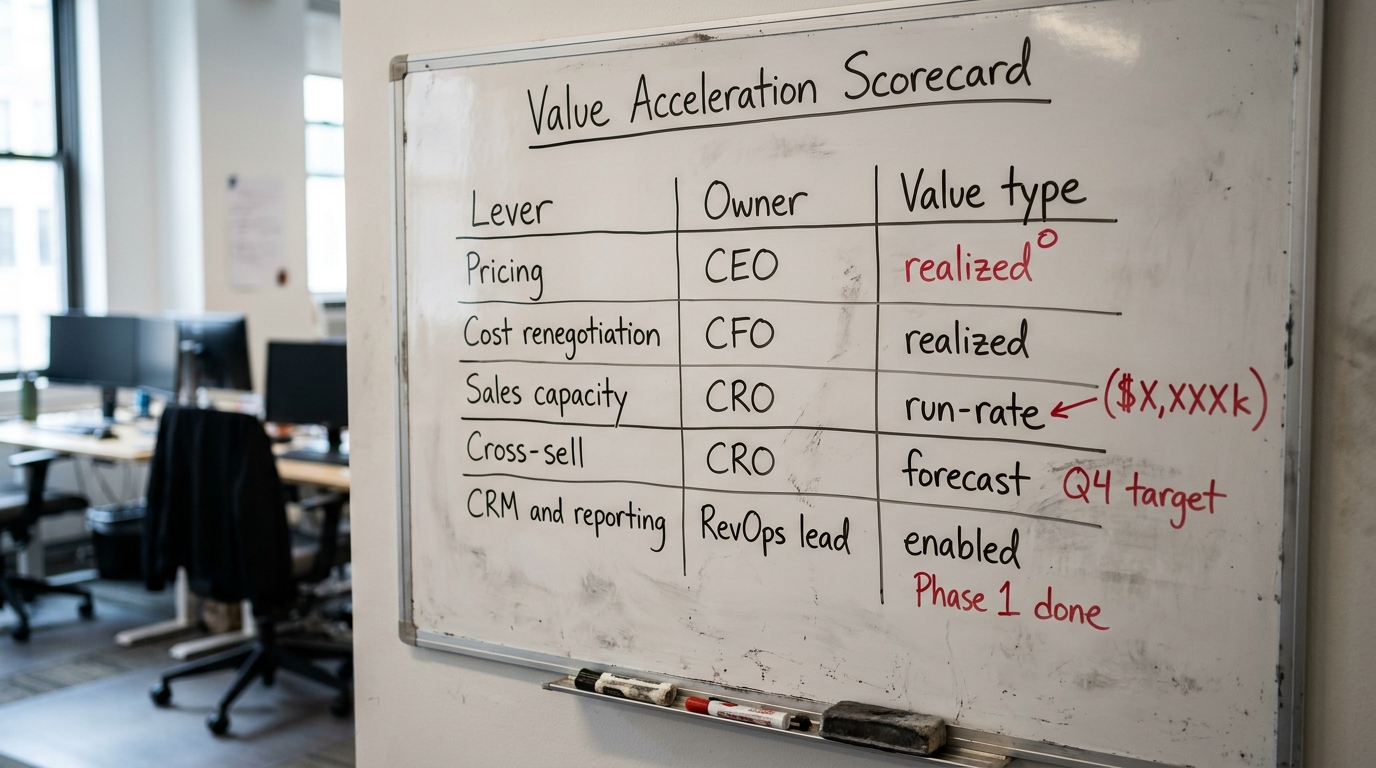
That means classifying the value you claim honestly as you build it. Realized improvement that is in the numbers is worth more than run-rate that only just started, which is worth more than forecast that is still a projection. When you report progress to the board and eventually to a buyer, keeping those categories separate protects your credibility. A forecast dressed as a realized number is the fastest way to lose a management team's trust and, later, a buyer's.
Preqin and Private Equity International both cover the exit environment and how buyers are pricing quality of earnings and growth durability. You can follow that through Preqin and Private Equity International. Harvard Business Review's coverage of mergers and acquisitions is a useful source on why so many deals underdeliver against the case, available at HBR's M&A topic hub.
11. The decisions checklist for value acceleration
If you are past close and building the plan, here is the short list of decisions that determine whether private equity value acceleration produces enterprise value or just activity.
- Reconcile the diligence plan with the runnable plan, and confirm management believes each number.
- Assign a single accountable owner to every material lever, with the spend authority to move it.
- Sequence certain cost wins early to fund riskier revenue bets, and do not mistake cost quarters for revenue progress.
- Establish a defensible baseline before setting any target.
- Reopen the diligence reports and turn their findings into your risk register.
- Structure the first 100 days as owned workstreams with dates and expected financial impact. Assign each workstream to one accountable owner, set a completion date, and estimate the EBITDA or revenue consequence if the work delivers as planned.
- Diagnose the go-to-market engine before funding expansion.
- Fix the reporting layer so actuals meet plan every month without a fire drill.
- Scope add-on integration as its own workstream, including systems and the web estate.
- Classify value as realized, run-rate or forecast, and manage every lever against the exit story.
12. Where the RevOps work sits in all of this
Most of the revenue levers in a value creation plan depend on a go-to-market system that can be measured and improved. That is the RevOps layer: the CRM that reports honestly, the pipeline math that holds up, the handoffs that do not leak, and the reporting that lets the board see actuals against plan without a week of manual work. When that layer is weak, every revenue target in the model is a guess.
The RevOps layer is the instrumentation that makes the rest of the plan manageable through the hold, and it is usually the fastest way to turn the diligence assumptions into numbers you can actually defend at the board and, later, in exit diligence. If your value plan rests on revenue growth, this is where the work concentrates.
DevriX and GrowthShuttle run this work as a RevOps engagement built specifically for PE-backed companies, from the first-100-days instrumentation through the reporting layer that survives a board cycle. If revenue acceleration is the largest lever in your plan and you need the go-to-market system to support it, review the private equity operating support offer and start with the workstream that is currently blocking your baseline.


