You inherited three portfolio companies running HubSpot, one running Salesforce, and two running a spreadsheet that one sales manager guards like a personal asset. The sponsor wants a single revenue view across the platform by the next board meeting, and someone in the room has already floated "let us just put everyone on one HubSpot instance." That instinct is not wrong, but the sequence usually is. Portfolio-wide HubSpot standardization fails or succeeds on decisions you make before a single object gets migrated, and most of those decisions concern data definitions, ownership, and reporting infrastructure.
This guide is for the operating partner or portfolio company executive who has budget approved and needs to decide what "standardized" actually means, who owns it, and how to judge whether the work is going well before the invoices pile up. It assumes you already know what a CRM is and what RevOps does. What you need is a way to scope the decision so it produces a comparable revenue view rather than five HubSpot instances that still cannot be summed.
1. Name the commercial reason before anyone touches a portal
Standardization is not a goal in itself. The sponsor is paying for one of a short list of outcomes: a comparable pipeline view across the group, faster onboarding of add-ons, a cleaner data room at exit, or lower per-company operating cost from consolidating tooling and admin. Each of those implies a different scope, and confusing them is how you end up spending eighteen months on a project nobody can point to in the value creation plan.
If the driver is a comparable revenue view for the board, you are standardizing definitions and reporting, and the CRM instance topology is secondary. If the driver is add-on integration speed, you are building a repeatable template so the next acquisition lands in a known configuration inside 60 days. Bain's annual PE report has tracked how much of recent returns depend on operational improvement rather than multiple expansion, which is exactly why sponsors now expect this kind of infrastructure work to show up in the plan. You can review Bain's ongoing coverage in its Global Private Equity Report.
Write the one-sentence reason down and get the deal partner to agree with it. That sentence decides everything downstream, including whether one shared instance or several standardized instances is the right answer.
2. One instance or many is a governance question, not a technical one
The single most consequential architecture decision is whether the portfolio runs one shared HubSpot instance with business unit separation, or separate instances built to a common template. Both can produce a comparable board view. They differ on control, data isolation, and how add-ons get absorbed.
When a single shared instance fits
A single instance works when the portfolio companies sell to overlapping buyers, when the sponsor wants tight central control of definitions, and when data isolation between brands is not a legal or competitive requirement. It gives you one place to enforce properties, one reporting layer, and the lowest marginal cost to add a small acquisition. The cost is that every company now depends on shared governance, and a change one team makes can affect another.
When separate standardized instances fit
Separate instances built to the same template fit when companies serve genuinely different markets, when a future carve-out is plausible, or when data must stay isolated for competitive or regulatory reasons. You keep clean separation and an exit-ready boundary for each company, at the cost of duplicated configuration work and a reporting layer that has to roll several instances up.
Most mid-market portfolios I would point at separate standardized instances, because the option value of a clean carve-out usually outweighs the marginal reporting convenience of one shared portal. Decide this against the exit thesis, not against the demo you were shown.
3. Standardize the data model before the workflows
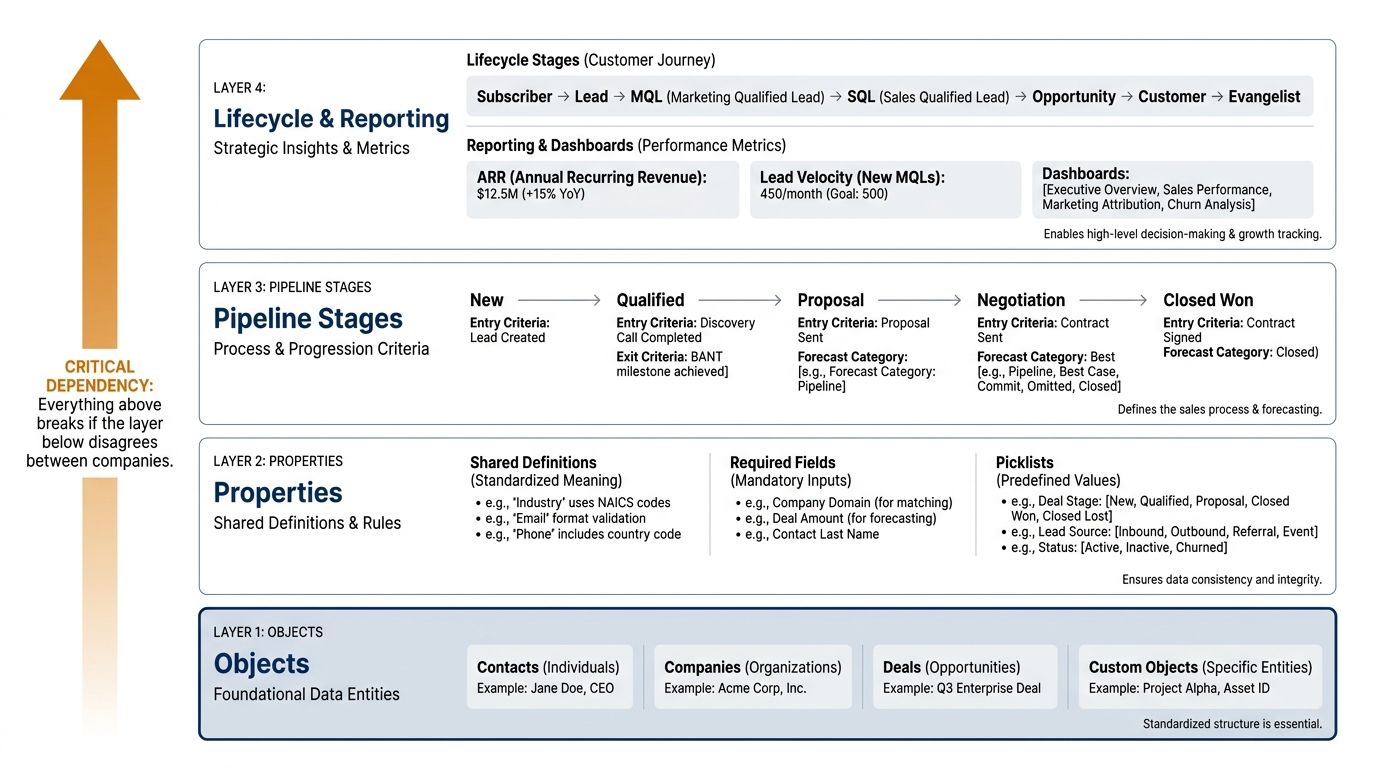
The reason five HubSpot instances cannot be summed is almost never the software. It is that "qualified lead," "closed won," "ARR," and "region" mean different things in each portal, and each sales team built its own pipeline stages to match how it happens to work. You cannot report across companies until those definitions match.
Fix the data model in this order: the objects you track, the properties on each object, the pipeline stages and their entry and exit criteria, and the lifecycle definitions. Everything else, including automation and dashboards, sits on top of that layer and breaks the moment the layer underneath it disagrees between companies.
This is the same failure that shows up in board reporting, where the sponsor pack and the operator's dashboard disagree because they draw from different definitions of the same metric. We wrote about that specific gap in why the sponsor pack and the operator's dashboard disagree, and portfolio-wide HubSpot standardization is largely an attempt to remove the root cause before it reaches the board.
4. Build the standard property dictionary first
Before any migration, produce a property dictionary that every company will adopt. It lists each standardized property, its exact definition, its allowed values, whether it is required, and who owns changes to it. This document is the actual product of standardization. The HubSpot configuration is just its implementation.
Keep the shared set deliberately small. Standardize the properties that the board view depends on, the fields that feed forecast, and the identifiers needed to deduplicate across companies. Let each company keep local properties for the things that only matter to their operators. Trying to standardize every field is how you turn a 90-day project into a permanent committee.
The properties worth arguing over
- Deal amount, currency, and how recurring versus one-time revenue is recorded
- Pipeline stage and the forecast category each stage maps to
- Lifecycle stage and the criteria for MQL, SQL, and opportunity
- Close date discipline, because slipped dates quietly destroy any cross-company forecast
- Region, segment, and product, because those are the cuts the board will ask for
Everything else can vary by company without harming the group view. The discipline is knowing which fields are load-bearing and which are decoration.
5. Decide who owns the standard and who owns the data
Standardization creates two distinct ownership questions, and portfolios that skip one of them regret it. The first is who owns the standard itself, meaning the property dictionary, the pipeline definitions, and the right to approve changes. The second is who owns the data quality inside each company against that standard.
Central ownership of the standard belongs with a RevOps lead who reports to the operating partner or a group commercial leader. That person holds the decision right on any change to a shared definition, so one company cannot quietly redefine "closed won" and break the roll-up. Local ownership of data quality belongs with each company's revenue leader, because the person accountable for the number has to be accountable for the hygiene behind it.
If you do not name these owners in writing, the default owner becomes whoever complains loudest, and the standard erodes within two quarters. The Harvard Law School Forum on Corporate Governance publishes useful ongoing work on how portfolio governance and accountability structures affect execution, worth reading alongside your operating model at the Harvard Law School Forum on Corporate Governance.
6. Sequence the rollout so you learn before you commit
Do not migrate all six companies at once. Pick one company as the reference build, get the standard right there, and only then template it out. The reference company should be one with a competent revenue leader and messy-but-typical data, because you want to surface the real problems during the first implementation.
A workable order of operations
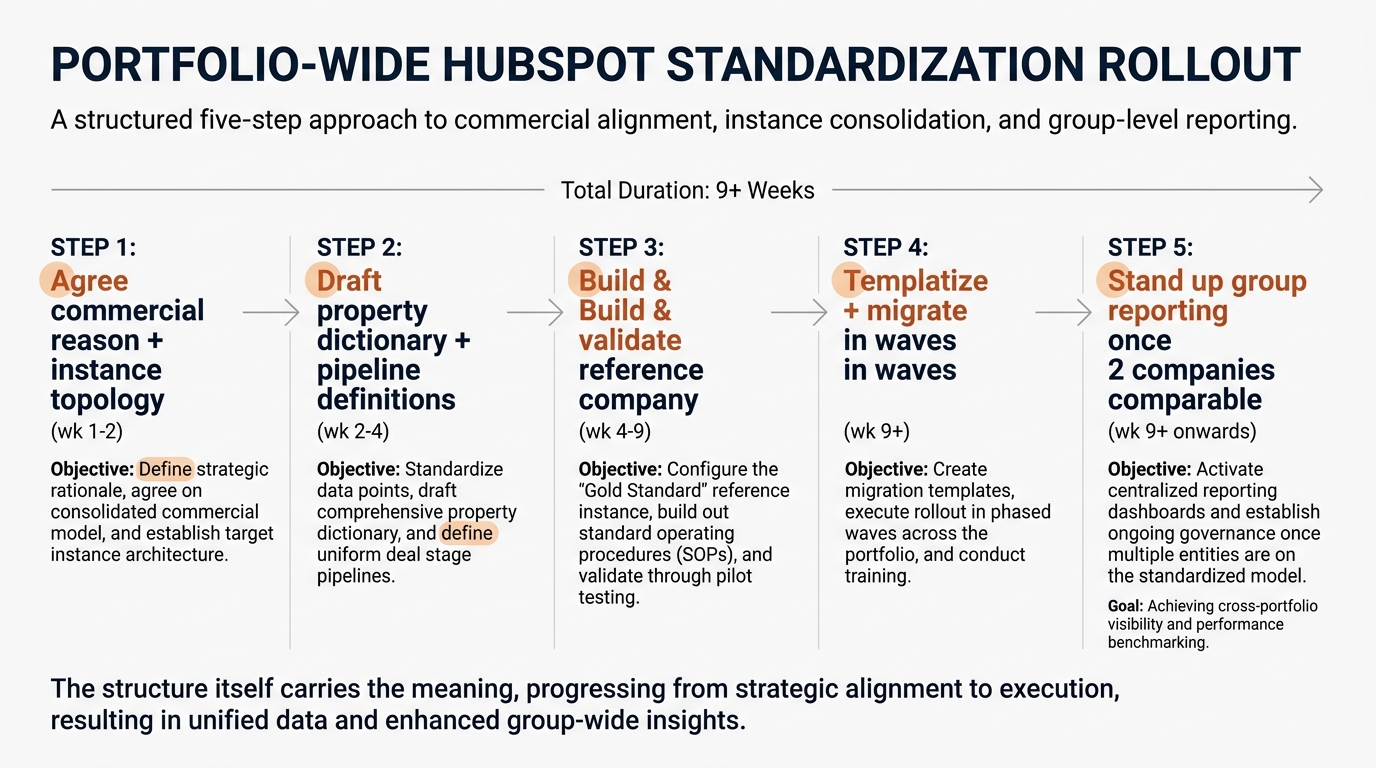
- Agree the commercial reason and the instance topology (weeks 1 to 2)
- Draft the property dictionary and pipeline definitions (weeks 2 to 4)
- Build and validate the reference company against the standard (weeks 4 to 9)
- Templatize the configuration and migrate the next companies in waves (weeks 9 onward)
- Stand up the group reporting layer once two companies are live and comparable
This sequencing mirrors the discipline of a strong first 100 days plan, where you prove a change on one asset before you impose it on the whole platform. It also gives the board an early, real proof point instead of a status update that says "migration in progress."
7. Treat data migration as the risk it actually is
Migration is where standardization projects quietly go wrong, because the visible work looks like moving records while the real work is reconciling meaning. Deduplication across companies with shared customers, currency normalization, mapping old pipeline stages to new ones, and preserving history for forecast comparison all carry revenue consequences.
Set migration acceptance criteria before you start moving anything. Record counts should reconcile, forecast in the new system should match the old system for the same period within an agreed tolerance, and no owner should log in on day one to find their pipeline looks wrong. A migration that changes the number without explanation destroys sales team trust faster than any bug, and you rarely get it back.
McKinsey's private capital research and BCG's principal investors practice both publish regularly on why data and integration work is where value creation plans slip, and both are worth scanning before you size the migration budget. See McKinsey's private capital research and BCG's private equity practice for the operational framing.
8. Connect the CRM standard to the numbers the board already sees
The point of portfolio-wide HubSpot standardization is that pipeline, bookings, and forecast become comparable across companies and roll up cleanly. That only happens if the CRM definitions match the definitions in the board pack and the finance model. If sales says "closed won" on a different basis than finance recognizes revenue, you have automated a disagreement rather than resolved it.
Reconcile the CRM lifecycle and deal stages to the metrics finance already reports. This is the same handoff math we covered in the pipeline math that doesn't survive a bad handoff, and it is why board reporting stays painful even after a CRM cleanup. We also traced the mechanics of why the monthly pack takes six people and still ships wrong numbers, and standardization only helps if it removes those manual reconciliation steps rather than adding a new one.
The AICPA and CIMA publish practical guidance on revenue recognition and reporting definitions that helps you align the sales-side and finance-side language before it reaches the sponsor, available through AICPA and CIMA.
9. Design for the next add-on, not just today's portfolio
If the thesis includes a buy-and-build, the real prize is a template that absorbs the next acquisition fast. A newly acquired company should map onto your standard property dictionary and pipeline in weeks, not quarters, so the sponsor sees a comparable revenue view for the add-on almost immediately.
That is a technology and integration capability the deal team should verify during diligence, not discover afterward. When you assess an add-on's CRM, you are effectively doing a small piece of technology due diligence on how hard it will be to bring onto the standard. Our own breakdown of what a five-day technical read actually covers shows the level at which this can be scoped without turning into a forensic exercise.
Design the template so the common questions, region, segment, product, stage, and forecast category, are already there. The local color a new company brings can be added as local properties without disturbing the group view.
10. Budget for the operating cost, not just the project
Standardization has two cost lines that portfolios routinely conflate. The one-time project cost covers the property dictionary, the reference build, migration, and templating. The ongoing cost covers governance, admin, license consolidation, and the RevOps capacity to keep the standard enforced as companies change.
The project cost is finite and easy to approve. The ongoing cost is what determines whether the standard survives, because a standard nobody maintains reverts to five divergent portals within a year. Model both and put the ongoing owner in the budget explicitly. PitchBook and S&P Global Market Intelligence both track how operational and technology spend inside portfolios trends over time, useful reference points when you defend the run-rate cost to the deal team, at PitchBook and S&P Global Market Intelligence.
11. How to judge the work while it is happening
You do not need to be a HubSpot administrator to tell whether this project is on track. Judge it on a small number of observable signals rather than status percentages.
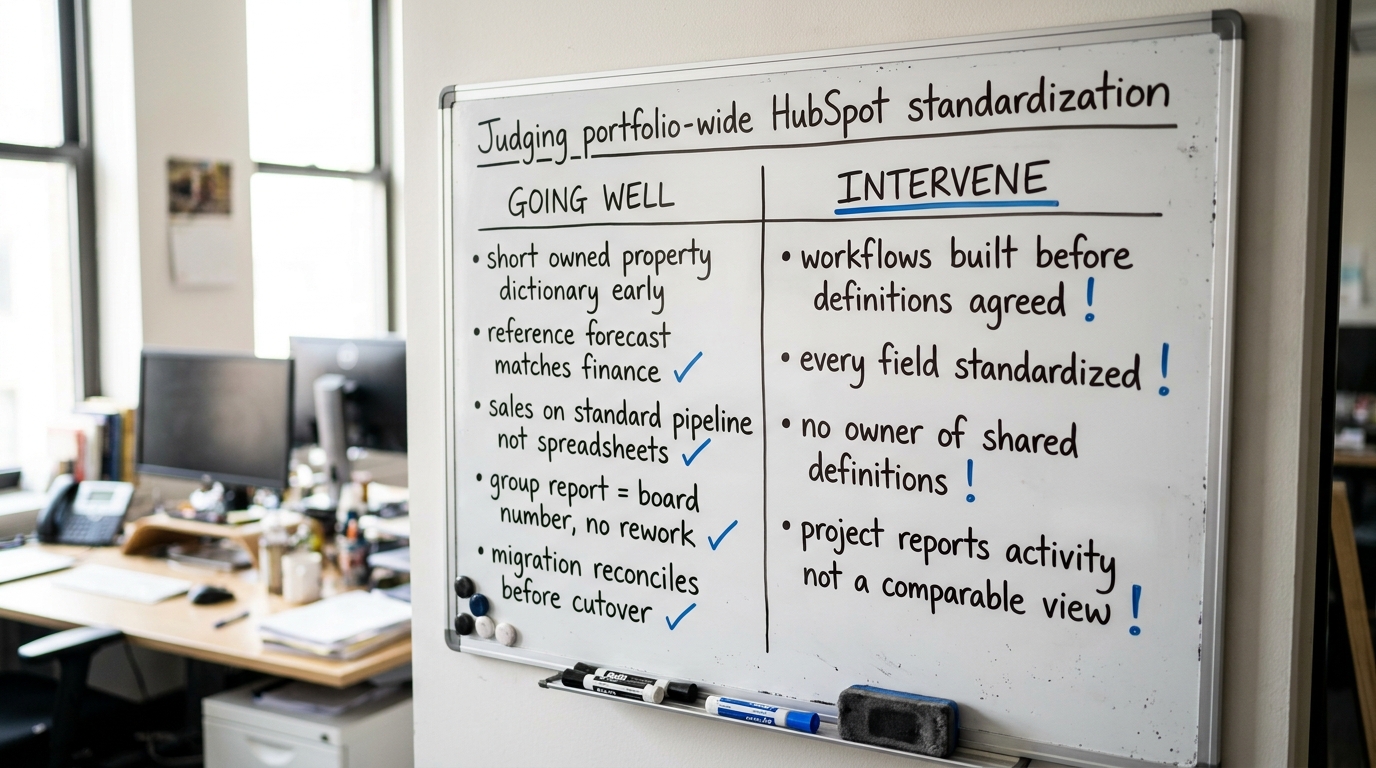
Signals the work is going well
- A written property dictionary exists early and is short, specific, and owned by a named person
- The reference company's forecast in HubSpot matches finance for the same period within tolerance
- Sales leaders in the reference company are using the standard pipeline, not shadow spreadsheets
- The group reporting layer produces the same pipeline number the board sees, without manual rework
- Migration reconciles on record counts and forecast before cutover, with acceptance criteria signed off
Signals to intervene
- The team is configuring workflows and dashboards before definitions are agreed
- Every field is being standardized instead of the load-bearing few
- Nobody holds the decision right on shared definitions, so changes happen ad hoc
- The project reports activity (records moved, workflows built) instead of a comparable revenue view
The last one matters most. A project that reports how busy it is rather than what it has made comparable is measuring the wrong thing, and that is a pattern worth catching early in any value creation program, as we argued in our note on private equity value acceleration.
12. A checklist for the decision, not the demo
Before you approve scope and budget, get clear answers to these. If any answer is vague, the project is not ready to start.
- What is the one-sentence commercial reason, and does the deal partner agree with it?
- One shared instance or separate standardized instances, decided against the exit thesis?
- Does a property dictionary with definitions, owners, and allowed values exist before migration?
- Who owns the standard centrally, and who owns data quality in each company?
- Which company is the reference build, and what proves it is done?
- Do CRM definitions reconcile to the finance model and the board pack?
- How fast can the next add-on be brought onto the standard, and who confirmed that?
- What is the ongoing operating cost and who owns it after the project ends?
- What are the migration acceptance criteria, and are they signed off before cutover?
This work sits inside the broader Revenue and GTM operating agenda, alongside how you sequence the first 90 days of any commercial change, which we laid out in the go-to-market timeline for the first 90 days. Standardization is one piece of that agenda, valuable precisely because it makes every other commercial number in the portfolio comparable.
If you want a partner to scope the reference build, write the property dictionary, and stand up the group reporting layer against your value creation plan, review the DevriX private equity operating offer and bring the decision to us before the migration starts, not after it stalls.


