You are three weeks from close on a services or light-manufacturing business, the commercial and financial reads are back, and someone on the deal team asks whether operations can actually carry the growth the sponsor expects to see. That question is where operational due diligence consulting earns its fee. Not a tour of the plant floor, not a list of software the company owns, but a defensible view of whether the operating base can produce the plan the sponsor underwrote. Get it wrong and the first 100 days are spent discovering what diligence should have surfaced, usually with a forecast that already misses.
This guide is written for the buyer who has budget and a decision to make: an operating partner scoping a portfolio audit, or a portfolio company executive being asked to sign off on an integration assumption. It covers what to ask for, how to sequence the work, and how to judge the deliverable before you pay for it.
1. The decision operational diligence is supposed to inform
Most operational reads fail because nobody wrote down the decision first. The commercial team is testing the revenue thesis. The financial team is testing the quality of earnings. Operational diligence sits between them, and if you do not define what it is deciding, you get a competent description of the business that changes no one's mind.
The decision is usually one of three. Can the operating base deliver the plan without step-change capital? What integration or standardization work has to happen, in what order, and who owns it? And where does operating risk sit that the model has not priced, from key-person dependency to a system migration nobody scoped. Every finding should route back to one of those three questions, or it does not belong in the report.
Bain's annual private equity report has tracked the shift toward operational value creation as multiple expansion became harder to rely on, and you can follow that work through the Bain Global Private Equity Report. The practical consequence is that diligence teams now commission the operational read to produce a value-creation input rather than a comfort memo.
2. What operational due diligence consulting actually covers
Operational due diligence consulting examines the machinery that turns the commercial plan into delivered revenue and cash: process, people, systems, supplier and customer concentration, and the operating cost base. It is distinct from the financial and commercial reads, and it should never be confused with a technology diligence exercise, though the two share evidence.
A serious scope covers process maturity in the functions that carry the plan, organizational capacity against the growth curve, system fit and data quality, the cost-to-serve by customer or product line, and the operating risks that would show up as variance in the first four quarters. McKinsey's private capital research, which you can reach through McKinsey, has documented how often value-creation plans stall on capacity and data problems that a proper operational read would have flagged.
The line I hold: if a finding cannot be tied to revenue growth, EBITDA, cash conversion, integration speed, or a specific risk, it is background, not diligence. Background is fine in an appendix. It should not drive the price of the work or the length of the report.
Where it overlaps with technical and commercial reads
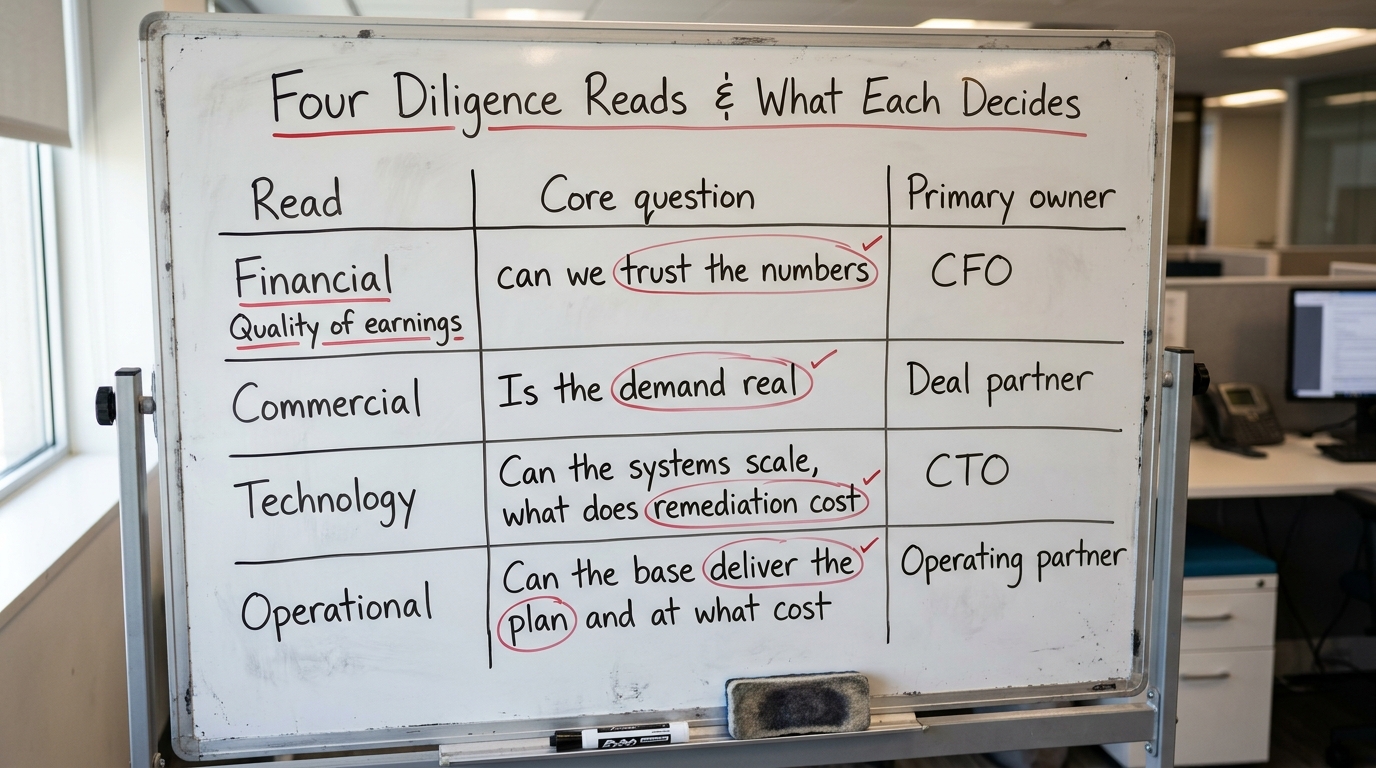
The operational read borrows evidence from adjacent workstreams and should be scoped so those streams do not repeat each other. A technology due diligence read tells you whether the systems can scale and what the remediation costs. The commercial read tells you whether the demand is real. The operational read connects them by answering whether the company can actually fulfill the plan given that demand and those systems, and at what cost to serve.
For the technology boundary specifically, it helps to know what a focused read produces, which this site covers in what a five-day technical read actually covers. Scope the operational engagement so it consumes those outputs rather than re-running them.
3. Scope the engagement before you ask for a price
The most expensive mistake buyers make is asking three firms for a proposal before deciding what they are buying. You get three different scopes, three prices you cannot compare, and a selection made on brand rather than fit. Write the scope first.
A workable scope names the target functions (say, order-to-cash, service delivery, and procurement), the decision each function's read informs, the evidence the provider will be granted, the deliverable format, and the date it lands relative to your milestone. For a mid-market portfolio audit, this typically sits in the $15,000 to $25,000 range depending on functional breadth and data access, and that number should move with scope, not with how impressive the logos are.
Timing matters more than most buyers admit. Confirmatory diligence has a hard wall at signing, so the read has to be scoped to land before it. If you are running this post-close as a portfolio audit, the trigger is usually the first board meeting or a forecast that has started to slip, and the scope can be broader because you have full access.
Access defines what the read can honestly claim
The single biggest determinant of quality is data access, and it is worth being explicit about it in the scope. A provider working from a management-prepared deck and two calls can give you hypotheses. A provider with system exports, actuals, and floor access can give you findings. If access is limited, the deliverable should say so and label its conclusions accordingly, and you should pay less for it.
4. The evidence a credible provider asks for
You can judge a firm before you hire it by what it asks to see. A provider that opens with a document request list keyed to the decisions is doing operational diligence. A provider that opens with a capabilities deck is selling one.
The request list I expect to see includes operational actuals rather than budgeted figures, system exports for the functions in scope, the organization chart with tenure and capacity, supplier and customer concentration data, and the process documentation that exists (or the honest admission that it does not). On the actuals point, I care that the provider distinguishes what the business did from what it planned to do, because the gap between them is often the whole finding.
PitchBook and S&P Global both publish operating and deal data that a competent provider will triangulate against management's numbers rather than accepting them at face value. You can reach those through PitchBook and S&P Global Market Intelligence. External triangulation is a fair thing to ask a provider to describe in its proposal.
Watch how they handle missing data
No target has clean data across every function, so the useful signal is how a provider handles the gaps. Strong firms state the gap, state the assumption they are making instead, and flag the finding as provisional. Weak firms paper over the gap and present the assumption as fact. The second habit is what produces a forecast that misses in Q2 for reasons the report never mentioned.
5. Read the operating base against the value-creation plan
The operational read is only useful when it is set against the specific plan the sponsor underwrote. A general assessment of operational health tells you the company is fine or not fine. A plan-referenced assessment tells you whether it can do the particular thing the sponsor needs it to do, which is a different and harder question.
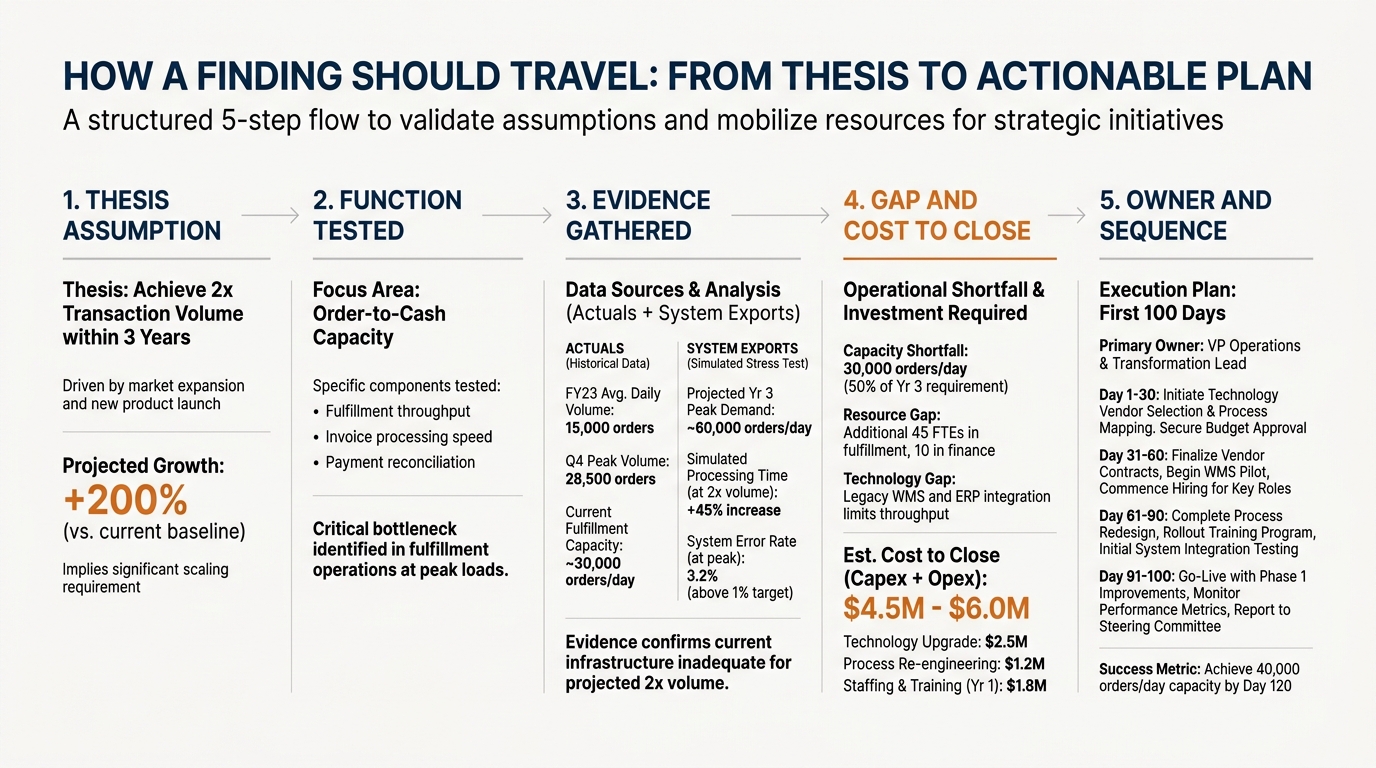
If the sponsor expects a doubling of volume in three years, the read has to test whether order-to-cash, delivery capacity, and procurement can carry that volume, and cost out the gaps. If the sponsor is counting on margin expansion through consolidation, the read has to test whether the systems and processes can be standardized and how long that takes. This is the connection between diligence and execution that GrowthShuttle covers in private equity value acceleration, where the same operating facts drive the post-close plan.
The Harvard Law School Forum on Corporate Governance, reachable at the HLS Forum, publishes work on how governance and operating oversight connect to value creation, which is useful background when you are framing what the board will expect the operating read to answer.
6. Systems and data quality as an operating constraint
Systems appear in the operational read as a constraint on the plan rather than as a technology inventory. The read answers whether the current stack and its data can support the growth or standardization the sponsor is counting on, what it costs to close the gap, and whether that cost fits the business case.
Data quality is where operational plans quietly die. A CRM full of duplicate accounts, a finance system that cannot produce cost-to-serve, or two portfolio companies on incompatible instances of the same platform all become integration work that the model rarely priced. This site treats the CRM case specifically in portfolio-wide HubSpot standardization as a data decision, and the general lesson holds: the software choice is the easy part, the data reconciliation is the cost.
When the plan depends on clean reporting, and most value-creation plans do, the read should test whether the numbers the board will rely on can actually be produced. GrowthShuttle has written twice on why that reporting breaks, in why the monthly pack takes six people and still ships wrong numbers and in why the sponsor pack and the operator's dashboard disagree. If diligence does not flag a reporting gap, the first board meeting will.
7. People and capacity, tested against the curve not the org chart
Headcount and an org chart describe the company today. The operational read has to describe whether the people can carry the plan, which means testing capacity and key-person dependency against the growth curve rather than the current state.
Two things matter most here. First, real capacity is rarely the same as headcount because senior people carry leadership and delivery at once and their available hours are lower than the org chart implies. Inside our own delivery planning a manager listed as full-time on a project is realistically at a fraction of that once leadership load is counted. Diligence should test real available capacity rather than roles.
Second, key-person risk. If one person holds the customer relationships, the pricing logic, or the system knowledge, that is an operating risk the model should price, and a retention question the first 100 days has to answer. BCG's principal investors work, at BCG, has documented how often value-creation plans depend on a small number of people who were never identified in diligence.
8. Cost-to-serve and the operating cost base
The financial read gives you margin at the aggregate level. The operational read has to go one layer down and tell you where the margin actually comes from, because the aggregate hides the customers and product lines that lose money and the ones that subsidize them.
This is where overservicing shows up, which is a pattern I watch closely in our own book of clients, where a handful of accounts consume far more delivery than they pay for. In a target, that same pattern sits inside the blended margin and only appears when you build cost-to-serve by customer. If the sponsor is counting on margin expansion, the read has to say whether it comes from pricing, from mix, or from fixing the accounts that are underwater, because those are three different execution plans with three different timelines.
The RevOps angle on this, how the revenue engine and the cost of serving it connect, is covered in the pipeline math that doesn't survive a bad handoff, which is worth reading alongside the operational cost work.
9. How to judge the deliverable before you pay
You should agree the deliverable standard before the work starts, so that judging it is a comparison against a spec rather than a taste test. A report you cannot act on is worse than no report, because it consumed diligence time and produced false comfort.
A deliverable I would accept does five things. It states each finding as a claim a partner could disagree with. It ties each finding to one of the three decisions from section one. It labels the evidence behind each finding and flags where evidence was thin. It quantifies the cost or timeline to close each gap. And it assigns an owner and a sequence so the finding becomes a first-100-days item.
The tests that separate diligence from a description
- Every material finding names the evidence it rests on and rates its confidence.
- Findings distinguish actuals from plan, and say so explicitly.
- Risks are sized, not just listed, with a cost or a probability attached where the evidence allows.
- Gaps carry an owner and a place in the sequence.
- The report says what it could not test and why, rather than pretending completeness.
GrowthShuttle's guide to picking a commercial due diligence provider and judging the work before you pay applies the same discipline to the commercial read, and the two standards are worth holding side by side when you compare proposals.
10. Connect the read to the first 100 days
Operational diligence that stops at the report is half a job. The findings are the input to the post-close plan, and the handoff between the two is where value either gets captured or gets lost. Scope the engagement so the deliverable feeds directly into the first 100 days plan, with owners and sequence already attached.
The mechanics of that early period are covered in the GrowthShuttle go-to-market timeline for the first 90 days, and the operational findings should slot into that timeline rather than sitting in a separate document nobody opens after close. The test is simple: on Day 1, can the operating partner pick up the report and know what to do first, who owns it, and what it costs.
Where the read surfaces process risk that spans functions, the fix usually depends on stakeholder buy-in as much as on the plan itself, which GrowthShuttle treats in how stakeholder feedback mitigates process risk. Sequencing a change without the people who run the process is how first-100-days plans slip.
11. Sources worth checking as you scope the work
A few external references help you frame the engagement and pressure-test a provider's method. HBR's coverage of mergers and acquisitions, at HBR on M&A, is useful for the integration angle. Preqin, at Preqin, and the AICPA, at AICPA and CIMA, are worth consulting on data standards and quality-of-earnings context that the operational read borrows from.
None of these replace the read itself. They tell you what good looks like and give you a basis for challenging a provider whose method you cannot see. If a firm cannot describe how it triangulates management's numbers against outside data, that is a signal in itself.
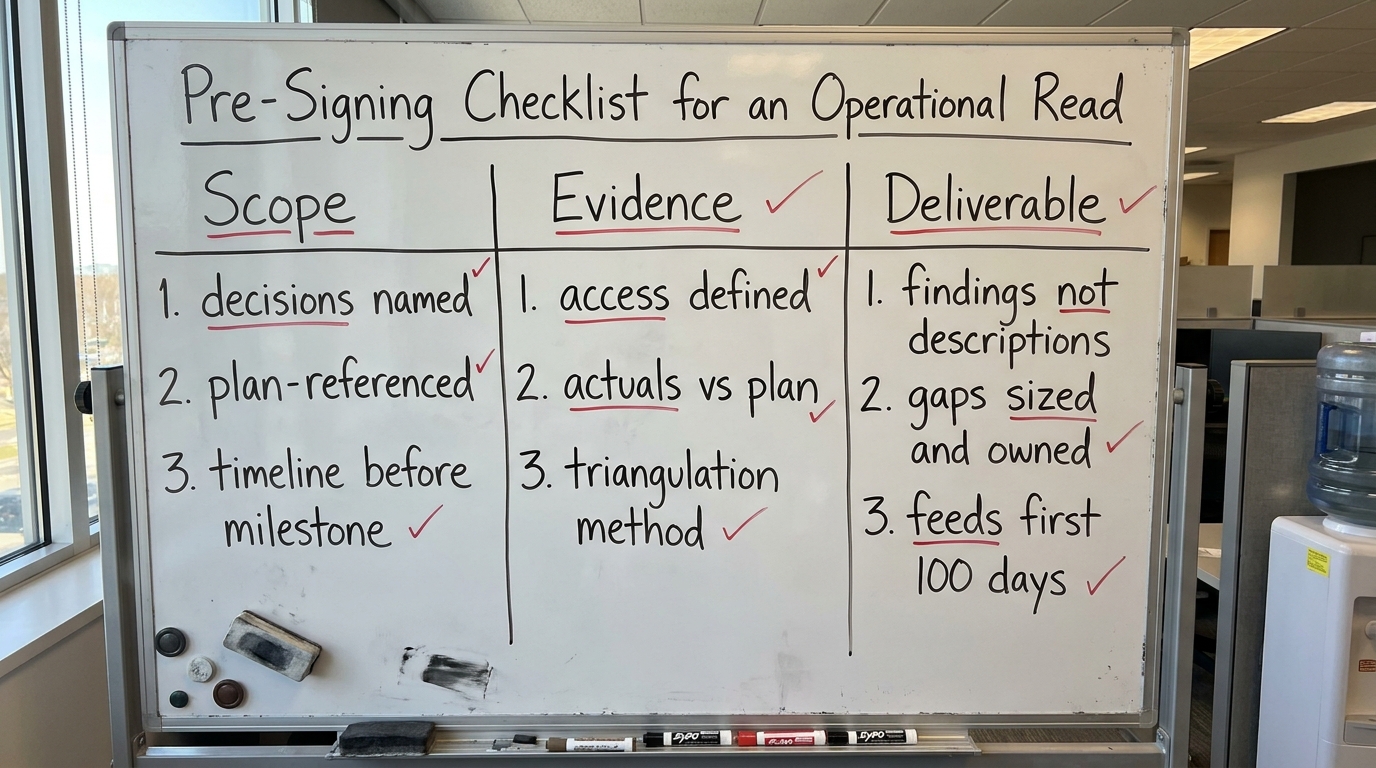
12. A checklist before you sign the engagement
Run the proposal against this list before you commit budget. If a provider cannot meet most of it, either the scope is wrong or the provider is.
- The scope names the specific decisions the read will inform, not just the functions it will examine.
- The proposal is keyed to a document and access request list.
- The read is set against the actual value-creation plan.
- The deliverable format is agreed in advance, with findings, evidence, sizing, and owners.
- The timeline lands before your milestone, whether that is signing or the first board meeting.
- The price moves with scope and access, and sits in a defensible range for a mid-market audit.
- The provider states how it handles missing data and how it triangulates management's numbers.
- The findings are built to feed the first-100-days plan, with sequence and ownership attached.
Operational due diligence consulting is worth its fee when it changes a decision: whether to proceed, what to price, or what to do first after close. Judged that way, the report either earns its place in the deal file or it does not, and you can tell which before you pay by holding it to the standard above.
If you are scoping a portfolio audit or an operational read against a specific value-creation plan, review the operational and technology diligence services and the portfolio audit offer on the DevriX private equity page, and bring the checklist above to the first conversation.


