
Overview
The fractional CMO pitch to private equity operators sounds efficient: senior marketing strategy, no full-time salary, month-to-month flexibility. The embedded team pitch sounds expensive: retainer commitment, multiple people, build time before output.
The kill-line is not which model costs less. It is what the portfolio company actually needs done, and whether the model you are buying can do it without creating a new bottleneck.
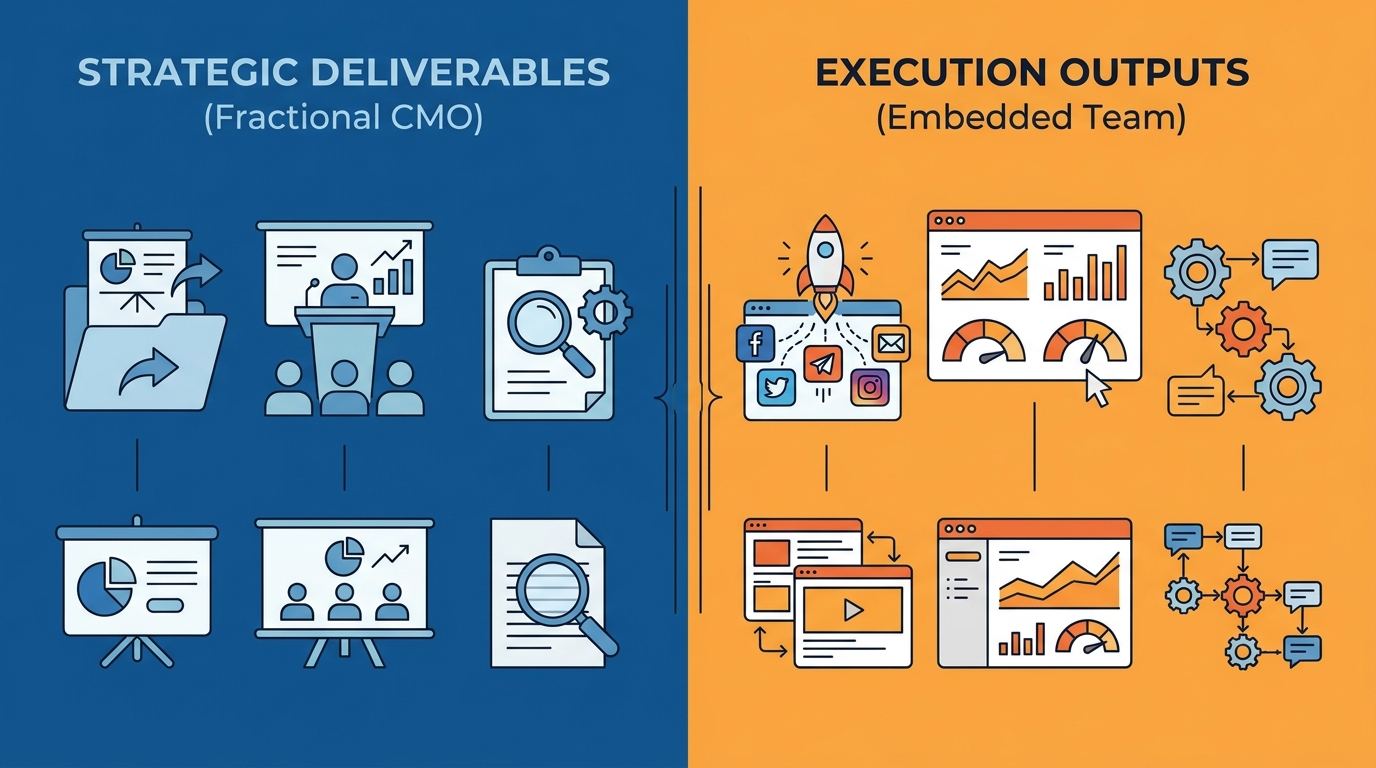
A fractional CMO is one person with 8-12 advisory hours per month. They diagnose positioning, audit the funnel, recommend tools, define KPIs, and present findings to the board. They do not build tracking infrastructure, write nurture sequences, run paid campaigns, or manage HubSpot lifecycles. That work requires execution capacity they do not sell.
An embedded marketing team is a multi-person operating unit contracted on retainer. DevriX’s model supplies 3-5 specialists, 80-120 delivery hours per month, lifecycle automation, analytics instrumentation, campaign execution, and monthly reporting. The team does not replace executive strategy, but it ships what the strategy calls for.
The decision point is simple: if the portco already has a clear plan and the constraint is execution, the fractional CMO creates a $12K/month dependency without moving the work forward. If the portco has neither plan nor capacity, you need both, and pretending one fractional seat will deliver both is how value creation plans miss their 100-day milestones.
Who This Model Is For
The fractional CMO model fits a portfolio company that has in-house marketing capacity but lacks senior strategic direction. The team can execute, the budget exists, the tools are licensed, but nobody is setting the roadmap or translating board priorities into marketing work. The fractional CMO steps into that gap for 10 hours a month, typically at $8K-$15K.
The embedded team model fits a portfolio company where marketing execution is the constraint. The strategy exists, the CEO knows what needs to happen, but there is no one to build the attribution model, wire Salesforce to HubSpot, instrument form-start events, or manage the paid acquisition budget. The team supplies 80-120 specialist hours per month, often $10K-$18K depending on scope.
The mistake is assuming one fractional executive can substitute for an operating team. A CMO with 10 monthly hours cannot execute a demand-gen program, build lifecycle automation, or manage agency vendors while also providing strategic counsel. Portfolio company operators who hire fractional leadership without matching execution capacity create a planning layer that surfaces work no one can complete.
If your portco has both gaps, strategy and execution, you need both models and should budget accordingly. Buying only the fractional CMO and expecting them to “figure out” execution with internal resources that do not exist is how 100-day plans turn into 200-day explanations.
What You Actually Get
A fractional CMO contract typically delivers 8-12 hours per month of advisory time. That time goes to board decks, positioning workshops, funnel audits, KPI definitions, vendor evaluations, and strategic prioritization. The output is a roadmap, a diagnosis, or a set of recommendations. Implementation is not included.
An embedded marketing team contract delivers 80-120 specialist hours per month across 3-5 people. The team builds tracking infrastructure, wires CRM integrations, runs paid campaigns, writes and deploys nurture sequences, manages content calendars, produces monthly performance reports, and iterates based on conversion data. The output is live marketing systems and measurable pipeline movement.
The core distinction: the fractional CMO is selling time and judgment. The embedded team is selling capacity and output. Both are legitimate models, but they serve different constraints and are not substitutes for each other.

Evaluation Criteria
Strategic Clarity
The fractional CMO wins decisively when the portfolio company lacks a coherent marketing strategy. A skilled fractional can audit the current state, identify positioning gaps, define ICP, and build a 12-month roadmap in their first 30 days. That clarity is worth the $12K/month cost if it prevents six months of random execution.
The embedded team assumes strategy exists or is being defined externally. The team can execute against a clear brief but does not replace executive judgment about positioning, pricing, or market segmentation. If your portco cannot articulate what marketing should accomplish, the embedded team will execute efficiently in the wrong direction.
Execution Velocity
The embedded team wins on execution velocity because it supplies the hands to build, ship, and iterate. A 100-hour-per-month retainer can instrument event tracking, launch three A/B tests, deploy a new nurture sequence, and report results in the same 30-day window a fractional CMO uses to present their first audit deck.
The fractional CMO’s 10 monthly hours cannot execute. They can prioritize, they can recommend tools, they can define success metrics. But if no one on the portco side has bandwidth to act on those recommendations, the fractional engagement produces clarity without movement, which is how value creation plans miss their EBITDA milestones.
Cost Structure
Fractional CMO engagements typically run $8K-$15K/month for 8-12 advisory hours. That translates to $1,000-$1,250 per hour of senior strategic time. Month-to-month terms, no long-term commitment, easy to start and stop.
Embedded team retainers run $10K-$18K/month for 80-120 delivery hours across multiple specialists. That translates to $125-$150 per hour of blended execution capacity. Typically structured as 6-12 month commitments with quarterly reviews.
The fractional model looks cheaper until you account for what it does not include. If you hire a fractional CMO and then need to hire agencies or contractors to execute their plan, you are now paying $20K-$30K/month for strategy plus execution, which is double the cost of an embedded team that delivers both layers.
Knowledge Retention
The embedded team model creates knowledge retention because the same people stay with the account for 12-24 months. They learn the product, the customer, the tech stack, and the reporting cadence. When you need to adjust the nurture sequence or debug a Salesforce integration, the person who built it is still on the retainer.
The fractional CMO model creates documentation but not continuity. When the fractional engagement ends, the strategy deck remains but the context leaves with the consultant. If the portco then hires a full-time CMO or switches to an embedded team, that new resource must re-learn what the fractional discovered, which adds 60-90 days to ramp time.
Strengths of the Fractional CMO Model
The fractional model delivers senior strategic judgment without a full-time salary commitment. For a portfolio company that has execution capacity but lacks marketing leadership, a fractional CMO can define positioning, prioritize initiatives, and translate board objectives into marketing KPIs for $12K/month instead of a $200K+ W-2 hire.
Month-to-month terms allow the PE sponsor to test fit before committing to a full-time hire. If the fractional CMO clarifies the strategy and proves the portco needs a permanent marketing leader, the engagement can convert to a full-time search. If the need was temporary, such as a post-acquisition positioning reset, the fractional can exit cleanly.
The fractional model works well when the portfolio company already has a marketing team that can execute but lacks strategic direction. The fractional CMO steps in as the senior voice, sets the roadmap, and lets the existing team run with it.
Weaknesses of the Fractional CMO Model
The fractional model fails when the portfolio company needs execution, not more strategy. If the constraint is no one to build tracking, wire integrations, or deploy campaigns, hiring a fractional CMO who delivers a roadmap and audit findings does not move the work forward. You now have a clearer diagnosis of a problem you still cannot solve.
Ten monthly advisory hours cannot substitute for an operating team. The fractional CMO can recommend HubSpot lifecycle automation, but they will not build the workflows, write the email sequences, or instrument the conversion events. That work requires 40-60 specialist hours the fractional contract does not include.
The fractional model creates a dependency without capacity. The portco now relies on the fractional CMO’s judgment for prioritization and board reporting, but the fractional cannot execute what they recommend. If internal resources are overloaded or under-skilled, the fractional engagement surfaces work that accumulates as backlog, which is how 100-day value creation plans turn into 200-day explanations of why initiatives are still pending.
Fractional engagements rarely include vendor management. If the strategy calls for paid acquisition, SEO, or content production, the portco must hire and manage those agencies separately. The fractional CMO can evaluate vendors and define success metrics, but they will not run the weekly standup or QA the deliverables, which means the portco still needs internal capacity to execute.
Strengths of the Embedded Team Model
The embedded team model delivers execution capacity that matches the scale of mid-market portfolio company needs. An 80-120 hour monthly retainer can build attribution infrastructure, deploy lifecycle automation, run paid campaigns, manage content calendars, and report results, which is the full scope of what a value creation plan typically requires from marketing.
The team model ships work in parallel. While one specialist instruments event tracking, another writes nurture sequences, a third manages the paid budget, and a fourth builds the monthly board deck. A fractional CMO working 10 hours per month cannot parallelize, which means every initiative runs sequentially and timelines stretch.
Multi-year relationships create compounding value. An embedded team that stays with a portco for 18-24 months learns the product, customer, and go-to-market motion deeply enough to propose improvements the client has not asked for. That institutional knowledge is worth more than the hourly rate difference between fractional advisory and embedded delivery.
The embedded model includes vendor and tool management. If the strategy requires Salesforce, HubSpot, Google Ads, and a content agency, the embedded team wires those integrations, manages the vendor relationships, and reports unified performance. The portco gets one throat to choke instead of coordinating four separate contracts.
Weaknesses of the Embedded Team Model
The embedded model requires a clear strategy to execute against. If the portfolio company cannot articulate positioning, ICP, or success metrics, the team will execute efficiently in the wrong direction. The model assumes someone, CEO, board, or advisor, is defining what marketing should accomplish. Without that input, the team optimizes for outputs instead of outcomes.
Six to twelve month commitments reduce flexibility. If the portfolio company’s go-to-market strategy shifts mid-engagement or a new full-time CMO wants to bring execution in-house, the retainer becomes a sunk cost. Fractional engagements terminate cleanly on 30 days’ notice; embedded teams are harder to unwind without losing continuity.
The cost is front-loaded. A $15K/month embedded retainer costs $90K over six months, while a fractional CMO at $12K/month costs $72K over the same period. If the portco only needs strategic direction and already has internal execution capacity, the embedded model is paying for capability the client does not need.
Pricing Reality
Fractional CMO rates in 2026 for mid-market PE portfolio companies typically fall between $8,000 and $15,000 per month for 8-12 advisory hours. Engagements are usually month-to-month or quarterly, with 30-60 day notice periods.
Embedded marketing team retainers typically range from $10,000 to $18,000 per month for 80-120 specialist hours across 3-5 people. Contracts are structured as 6-12 month commitments with quarterly performance reviews and scope adjustments.
The financial trap is hiring only the fractional CMO when the portfolio company needs both strategy and execution. A fractional CMO at $12K/month who then recommends hiring a paid ads agency ($5K/month), a content producer ($4K/month), and a HubSpot consultant ($6K/month) to execute their plan now costs $27K/month total, nearly double the cost of an embedded team that delivers strategy and execution in one retainer.
The correct budgeting approach: if your portco has clear strategy and needs execution, skip the fractional CMO and hire the embedded team. If your portco has execution capacity but lacks strategic direction, hire the fractional CMO. If your portco has neither, budget for both and structure them as complementary, the fractional defines what to build, the embedded team builds it.
Alternatives to Consider
A full-time VP Marketing hire makes sense when the portfolio company has reached $50M+ ARR, has budget for a $180K-$250K W-2 salary, and needs a permanent leader who will build and manage an internal team. The full-time hire delivers both strategy and execution ownership but requires 12-18 months to prove ROI and cannot be unwound cleanly if the fit is wrong.
A marketing agency of record delivers campaign execution, creative production, and media buying but rarely includes the strategic layer a fractional CMO provides. Agencies optimize for outputs, impressions, clicks, leads, without the business-model understanding a fractional or embedded team brings. Content-focused operators managing portfolio marketing often find agencies produce volume without business impact.
A RevOps consulting firm focuses on CRM architecture, pipeline reporting, and forecast accuracy but does not typically include demand generation, content, or paid acquisition. If your portco’s constraint is attribution and reporting infrastructure, a RevOps engagement at $15K-$25K/month may deliver faster than either a fractional CMO or an embedded marketing team.
Final Verdict and Recommendation
The kill-line between a fractional CMO and an embedded marketing team is not cost, it is what the portfolio company actually needs done and whether the model you are buying can do it.
Hire a fractional CMO when your portco has internal execution capacity, budget, tools, and people, but lacks strategic direction. The fractional will define positioning, prioritize initiatives, set KPIs, and let your existing team execute. Do not hire a fractional CMO when the real constraint is no one to do the work.
Hire an embedded team when your portco has a clear strategy but no capacity to execute it. The team will build tracking, wire integrations, deploy campaigns, manage vendors, and report results. Do not hire an embedded team if you cannot articulate what marketing should accomplish, they will optimize for the wrong outcomes.
If your portco needs both strategy and execution, budget for both. A fractional CMO at $12K/month defining the roadmap plus an embedded team at $15K/month shipping the work costs $27K/month, which is the correct price for both layers. Trying to collapse both into one $12K fractional engagement creates a planning bottleneck that explains to the board why nothing shipped.
The most common mistake PE operators make is hiring a fractional CMO, receiving a strategy deck and audit findings, and then discovering the portco has no one to act on the recommendations. That scenario costs $12K/month for six months, produces a roadmap no one can execute, and adds 180 days to the value creation timeline. If that describes your portco’s current state, skip the fractional model and hire the embedded team that can ship the work your CEO already knows needs doing.
The second most common mistake is hiring an embedded team without defining success metrics or strategic priorities. The team will execute efficiently, but if the strategy is wrong, you will spend $90K over six months optimizing conversion rates on a positioning narrative that does not resonate with your ICP. If your portco cannot articulate who the customer is and what problem you solve for them, hire the fractional CMO first.
For most $30M-$150M PE-backed portfolio companies in the first 12 months post-acquisition, the correct answer is the embedded team model. The value creation plan already exists, the board has defined EBITDA targets, and the constraint is execution capacity to build attribution, deploy demand gen, and report pipeline movement. A fractional CMO at that stage delivers diagnosis the sponsor already has and does not move the work forward. Mid-market operators executing a 100-day plan need people who ship, not another deck explaining what should ship.
The exception is a portco acquired for product or technology where the marketing function was historically weak and the new owner needs to define go-to-market strategy from first principles. In that scenario, a 90-day fractional CMO engagement to build the strategy, followed by an embedded team to execute it, is the correct sequencing.
The pricing reality: if you are budgeting $12K/month for a fractional CMO and expecting them to deliver both strategy and execution, you are underfunding the engagement by half. Either increase the budget to $25K-$30K to include execution resources, or accept that the fractional will deliver a plan that sits in a slide deck while your 100-day value creation milestones slip.
What the Embedded Model Actually Delivers
An embedded marketing team operating under a multi-year retainer typically includes a marketing strategist, a demand-gen specialist, a content producer, and fractional access to design and development resources. The team owns execution against agreed KPIs, reports weekly on pipeline and attribution, and operates as an extension of the portco’s internal team without requiring office space, benefits, or equity.
The deliverables are concrete: tracking instrumentation, attribution reporting, campaign deployment, content production, vendor management, CRM hygiene, lead scoring, nurture sequences, and monthly performance decks the CFO can present to the board. The embedded team does not deliver strategy recommendations, it executes the strategy the sponsor and portco leadership already agreed to in the value creation plan.
The economic logic is predictability. A $15K/month embedded team costs $180K annually, which is less than one mid-level marketing hire when you add salary, benefits, recruiting fees, onboarding time, and severance risk. The embedded team starts delivering in week one, does not require internal management, and scales up or down based on the portco’s stage without creating HR complications.
For PE sponsors managing a portfolio of 8-12 companies, the embedded model also creates consistency. The same team structure, reporting cadence, and KPI framework can be deployed across multiple portcos, which means the operating partner reviewing performance decks sees comparable metrics and does not need to translate between different agencies’ custom dashboards.
When Neither Model Fits
If your portco is sub-$30M in revenue, has no existing marketing infrastructure, and the CEO does not understand why attribution matters, neither a fractional CMO nor an embedded team will create value. The real constraint is that the business is not ready for professional marketing, and the correct intervention is basic sales process documentation and a CRM that the sales team actually uses.
If your portco is above $150M and has a functioning internal marketing team of five or more people, hiring either a fractional CMO or an embedded external team usually signals that the internal team is not performing and you are avoiding the personnel conversation. In that scenario, the correct decision is replacing the VP Marketing, not layering external resources on top of a team that is already failing to execute.
The embedded model also does not work if the portco leadership treats marketing as a discretionary expense that can be paused when a quarter misses forecast. Marketing infrastructure, attribution, and pipeline development require sustained investment over 6-12 months to produce measurable results. If the CFO’s instinct during a revenue shortfall is to cut the marketing budget first, do not hire an embedded team, because you will terminate the engagement before it delivers ROI and the sponsor will have paid $90K for three months of setup work with no output.
How to Decide
Ask three questions. First, does the portco have a documented go-to-market strategy that defines ICP, positioning, key messages, and target channels? If yes, you likely need execution capacity, not another strategist. If no, start with the fractional CMO to build the foundation.
Second, does the portco have internal resources (designers, developers, content writers, marketing coordinators) who can execute against a plan if someone gives them clear direction? If yes, the fractional CMO can leverage that capacity. If no, you need the embedded team.
Third, what does the 100-day value creation plan actually require marketing to deliver? If the milestones are strategic (define positioning, audit competitive landscape, recommend channel mix), hire the fractional. If the milestones are tactical (deploy attribution, launch demand-gen campaigns, report pipeline weekly), hire the embedded team. If the milestones include both and you are only budgeting for one, your value creation plan is underfunded and the sponsor should know that now, not in month four when nothing has shipped.
The decision between a fractional CMO and an embedded marketing team is not a cost optimization problem. It is a diagnostic question about what the portco actually needs to move the EBITDA bridge forward, and whether the model you are considering can deliver it within the timeline the sponsor committed to LPs.
What This Looks Like in Practice
A portfolio company in the business services vertical, $85M revenue, was acquired with a thesis built on geographic expansion and moving upmarket. The internal marketing team was one coordinator who managed trade show logistics and updated the website twice a year. The operating partner’s instinct was to hire a fractional CMO to “build a marketing function.”
The correct diagnosis was that the portco had no demand generation infrastructure, no CRM hygiene, no attribution, and no content engine. A fractional CMO would have spent three months auditing the situation, writing a strategy deck, and recommending that the company hire an embedded team. That is three months of the value creation timeline burned producing a report that recommends spending more money.
The sponsor instead deployed an embedded team in week one: marketing ops to instrument attribution and connect HubSpot to Salesforce, a content lead to build nurture sequences and case studies, and a demand-gen specialist to launch paid and organic campaigns. The fractional CMO conversation happened six months later, after the portco had working infrastructure and twelve months of performance data that a strategic hire could use to prioritize channels and refine positioning.
The sequencing mattered. Hiring strategy before you have infrastructure means the strategy sits in a deck while the portco continues to operate blind. Hiring infrastructure first means you generate data that makes the strategic decisions easier and more defensible when you are ready to make them.
The Risk No One Talks About
The hidden risk in the fractional CMO model is that it optimizes for the sponsor’s comfort rather than the portco’s needs. A fractional CMO shows up to board meetings, speaks the language of brand positioning and customer segmentation, and produces decks that look like strategy. That makes the operating partner feel like marketing is handled.
But if the portco cannot measure pipeline contribution, cannot attribute revenue to campaigns, and does not have a repeatable process for generating leads, the fractional CMO is narrating a strategy that no one can execute. The board deck looks clean, the marketing narrative is coherent, and six months later the revenue target is still missed because nothing in the go-to-market motion actually changed.
The embedded team has the opposite risk profile. It produces measurable output, weekly reporting, and visible activity, but it does not create the strategic narrative that a board wants to hear. If the operating partner cannot translate “we deployed attribution across eight campaigns and identified that enterprise inbound converts at 4.2% while mid-market paid converts at 1.8%” into a coherent value creation story, the embedded team’s work looks like vendor activity rather than strategic progress.
The answer is not to pick the model that makes board reporting easier. The answer is to hire the model the portco needs, and then ensure the operating partner can translate execution into the narrative the sponsor requires.