Disclosure: some links in this article are affiliate links. If you sign up through one, we may earn a commission at no extra cost to you.
You are an operating partner or a portfolio-company CEO who has been handed a shortlist of value creation firms, and you have maybe three weeks to pick one before the next board meeting expects a plan. The names on that list all claim the same things: EBITDA lift, faster integration, a repeatable playbook. Most of them will show you a methodology deck and a logo wall. Few will tell you who owns the number they promise to move, or what happens when the forecast slips in month four. That gap is where the wrong choice costs you a quarter of the hold period.
This guide ranks the categories of the top private equity value creation firms the way a buyer with budget should read them, not by brand prestige but by what each actually delivers against the problem in front of your portfolio company. The point is to help you decide, not to admire a market map.
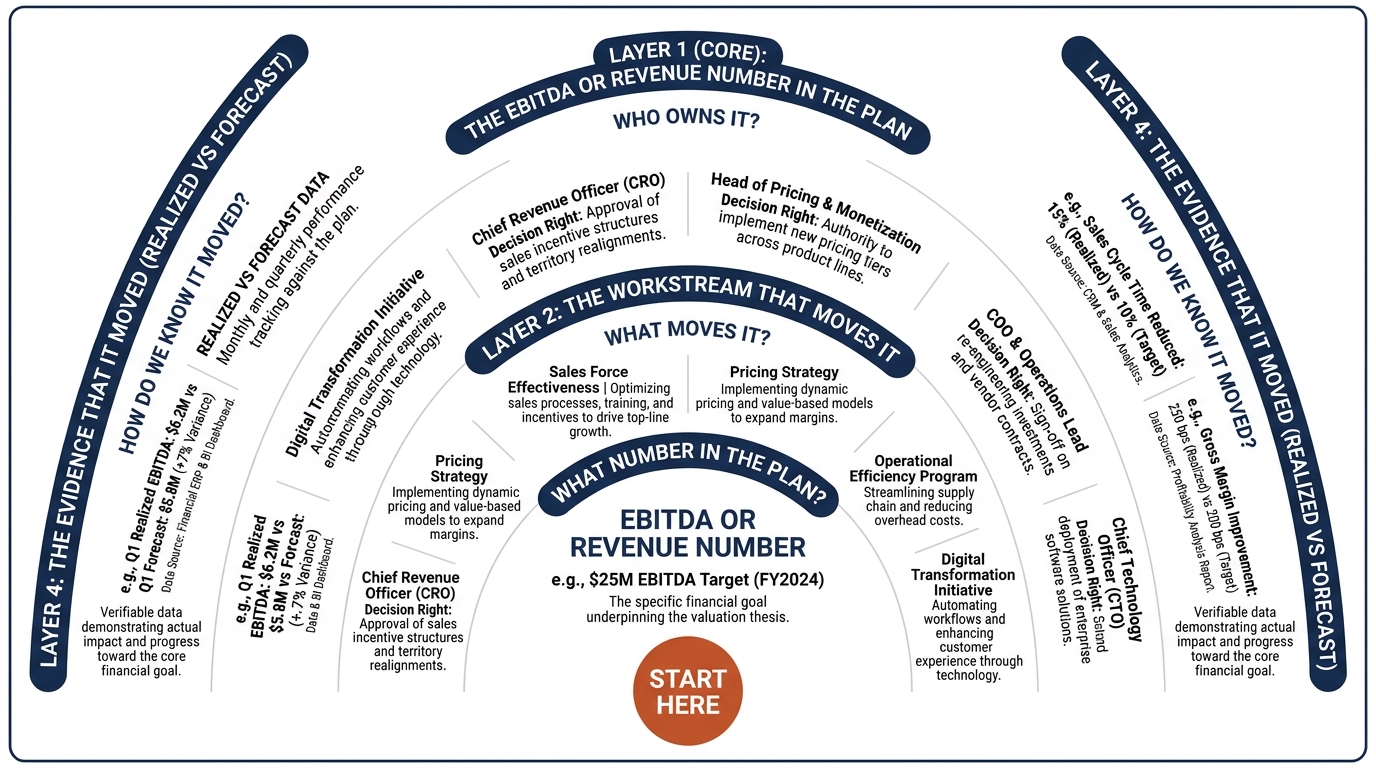
1. Start from the number you are being held to, not the firm's capability list
The firms on your shortlist sell capabilities: commercial strategy, operational excellence, digital, data, pricing. A PE-backed buyer is not purchasing any of those. It is purchasing a measurable move in enterprise value, which for your deal means revenue growth, EBITDA expansion, cash-flow improvement, a faster integration, or a shorter path to exit. Before you read a single proposal, write down the one or two numbers in your value creation plan that this engagement has to move, and the baseline each sits at today.
Bain's annual private equity report has tracked for years how much of the industry's return now comes from operational improvement rather than leverage or multiple expansion, and that shift is why value creation firms exist as a category at all. You can read the current edition of the Bain & Company Global Private Equity Report for the macro picture. The practical consequence for you is narrower: if a firm cannot connect its workstream to the specific line in your plan, it is selling activity.
Ask every firm to classify the impact it is promising. Is it realized value, run-rate value, forecast value, or value that is merely enabled once something else happens? A firm that lets forecast value read as money already in the bank is a firm that will miss its own targets and call it a learning.
2. The large strategy and operations houses
These are the firms a deal partner reaches for when the thesis is big and the value creation plan spans several levers at once: pricing, commercial, footprint, procurement, org design. They bring scale, benchmark data across hundreds of deals, and partners who have sat through many board meetings. McKinsey, BCG and Bain all publish openly on how they think about this work, and reading them is a cheap way to calibrate your questions. BCG's principal investors and private equity practice and McKinsey's private capital research are both worth a session before any pitch.
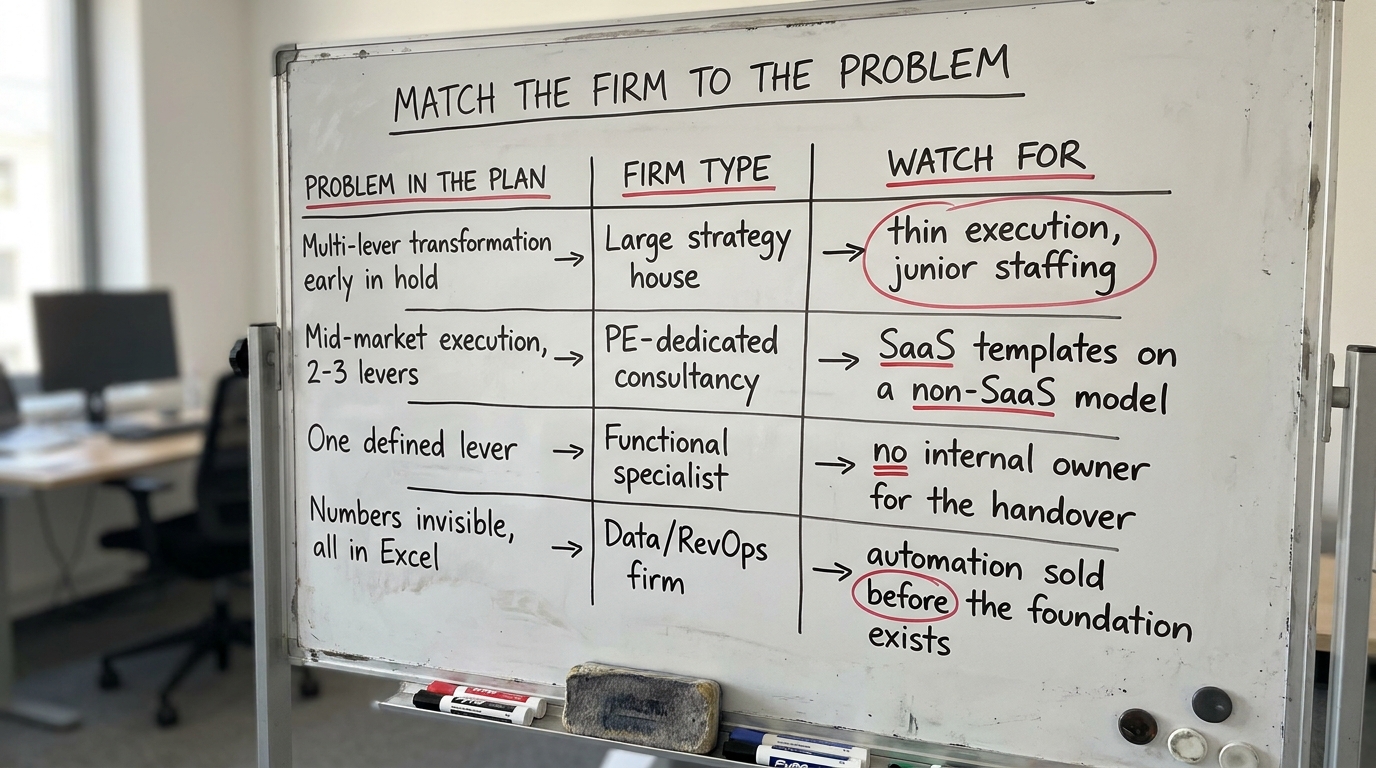
What you are buying here is breadth and credibility with the deal team, and it is expensive. The risk is that the engagement produces a comprehensive plan and thin execution, because the senior people who sold it are not the ones who show up in your portfolio company on a Tuesday. If you go this route, pin down in writing who is on the ground, for how many days a week, and which of them holds a decision right versus a recommendation.
When this fits
Large, multi-lever transformations early in the hold, where the deal partner wants a plan the board will trust and the company can absorb the day rate. It fits less well for a single add-on or a narrow commercial fix, where you are paying for scale you will not use.
3. The PE-dedicated value creation consultancies
A tier of firms exists specifically to serve sponsors and their portfolios, with people who have operated inside companies rather than only advised them. They tend to price below the global houses, move faster, and staff with practitioners. Accordion is one example that works across finance and data in the portfolio; West Monroe and Alvarez & Marsal sit in adjacent spots with operational and restructuring depth. The category has grown because sponsors wanted execution hands, not another slide pack.
The thing to test is whether the firm arrives already fluent in your portfolio company's business model. A distributor, a project-delivery firm and a clinic group do not run on the same economics, and a template built for SaaS applied to any of them produces a plan that does not survive contact with the actual revenue. Preqin's data on fund and manager activity is useful background on which firms sponsors actually retain; their alternative assets data covers the manager universe.
When this fits
Mid-market deals where you need execution capacity more than brand, and where the value creation plan has two or three concrete levers rather than a full transformation. This is the tier most of the top private equity value creation firms your mid-market shortlist should be drawn from.
4. The functional specialists you rent, not the generalists you retain
Some of the most useful firms do one thing. A pricing specialist, a procurement house, a RevOps shop, a data-and-analytics team. You rent them for a defined workstream with a defined number attached, and you do not ask them to run the whole plan. For a portfolio company whose problem is that the commercial basics are not in place, a narrow specialist beats a broad consultancy, because the broad firm will diagnose the same gap and then charge you to fix it through a generalist.
If the gap is that the company runs its revenue engine on Excel and disconnected systems, the right move is often a focused RevOps engagement rather than a strategy study. We wrote about what to rent and what a portfolio company should never hire full-time in RevOps as a service for private equity, and the same rent-versus-build logic applies to pricing, data and demand generation.
When this fits
A single, well-defined lever with a clear owner inside the company who can absorb the output. Specialists fail when nobody internal owns what they hand over.
5. The fractional operator and interim leadership providers
Not every value creation problem requires a consultancy. Sometimes you need a person with a title for a defined period: an interim CRO to fix the commercial engine, a fractional CFO to get the forecast reliable before a refinancing, a fractional CIO to run a systems migration the company cannot staff. These providers sit between a consultancy and a hire, and they are usually cheaper than both for the window you need them.
The judgment is about scope and the title you are actually buying. We covered the traps in hiring a provider for interim CRO work across portfolio companies, in hiring a fractional CFO without buying a title you cannot use, and in buying fractional CIO services without overpaying for a title. The pattern across all three is the same: pay for the decisions the person will own, not the seniority of the business card.
When this fits
A capability gap in one function during a defined window, often the stretch before a permanent hire lands or the push through an integration. It fits poorly when the problem is cross-functional and needs a team.
6. The data and digital value creation firms
A large share of the gap in a mid-market portfolio company is that the business cannot see its own numbers. ERP, CRM and martech do not talk to each other, the company runs on spreadsheets, and the first board pack takes a week to assemble by hand. Firms that fix this connect the systems, build a single model, and get the first dashboards live in days, with finance keeping Excel on the same data and leadership getting a visual view. This is the problem Mario Peshev's framework calls digital value creation from investment thesis to funded work.
The same firms carry digital demand, analytics and increasingly AI search visibility, which matters because buyers now shortlist in AI assistants before they ever contact a vendor. Judge these firms on whether they fix the data foundation before they sell automation on top of it. A firm that pitches advanced AI before the CRM is governed is selling you the roof before the walls. S&P Global and PitchBook both publish on where digital and data spend is landing across the portfolio; see S&P Global Market Intelligence and PitchBook research and data.
At DevriX we run this work as the digital side of private equity value creation, and we pull Semrush keyword and competitor data for the 60+ domains we track when we baseline a portfolio company's demand position.
When this fits
Almost any deal where management visibility is weak, which is most of the lower mid-market. It is the foundation other levers depend on, so it usually goes first.
7. The diligence firms that stay through the first 100 days
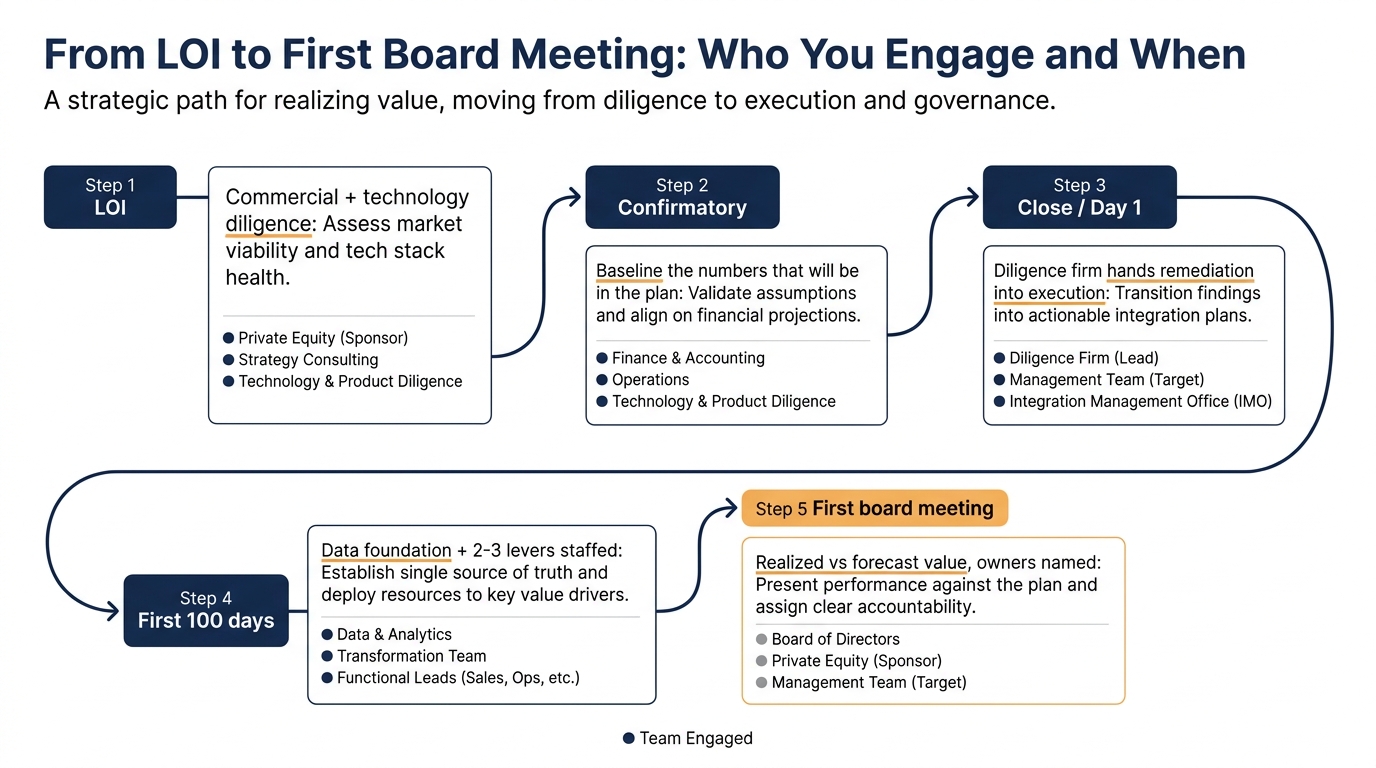
Some of the most valuable value creation work is not labelled value creation at all. It is diligence that was done well enough to hand straight into execution. A commercial due diligence that produces a report nobody can use after close is a wasted spend, and so is a technology diligence that flags risks but does not sequence the fixes. The firms worth keeping are the ones whose diligence output becomes the first draft of the plan.
We wrote about how to avoid buying a diligence deliverable you cannot use in hiring commercial due diligence without buying a report you cannot use, and about the price consequences in digital marketing due diligence that changes the price you pay. On the systems side, a serious technology due diligence should give you a remediation plan you can start on Day 1. The Harvard Law School Forum on Corporate Governance publishes regularly on diligence and governance practice; their archive is a solid reference.
When this fits
Pick these firms before you sign the LOI, not after, because the value is in continuity. A firm that diligences the deal and then owns the remediation knows where the bodies are buried and does not need a month to re-learn the company.
8. The add-on and integration specialists
If your thesis runs on a buy-and-build, the firm that matters most may be the one that integrates the add-ons. Integration is where value creation plans quietly die: two CRMs that never merge, finance closing two sets of books, a sales team selling the old catalogue. The specialists here think in integration dependencies and risk registers, and they sequence the Day 1 and first-100-day work so the synergy case in your deal model actually lands.
We keep two practical references for this. One is the post-merger integration checklist for private equity add-ons, and the other is a 100-day digital integration plan that survives contact with the actual systems. The first 100 days is where most of the integration value is either captured or lost. Harvard Business Review's coverage of mergers and acquisitions is a good external read on why integration, not the deal itself, is where returns are made or missed.
When this fits
Any platform where your deal model prices in synergies from add-ons. Judge the firm on whether it owns an integration outcome, with a dependency map and named owners, or only facilitates meetings.
9. How to run the selection, not just read the list
Once you know which category fits your problem, the selection itself comes down to a handful of checks that filter out the firms that look strong in a pitch and underdeliver in the work.
- Ask who shows up. Get the named team and their days per week in writing, and confirm the partner who sold it is accountable for the result.
- Tie the fee to the number. The engagement should reference the specific line in your plan it moves, with a baseline and a method for measuring the move.
- Test business-model fluency before you hire. A firm that needs constant correction on how your portfolio company makes money will burn weeks you do not have.
- Buy the smallest low-risk first step. A scoped diagnostic or a two-week baseline tells you more than a six-month commitment, and it lets the champion sell the firm internally.
- Watch for the tool seller. A firm that only recommends its own platform is optimizing for its revenue.
Industry data on manager selection and spend is worth keeping close through this. Private Equity International and Buyouts both track which advisers sponsors actually retain and why; see Private Equity International and Buyouts. For the professional-standards view on diligence and forecast reliability, the AICPA & CIMA material is useful, and for the disclosure framing that governs what a firm can represent, the U.S. Securities and Exchange Commission is the primary source.
10. What loses, so you can disqualify fast
Half of selecting well is knowing what to rule out before it eats your time. A few patterns are reliable losers in a PE portfolio context.
- A time-and-materials project that takes months to start and opens at six figures, when an AI-era scoped build should cost tens of thousands and move in days.
- Templates built for one business model applied to a company that runs on a different one.
- Advanced automation pitched before the CRM and data foundation exist.
- A one-off audit with no execution plan attached, which leaves you holding findings and no owner.
- Any firm whose evidence is a logo wall rather than a baseline, a method and a number.
The common thread is that these firms sell activity and let you infer outcome. The firms worth your budget do the reverse: they name the enterprise-value outcome first and show you how the work connects to it. For a specific sector read, we covered how to judge fit before signing in private equity buyers for engineering companies, and the same discipline applies to selecting an adviser as to selecting a buyer.
11. A short checklist before you sign
Run the shortlist through this before the next board meeting, and the choice usually makes itself.
- I can name the one or two enterprise-value numbers this engagement must move, with today's baseline for each.
- The firm's category matches my problem: transformation houses for multi-lever, specialists for one lever, fractional operators for a function, data firms for visibility, integration firms for add-ons.
- I have the named on-the-ground team and their days per week in writing.
- The firm arrived fluent in my portfolio company's business model.
- The impact it promises is classified as realized, run-rate, forecast or enabled, and forecast is not dressed as money in the bank.
- There is a small, low-risk first step I can buy to test the firm before a long commitment.
- The diligence or baseline work hands straight into execution rather than ending as a report.
A firm worth counting among the top private equity value creation firms for your deal will pass all seven without flinching. One that stalls on the baseline question or the named-team question is telling you how the engagement will go.
If you want the digital and data side of this run against your portfolio company's actual numbers, with a scoped first step a deal team can approve, see how we structure private equity value creation at DevriX and bring the specific number you need moved.


