You are two weeks from signing, the growth equity thesis rests on the target doubling inbound pipeline in three years, and the data room gives you a traffic dashboard, a media plan, and an agency that reports leads without saying where they came from. The deal partner wants to know whether the growth story holds. You need to decide, before the price is locked, whether the demand engine you are buying actually works or whether it has been rented month to month and will stall the week the founder leaves. Digital marketing due diligence is how you answer that, and it is one of the few workstreams that can move the number on the term sheet rather than just confirm it.
This guide is written for the person with budget and a decision to make: the operating partner running commercial diligence, the portfolio company executive asked to vet the target's marketing, or the CFO who has to live with the forecast afterwards. It assumes you already know what EBITDA and a QoE are. It walks through what to actually test, how to read the evidence, and where the real risk hides when a seller dresses up paid demand as organic strength.
1. Why digital marketing due diligence belongs in the commercial workstream, not the IT one
Commercial due diligence tends to answer market size, competitive position, and customer concentration. The marketing engine often gets folded into a line item or left to the technology due diligence team, who will tell you the martech stack is on HubSpot and move on. That split leaves a gap, because the tools they run matter less than whether the revenue they report is repeatable and whether it survives the sellers walking out the door.
Bain's annual private equity report has tracked for years how much of the industry's return now depends on operational improvement rather than multiple expansion, which means the quality of the demand engine you inherit is no longer a soft factor. You can read the current picture in Bain's Global Private Equity Report. McKinsey's private capital research makes a similar point about value creation discipline, available through McKinsey. If growth is the thesis, the growth engine deserves the same scrutiny as the P&L.
The output of this work is a view the deal team can price. You are producing a baseline, a risk register, and a short list of what breaks on Day 1. If the engine is weak, that is a negotiation point or a condition, not a surprise you discover in month four.
2. The seven questions that decide whether the growth story holds
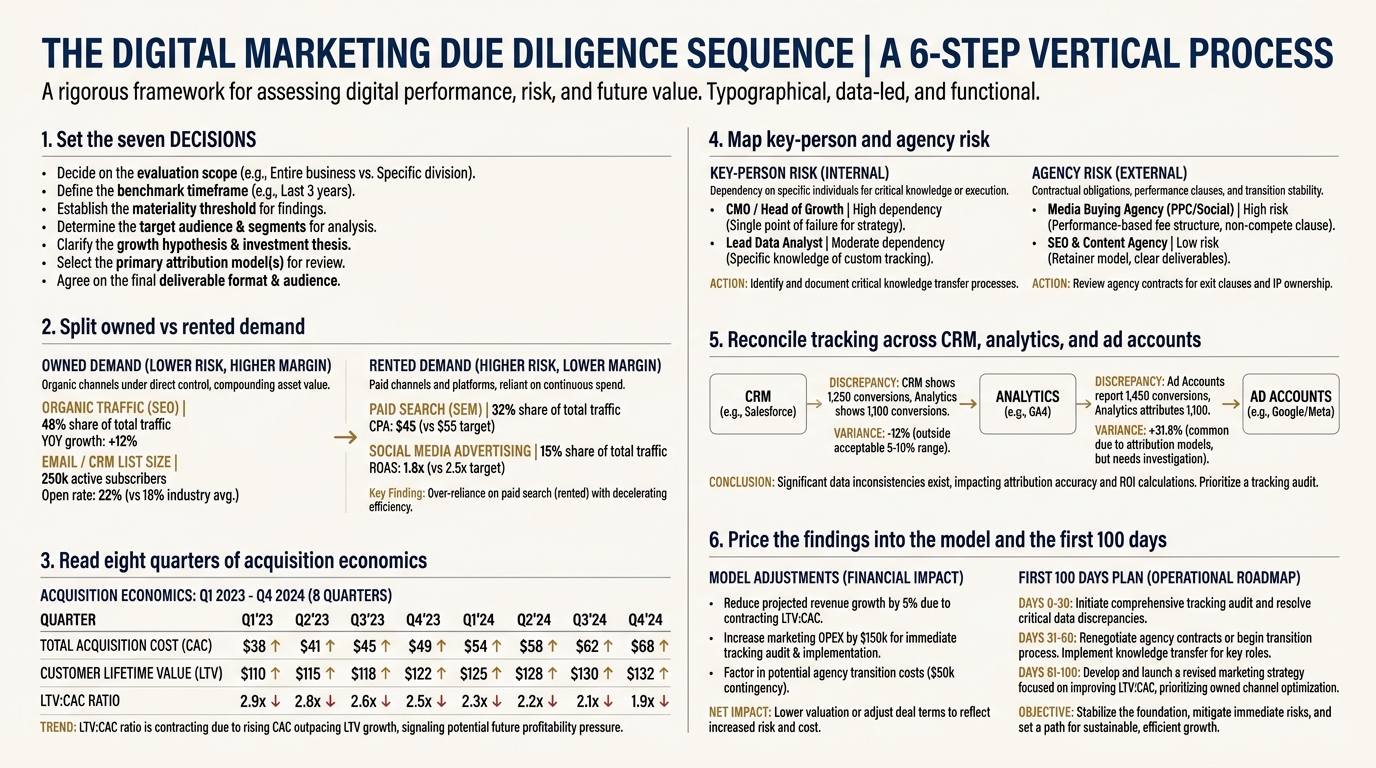
Before you ask for a single file, write down what you are trying to decide. Most digital marketing due diligence drowns in dashboards because nobody set the questions first. Here are the seven that carry the weight.
- Where does qualified pipeline actually come from, by channel, and how concentrated is it?
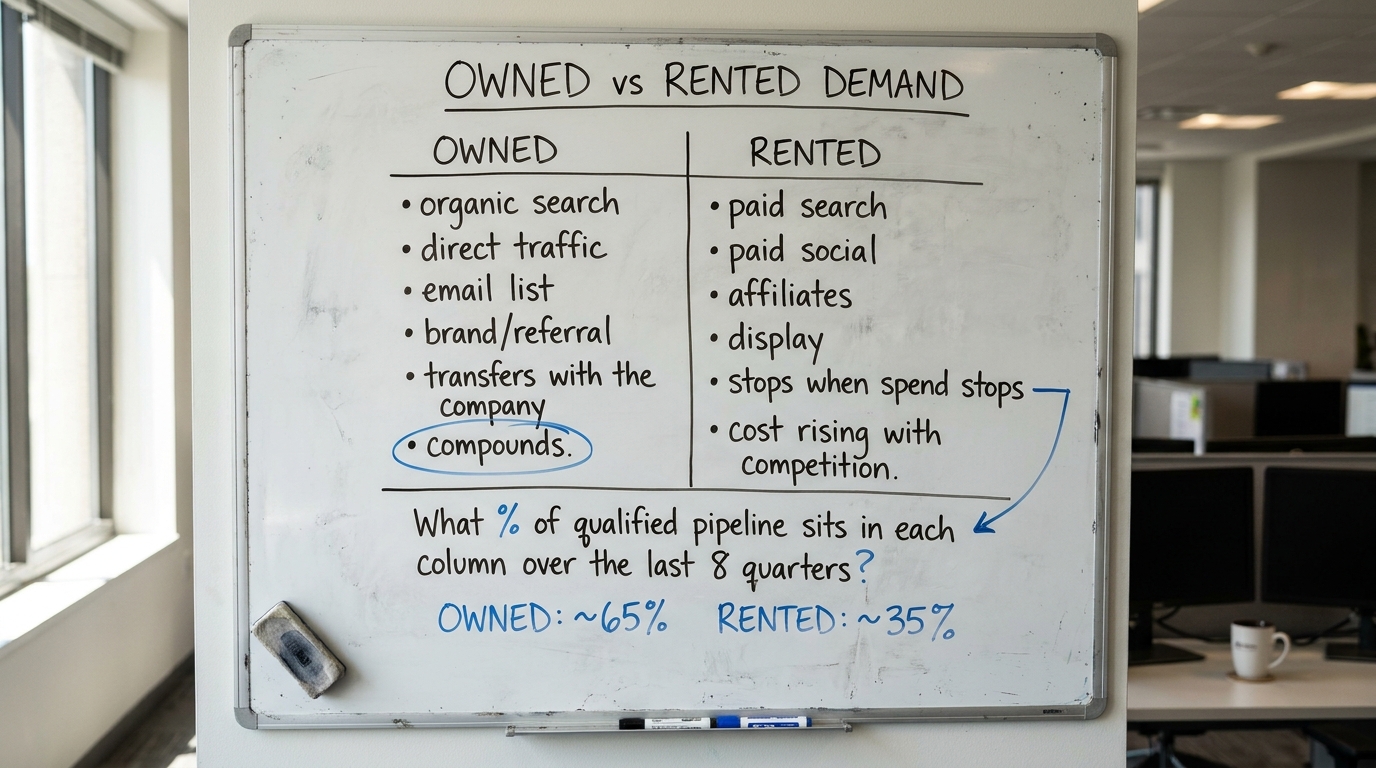
- How much of current demand is owned (organic, brand, email list, direct) versus rented (paid search, paid social, affiliates)?
- What does it cost to acquire a customer, and is that cost rising or falling over the last eight quarters?
- Who holds the knowledge: the team, a founder, or an outside agency that leaves when the deal closes?
- Is the tracking trustworthy, or is attribution inflating results the business cannot repeat?
- What is the brand worth as a demand asset, separate from paid spend?
- What would a competent operator fix in the first 100 days, and what does that cost?
Everything that follows is how you answer these with evidence rather than the seller's narrative. A useful companion read on separating brand strength from spend is this brand capital diagnostic for PE portfolio companies, which goes deeper on question six than I will here.
3. Separate owned demand from rented demand before anything else
This is the single most important cut in the whole exercise. A business that generates leads from organic search, a warm email list, direct traffic, and brand recognition owns an asset that compounds and transfers with the company. A business that buys most of its leads through paid search and paid social owns a monthly bill, and the demand stops the day you pause the cards.
Ask for an attribution breakdown of the last eight quarters, split into owned and paid. Then verify it, because self-reported attribution is where sellers hide the weakness. Pull the actual channel data yourself where you have access: analytics platform exports, ad account spend, and the CRM's source field. On our own network we use Semrush to check a target's organic visibility and competitor position against the story the seller is telling, because a company claiming strong organic demand should rank for the terms its buyers actually search.
The illustrative case I use with operating partners: a target reports lead volume up 30 percent year on year, and it looks like a growth story until you split the channels and find paid spend rose 45 percent over the same period, so the owned engine actually shrank. Both numbers are real. The blend hides which one you are buying.
4. Read the acquisition economics across eight quarters, not one
A single period of customer acquisition cost tells you almost nothing. The trend over two years tells you whether the engine is getting more efficient or quietly degrading while revenue masks it. Ask for blended and paid-only acquisition cost by quarter, alongside the spend that produced it and the conversion rate at each stage of the funnel.
What you are looking for is the direction. Rising acquisition cost with flat conversion usually means the cheap demand has been exhausted and the business is paying more for the same customer, which is a margin problem you will inherit. Falling cost with rising volume is rare and worth confirming twice, because it often turns out to be a tracking artifact rather than real efficiency.
Tie this back to the financial model the deal team is running. If the growth case assumes acquisition cost stays flat while volume triples, and the last eight quarters show cost climbing, the model needs a haircut. That is a finding with a number attached, which is the only kind the investment committee acts on. PitchBook and S&P Global both publish data on deal multiples and sector performance you can use to frame whether the target's economics are normal for its space, at PitchBook and S&P Global Market Intelligence.
5. Find out who actually holds the knowledge
Marketing engines fail in transition far more often than they fail in operation. The reason is usually that the knowledge sat with one or two people, or with an outside agency, and none of it was written down. When the founder who ran paid search by feel leaves at close, the account degrades within a quarter and nobody notices until pipeline drops.
Map the dependency, not the org chart
Ask who sets budgets, who writes the ads, who owns the analytics, and who can explain why last quarter worked. If the honest answer to most of those is the departing founder or a single agency, you have a key-person risk in the demand engine, and it belongs on the risk register with a mitigation plan and a cost. The same logic applies to engineering teams, and the fit questions overlap more than you would expect, which is why this read on judging PE fit for engineering companies is worth your time if the target is technical.
Check the agency contract and the handover reality
If an agency runs demand, read the contract for notice periods, data ownership, and who holds the ad accounts. I have seen deals where the agency owned the Google Ads account outright, which meant the buyer was renting its own historical performance data. That is a Day 1 problem you want priced before close rather than discovered afterwards.
6. Pressure-test the tracking before you trust a single number
Every number in the data room rests on the tracking underneath it, and that tracking is frequently broken in ways that flatter the seller. Attribution models that assign full credit to the last click will overstate paid channels and understate the brand and organic demand that actually drove the purchase. Before you argue about what the numbers mean, confirm the numbers are real.
- Reconcile the CRM's reported lead source against the analytics platform and the ad accounts. Gaps mean the attribution is a story, not a measurement.
- Check whether conversions are deduplicated. Double-counted leads inflate volume and depress apparent acquisition cost.
- Ask which attribution model is in use and what the picture looks like under a different one. If the growth story only holds under last-click, it is fragile.
- Verify that the tracking survived any website migration or platform change in the period you are analysing, because those events routinely break historical comparability.
The RevOps discipline that fixes this after close is the same you use to judge it before. This walkthrough of the CRM you inherit on Day 1 covers the hygiene problems that most often corrupt a target's reported funnel. The AICPA has published guidance on data quality and non-financial metrics that is useful when the tracking feeds the QoE, available through AICPA and CIMA.
7. Judge the brand as a demand asset with a dollar value
Brand sounds like a soft factor until you treat it as the thing that lets a business acquire customers without paying for every click. A target with strong brand recall generates direct traffic, branded search, and inbound referral that cost almost nothing at the margin. A target without it has to buy every lead, which caps margin no matter how well the paid team executes.
Measure it concretely. Branded search volume, direct traffic share, and the gap between what the business pays to acquire a customer through paid versus what it gets for free through brand are all countable. Harvard Business Review's coverage of mergers and acquisitions has useful framing on how intangible assets drive deal value, which you can find at HBR's M&A topic hub. The practical point for diligence is that brand strength lowers the acquisition cost assumption in your model, and brand weakness raises it.
8. Model what a competent operator fixes in the first 100 days
Diligence that only identifies problems is half the job. The half that earns its fee is pricing the fix, because that number flows into both the offer and the value creation plan. For each weakness you find, write down what a competent operator does about it, how long it takes, and what it costs.
Most marketing fixes fall into a short list: rebuild tracking so the numbers are trustworthy, reduce dependence on a single paid channel, document the agency's playbook so it transfers in-house, and shift budget from rented demand toward owned channels that compound. The sequencing of that work in the early months is its own discipline, and the first 100 days plan should carry the marketing workstream with the same rigor as finance and systems.
If there is a parallel acquisition or carve-out in play, the integration adds dependencies that change the plan. This guide to a 100-day digital plan that survives the real systems is the companion piece for that situation, and it covers the migration risks that break tracking continuity.
9. Decide what the findings do to the price and the terms
The reason this workstream sits inside commercial diligence rather than off to the side is that its findings have three possible homes: the price, the terms, or the plan. A weak owned engine that will cost real money to rebuild is a price conversation. A key-person risk in the founder or agency is a terms conversation, resolved through retention, escrow, or a transition clause your counsel drafts. A fixable tracking problem is a plan item that belongs in the first 100 days with an owner and a budget.
Harvard Law School's Forum on Corporate Governance regularly publishes practitioner analysis of how diligence findings translate into deal structure, which you can follow at the Harvard Law School Forum on Corporate Governance. The point for your work is to classify each finding by where it lands, because a risk you cannot route is a risk the deal team cannot act on.
Say what you are confident in and what you are not
Credibility in a diligence report comes from distinguishing what you verified from what you inferred. If you reconciled the CRM against the ad accounts and the numbers tie out, say so plainly. If you could not get agency-level access and the attribution is the seller's self-report, flag it as unverified rather than letting it read as confirmed. The deal team makes better decisions when it knows which findings are solid.
10. How to resource and price the work itself
Digital marketing due diligence runs on a compressed timeline, usually inside confirmatory diligence with two to four weeks and read-only access. You can run it with an internal operating partner who knows the playbook, an outside specialist, or a blend. The deciding factor is whether you have someone who can read channel data at speed and tell the difference between a real trend and a tracking artifact.
On cost, treat it the way you treat any diligence line: scoped to the decision, not open-ended. A focused engagement that answers the seven questions and prices the findings should move in days and cost in the low tens of thousands, not six figures for a months-long study nobody reads before signing. If you are weighing whether to build this capability in-house or rent it, the economics are covered in this piece on buying a value creation office as a service, and the general question of what a diligence quote should cost is addressed in what a portfolio company audit should cost.
Preqin and Private Equity International both track how firms are staffing operational diligence and value creation functions, useful context if you are deciding where this capability should live, at Preqin and Private Equity International.
11. The due diligence checklist you can hand to the team
Here is the whole exercise compressed into a list you can work through with the target. Each item maps to a decision, not an activity.
- Get the eight-quarter attribution split into owned and paid demand, and verify it against raw channel data.
- Calculate blended and paid-only acquisition cost by quarter and chart the trend, not the latest number.
- Reconcile CRM lead source against analytics and ad accounts; flag every gap as unverified.
- Confirm which attribution model is in use and whether the growth story survives a different one.
- Map who owns budgets, creative, analytics, and institutional knowledge; mark key-person risk.
- Read the agency contract for notice, data ownership, and account custody.
- Measure brand strength through branded search, direct traffic, and the free-versus-paid acquisition gap.
- Check that tracking survived any migration or platform change in the analysis window.
- Price each weakness as a first-100-days fix with an owner, a timeline, and a budget.
- Route every finding to price, terms, or plan, and label what you verified versus what you inferred.
Two related reads round this out. If the broader question is who should own the commercial playbook across the portfolio, this piece on what a portfolio operations advisor should actually do is the right follow-on, and the cadence problem of keeping the plan current is covered in the value creation plan you refresh every quarter. For deal-level context on how diligence findings are trending across the market, PE Hub and Buyouts publish ongoing coverage at PE Hub and Buyouts, and the SEC's filings database at the U.S. Securities and Exchange Commission is where you confirm the financial claims that marketing data is supposed to support. BCG's principal investors research adds the operational value creation angle at BCG.
12. What this changes about the deal
Done properly, this workstream turns the growth thesis from a story the seller tells into a baseline you can price. You know how much demand the company owns versus rents, whether the acquisition economics are improving or degrading, who you need to retain, and which numbers you can trust. Each of those becomes a line in the model, a clause in the agreement, or a task in the first 100 days with a name against it. That is the difference between inheriting a demand engine and inheriting a monthly bill you did not understand until the pipeline dropped.
If you want this run on a live deal, DevriX offers digital marketing and commercial diligence scoped to the seven decisions above, built for private equity deal teams and portfolio companies. Bring us in during confirmatory diligence and we will tell you, with the raw channel data behind it, whether the growth story holds.


