You are three months from close on a lower-middle-market deal, the value-creation plan exists as a slide, and nobody on either side owns the quarterly job of turning that slide into measured EBITDA movement. Hiring a full in-house value creation team costs more than the asset can carry at this check size, and your operating partner is already covering four other portfolio companies. A value creation office as a service is the usual answer to that gap, and the decision in front of you is not whether the function is useful but what you are actually buying, who owns the decision rights, and how you will know within two quarters whether it is working.
This guide is for the buyer with budget and a live mandate: the operating partner, the deal team member who inherits portfolio oversight, or the portfolio-company CEO who has been told to professionalize before the next board cycle. It walks through what the service covers, what it should never cover, and how to judge a provider before you sign. It will not define what value creation is or explain the fund model, because if you are reading this you already run inside it.
1. The problem a value creation office as a service is meant to solve
The structural issue at the lower end of the market is that the value-creation agenda is real but the recurring workload is lumpy. You need intense work in the first 100 days, a quarterly cadence of refresh and board prep after that, and occasional deep dives when a workstream slips. A full-time director of value creation sits mostly idle between those peaks, and a management-consulting engagement priced at a large firm's day rate burns the budget before you reach the second initiative.
Bain's annual private equity report has tracked for several years how hold periods have lengthened and how returns depend more on operational improvement than on multiple expansion or leverage, which you can follow in the Bain & Company Global Private Equity Report. When the return math leans on operating gains, the office that plans and tracks those gains stops being optional. The question is only how you staff it for an asset that cannot afford a standing team.
A value creation office as a service answers that by renting the function: a defined scope of planning, tracking, cadence and selected delivery, run by an outside team on a retainer or a fixed-scope engagement, with decision rights that stay inside the deal. Done well it covers the peaks and the quarterly grind without the fixed cost. Done badly it becomes an expensive status-report factory that produces decks nobody acts on.
2. What you are actually buying, workstream by workstream
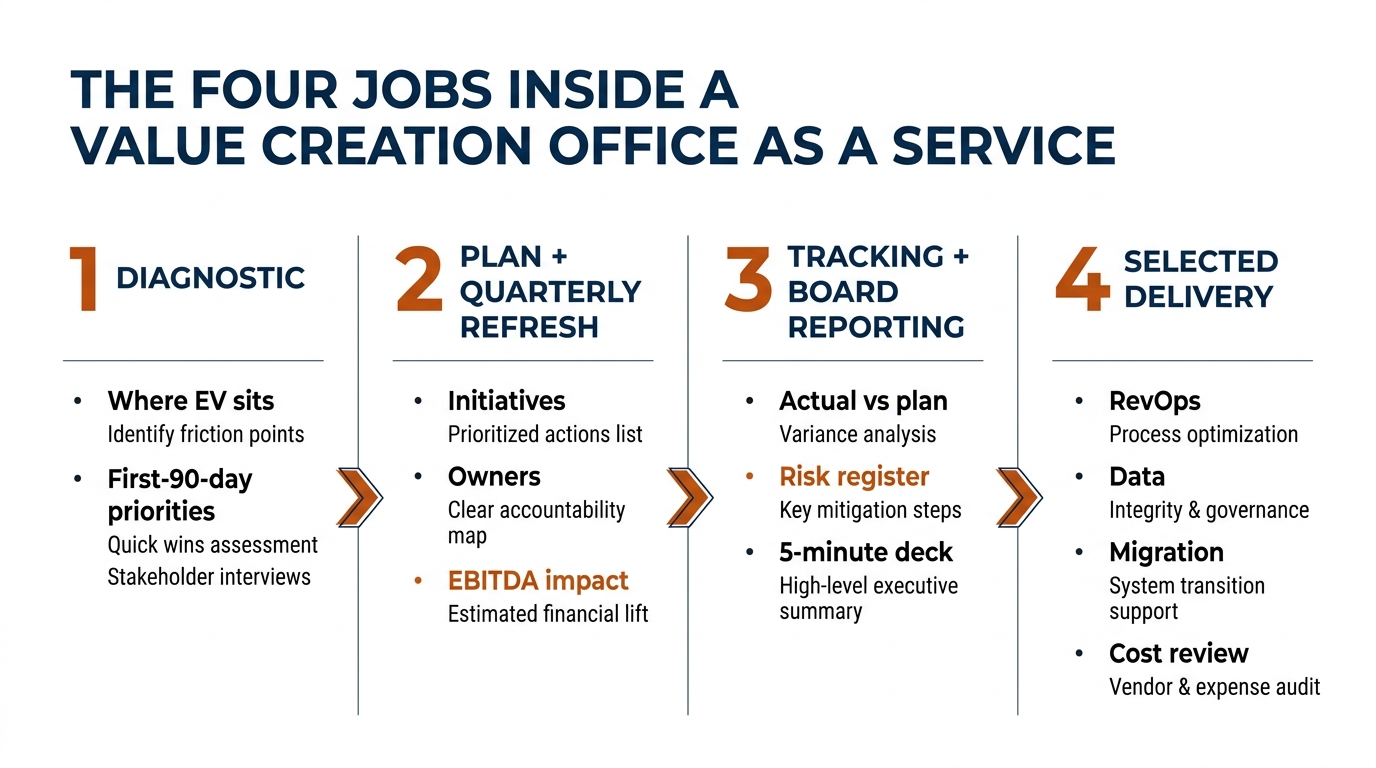
Before you compare providers, write down the specific workstreams you expect the service to own. The phrase covers at least four distinct jobs, and most disappointment comes from a buyer assuming all four are included when the contract only funds one.
The value-creation plan and its refresh cadence
The first job is building the plan and keeping it current. A plan that is written once at close and reopened only when someone drafts the exit memo is a liability, not an asset, as argued in The Value-Creation Plan Nobody Reviews Until the Exit Memo. The service should own a living document, refreshed on a quarterly rhythm rather than an annual one, with initiatives tied to named owners and expected EBITDA impact. The case for the shorter cycle is laid out in The Value-Creation Plan You Refresh Every Quarter, Not Every Board Cycle.
The diagnostic that sets the first 90 days
The second job is diagnosis: finding out where the enterprise value actually sits and where the first effort pays back fastest. This is what a portfolio company audit produces, and it is the part most worth buying from outside because the provider has seen the pattern across companies and the internal team has seen one. The logic of sequencing the first 90 days off a diagnostic is covered in The Portfolio Company Value Creation Diagnostic That Tells an Operating Partner Where to Spend the First 90 Days.
The tracking and board reporting layer
The third job is measurement: actual versus plan, a risk register that someone updates, and a board deck a sponsor can read in under five minutes, which is the standard set out in Board Reporting for a PE Portfolio Company. This is the recurring grind that a part-time office handles well because it is structured, repeatable and does not need a full-time head.
Selected delivery on specific workstreams
The fourth job is doing the work, not just planning it. RevOps cleanup, data visibility, a systems migration, a cost review. Some providers plan and track but hand delivery back to management, others deliver on a named subset. Decide which model you want before the first call, because a provider who only plans leaves you holding the execution risk you were trying to offload.
3. What the service should never own
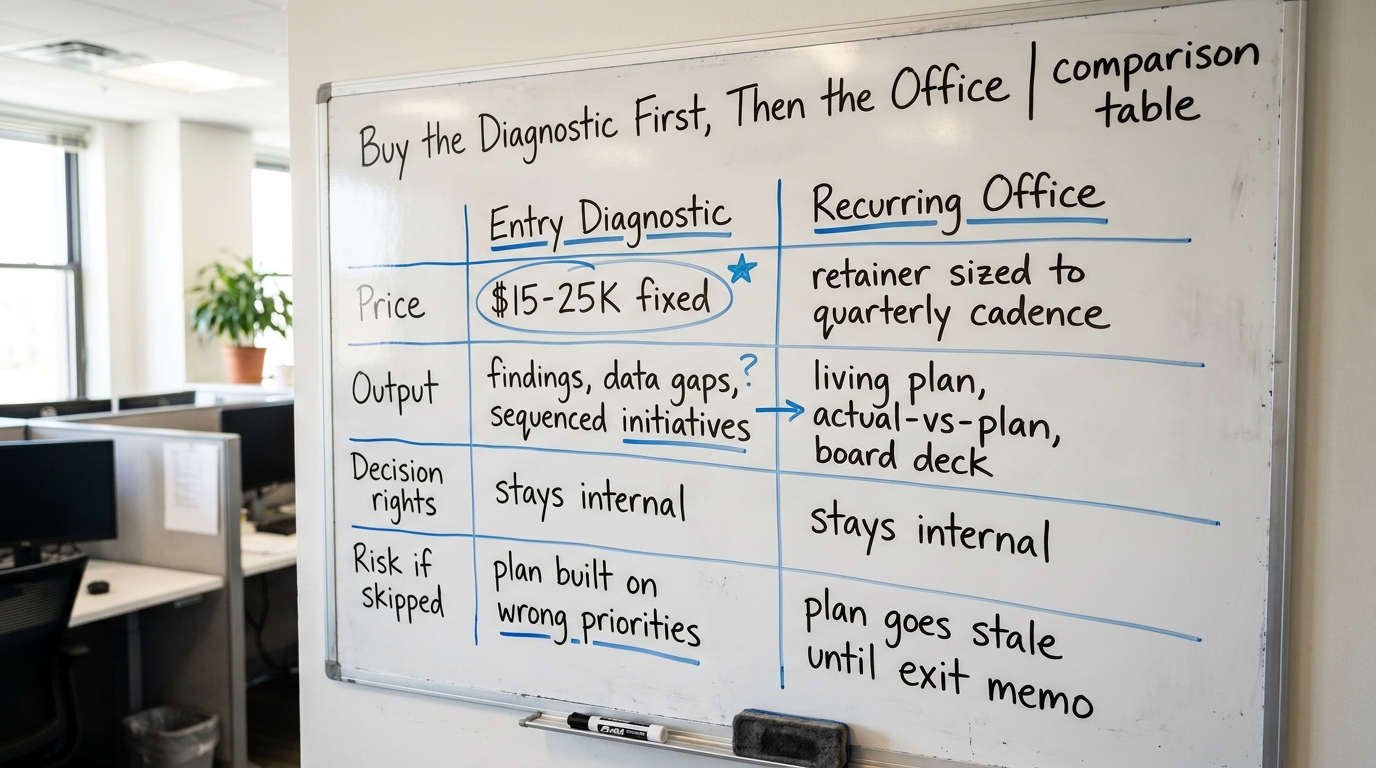
Decision rights are the line that separates a useful outside office from a dependency you cannot unwind. The provider builds the plan, tracks it, and recommends. The deal team and the portfolio-company CEO decide. If you let an outside team hold the capital-allocation calls, the hiring decisions or the final say on which initiatives proceed, you have not rented a function, you have outsourced governance, and you will discover the cost at exit when the buyer's diligence finds no internal owner of anything.
Harvard Law School's governance forum publishes extensively on board and oversight structures in private-equity-backed companies, worth reading at the Harvard Law School Forum on Corporate Governance, and the consistent theme is that accountability has to land on named internal people. The service feeds those people better information and takes the recurring load off their calendar. It does not replace them as the accountable party.
Two practical boundaries follow. First, the provider should not be the only place a given dataset lives; read-only connections and exportable artifacts mean you can walk away with the work. Second, the provider should not write its own renewal case by controlling the metric that measures it. Keep the actual-versus-plan reporting auditable by your CFO or finance lead.
4. How to scope it against the size of the asset
The spend has to fit the enterprise value it protects. A portfolio company audit as the entry engagement typically runs in the $15,000 to $25,000 range, which is a defensible number to put in front of a deal team because it buys the diagnostic and the initial plan without committing to a standing cost. The recurring office that follows should be priced as a retainer sized to the quarterly cadence, not as an open-ended consulting relationship.
Benchmark the quote against what the work costs to build today, not against what a large advisory firm charged five years ago. Tooling and AI-assisted data work have moved entry-level diagnostic and reporting costs down, and a quote that still starts in six figures for a lower-middle-market asset is pricing you a structure you do not need. PitchBook and S&P Global both publish deal and operating data useful for sizing, available at PitchBook and S&P Global Market Intelligence, and McKinsey's private capital research, at McKinsey, tracks how operating-improvement spend maps to returns across hold periods.
A simple test: if the annual cost of the service exceeds a few percent of the EBITDA improvement you expect it to help deliver, the math does not work and you should either narrow the scope or question the plan's targets.
5. Judge the provider on the diagnostic, not the deck
The fastest way to separate a real provider from a slide factory is to buy the diagnostic first and judge what it tells you. A good portfolio company audit arrives with findings specific to your business model, not a template built for a SaaS company and applied to a distributor or a clinic group. It names where the enterprise value sits, flags the data you cannot currently see, and sequences the first initiatives by payback, not by what the provider is best at selling.
The reasoning behind buying the diagnostic as a low-risk first step, and what it should contain, is set out in A Portfolio Company Diagnostic for Private Equity That Tells You What to Fix First. Ask for a redacted example of a prior diagnostic. If the provider cannot show you the shape of the output, you are buying a promise.
Three things a serious diagnostic covers
- A read on where the company's reporting actually breaks: which numbers live in Excel, which systems do not talk to each other, and what the business cannot currently see about itself.
- A sequenced list of initiatives with expected impact and effort, so the first 90 days go to the work that pays back first rather than the work that is most visible.
- An honest account of what the current management team can run and where capability has to be added, rented or replaced.
6. The data foundation question you have to answer early
Most value creation plans stall on the same thing: the company cannot see its own numbers. The ERP, the CRM and the marketing stack are disconnected, the business runs on spreadsheets, and every board report is hand-assembled. No amount of planning cadence fixes a company that cannot produce reliable actuals.
So the early question for any value creation office as a service is how it handles the data layer. The right answer is read-only connections into the existing systems, a unified model, and the first dashboards in days rather than months, with finance keeping its spreadsheets on the same underlying data and leadership getting a visual view with insights flagged. The sequence matters: fix the reporting hygiene before building anything clever on top of it. The equivalent discipline on the revenue side, cleaning the CRM you inherit before touching pipeline, is covered in RevOps for PE-Backed Companies.
7. Fit it to the deal timeline, not the calendar
The value of the office changes depending on where the deal sits. During confirmatory diligence, the diagnostic doubles as a check on the thesis: if the planned EBITDA improvement depends on data the company cannot produce or systems that cannot scale, you want to know before close. This overlaps with technology due diligence, and the two are worth running together rather than in sequence.
At Day 1 and through the first 100 days, the office is at its most intensive: the diagnostic lands, the plan is built, owners are named, and the first dashboards go live. This is the peak the service is designed to cover without a permanent hire. After that, the work settles into the quarterly cadence of refresh, tracking and board prep, which is where a part-time office earns its keep against a full-time one.
Tie the engagement structure to these triggers explicitly. A retainer that bills flat from Day 1 overcharges you in the quiet quarters; a pure project fee leaves you re-contracting every time a workstream slips. A staged structure, heavier at the start and lighter in the cadence phase, matches the actual workload.
8. How this differs from an operating partner and a cost consultant
Buyers conflate three roles, and the overlap causes both double-spend and gaps. An operating partner is accountable, sits closer to the fund, and covers a portfolio; the office is a resource that partner directs, not a replacement for them. The distinction is drawn out in What a Portfolio Operations Advisor for Private Equity Should Actually Do For Your Deal and in How to Choose an Operational Value Creation Firm for a Portfolio Company.
A cost optimization consultant is narrower still: brought in to find spend reductions, often on a one-off basis, and worth hiring carefully because a cut that breaks delivery destroys more value than it saves, as laid out in How to Hire a Cost Optimization Consultant Without Buying a Spend Cut That Breaks Delivery. The value creation office sits above both: it holds the plan that a cost review feeds into and that an operating partner uses to direct the portfolio.
If you are also integrating back-office functions, the office intersects with HR and payroll decisions such as portfolio company PEO integration, and the plan should name those dependencies rather than leave them to surface mid-integration.
9. The contract terms that protect you
Four terms decide whether you can run the relationship on your terms rather than the provider's.
Exit and data portability
You should be able to end the engagement and keep every artifact: the plan, the dashboards, the underlying data model and the reporting templates. Insist on exportable formats and read-only connections you control. A provider who holds your data hostage has engineered a renewal you cannot refuse.
Named people, not a logo
Contract for the specific people who ran the diagnostic, not a firm that may staff your account with whoever is free. The quality of a value creation office is the quality of the two or three people doing the work.
A short initial term with a real break
Structure the first engagement so you can judge it on the diagnostic and the first quarter before committing to a longer cadence. A three-month committed term with a clear review point is enough to see whether the actuals move and whether management adopts the plan.
Metrics your finance team can audit
The actual-versus-plan reporting must be reproducible by your CFO from the source data. If only the provider can produce the number that justifies the provider, you have lost the ability to judge them. AICPA and CIMA publish relevant guidance on management reporting integrity at AICPA & CIMA, and for any question touching disclosure or governance the U.S. Securities and Exchange Commission is the primary reference.
10. What good looks like after two quarters
Set the bar you will judge the service against before you sign, so the renewal decision is evidence-based rather than a matter of whether the relationship feels good. BCG's work on operating-model improvement in private equity, at BCG, and Harvard Business Review's M&A coverage, at Harvard Business Review, both reinforce that the signal is movement in the operating numbers, not the volume of analysis produced.
Two quarters past Day 1, you should have a living plan with named owners, dashboards that produce reliable actuals, a board deck the sponsor reads without a translator, and at least one initiative moving against baseline. The actual-versus-plan picture should be honest enough that you can reallocate effort based on what is working. If after two quarters the office has produced more decks than movement, you are paying for activity, and the renewal should be a no.
11. A buyer's checklist before you sign
- Scope: have you written down which of the four jobs (diagnostic, plan, tracking, delivery) the contract actually funds, and which stay with management?
- Decision rights: are capital, hiring and go/no-go calls explicitly reserved to the deal team and the CEO?
- Entry engagement: are you buying the portfolio company audit first, in the $15-25K range, before committing to a recurring retainer?
- Data layer: does the provider offer read-only connections, a unified model, and first dashboards in days, with finance keeping Excel on the same data?
- Evidence: have you seen a redacted prior diagnostic so you know the shape of the output?
- People: are the specific individuals named in the contract?
- Portability: can you exit and keep the plan, dashboards, data model and templates?
- Auditability: can your CFO reproduce the actual-versus-plan numbers from source?
- Pricing: does the annual cost sit well under a few percent of the EBITDA improvement it supports?
- Cadence: is the engagement staged heavier at Day 1 and lighter in the quarterly phase, tied to real triggers?
Run that list against any quote and most of the weak providers fall out before you have spent a dollar. The ones left are the ones worth a diagnostic. For a wider view of how these engagements fit the fund model, the resources at Preqin, Private Equity International, Buyouts and PE Hub track how operating teams are structured across the market.
12. Where to start
The lowest-risk way into this is the diagnostic, because it tells you whether the plan you are about to fund is pointed at the right initiatives and whether the company can even produce the numbers to track them. It is a small, fixed-scope commitment that earns the right to the recurring work rather than assuming it.
If you want that entry engagement run on your asset, the private equity portfolio company audit from DevriX and GrowthShuttle delivers the diagnostic, the data-visibility read and the sequenced first-90-day plan as a fixed-scope engagement you can judge before committing to anything recurring. Start there, judge the findings, and let the output decide whether you build the standing office or keep renting it.


