If you are heading into the first 100 days on a newly closed platform, or you just inherited a portfolio company where HR runs on a Professional Employer Organization, the PEO question lands on your desk fast. The management team likes it because payroll, benefits and compliance are handled. The deal team flagged it in diligence as a line item. And now someone has to decide whether to keep it, replace it, or unwind it, because that decision touches benefits renewal, headcount reporting, employee data ownership and the reliability of the people numbers you are about to forecast against. Portfolio company PEO integration is rarely the headline value lever, but handled badly it quietly erodes margin, delays reporting and creates an exit-readiness problem you will meet again at the next diligence.
This guide is for the operating partner, portfolio CFO or portfolio CEO with budget and a decision to make, not for someone learning what a PEO is. The goal is to give you the small set of decisions you actually own, the evidence to demand, and a way to judge whether the current arrangement helps or hurts enterprise value.
1. Why the PEO question shows up on an operating partner's desk at all
Smaller platforms, especially in services, trades, healthcare and multi-site consumer businesses, often outsource the employer-of-record function to a PEO before you buy them. The founder did it to avoid building an HR department, and it worked for a company of 40 people. At 120 people across three acquisitions, the same arrangement starts to cost more than it saves and obscures data you need.
The commercial consequences are concrete. PEO fees are usually charged as a percentage of payroll or per employee per month, so they scale with headcount growth rather than with the work performed. Benefits sit inside the PEO's master plan, which means you do not fully control renewal timing or plan design. And employee data, the system of record for one of your largest cost categories, lives in a platform you do not own.
Bain's annual private equity report has tracked how value creation has shifted toward operational improvement rather than financial engineering, and labor cost and HR infrastructure sit squarely inside that operational work. You can read Bain's ongoing coverage in its Global Private Equity Report. The PEO decision is a small, unglamorous version of that same shift.
2. The five decisions you actually own
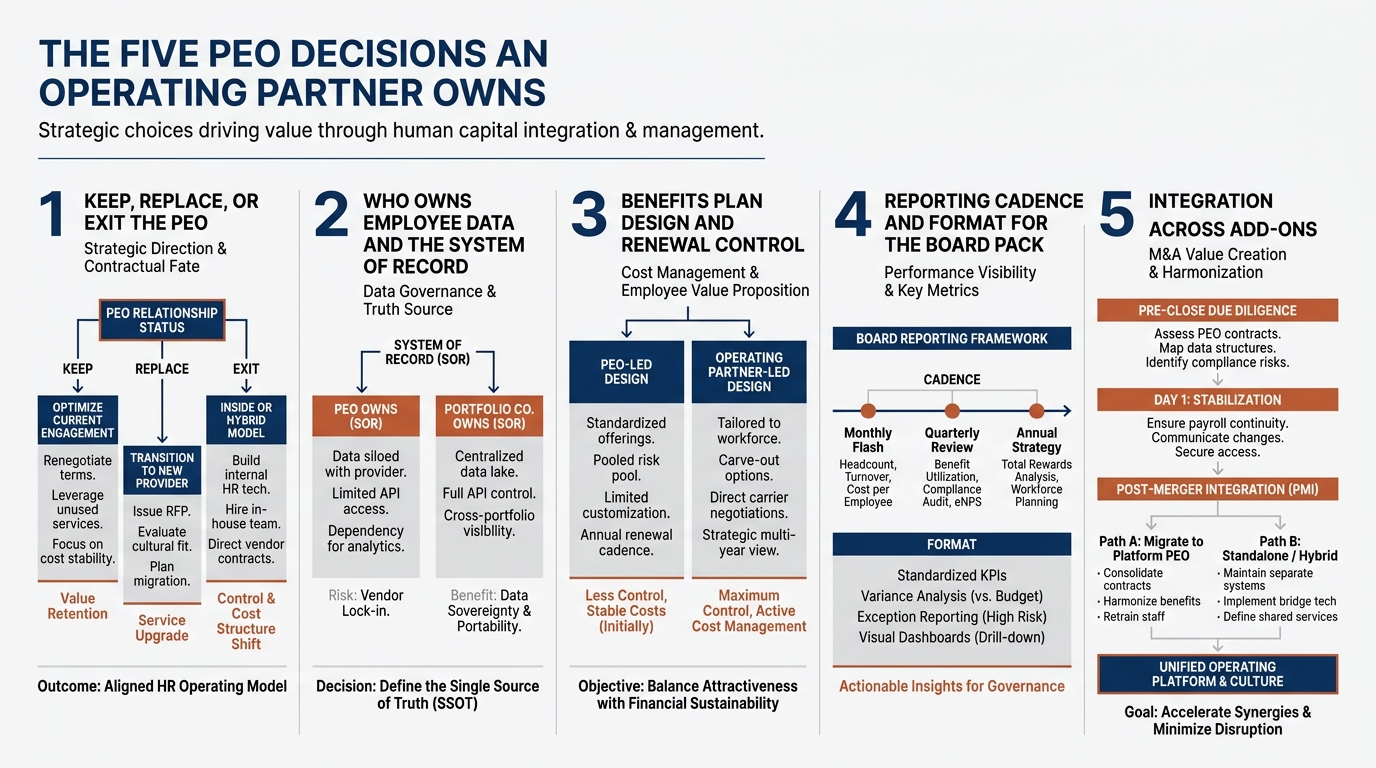
Most of the noise around PEOs comes from treating this as one big yes-or-no. It is five separate decisions, and you can make them at different times.
- Keep, replace, or exit the PEO entirely. This is the headline decision and the one everyone jumps to first, usually too early.
- Who owns employee data and in what system. You can keep a PEO and still insist on a clean, exportable system of record under your control.
- Benefits plan design and renewal control. Deciding whether the PEO's master plan serves your population or whether you sponsor your own plans.
- Reporting cadence and format for the board pack. What the PEO must deliver, when, and in what shape so your people numbers are reliable.
- Integration sequencing across add-ons. Whether each acquisition joins the PEO, stays separate, or moves onto a shared platform.
The mistake I see most often is a brand-new operating partner deciding to rip out the PEO in month two because it feels like obvious cost to cut, before anyone has priced the transition or secured the data. The decision that matters first is data ownership, not the contract.
For a broader frame on how to sequence operational work and when to bring in outside help, the guide on how to choose an operational value creation firm for a portfolio company is a useful companion to this one.
3. Start with the evidence, not the opinion
Before anyone argues for keeping or dropping the PEO, you need a baseline. The management team's view is usually anchored on convenience, and the deal team's view is usually anchored on cost. Neither is a baseline. A baseline is a short, documented set of facts that both sides accept.
The numbers to pull first
- Total PEO cost over the last 12 months, split into administrative fees, benefits premiums, and any pass-through charges.
- Headcount by entity and location, with full-time, part-time and contractor split.
- Benefits participation and claims experience, if the PEO will release it (many resist, which is itself a finding).
- Workers' compensation and unemployment insurance rates and how they are set.
- Any state registration or compliance obligations the PEO currently carries on your behalf.
The last point matters more than it looks. When a PEO acts as the employer of record, it holds registrations, tax IDs and compliance filings in its own name for your workforce. Exiting means re-establishing those in your entity, which takes time and sequencing. That is why the data and compliance picture, not the fee, usually governs how fast you can move.
McKinsey's work on private capital has repeatedly made the point that operational data quality is the binding constraint on value creation, and HR data is among the messiest categories in a lower-middle-market company. You can follow that research through McKinsey's private capital research.
4. How to judge whether the current PEO helps or hurts enterprise value
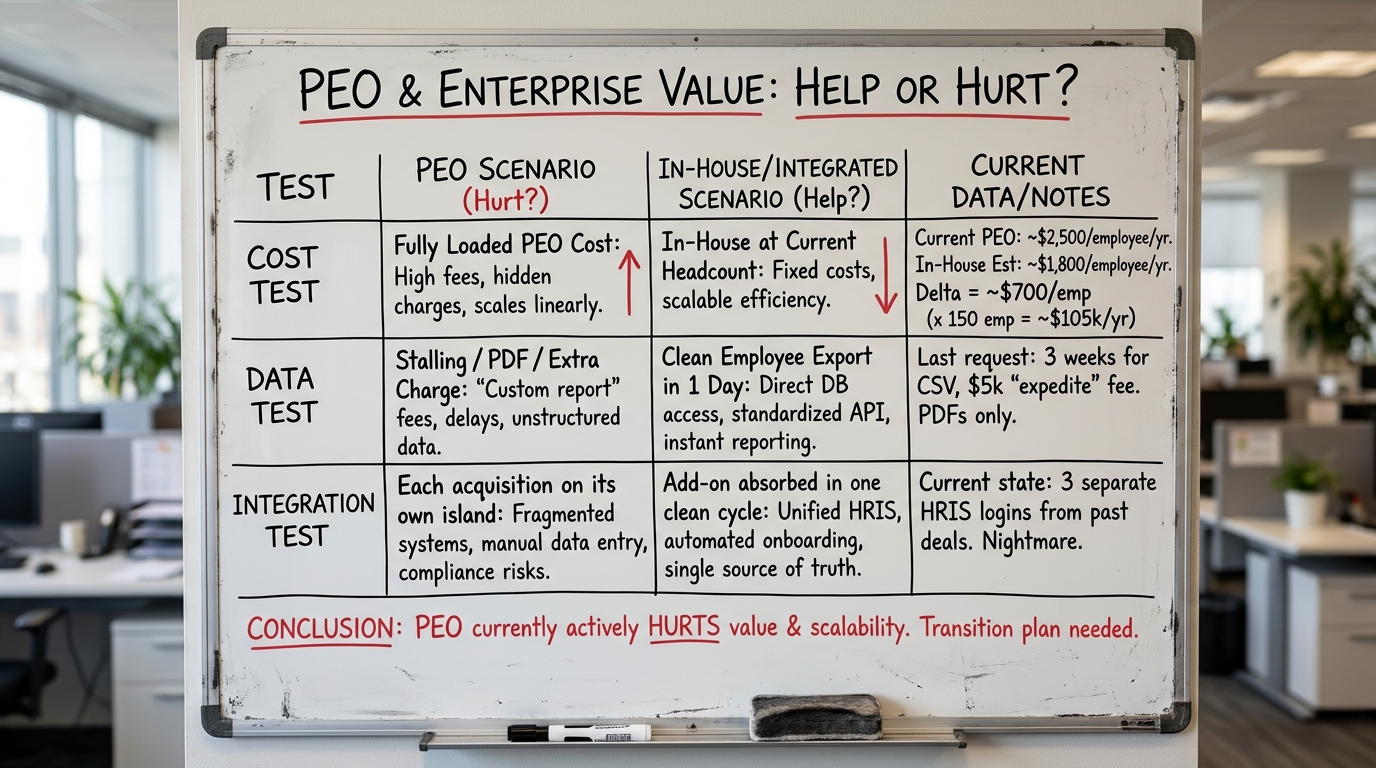
Keep the test simple and tie it to value, not to feelings about the vendor. A PEO arrangement helps enterprise value when it does three things: it keeps blended labor administration cost below what you would spend to run it internally at your current scale, it produces clean and timely data, and it does not block add-on integration. It hurts enterprise value when any of those three fails.
The cost test
Compare the fully loaded PEO cost against the realistic cost of in-house HR, payroll and benefits brokerage at your headcount. Realistic means including the HR hire, the payroll platform, broker fees and the management time. At 40 employees the PEO usually wins. Somewhere between roughly 75 and 150 employees, depending on geography and complexity, the math flips. Do not guess where you sit; model it.
The data test
Ask for a standard export of employee records, compensation history and benefits enrollment. If you get a clean file in a day, the data is healthy. If the PEO stalls, charges for it, or hands you a PDF, you have found a reporting and exit-readiness risk that will resurface at your own sale.
The integration test
When you buy an add-on, can its employees move onto the same platform in a clean cycle, or does each acquisition stay on its own island? A PEO that cannot absorb add-ons without months of manual work is a drag on your buy-and-build thesis.
These tests belong in the same discipline you would apply to any specialist you let near the business. The approach in how to judge a margin expansion consultant before you give one a portfolio company applies here almost directly: demand evidence, define the decision rights, and name the owner.
5. The data ownership decision comes before the contract decision
This is the single piece of sequencing most teams get backwards. You can argue about whether to keep the PEO for months. What you cannot afford to delay is securing control of your own employee data.
Insist on three things regardless of which direction you choose on the contract. You want a documented, scheduled export of the full employee dataset in a structured format you can load elsewhere. You want written confirmation of who holds which compliance registrations and filings. And you want clarity on what happens to historical records if you leave, because benefits claims history and prior payroll records have real value in a dispute or an audit.
Treating the data as a live diligence workstream, rather than a contract afterthought, is the operator move. It is the same instinct that drives a serious technology due diligence process, where the question is never just what the system does but who controls the data and whether you can get it out cleanly.
If you are building the systems picture across the portfolio, the related work on IT cost optimization in private equity covers how HR and payroll platforms fit the wider software and vendor stack you are rationalizing.
6. Sequencing the decision against the deal calendar
The PEO decision has natural trigger points, and acting at the wrong one creates avoidable cost.
During confirmatory diligence
This is when you get the cleanest look. Request the PEO cost history, the service agreement, the data export terms and the exit provisions as part of the diligence request list. If the target's team cannot produce the service agreement quickly, note it on the risk register. The goal in this window is to know what you are inheriting and what it costs to change.
In the first 100 days
This is when you set up data ownership and reporting, not when you unwind the contract. Lock the export schedule, confirm the compliance registrations, and define exactly what the PEO must deliver into your board pack and on what dates. The work in this window is about securing control of the system of record, because that control determines exit readiness three or five years out. A clean approach to this window is covered in the first 100 days playbook, which treats reporting reliability as a foundation rather than a later cleanup.
At the first benefits renewal
Benefits renewal is the real decision window for plan design and for exiting a PEO master plan. Renewals run on an annual cycle with firm deadlines, so you need to start the analysis several months ahead. Missing the window usually means another full year locked into terms you did not choose.
Ahead of each add-on close
Decide integration sequencing before the add-on closes, not after. If the plan is one shared platform, the add-on's employee onboarding should be built into the integration plan from Day 1, with a named owner.
The broader logic of sequencing operational moves against the deal clock sits inside private equity value creation work generally, where timing a change to a natural renewal or integration window often matters more than the change itself.
7. What good reporting from a PEO actually looks like
A large share of PEO frustration is really a reporting problem. The administration works fine, but the numbers arrive late, in a format nobody can use, and they do not reconcile with the board pack. That failure quietly damages forecast reliability, which is the thing a CFO is judged on.
Define the reporting standard in writing and hold the PEO to it:
- Monthly headcount by entity and location, reconciled to payroll, delivered by a fixed working day each month.
- Fully loaded labor cost in a structured file, split into base, variable, benefits and employer taxes.
- Benefits cost and participation trends, so you can see renewal exposure coming.
- Turnover and new-hire data, so the people story in the board pack is grounded in fact.
If the current arrangement cannot produce this, that is a concrete, costed reason to change platforms, and a far better argument than a vague sense that the PEO is expensive. The discipline of choosing the right operational metrics, rather than every available one, is the same thinking behind the guide on the best help desk metrics for team productivity: pick the numbers that drive a decision and ignore the rest.
Harvard Law School's governance forum has covered how private equity owners increasingly expect reporting infrastructure that holds up through to exit, and HR reporting is part of that expectation. Its coverage sits at the Harvard Law School Forum on Corporate Governance.
8. The exit-readiness angle most teams forget
Whatever you decide at entry, you will meet the PEO question again at your own sale, this time from the other side of the table. A buyer's diligence team will ask for the same employee data, benefits history and compliance picture you are wrestling with now. If that data is trapped in a PEO platform you cannot export cleanly, you create friction in your own process.
This is why data ownership is the decision that compounds. Securing a clean, exportable system of record in the first 100 days sets up this year's reporting and protects you from an avoidable diligence problem three or five years out. Work on exit preparation, including the broader argument in Harvard Business Review's coverage of mergers and acquisitions, keeps returning to the point that clean, controllable data shortens a sale process.
PitchBook and S&P Global both publish data on deal timelines and process friction, and the pattern is consistent: diligence drags where data is hard to assemble. You can follow those through PitchBook research and data and S&P Global Market Intelligence.
9. Common failure modes and how to avoid them
Ripping out the PEO too early
Exiting before you have secured data, confirmed compliance registrations and timed the move to a renewal window turns a manageable transition into a scramble. Decide data first, contract later.
Letting each add-on stay on its own arrangement
Every acquisition that joins on a separate HR and payroll setup adds reporting reconciliation work and slows your consolidated view. Decide the target-state platform early and route add-ons toward it.
Confusing a benefits problem with a PEO problem
Sometimes the complaint is that benefits cost too much or do not fit the workforce. That is a plan-design question you can often solve inside or outside a PEO. Separate the two before you blame the vendor.
Treating people data as HR's problem rather than a reporting asset
HR runs the administration, but the operating partner and CFO own the reliability of the people numbers in the board pack. The same principle shows up in how SMEs mishandle people processes, discussed in the piece on 360-degree feedback mistakes SMEs make: the process fails when nobody owns the output.
10. A decision checklist you can run this quarter
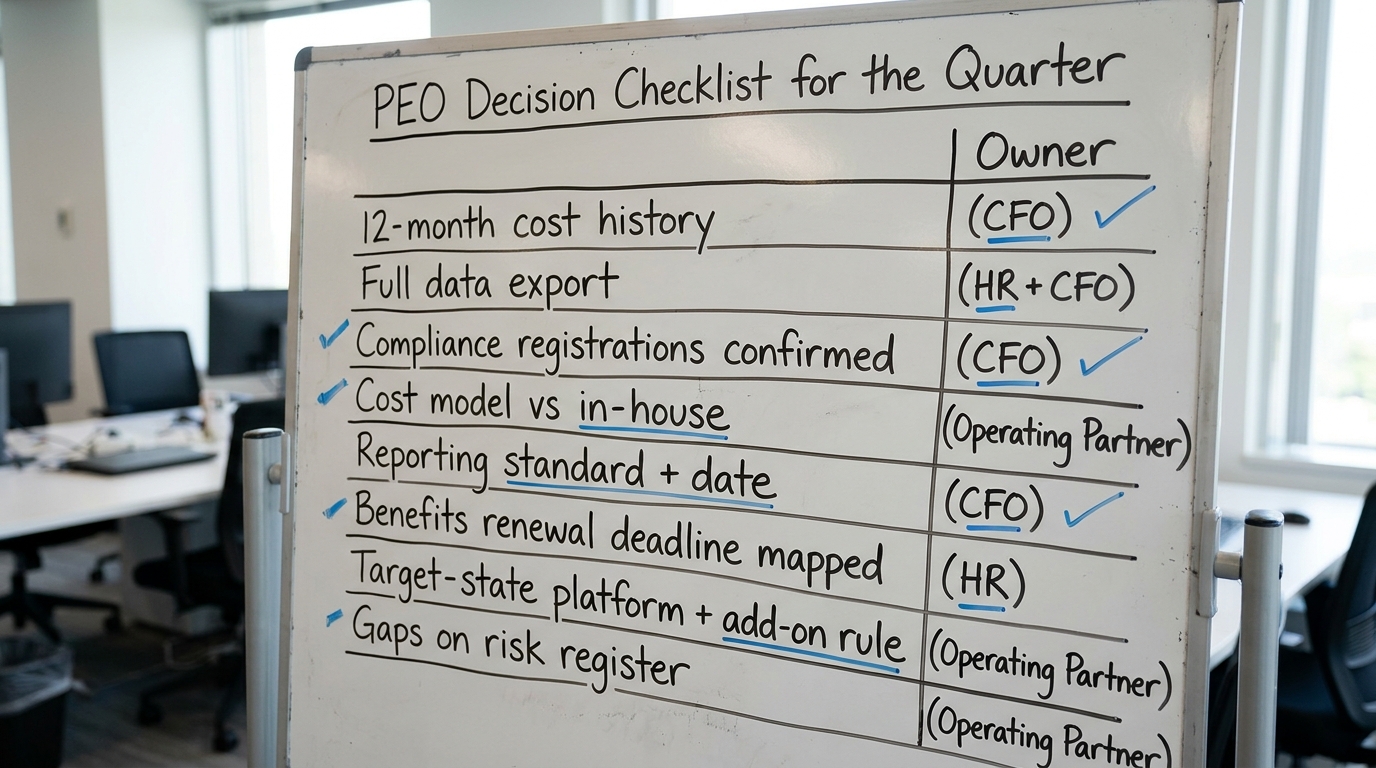
Use this as the short agenda for the PEO workstream. Each item has an owner and a date, or it is not real.
- Pull the 12-month PEO cost history, split into fees, premiums and pass-through charges. Owner: CFO.
- Request a full structured export of employee, compensation and benefits data. Owner: HR lead, with CFO sign-off.
- Confirm in writing which compliance registrations and filings the PEO holds in its name. Owner: CFO.
- Model fully loaded PEO cost against in-house HR, payroll and brokerage at current headcount. Owner: operating partner.
- Define the monthly reporting standard and delivery date for the board pack. Owner: CFO.
- Map the next benefits renewal date and work back the decision deadline. Owner: HR lead.
- Set the target-state platform and the add-on integration rule. Owner: operating partner.
- Log any data, cost or compliance gap on the portfolio company risk register. Owner: operating partner.
Run that checklist and you convert a vague "should we keep the PEO" debate into five dated decisions with named owners, which is the whole job. Preqin and Private Equity International both document how operational discipline in the first year correlates with cleaner exits, and you can track that work through Preqin alternative assets data and Private Equity International.
11. Where this sits in a portfolio company audit
The PEO question is one workstream inside a wider operational picture. On its own it rarely moves the headline number, but combined with payroll accuracy, benefits design, reporting reliability and add-on integration, it affects margin, management visibility and how clean your next diligence looks. That is why it belongs inside a structured audit rather than a one-off vendor review.
A portfolio company audit gives you the same treatment across HR, finance systems, technology and reporting: a baseline, the evidence, the decisions you own, and the owners and dates to act on. The sales and commercial side of that same audit discipline shows up in what a sales enablement consultant should deliver inside a PE portfolio company and in how to judge an EBITDA improvement consultant for a PE-backed business. The EBITDA lens matters here because the PEO decision ultimately resolves into labor administration cost and reporting quality, both of which feed the number a buyer underwrites.
AICPA and CIMA have published guidance on employer-of-record reporting and payroll controls that is useful background when you set your reporting standard, available through AICPA and CIMA, and the SEC's materials on disclosure and controls at the U.S. Securities and Exchange Commission are a reference point for the data-integrity expectations that reach even lower-middle-market companies as they prepare for sale.
12. The summary you can take to the next board meeting
The PEO decision splits into five pieces: the contract, data ownership, benefits design, reporting, and add-on sequencing. Secure data ownership first because it governs how fast you can do anything else and because it compounds into exit readiness. Judge the current arrangement against three tests: cost at current scale, data quality, and ability to absorb add-ons. Time any change to a natural window (the benefits renewal or an add-on close) rather than forcing it mid-cycle, and assign every item an owner and a date so the workstream actually moves.
Handled this way, portfolio company PEO integration stops being a nagging line item and becomes a small, measurable contribution to margin, management visibility and a cleaner next diligence. BCG's work on principal investors makes the broader case that these operational basics, done consistently across a portfolio, are where returns increasingly come from, and you can read that through BCG's principal investors and private equity coverage.
If you want this run as a structured workstream rather than a debate, a Portfolio Company Audit scopes the PEO decision alongside finance systems, reporting and technology, with the evidence, decisions and owners written down. See how the private equity operating offer is structured and start with the audit before the first board meeting where this question comes up again.


