You are three months into a hold, the forecast is drifting below plan, and the sponsor wants to know why margin has not moved. Someone on the deal team suggests bringing in an EBITDA improvement consultant, and now you own a decision with real money and real board attention attached to it. The spend is small next to enterprise value, but the wrong engagement burns two quarters you do not have and leaves the management team more skeptical than before. This guide is written for the operating partner or the portfolio company CFO who has to scope, buy, and grade that work, not for someone learning what EBITDA means.
An EBITDA improvement consultant in a private equity context is judged on one thing: whether the margin improvement they claim is real, durable, and traceable to actions you can see in the P&L. Everything else is process. Below is how to decide what you actually need, how to scope it so it is measurable, and how to tell a serious operator from a deck.
1. Start with the gap between plan and actual, not with the consultant
Before you talk to anyone, get the variance in front of you. The useful question is not "how do we improve EBITDA" but "which line in the model is missing plan, by how much, and since when." A consultant who cannot start from your actual-versus-plan bridge is going to sell you a generic program, and generic programs move slowly because they treat every line as equally worth fixing.
Pull the last four quarters of monthly P&L against the operating plan the sponsor underwrote. Mark where the miss is concentrated: gross margin, sales and marketing as a percent of revenue, headcount cost, or an operating line that grew faster than revenue. That variance is the brief. If the miss is in gross margin, a pricing and quote-to-cash engagement is the relevant scope, and our walkthrough of quote-to-cash optimization in a portfolio company covers where that leakage usually hides.
Bain's annual Global Private Equity Report has tracked for years how much return in the current environment comes from operational improvement rather than multiple expansion or leverage. That shift is the reason this role exists at all, and it is why the sponsor is asking you the question now.
2. Decide which of the three EBITDA levers you are actually buying
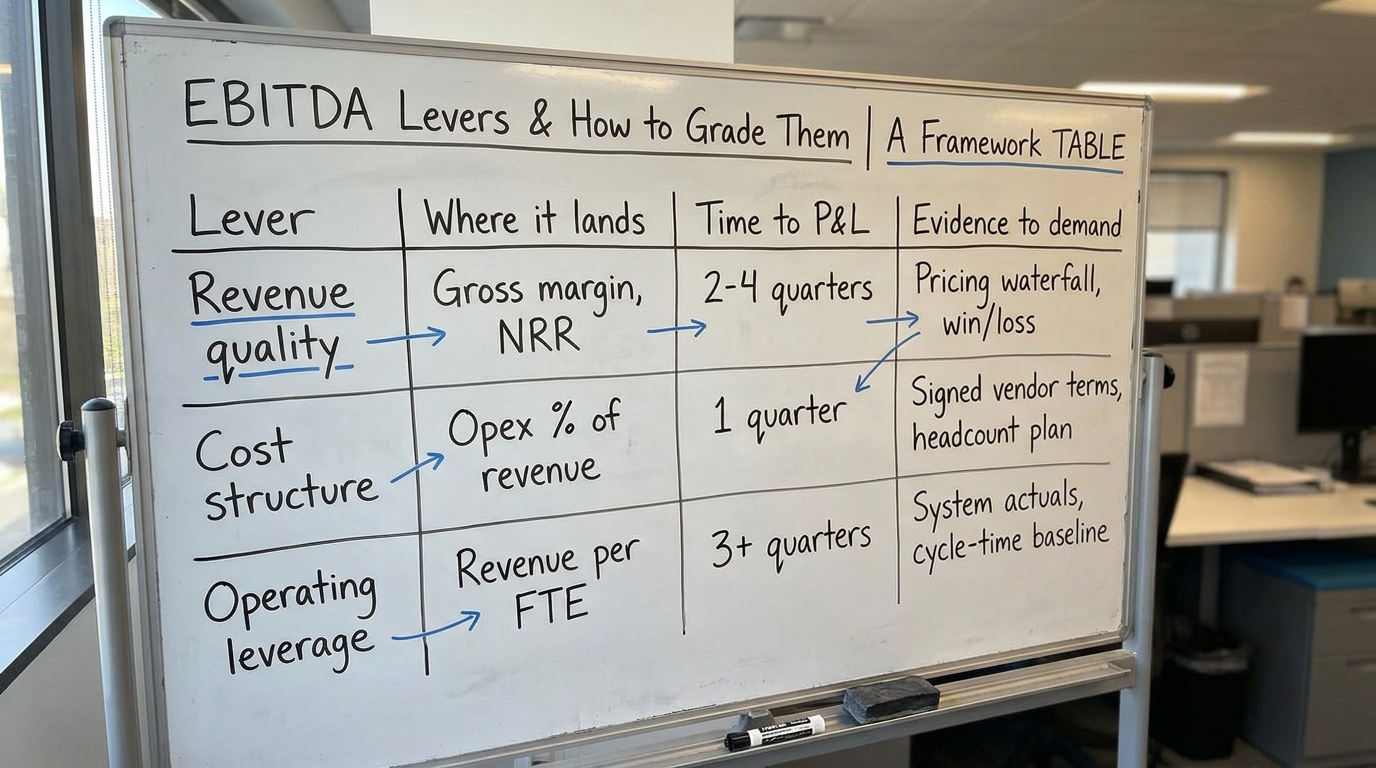
Margin improvement work falls into three categories, and they need different people, different timelines, and different evidence. Naming which one you are buying prevents the most common scoping error, which is hiring a revenue consultant to fix a cost problem.
- Revenue quality. Pricing, discount discipline, mix, churn, and the commercial motion. This lands in gross margin and net revenue retention, and it takes two to four quarters to show in the P&L because it moves through the renewal and new-business cycle.
- Cost structure. Procurement, vendor consolidation, headcount productivity, and overhead. This shows faster, often within a quarter, but it is also where a careless program does damage that surfaces two quarters later as capacity you cut and now have to rehire.
- Operating leverage. Making the same team and systems carry more revenue without a proportional cost increase. This is slower and harder to attribute, and it is where technology and process work sits.
Most drifting forecasts have a problem in one of these, not all three. A consultant who wants to address all three at once in the first 100 days is describing a headcount plan, not a value creation plan.
3. Insist on a baseline before any work starts
The single most important discipline in this kind of engagement is the baseline. If you do not agree, in writing, what the current numbers are before the consultant touches anything, you will spend the whole engagement arguing about attribution. Every improvement claim will be contested at the board, and you will not win the argument because you never established the starting point.
A baseline is the specific metric, the period it covers, the data source, and the method used to calculate it. For a pricing engagement that means the current realized price by segment, the discount distribution, and the source system it came from. For a cost engagement it means the signed contract value and volume for each vendor line you intend to renegotiate.
The AICPA and CIMA publish guidance on quality of earnings and adjustment discipline through AICPA and CIMA that is worth reading before you accept any consultant's definition of an EBITDA adjustment. A good consultant will define adjustments the way a QoE provider would, because they know their work will eventually be tested at exit.
4. Separate realized improvement from the three softer categories
When a consultant reports results, make them classify every claimed improvement into one of four states, and hold the classification through the whole engagement. This is the difference between a number the CFO can book and a number that lives only in a slide.
- Realized. It is already in the P&L. You can point to the month it appeared.
- Run-rate. The action is done, the price is changed or the contract is signed, and it will annualize. Not yet fully in the trailing numbers.
- Forecast. The plan is built and credible, but the action has not happened yet. This number is a commitment the firm has made.
- Risk avoided. A cost or a churn event that did not happen. Real, but the hardest to prove and the easiest to inflate.
The failure mode is a report that blends all four into one headline number and presents it as realized. At the next board meeting the sponsor's finance team reconciles it to the actuals, finds a third of it is forecast, and the credibility of the whole program drops. Our note on why the sponsor pack and the operator's dashboard disagree covers exactly this reconciliation problem.
5. Judge the consultant on where they place the owner of each action
A consultant who keeps the ownership of every improvement inside their own team is building dependency, and dependency evaporates the day their invoice stops. The improvements that survive are the ones a named person inside the management team owns and can run without the consultant in the room.
Ask directly, for each workstream, who inside the company will own it after the engagement ends and what has to be true for them to run it. If the answer is always "our team will stay involved," you are buying a retainer, not a capability. The strongest engagements spend part of their time making the internal owner competent to hold the metric, which is the whole logic of an embedded model rather than an advisory one. We drew that line explicitly in fractional CMO versus embedded team for portfolio companies.
6. Match the engagement to the moment in the hold
The right scope changes depending on where you are, and a consultant who ships the same 100-day plan regardless of the trigger is not reading your situation.
During confirmatory diligence
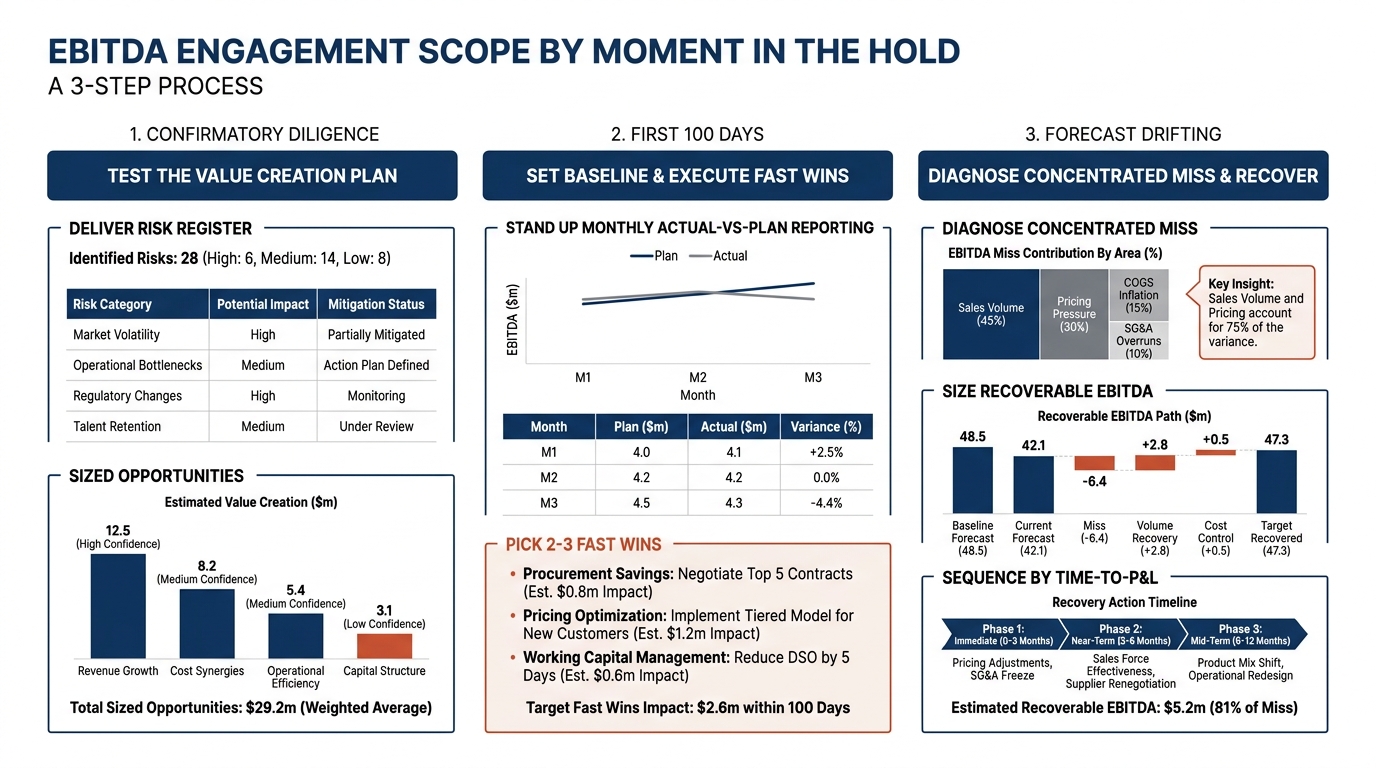
Here the work is to test whether the value creation plan the deal team underwrote is real before close. This is operational due diligence work, and the deliverable is a risk register and a sized opportunity list. If the pricing upside in the model does not survive a data check now, you want to know before the wire goes out.
In the first 100 days
The first 100 days are for establishing the baseline, standing up the reporting that lets you see actual versus plan monthly, and picking the two or three improvements with the shortest path to the P&L. Slow operating-leverage work belongs later. The immediate work is to prove the program can move a number.
When the forecast is already drifting
This is the situation most of this guide addresses. The work is diagnostic first: find the concentrated miss, size the recoverable portion, and sequence the fixes by time-to-P&L. A consultant who proposes a broad transformation when you have a specific two-line variance is solving a problem you do not have.
7. What a serious EBITDA improvement consultant private equity buyers should demand in the proposal
When you read a proposal, the tells are concrete. A serious document from an EBITDA improvement consultant private equity firms would actually retain does five things, and a weak one does none of them.
- It names the specific P&L lines it intends to move, not "EBITDA" in the abstract.
- It states the baseline it will establish and the data source it will use, before it quotes any upside.
- It sizes the opportunity as a range with a stated confidence, and classifies it as realized, run-rate, or forecast.
- It names the internal owner for each workstream after the engagement.
- The fee is tied to a milestone or a measured result, in addition to (or instead of) elapsed time.
McKinsey's private capital research at McKinsey and BCG's work on principal investors and private equity both point to the same pattern: the value creation that holds up at exit is the value creation that was measured and owned inside the company, not the value creation that lived in a consulting engagement. A proposal that reads like a staffing plan is a staffing plan.
8. Price the engagement against the decision it informs, not the day rate
A scoped portfolio company audit that establishes the baseline, finds the concentrated miss, and sizes the recoverable EBITDA typically runs in the range of $15,000 to $25,000, and it is the right first spend precisely because it is small relative to what it protects. You are not buying a transformation at that price. You are buying a decision: whether there is real recoverable margin, where it sits, and whether the internal team can hold it.
Compare that to the cost of a six-month full program that starts before anyone agreed the baseline. If the program cannot prove attribution at the board, you have spent multiples of the audit cost and gained an argument. The audit is cheaper than being wrong about scope, and the two quarters you spend before you find out it does not work carry more consequence than the fee. We laid out the buyer's view of this in how to hire an EBITDA growth consultant for a PE-backed business, and the broader logic of what a mid-market portfolio company actually buys in equity value creation advisory.
9. Do not let technology be scoped as activity
Where the improvement lever is operating leverage, the work usually touches systems, and this is where scope goes wrong most often. A consultant who quotes engineering hours, tickets, or a platform migration is selling you activity, and activity is not margin. The question is always which cost or capacity constraint the system change removes, and how that shows in revenue per employee or in an opex line.
If the audit surfaces a systems dependency, treat it as a technology due diligence question with a P&L answer attached. A CRM standardization program, for example, is a data decision long before it is a software purchase, which we argued in portfolio-wide HubSpot standardization. The consultant should be able to tie the system change to the number it moves. If they cannot, the technology scope is padding.
10. Verify the improvement will survive a quality of earnings review at exit
Every EBITDA improvement you book during the hold gets tested again when you sell. A buyer's QoE provider will strip out anything that looks like a one-time adjustment dressed as a run-rate improvement, and if a large share of your claimed value creation does not survive that review, it does not support the multiple you are underwriting at exit.
So the durability test is not academic. Ask the consultant, at the start, whether each improvement would survive a QoE review, and make them define adjustments accordingly. The Harvard Law School Forum on Corporate Governance and Harvard Business Review's work on mergers and acquisitions both document how much value is lost at exit when the improvement story does not reconcile to audited results. Data providers like PitchBook, Preqin, and S&P Global Market Intelligence track the widening gap between entry and exit expectations that makes durable margin the thing buyers now underwrite most carefully.
11. Grade the consultant against how they handle the management team
The management team has usually seen a consultant before, and if the last one produced a deck and left, they will treat the next one as a tax. A consultant who arrives, extracts data, and reports upward without making the operators part of the diagnosis will get compliance, not adoption, and the improvements will not stick after they leave.
Watch how the consultant runs the first two weeks. If they are interviewing the people who own the metrics, reconciling their numbers to the operators' own view, and getting the management team to agree the baseline, that is the behavior that produces durable results. If they are building a model in isolation and presenting it as fact, you will spend the engagement mediating. This matters as much for hiring inside the company as it does for the consultant, which is why disciplined hiring practices carry over even into lean teams, a point we made in the nonprofit hiring checklist for small teams.
12. The checklist to run before you sign
Use this as the decision gate. If a proposal cannot clear most of it, the two quarters you spend before you find out it does not work carry more consequence than the fee.
- Variance is identified. You know which P&L line is missing plan, by how much, and since when, before you brief anyone.
- Lever is named. The engagement targets revenue quality, cost structure, or operating leverage, not all three at once.
- Baseline is agreed in writing. Metric, period, data source, and method, established before any work starts.
- Every claim is classified. Realized, run-rate, forecast, or risk avoided, and the classification holds through the engagement.
- An internal owner is named. Each workstream has a person inside the company who holds the metric after the consultant leaves.
- Scope matches the moment. Diligence, first 100 days, or forecast recovery, each gets a different plan.
- Technology ties to a number. Any system change is scoped by the constraint it removes.
- It survives QoE. Adjustments are defined the way an exit buyer's provider would test them.
- Fee ties to result. At least part of the fee tracks a milestone or a measured improvement, in addition to (or instead of) elapsed time.
The pattern across all of these is the same: measurable improvement, traceable to an action, owned inside the company, durable enough to survive the next diligence. That is what a private equity sponsor is paying for, and it is what separates a consultant who moves a number from one who produces a program. For a fuller view of how sponsors sequence this across a portfolio, our overview of private equity value acceleration connects the audit to the wider value creation plan.
One aside worth keeping: some drifting forecasts do not need a consultant. Sometimes the baseline exercise reveals the miss is a timing issue or a single lost account, and the fix is a management conversation. A consultant honest enough to tell you that in the first two weeks is worth keeping.
Where to start
If your forecast is drifting or you are heading into the first 100 days without an agreed baseline, the right first step is a scoped portfolio company audit that finds the concentrated miss, sizes the recoverable EBITDA, and names who inside the company will own it. See how the DevriX and GrowthShuttle portfolio company audit is structured and what it delivers before you commit to a broader program.


