You are three months past close, the forecast is drifting, and the IT line has just become interesting for the wrong reason. Someone on the deal team saw a cloud invoice, a stack of overlapping SaaS contracts, and a managed-services renewal that auto-renewed at a rate nobody remembers agreeing to. Now IT cost optimization private equity work has landed on your desk, and the real question is not "can we cut it" but "how much can we take out without breaking a system the business runs on, and how fast will that show up in EBITDA."
This guide is for the operating partner or portfolio company executive who has the budget and the mandate. It walks through what to decide, in what order, and how to judge whether the savings are real or cosmetic. The distinction matters because a rushed re-buy costs more than the line you thought you saved.
1. Why the IT cost line moves onto the value creation plan
In most lower-middle-market deals, IT spend was never designed. It accumulated. A founder bought tools as problems appeared, a prior acquisition brought its own stack, and nobody retired anything because retiring things is riskier than paying for them. The result is a cost base with real waste inside it, but the waste is tangled with things the business genuinely depends on.
The commercial case is straightforward. IT and software spend is an operating expense that flows directly to EBITDA, and at a mid-market exit multiple, a permanent dollar removed from the run-rate is worth several dollars of enterprise value. Bain's annual review of the industry, its Global Private Equity Report, has documented for several years how sponsors have leaned harder on operational improvement rather than multiple expansion to generate returns. Cost discipline is a large part of that shift.
The trap is treating IT as though it were a simple procurement line. It is the plumbing under revenue operations, finance, and customer delivery, which is why the work belongs to someone who can weigh a saving against an operating risk rather than running it as a procurement exercise in isolation. If you are still framing the broader mandate, our note on private equity value acceleration sets the wider context this fits inside.
2. Establish the baseline before you touch a single contract
You cannot claim a saving against a number you do not have. The first decision is to build a defensible IT cost baseline, and to do it before anyone starts negotiating renewals, because negotiations without a baseline produce discounts you cannot prove and cannot bank in the forecast.
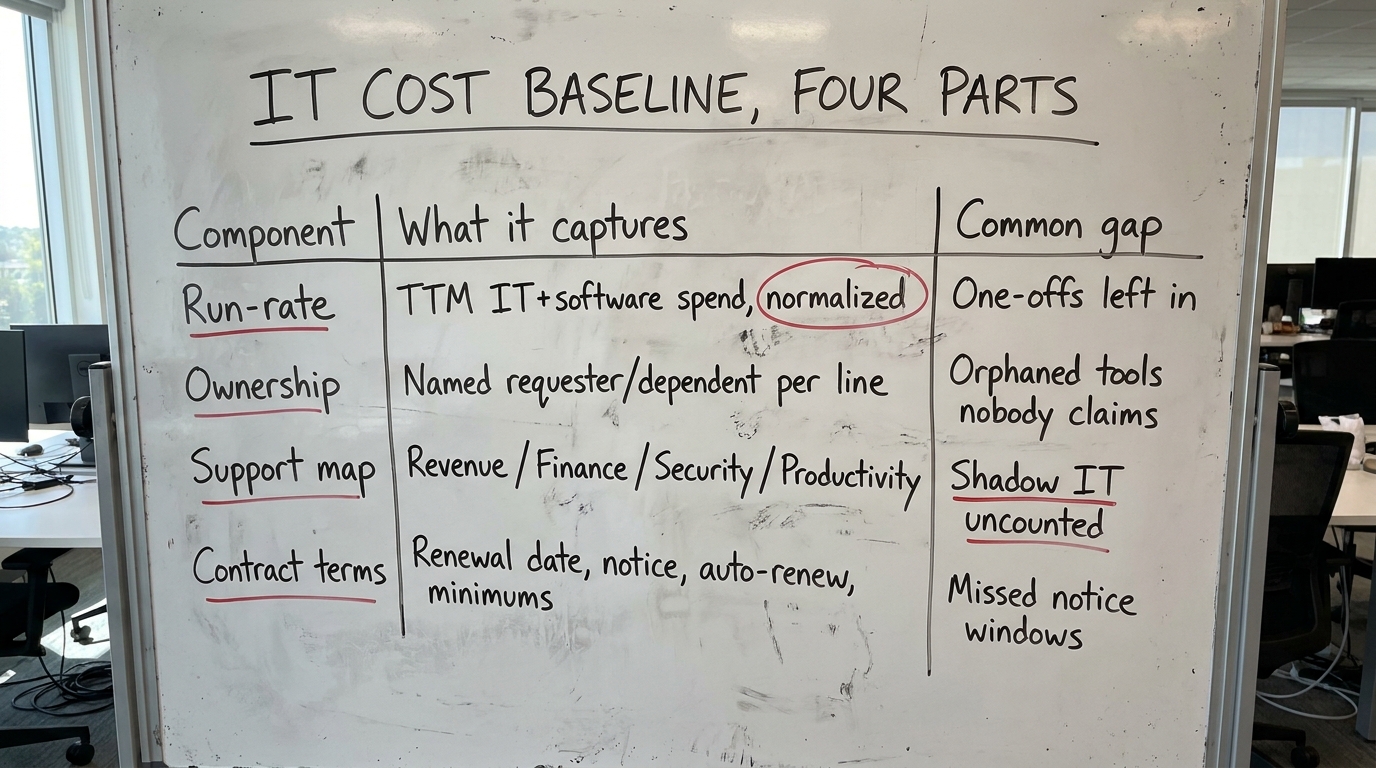
A usable baseline has four parts. First, total IT and software run-rate over the trailing twelve months, normalized for one-off implementation costs. Second, that spend mapped to owners inside the business, so every line has a named person who requested it or depends on it. Third, spend mapped to what it actually supports (revenue systems, finance systems, security, general productivity). Fourth, contract terms: renewal dates, notice periods, auto-renewal clauses, and minimum commitments.
That fourth item is where most timing mistakes live. A contract that auto-renews for twelve months in six weeks is a decision you have to make now, not next quarter. Treat the renewal calendar as a live risk register, not a filing cabinet.
3. Separate the four kinds of spend, because they need different decisions
Not all IT cost behaves the same way, and treating it as one bucket is how good businesses cut the wrong thing. Sort the run-rate into four categories, and decide each one with different criteria.
Redundant spend
Two or more tools doing the same job, usually the residue of prior acquisitions or a team that bought its own solution rather than adopt the standard. This is the cleanest saving because consolidation removes cost without removing capability. It still requires a migration plan, but the risk is execution, not loss of function.
Oversized spend
The right tool, wrong tier or wrong seat count. Licenses provisioned for a headcount you no longer have, storage or compute reserved far above actual use, an enterprise plan bought for features nobody turned on. Rightsizing is reversible and low-risk, which makes it a strong candidate for the first sixty days.
Underused spend
Tools that are paid for and barely touched warrant investigation before cancellation. Low usage can signal a poor rollout of something the business actually needs rather than redundant spend. Determine whether the tool itself failed to deliver value or whether adoption failed due to insufficient training, unclear ownership, or competing workflows before deciding to cancel.
Structural spend
The ERP, the core cloud infrastructure, the security stack, and the platform revenue runs on are load-bearing systems that require careful optimization through architecture and commercial terms rather than cuts. A rushed cut in these areas typically produces an outage and an emergency re-buy at a worse price rather than savings.
4. Decide the sequence, and put the reversible cuts first
The order you act in determines how much trust you keep. Lead with changes that are reversible and low-risk, because early wins that hold buy you the credibility to attempt the harder structural work later. Lead with a bold cut to a core system and you can spend the rest of the year firefighting.
A defensible sequence for the first 100 days looks like this. Rightsize licenses and cloud commitments first, since those are quick and low-risk. Retire clearly redundant tools next, once the migration path is confirmed. Renegotiate contracts approaching renewal, using the consolidated baseline as leverage. Leave structural re-architecture for a planned workstream with its own timeline and its own risk owner.
McKinsey's work on how sponsors run the early ownership period, published across its private capital research, has repeatedly made the point that the highest-return moves are the ones with a clear owner and a short path to measurable impact. IT cost fits that pattern well when it is sequenced, and badly when it is attempted all at once.
5. Assign a single owner and a real decision right
Every line you plan to change needs an owner, and the owner needs the authority to make the call. In practice, IT cost programs stall when the person running the analysis cannot approve a cancellation, because a department head defends a tool and the program manager has no mandate to overrule them.
Decide up front who holds the decision right for each spend category. Rightsizing and redundant-tool decisions can usually sit with the CTO or an interim operating lead. Structural systems and anything customer-facing should require sign-off from the executive who owns that outcome, so the saving is weighed against the operating consequence by the person accountable for both.
This is also where you decide whether the business has the internal capacity to run the program at all. If it does not, the choice between a fractional lead and an embedded team matters, and our comparison of the fractional versus embedded model, though framed around marketing, lays out the same trade-off you face here.
6. Judge the savings by whether they are realized, run-rate, or merely forecast
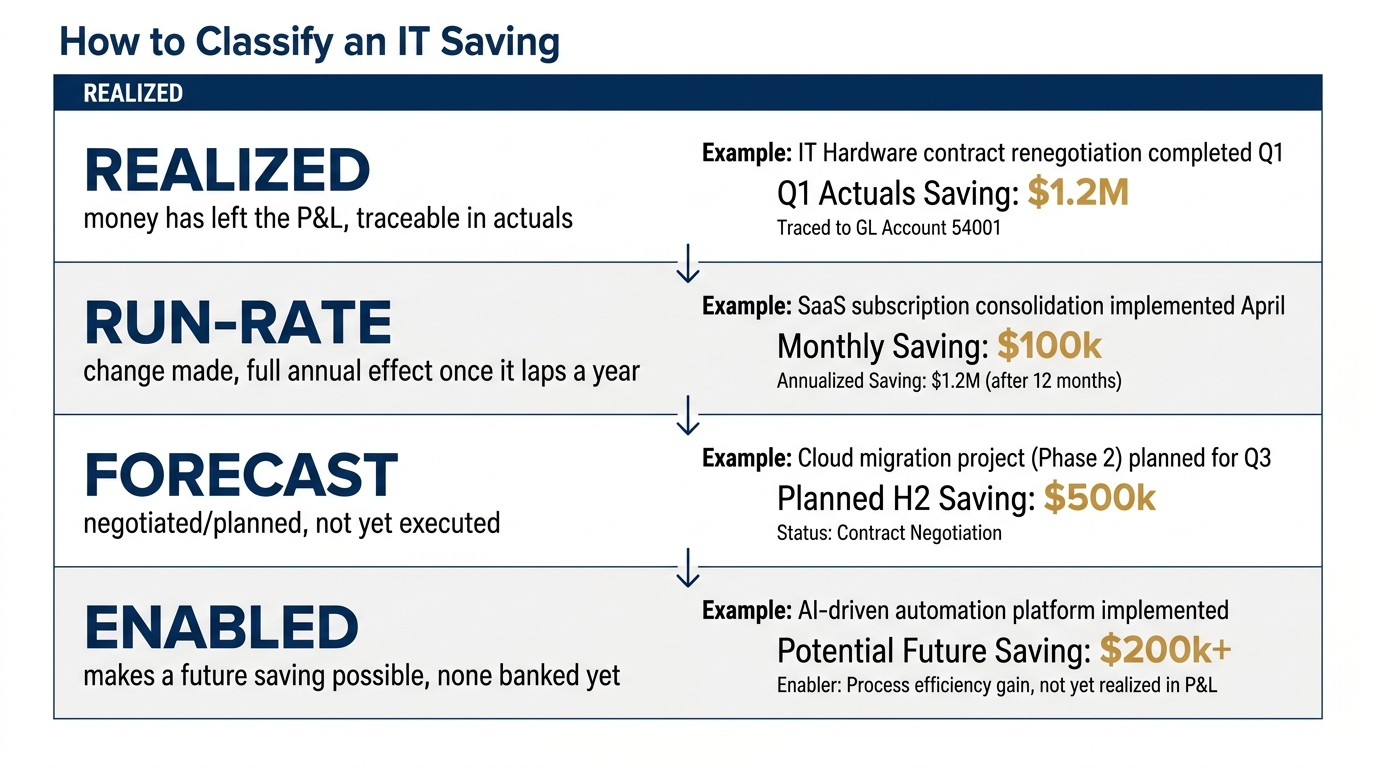
This is the section that separates a real program from a slide. Classify every claimed saving honestly, because a board that later discovers "savings" were never banked will discount everything you present after that.
- Realized: the money has actually left the cost base. A contract was cancelled, an invoice dropped, the P&L shows it.
- Run-rate: the change is made and will show its full annual effect once it laps a full year. Real, but not yet fully in the trailing numbers.
- Forecast: negotiated or planned, not yet executed. Legitimate to track, but not something to report as delivered.
- Enabled: a change that lets a future saving happen but has not produced one yet.
The discipline is to never let a forecast or enabled number read as realized in a board pack. The AICPA and CIMA, whose finance and management-accounting guidance underpins how many portfolio finance functions report, are clear that a claimed benefit needs a baseline and a method behind it. Apply the same test to IT savings that a quality-of-earnings process would apply to any adjustment: what was the baseline, what changed, and can you trace the reduction in the actuals.
7. Protect the systems that carry revenue and diligence risk
Some IT spend looks like waste and is actually insurance. Security tooling, backup and recovery, and the systems that produce audit-ready financials are the obvious examples. Cutting them shows up as a saving this quarter and as a diligence problem at exit, when the next buyer's technology due diligence finds a business that traded resilience for a small line-item reduction.
The same logic applies to the systems that produce clean numbers. If the quote-to-cash chain runs on a tool you are considering cutting, you are not looking at an IT decision, you are looking at a revenue-recognition and forecasting decision. Our piece on quote-to-cash optimization in a portfolio company walks through why those systems deserve protection rather than pressure.
Guidance summarized on the Harvard Law School Forum on Corporate Governance has covered how cybersecurity and data governance have become standard diligence items rather than optional ones. Treat any cut to security or data infrastructure as a decision that has to clear a higher bar, with the risk owner signing off explicitly.
8. Handle add-ons and integration as a consolidation opportunity, not a doubling of stacks
If the thesis includes a buy-and-build, IT cost optimization private equity work and integration planning are the same conversation. Each add-on arrives with its own tools, its own contracts, and its own way of doing things. Left alone, the platform ends up paying for three CRMs, four productivity suites, and a security posture that varies by acquisition.
At each add-on, the decision is which stack survives. Standardize onto one platform per function and retire the rest as contracts allow, timing the retirements against renewal dates to avoid paying breakage fees. The baseline work pays off a second time here because you already know every contract term across the platform.
Data standardization usually has to happen before software standardization, which is a point we make in detail in our note on portfolio-wide HubSpot standardization. The sequence matters: consolidate the data model, then consolidate the tools, or you migrate a mess into a more expensive container.
9. Set the reporting so the board sees IT cost the way it sees every other lever
IT savings should appear in the same reporting cadence as every other value creation workstream, with the same actual-versus-plan discipline. A separate "IT savings" slide that lives outside the main pack invites the suspicion that the numbers are softer than the rest. They should not be, and reporting them alongside everything else forces them to hold to the same standard.
Report three things per period: the baseline you started from, the realized reduction in the actuals, and the forecast still in flight with its execution date. Do not report activity, because a count of contracts reviewed or tools audited tells the board nothing about EBITDA. The sponsor pack and the operator's working view often diverge here, which is a tension we unpack in why the sponsor pack and the operator's dashboard disagree.
Industry data providers such as PitchBook and Preqin track how operational value creation is measured across the industry, and the through-line is consistent: benefits that cannot be tied to a baseline and traced in the numbers do not survive scrutiny. Hold your IT program to that.
10. Know when to bring in outside help, and what it should deliver
Some portfolio companies have the internal capacity to run this well. Many do not, especially when the founder-era IT lead is stretched or when the platform is integrating multiple add-ons at once. The decision to bring in outside help should turn on capacity and independence, not on whether the work is hard.
Independence matters because the person who bought the tools is rarely the best person to recommend killing them. An outside review can classify the spend, verify the baseline, and separate the reversible cuts from the structural ones without the loyalty to past decisions that an incumbent team carries. If you are weighing that choice more broadly, our guide on how to hire an EBITDA growth consultant covers what to demand from any outside advisor working a value creation mandate.
Whatever you buy should deliver a baseline you can defend, a classified list of every line of spend, a sequenced action plan with owners and dates, and a savings register that distinguishes realized from forecast. Anything delivering less is a report rather than a program. Our view of what operational due diligence should deliver before you sign applies the same standard to the diligence stage.
11. A checklist you can hand to the person running the program
Use this to judge whether an IT cost program is real work or a slide with a savings number attached.
- The trailing-twelve-month IT and software run-rate is documented and normalized for one-off costs.
- Every line of spend has a named owner and a mapped dependency.
- The contract renewal calendar is treated as a live risk register, with notice windows flagged.
- Spend is sorted into redundant, oversized, underused, and structural, with different decision criteria for each.
- Reversible, low-risk cuts are sequenced first; structural re-architecture has its own timeline and risk owner.
- Each spend category has a clear decision right and someone with the authority to approve a cut.
- Every claimed saving is classified as realized, run-rate, forecast, or enabled, and none is reported above its true status.
- Security, backup, and financial-reporting systems clear a higher bar before any cut, with explicit sign-off.
- Add-on integration is treated as a consolidation opportunity, with data standardized before tools.
- IT savings are reported in the main board pack, on the same actual-versus-plan basis as every other lever.
If most of these boxes are unchecked, the number on the savings slide is a forecast wearing the costume of a result. Fix the baseline and the classification first, and the credible savings will follow.
12. Where this sits in the wider value creation picture
IT cost optimization is one lever among several, and it is rarely the largest. It earns its place because the savings are relatively fast, relatively low-risk when sequenced well, and flow straight to EBITDA. But it works best inside a broader plan that connects each operating change to enterprise value, which is the frame we use in our overview of what a $30M to $500M portfolio company actually buys from value creation advisory.
The reporting and analyst hubs worth checking as you benchmark your own program include BCG's principal investors and private equity practice, S&P Global Market Intelligence, and the deal and operating coverage at PE Hub. For the exit-readiness angle, where filed financials and disclosed risks matter, the SEC and the M&A coverage in Harvard Business Review are useful references for how buyers scrutinize what you built.
The through-line across the whole program is discipline about what is real. A portfolio audit that establishes the baseline, classifies the spend, and hands you a sequenced plan with owners and honest savings categories is the work that makes this private equity lever count.
If you want that baseline and classified savings plan built for a specific portfolio company, with realized-versus-forecast discipline applied from the start, start the DevriX portfolio audit for your PE-backed business.


