You are three months into a hold, the value creation plan committed to a number, and the operating partner running the account wants a consultant to close the gap between the model and what the portfolio company is actually doing. The question in front of you is not whether outside help would be useful in the abstract. It is whether the person you are about to sign owns a measurable improvement in earnings, or bills for activity that never reaches the P&L. That distinction decides whether the engagement returns the fee several times over or quietly becomes another line the CFO writes off at the next quarterly review.
This guide is for the buyer with budget and a mandate: the operating partner, the portfolio company CEO, or the CFO who has been told to find an EBITDA growth consultant for a private equity asset and now has to judge one. I will keep the framing commercial and concrete, and I will assume you already know what EBITDA is and what a value creation plan does. What follows is how to scope the work, what to demand before you sign, and how to tell a real operator from someone selling a deck.
1. Name the earnings gap before you name the consultant
Most engagements go wrong at the start because the buyer hires against a feeling rather than a number. The value creation plan says EBITDA should reach a figure by a given year, actuals are trailing, and the reflex is to bring in help. That reflex skips the step that determines everything downstream: writing down exactly where the gap sits and what mechanism closes it.
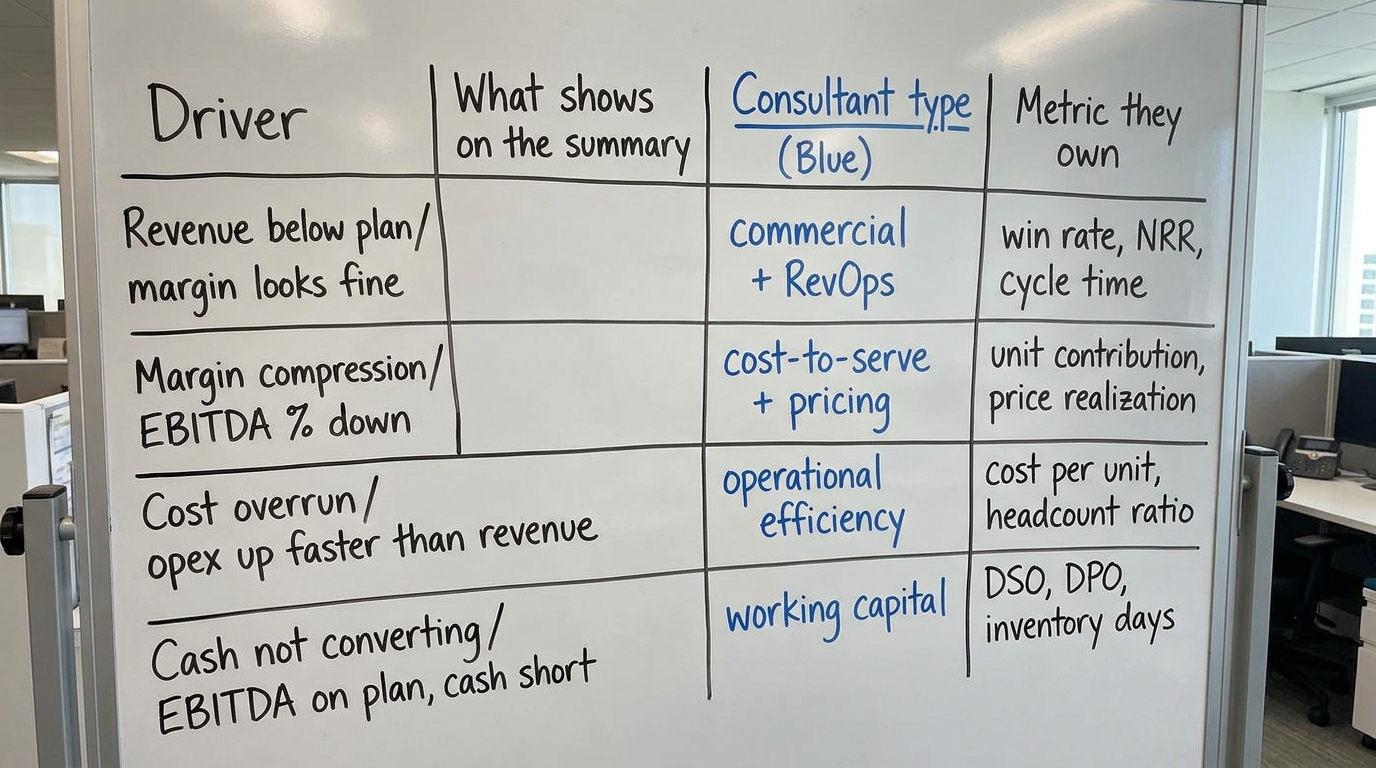
An earnings gap decomposes into a small number of drivers. Revenue is below plan, or gross margin has slipped, or operating cost has grown faster than revenue, or working capital is trapping cash that the finance team assumed would be free. Each of those has a different owner, a different evidence base, and a different kind of consultant. A commercial pricing problem and a cost-to-serve problem both show up as margin compression on a summary slide, but the work required to fix one shares almost nothing with the work required to fix the other.
Before you brief anyone, get your finance team to attribute the variance. If EBITDA is 2 points below plan, how much of that is volume, how much is price, how much is mix, how much is a cost line that ran ahead? A consultant who cannot start from that attribution will spend the first month rebuilding it on your time and your fee.
Bain's annual Global Private Equity Report has tracked for years how much of realized returns now come from operational improvement rather than multiple expansion or leverage, which is precisely why the attribution matters: the earnings you are trying to add are the return, not a bonus on top of it.
2. What an EBITDA growth consultant in private equity actually owns
The phrase EBITDA growth consultant private equity covers a wide range of people, and the range is the problem. At one end sits a strategy adviser who produces a diagnostic and a set of recommendations and leaves you to execute. At the other sits an operator who takes a workstream, drives it through the portfolio company's own teams, and is measured on the delta in a specific line of the P&L. Both call themselves the same thing. Only one is accountable for the number.
For a PE hold, you almost always want the second. A diagnostic without execution is a document, and portfolio companies rarely fail for lack of a document. They fail because nobody with authority owned the change through to the point where it showed up in the monthly accounts. So the first thing to establish is the decision right: does this person get to direct the portfolio company's people and systems toward the outcome, or do they advise a management team that is already stretched?
Get this explicit in the scope. If the consultant advises and management executes, then management's capacity is your binding constraint, and you should size the engagement to what a busy team can absorb. If the consultant executes with embedded capacity, you are buying speed, and the question becomes whether they bring the hands to do it. The choice between a fractional lead and an embedded team turns on exactly this, and getting it wrong wastes the first sixty days.
3. Match the consultant to the driver, not to the title
Once you have decomposed the gap, the type of consultant follows from the driver. Hiring the wrong specialty is the most common and most expensive mistake, because a good consultant working the wrong lever will produce real, well-executed work that does not move the number you committed to.
Revenue and commercial gaps
If the shortfall is on the top line, you are looking at pricing, sales productivity, pipeline conversion, or retention. This is where revenue operations discipline earns its fee, and where most portfolio companies leak the most. A great deal of committed revenue growth fails to materialize in the handoff between marketing, sales, and account management, which is the subject of the pipeline math that does not survive a bad handoff. A consultant here should speak in conversion rates, cycle time, win rate by segment, and net revenue retention, not in campaigns and impressions.
Margin and cost-to-serve gaps
If revenue is on plan but margin is not, the work is procurement, cost-to-serve, pricing waterfall, or operational efficiency. This consultant lives in unit economics and needs access to transaction-level data, not summary reports. McKinsey's private capital research and BCG's work with principal investors both document how much margin sits inside pricing discipline and cost-to-serve that management teams under-manage during a growth phase.
Cash and working capital gaps
If EBITDA is roughly on plan but the model's cash conversion is not materializing, you need someone who works receivables, payables, and inventory, and who understands how covenants and the debt structure constrain what you can actually do. This is a different animal from a commercial consultant, and confusing the two costs you a quarter.
4. Judge the diagnostic before you fund the plan
The best filter for a serious consultant is a short, paid diagnostic before any large commitment. Ours in the audit line sits in the $15,000 to $25,000 range for a reason: it is enough to buy a real read of the business and small enough that you are not underwriting a full program on a first impression. Treat the diagnostic as the interview. What the consultant produces in two to three weeks tells you more than any pitch.
A good diagnostic starts from a baseline you can defend, ties every proposed action to a P&L line, and separates what is realized today from what is forecast. It names owners inside the portfolio company, not just the consultant's team. It sizes each opportunity with a range and states the assumptions, so you can stress the ones you doubt. And it flags the dependencies that will slow execution, the system that needs to change first, the data that is not clean, the hire that has to happen.
A weak diagnostic reads as a list of best practices with no baseline, no owner, and no sequencing. If you cannot trace a recommendation back to a number in your own accounts, the structure is not a plan. The structure of a serious pre-signing read is laid out in what operational due diligence consulting should deliver before you sign, and the same standard applies here.
5. Insist on a baseline you can measure against later
You cannot claim an EBITDA improvement you cannot measure, and you cannot measure an improvement without a baseline that everyone agreed to before the work started. This sounds obvious and it is the single most skipped step. Six months in, the consultant claims a two-point margin gain, the CFO's actuals show less, and nobody can reconcile the two because there was no agreed starting point and no agreed method.
Fix this at the scoping stage. Write down the metric, the period, the source system, and the calculation. If the target is gross margin, specify which cost lines are in it. If the target is net revenue retention, specify the cohort and the window. The AICPA and CIMA's guidance on performance measurement is a reasonable reference for making these definitions unambiguous, because a metric that two smart people can compute two different ways will produce a dispute at exactly the moment you want a clean result.
This matters most at the board. The sponsor's pack and the operator's dashboard often disagree on the same number, and the reasons are usually definitional rather than dishonest, a point covered in detail in why the sponsor pack and the operator's dashboard disagree. Agree the definition once, at the start, and you avoid relitigating the consultant's value every quarter.
6. Classify every claimed impact by how real it is
Not all EBITDA improvement is the same, and a consultant who blurs the categories is either careless or selling. Before you accept a number in a proposal or a progress report, force it into one of these buckets, because they carry very different weight with a lender, a board, and a future buyer.
- Realized: it is in the trailing accounts. A buyer at exit will credit it with little argument.
- Run-rate: the change is in place and the monthly figure is now higher, but the trailing twelve months does not yet show it. Credible, and worth annualizing carefully.
- Forecast: the action is planned and modeled but not executed. This is a promise, not a result, and it should never be reported next to realized numbers without a label.
- Enabled or risk avoided: a system, a hire, or a fix that makes future improvement possible or prevents a loss. Real, but the softest to defend in a quality of earnings review.
A quality of earnings analysis will apply exactly this scrutiny at exit, and any add-back that cannot be evidenced gets challenged. The Harvard Law School Forum on Corporate Governance regularly publishes on how earnings adjustments hold up under diligence, and the pattern is consistent: forecast dressed as realized does not survive a buyer's advisers. Make your consultant carry that discipline from day one rather than discovering it eighteen months later.
7. Set the engagement against real triggers, not the calendar
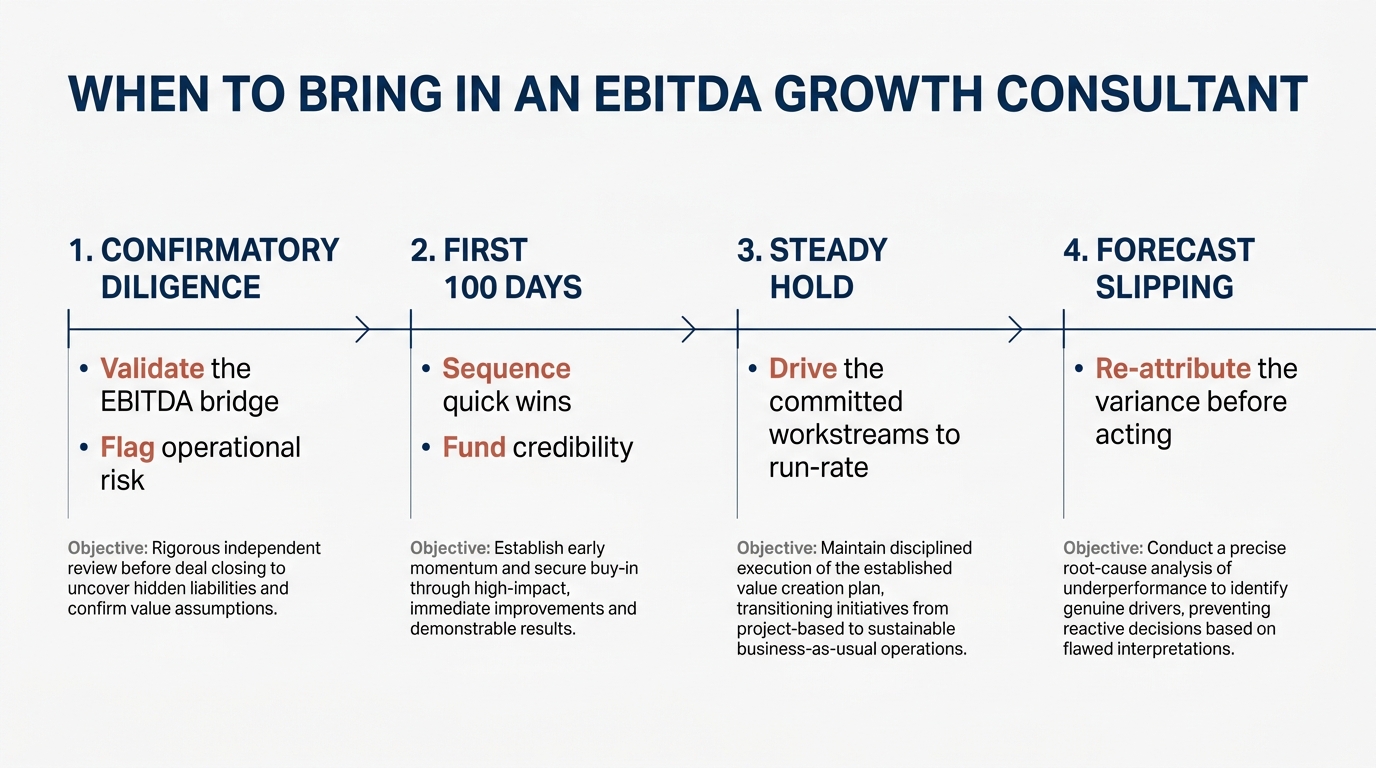
When you bring in an EBITDA growth consultant should follow the deal clock, because the same person adds very different value depending on where you are in the hold.
During confirmatory diligence
Before you own the asset, the useful work is validating the value creation thesis, not executing it. A consultant here pressure-tests whether the committed EBITDA bridge is achievable and flags the operational risk that a financial model does not capture. This overlaps with, but is not the same as, technology due diligence, which examines whether the systems and engineering can support the plan you are underwriting.
In the first 100 days
Post-close is where a growth consultant earns the most, because the early quick wins fund credibility for the harder changes. The sequencing here matters more than the ambition, and the discipline of the first 100 days is what separates a plan that compounds from one that stalls. A structured go-to-market timeline for the first 90 days gives the commercial workstream a spine.
When the forecast starts to slip
If you are already mid-hold and actuals have fallen behind plan, the consultant's job is diagnostic first and remedial second. The temptation is to skip to action, but a forecast that is slipping usually reflects a driver you have not correctly identified, which returns you to the attribution work in section one.
8. Price the engagement against the earnings it moves, not the hours it bills
A consultant who quotes you a day rate and a headcount is selling activity. A consultant who quotes you against the earnings improvement they will own is selling an outcome, and the difference tells you which one you are dealing with. You are not buying weeks of work. You are buying a change in a line of the P&L, and the fee should be legible against that change.
That does not mean you should only pay on results, which often distorts behavior toward whatever is easiest to claim. It means the proposal should state the target improvement, the fee, and the ratio between them, so a partner can look at it and judge whether it clears the bar. A $200,000 engagement that credibly targets a $2 million run-rate EBITDA gain is a straightforward decision. The same fee against a vague promise to improve efficiency is not.
PitchBook's research and data and S&P Global Market Intelligence's market intelligence both track how operating value creation has become the dominant return driver as entry multiples and cheap leverage stopped doing the work. That shift is exactly why the fee-to-impact ratio should be explicit: the earnings this consultant adds are a large part of your return, so treat the spend like an investment with an expected multiple, not like a cost line to minimize.
9. Check that the consultant can work through your systems and data
Almost every EBITDA improvement in a modern portfolio company runs through a system: the CRM that holds the pipeline, the ERP that holds the cost data, the billing platform that holds the revenue. A consultant who cannot get inside those systems, or who proposes a plan that ignores their state, will produce recommendations that management cannot execute because the data is not there or is not clean.
Ask directly how they will access and validate the underlying data, and what they will do when it is messy, because it will be. A commercial plan that assumes clean CRM data in a company that has never enforced pipeline hygiene is a plan for a company you do not own. The same is true of any standardization work: portfolio-wide HubSpot standardization is a data decision before it is a software one, and a consultant who treats it as a tool swap will miss the real cost.
This is also where a light technical read pays for itself. A focused five-day technical read will tell you whether the systems can support the commercial plan before you fund the commercial plan, which is cheaper than discovering the constraint in month four.
10. Distinguish the operating partner's job from the consultant's
If you are an operating partner reading this, one of your decisions is how much of this you keep and how much you buy. Your firm's operating team carries pattern recognition across the portfolio and the authority that comes from the sponsor. A consultant carries capacity, specialist depth, and the ability to embed full-time in one asset without being pulled to five others. The two are complements, and the mistake is to buy a consultant to do the operating partner's oversight or to expect the operating partner to do the consultant's hands-on execution.
The cleanest split I have seen: the operating partner owns the value creation plan and the accountability to the deal team, the consultant owns a defined workstream inside it, and both report against the same baseline. When that boundary is blurred, you get two people managing and nobody executing, or you get a consultant quietly setting strategy that the sponsor never signed off. The broader case for a disciplined operating approach is set out in private equity value acceleration.
11. Watch for the failure modes that show up in month four
By the time a bad engagement is obvious, you have spent a quarter and some credibility. A few signals let you catch it earlier.
- Reporting drifts from the P&L to the activity register. When the monthly update leads with meetings held, workshops run, and slides produced rather than the movement in the target metric, the work has detached from the outcome.
- The baseline keeps getting revised. A consultant who quietly restates the starting point is usually managing the appearance of progress rather than the progress.
- Management is not in the room. If the consultant's work does not transfer to the portfolio company's own people, the improvement leaves when the consultant does, and you are renting a result rather than building one.
- Forecast and realized get reported together without labels. This is the tell that the numbers will not survive a quality of earnings review at exit.
None of these are subtle once you know to look. The reason they persist is that the monthly board pack often obscures them, which is its own problem, covered in why the monthly pack takes six people and still ships wrong numbers. A reporting layer that hides drift is worse than no reporting, because it lets a slipping engagement look healthy.
12. A checklist before you sign
Run the candidate and the scope against this list. If more than a couple of these are missing, you are not ready to sign, or they are not the right consultant.
- Your finance team has attributed the EBITDA variance to specific drivers, and the consultant's scope targets those drivers.
- The engagement type is explicit: advise-and-management-executes, or embed-and-execute, with the decision right written down.
- There is a paid diagnostic that ties every recommendation to a P&L line before any large commitment.
- A baseline is agreed, defined by metric, period, source system, and calculation, and signed off by the CFO.
- Every claimed impact is classified as realized, run-rate, forecast, or enabled, and forecast is never reported as realized.
- The fee is legible against a target earnings improvement, with the ratio stated.
- The consultant has a plan to access and validate the underlying system data, and a fallback for when it is messy.
- The boundary between the operating partner's oversight and the consultant's workstream is clear.
- Reporting is set to lead with the target metric. The activity register comes after.
Beyond this list, two shifts in how portfolio companies work are worth keeping in view because they change what a good consultant does. Private Equity International's coverage of operating trends tracks how firms are building deeper in-house operating capability, and even the way distributed teams run their tooling, covered in our look at voice assistant trends for remote teams, changes how quickly a consultant can embed and how the work gets executed across sites.
13. The decision this comes down to
Strip away the titles and the pitch, and hiring an EBITDA growth consultant for a PE-backed business comes down to three judgments. First, whether the person owns a measurable change in a line of the P&L or bills for work that never reaches it. Second, whether the engagement is scoped against a baseline you and your CFO will still agree on in six months. Third, whether the fee is legible against the earnings it moves, so a partner can approve it on the ratio alone.
Get those three right and the rest of the engagement tends to run itself, because everyone is measured against the same number from the same starting point. Get them wrong and you will spend the hold relitigating what the consultant actually delivered, which is a worse use of a quarter than the shortfall you hired them to fix. The reporting in Buyouts and PE Hub is full of holds where the operating thesis was sound and the execution accountability was never nailed down.
If you want a diagnostic built to this standard, one that attributes the earnings gap, ties every action to a P&L line, and hands you a baseline the CFO will sign, our private equity portfolio audit is scoped to do exactly that before you commit to a full program.


