You have signed, the first board meeting is on the calendar, and the CFO's forecast already looks soft on cash conversion. Somewhere between the sales rep building a quote and the customer's payment clearing, the business is leaking margin, delaying revenue recognition, and producing numbers the finance team cannot reconcile without three days of manual work. That span, quote to cash, is where a surprising share of enterprise-value improvement hides in the average lower-mid-market business, and it is almost never fixed by buying more software.
This guide is written for the operating partner, the portfolio company CEO, and the CFO who now own that problem. The goal is to help you decide what to fix first, who owns it, what evidence to demand before you spend, and how to judge whether a quote-to-cash optimization effort is actually moving cash and EBITDA rather than generating activity. I will keep the framing commercial and operational.
Why quote-to-cash is a cash and EBITDA problem, not an ops project
When a deal team underwrites a business, they build a financial model with assumptions about cash conversion cycle and revenue timing that the operating reality rarely matches. The gap between them usually lives in quote-to-cash: discount leakage on the sell side, error rates in order entry, invoice disputes, and days sales outstanding that runs 15 to 30 days longer than the underwriting projected.
Discount leakage compresses gross margin, which flows straight to EBITDA. Slow or disputed invoicing extends DSO, which ties up working capital the sponsor would rather see funding growth or paying down debt. Bain's annual Global Private Equity Report has tracked for several years how much of today's returns have to come from operational improvement rather than multiple expansion, and working capital is one of the cleanest places to find it.
So the first decision is a framing one. Treat quote-to-cash as a value-creation workstream with an owner, a baseline, and a target, not as a back-office tidy-up that the controller runs in spare hours. If it does not appear on the value-creation plan with a number attached, it will not get the attention it needs.
Build the baseline before you touch anything
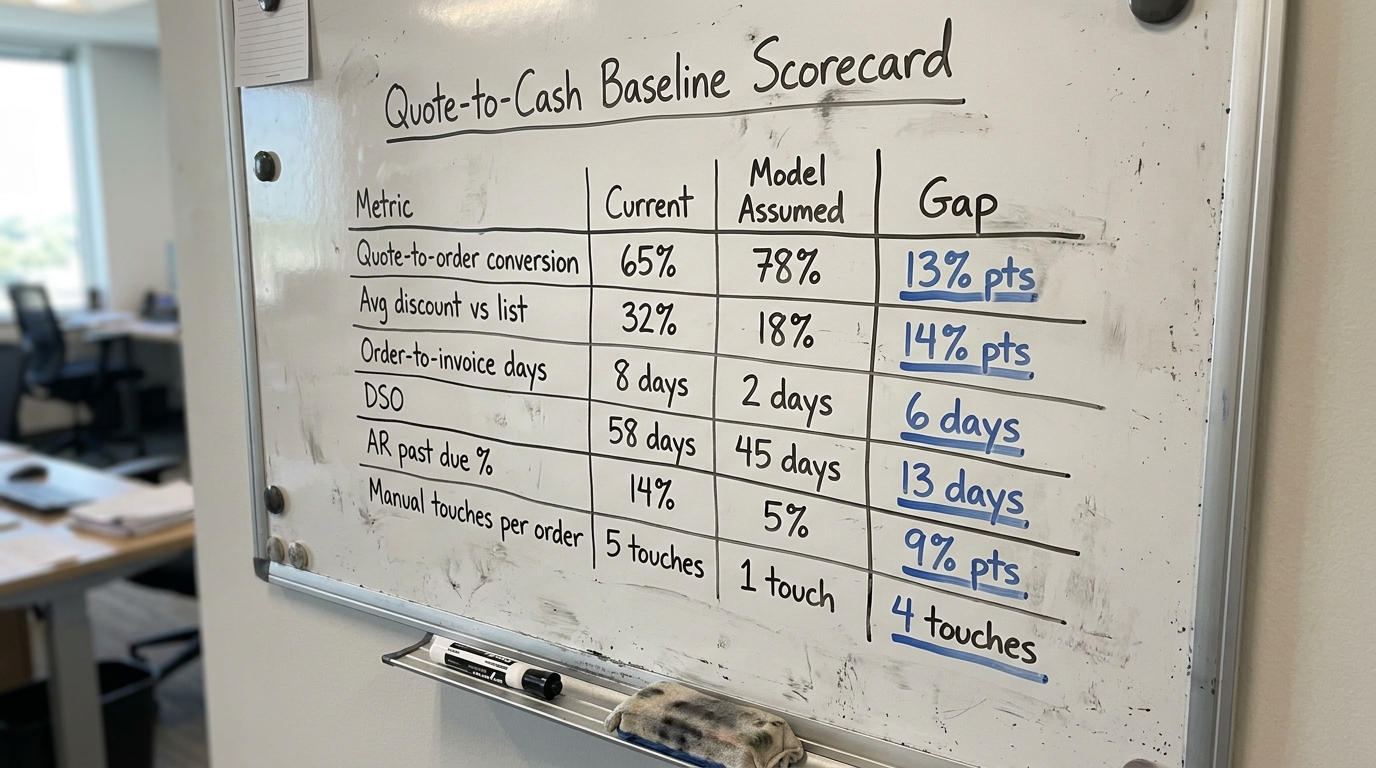
You cannot judge improvement without a baseline, and most portfolio companies do not have one at the level of detail this requires. Before any project starts, insist on measured current-state numbers for the full cycle. Estimates from the CFO's memory do not count.
The baseline metrics that matter
- Quote-to-order conversion rate and average time from quote issued to order booked.
- Average and worst-case discount versus list, by product line and by rep, so you can see leakage.
- Order-to-invoice cycle time and the error rate that forces rework.
- Days sales outstanding, plus the share of AR past due and the dispute rate on invoices.
- Manual-touch count: how many people handle a typical order between quote and cash.
The manual-touch number is the one that predicts most of the pain. Every handoff is a place data gets re-keyed, a discount gets approved off-system, or an invoice gets built from the wrong contract. This is where a disciplined diligence process pays off later; if you have not read what operational due diligence consulting should deliver before you sign, it explains why the baseline you want should have been started during the deal, not after.
Map the actual flow, not the flowchart on the wall
Every business has a documented process and a real one, and they diverge most in companies that grew through acquisition. If your portfolio company is a platform with add-ons, you likely have two or three quoting tools, incompatible SKU structures, and finance teams that reconcile by exporting to spreadsheets.
Spend a week watching real orders move. Follow ten recent deals end to end, including at least two that went wrong. Note every system they pass through, every approval that happened in email, and every point where someone typed the same data twice. The map you produce is the evidence you will use to prioritize, and it will contradict the official diagram in ways that matter.
This mapping is also where the technical constraints surface. If the quoting logic lives in a spreadsheet that one sales ops person maintains, that is an integration dependency and a key-person risk at once. A proper technology due diligence read on the system landscape tells you whether the fix is configuration or replatforming, which changes the cost by an order of magnitude.
Decide what to fix first using cash and margin, not complaint volume
You will hear loudly from whoever suffers most, usually the sales team frustrated by slow quoting. That noise is not the same as the biggest financial opportunity. Rank fixes by their effect on cash and margin, then by effort.
A practical prioritization order
- Discount governance first when leakage is wide, because approval rules and floor pricing recover margin quickly with low technical cost.
- Invoicing accuracy and speed next when DSO runs long, because faster clean invoices convert to cash inside a quarter.
- Dispute reduction when a meaningful share of AR sits in dispute, since disputed invoices are aged revenue you already earned.
- Quoting speed and CPQ when slow quotes are demonstrably costing deals, which is harder to prove and slower to build.
Notice that the highest-value moves are often the least glamorous. Recovering three points of margin through discount discipline usually beats a shiny new configure-price-quote tool that takes nine months to deploy. McKinsey's private capital research has repeatedly made the case that pricing discipline is among the fastest EBITDA levers available to a new owner, and quote-to-cash is where pricing discipline either holds or fails.
Fix pricing and discount governance before the tooling
Discount leakage is the closest thing to found money in most quote-to-cash reviews. The typical pattern is that reps have discretion no one measures, approvals happen verbally, and the CRM records the final price without the reason. The margin walks out the door one deal at a time.
The decisions here are commercial, and they belong to the CEO and CFO, not to a systems vendor:
- Set a discount floor by product line, below which a named person must approve in the system.
- Require that every discount above threshold carry a recorded reason code.
- Report leakage by rep monthly, and tie it into the comp conversation.
- Kill off-system approvals, so no quote leaves without its price recorded where finance can see it.
None of this needs new software on day one. It needs a policy, a place to record the data, and a manager willing to enforce it. The first 100 days is exactly when that enforcement is credible, because the organization expects change and has not yet decided the new owner is all talk. Wait six months and the policy reads as bureaucracy.
Standardize the data before you standardize the stack
The instinct after acquisition is to consolidate onto one CRM or one billing system. That is the right destination and the wrong first move. If your customer records, product catalog, and pricing tables are inconsistent across the acquired entities, migrating them into a single system just moves the mess into a more expensive container.
Get the data structures right first: a single product catalog with consistent SKUs, a clean customer master with resolved duplicates, and pricing tables that mean the same thing everywhere. We covered this work in detail in portfolio-wide HubSpot standardization is a data decision before it is a software one, and the logic applies to any quote-to-cash tooling decision.
The commercial reason to sequence it this way is integration speed. When you later add another bolt-on, clean shared data structures let you fold its quote-to-cash flow into the platform in weeks. Messy ones mean every add-on becomes a bespoke integration project, and integration cost is one of the quiet destroyers of deal returns that BCG's principal investors and private equity work has flagged in its post-merger analyses.
Pick the right owner and the right decision rights
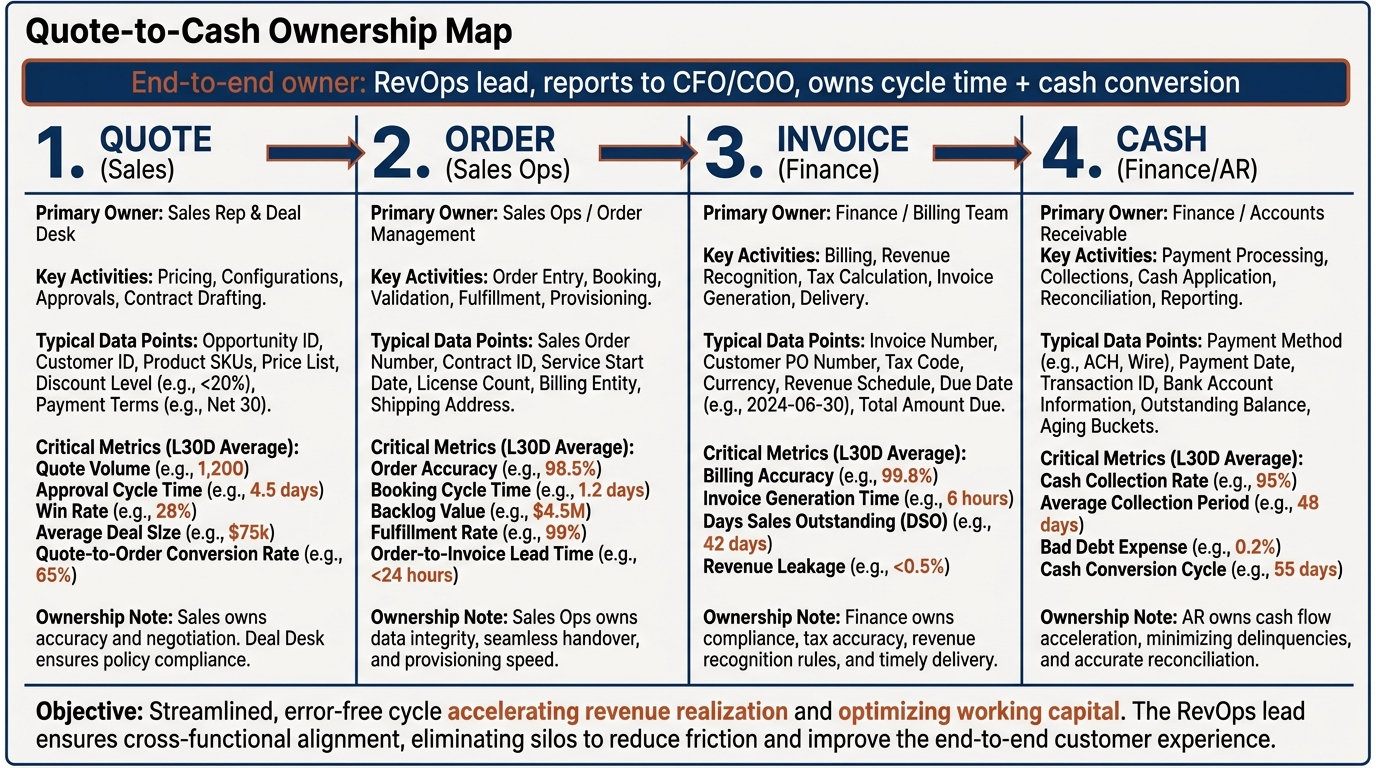
Quote-to-cash crosses sales, sales ops, finance, and IT, which is why it stalls. Every function owns a piece and none owns the outcome. The single most useful structural decision you make is naming one accountable owner for the end-to-end cycle time and cash conversion, with the decision rights to change process across those functions.
Who should own it
In most lower-mid-market portfolio companies this sits best with a RevOps lead reporting to the CFO or COO, not with the VP of Sales (who is measured on bookings, not cash) and not with IT (who will optimize for system stability over commercial outcome). If the company has no RevOps function, that gap is itself a finding, and it usually explains why the numbers are hard to trust.
We wrote about the pipeline consequences of this ownership gap in RevOps consulting for PE-backed companies, and the same handoff failures that break pipeline math break quote-to-cash. The question of whether to build that capacity internally or bring it in is a real one, and the trade-offs are laid out in fractional CMO vs embedded team for portfolio companies.
Attack DSO and disputes as a working-capital play
Days sales outstanding is where quote-to-cash meets the cash flow the sponsor watches. Long DSO is usually not a collections problem; it is an upstream accuracy problem. Invoices that do not match the contract get disputed, disputed invoices age, and aged AR reads as a collections failure when the cause was a quoting or order-entry error weeks earlier.
So work it upstream and downstream at once:
- Reduce invoice errors by ensuring the invoice is generated from the same approved quote and contract rather than rebuilt by hand.
- Track dispute reasons and feed the top three back into the quoting and order steps, since the same errors repeat.
- Tighten terms enforcement so the standard payment term is actually applied and exceptions require approval.
- Automate reminders at set intervals rather than relying on an AR clerk's memory.
The AICPA and CIMA's finance transformation guidance makes the same point from the controller's chair: most collections problems are billing-quality problems in disguise. Fixing the upstream error is what makes the working-capital improvement durable rather than a one-quarter push that reverses the moment attention moves elsewhere.
Only now decide whether to buy tooling, and what
Once governance, data, ownership, and process are in order, a CPQ or billing platform amplifies what you have built. Deployed onto a broken process, it just makes the broken process faster and more expensive. That sequencing is the difference between software that pays back and software that becomes a line item you cannot kill.
Questions to answer before you sign a software contract
- Which specific baseline metric will this tool move, and by how much, on what timeline?
- Does it depend on the data standardization being finished first? If yes, it waits.
- What is the total cost including implementation and internal time, in addition to the license?
- Who owns configuration after the vendor leaves, and is that a key-person risk?
- Does it fold cleanly into the platform's shared data, or does it create another island?
A vendor pitch that leads with features rather than a specific effect on a baseline metric is a vendor selling activity. Hold the same standard here you would hold when hiring any outside help; the criteria in how to hire an EBITDA growth consultant for a PE-backed business transfer directly to a software decision.
Measure it the way the board will read it
The improvement is only real if the board pack shows it, and this is where operating teams and sponsors often disagree about the numbers. The operator's dashboard and the sponsor pack frequently pull from different sources and report different figures, which we unpacked in why the sponsor pack and the operator's dashboard disagree.
For quote-to-cash, agree up front on the definitions of DSO, discount leakage, and cycle time, and on a single source for each. Then report the same three numbers every month against the baseline you established in section two. Classify what you are claiming honestly: recovered margin from discount governance is realized value once it is in the P&L, while a DSO improvement is run-rate cash until it actually clears. Presenting forecast improvement as realized is how a value-creation story loses credibility at the third board meeting.
If the monthly pack itself takes half the finance team to produce and still ships wrong, that reporting burden is part of the same quote-to-cash data problem; we covered that specific failure in why the monthly pack takes six people and still ships wrong numbers.
Sequence it against the deal clock
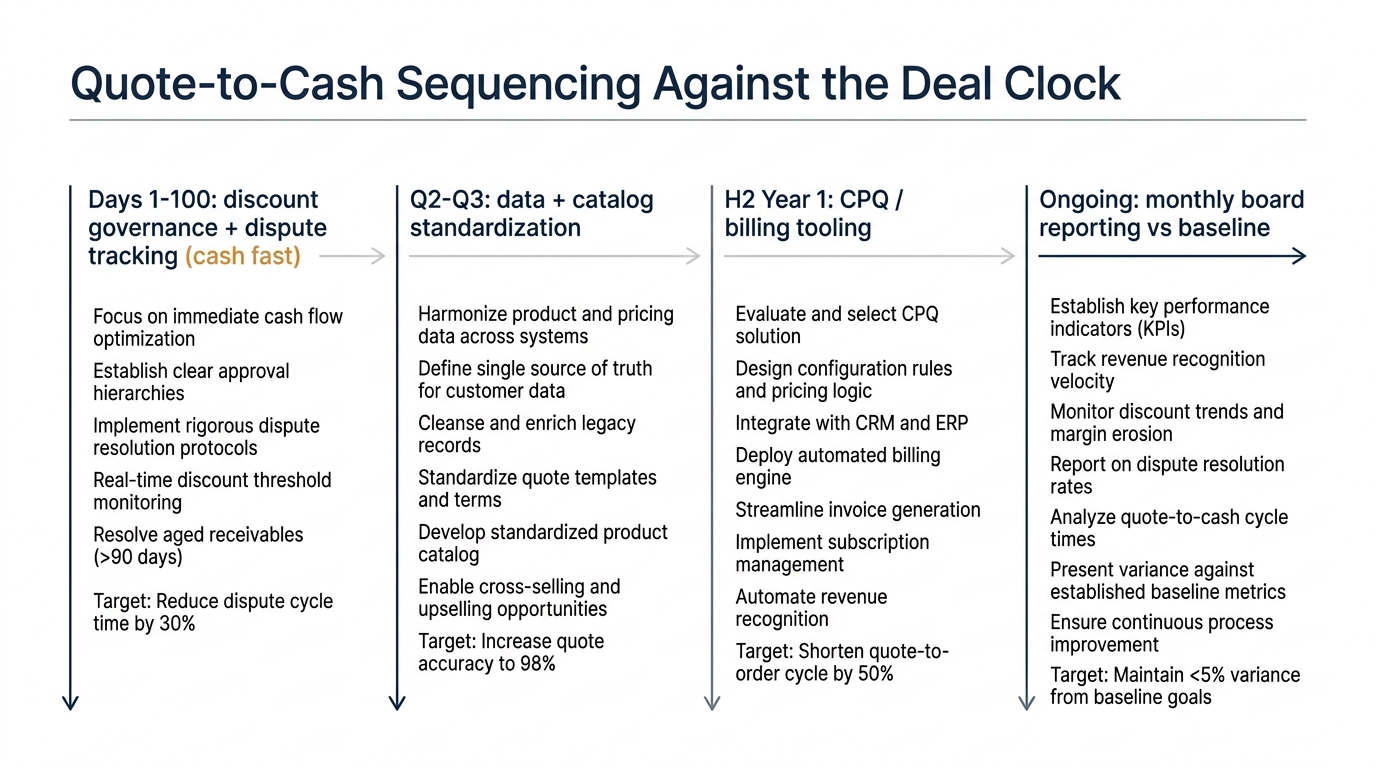
Timing decides how much of this you can bank before the next milestone. The discount governance and dispute-tracking work should start inside the first 100 days, because they need no new systems and produce visible margin and cash quickly. Data standardization runs in parallel but takes longer, usually a quarter or two. Tooling decisions come after both, so they sit in the second half of year one.
This ordering is the same logic behind a disciplined go-to-market timeline for the first 90 days, and it fits inside a broader private equity value acceleration plan rather than sitting off to the side as an IT project. The point is to bank the cash-releasing wins early, where they help the working-capital story the sponsor tells its own investors, and PitchBook's research and data on hold periods is a reminder that early operational wins compound over a five-year hold in a way late ones cannot.
The decision checklist
Before you approve a quote-to-cash optimization effort, you should be able to answer each of these:
- Is there a measured baseline for conversion, discount, cycle time, DSO, disputes, and manual touches (as opposed to an estimate)?
- Has someone followed ten real orders end to end and documented where the process actually diverges from the diagram?
- Are fixes ranked by effect on cash and margin, with discount governance and invoicing accuracy ahead of new tooling?
- Is there one named owner for end-to-end cycle time and cash conversion, with decision rights across sales, finance, and IT?
- Is data standardization sequenced before any consolidation onto a single stack?
- Does every proposed software purchase name the specific baseline metric it will move and by how much?
- Are DSO, leakage, and cycle time defined once, sourced once, and reported monthly against baseline in the board pack?
- Is each claimed improvement classified honestly as realized, run-rate, or forecast?
- Does the sequencing put cash-releasing wins inside the first 100 days?
If you cannot answer several of these, the effort is not ready to fund yet, and funding it anyway is how you end up with a slower, more expensive version of the same leak.
Where the value actually lands
Done in the right order, this work shows up in three places the sponsor cares about. Margin recovers as discount discipline holds, which flows to EBITDA. Working capital frees up as DSO and disputes fall, which improves cash and the story around the debt. And the platform gets easier to bolt add-ons onto, which shortens integration on the next deal.
The Harvard Law School Forum on Corporate Governance and reporting from Private Equity International both keep returning to the same theme across the current cycle: with multiple expansion harder to count on, operational cash and margin improvements are carrying more of the return, and they have to be demonstrable at exit. Quote-to-cash is one of the few workstreams that touches all three of those at once, which is why it deserves a place on the value-creation plan rather than a footnote in the ops review.
If you want a structured, evidence-first read on the quote-to-cash cycle in one of your portfolio companies, mapped to cash and EBITDA and sequenced against your hold period, look at the DevriX private equity RevOps offer and start with a baseline before you spend a dollar on tooling.


