You signed the deal on a thesis that assumes a specific EBITDA bridge, and now you are the operating partner or the portfolio CEO who has to make it real. The hold-period model has a line in it for margin expansion, another for organic growth, maybe a third for add-on integration, and none of those lines close themselves. So you start interviewing help, and within two weeks every firm on the list calls itself an operational value creation firm. The category tells you almost nothing about whether the firm in front of you can actually move the number your investment committee is watching.
This guide is for the buyer who already has budget and a mandate, not for someone deciding whether to use outside help at all. The question is which firm, scoped to do what, measured against which baseline, and owned by whom. Get that wrong and you spend six months of a five-year hold paying for decks.
1. Start with the decision the engagement has to inform
Before you shortlist anyone, write down the decision you are trying to make and the date by which you need it made. An operational value creation firm is only worth hiring against a specific commercial consequence, and the consequence changes what good looks like.
If you are in the first 100 days after close, the decision is usually about sequencing: which two or three initiatives go first, which management gaps get backfilled, and what the Day 1 operating baseline actually is versus what the CIM claimed. If you are eighteen months in and the forecast is drifting below plan, the decision is diagnostic: what broke, is it fixable with the current team, and how much of the gap is recoverable inside the remaining hold.
Those are different engagements with different deliverables, and a firm that answers both with the same methodology deck is selling you a template. Bain's annual private equity report has tracked for years how much of recent returns depends on operational improvement rather than multiple expansion or leverage, which is exactly why the scoping discipline matters now. You can review the current edition of the Bain & Company Global Private Equity Report for the macro picture before you commit internal time.
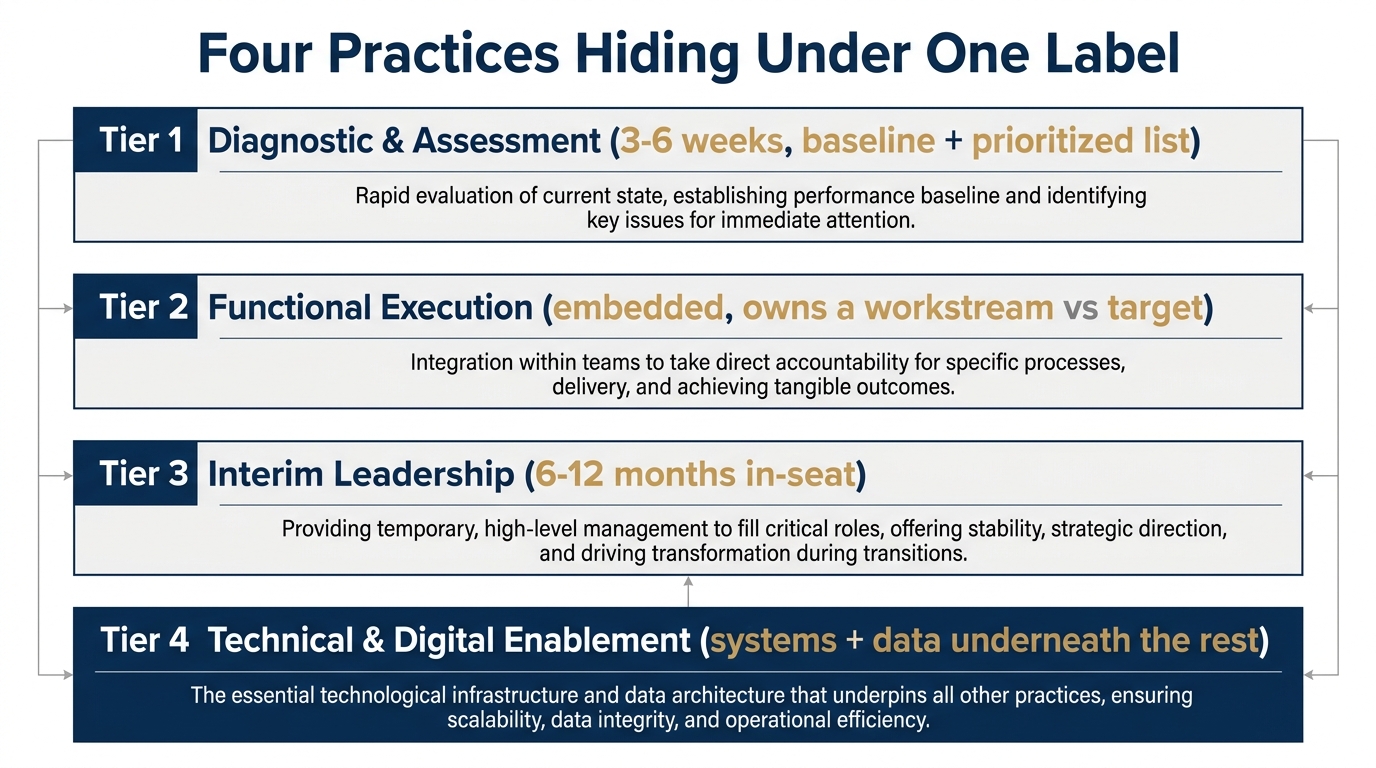
2. Separate the four things that hide under one label
The phrase covers at least four distinct practices, and most firms are genuinely good at one or two of them. Naming which one you need is the first filter that eliminates half your list.
Diagnostic and assessment work
Short, intensive reviews that produce a baseline, a prioritized initiative list, and a value-at-stake estimate per initiative. This is the Portfolio Audit shape: three to six weeks, a defined set of interviews and data pulls, and a document your investment committee can act on. It does not include execution.
Functional execution
Hands-on delivery inside one function, pricing, sales operations, procurement, supply chain, finance transformation. The firm embeds people and owns a workstream against a target. McKinsey's private capital research and the operational content on the McKinsey site describe this embedded model in detail, and it carries a very different cost and risk profile than a diagnostic.
Interim leadership
A seasoned operator who sits in a seat, CFO, COO, head of commercial, for six to twelve months while you recruit a permanent hire or stabilize the function. An operating partner or interim executive brings their own playbook and runs the function directly while you search for the permanent hire.
Technical and digital enablement
The systems, data, and software layer that most of the above depends on. A pricing initiative with no clean transaction data produces recommendations you cannot implement. This is where technology due diligence findings turn into post-close work, and it is routinely underscoped because it looks like a cost center rather than a margin driver.
3. Match the firm to your stage in the hold
The same firm is a good choice at close and a poor one in year three, because the question has changed. Early in the hold you are buying speed and a defensible baseline; later you are buying recovery and the hard call about whether the original thesis still holds.
At close, a diagnostic that gets you a ranked initiative list in six weeks is worth more than a flawless twelve-week study, because every week of ambiguity is a week the management team spends guessing at priorities. In a recovery situation, the firm needs enough functional depth to tell you whether the plan was wrong or the execution was, and those have opposite remedies.
For the specific case of a lower-to-mid-market company, the piece on what a $30M to $500M portfolio company actually buys walks through how the engagement shape should change with company size, and it is a useful calibration before you take meetings.
4. Read the firm's method for where value actually sits
Ask any shortlisted operational value creation firm to walk you through its last three engagements in your rough size band, and listen for where they claim the value came from. A firm that attributes everything to revenue growth and nothing to cost or working capital is either lucky, selective in what it tells you, or working in a different kind of business than yours.
The honest answer is usually a mix, and it varies by sector. BCG's principal investors and private equity practice publishes sector-level breakdowns of where operating improvement tends to concentrate, and the material on the BCG site is a reasonable external benchmark for whether a firm's claimed value distribution is plausible. If a firm cannot say where the EBITDA came from in its own past work, it cannot plan where it will come from in yours.
Watch for the activity substitution
The most common tell is a pitch built on activity rather than consequence. The deliverable you are paying for is a change in the P&L or the balance sheet, traced back to a specific intervention with a baseline and a date. Hours delivered, workshops run, dashboards built, and initiatives launched come second. The guidance on how to judge an EBITDA improvement consultant covers the exact questions that separate the two, and they apply to every tier above.
5. Insist on a baseline before anyone touches a target
No improvement claim means anything without the number it improved from. The first thing a competent firm does, often before the formal engagement starts, is establish the current-state baseline: the actual run-rate EBITDA, the real gross margin by product or customer, the true working capital cycle, and the operating metrics underneath them.
This sounds obvious and it is routinely skipped, because the baseline is where the awkward conversations live. The CIM margin and the actual margin frequently disagree. The reported recurring revenue includes things that are not recurring. A firm willing to do the unglamorous reconciliation work before it promises you anything is signaling discipline; a firm that leads with the upside number and gets to the baseline later is managing your expectations, not your business.
For companies where the baseline problem is a forecasting problem, the SME guide to retail sales forecasting shows how far reported numbers can sit from reality when the forecasting method is weak, and the same gap shows up in any sector with volatile demand.
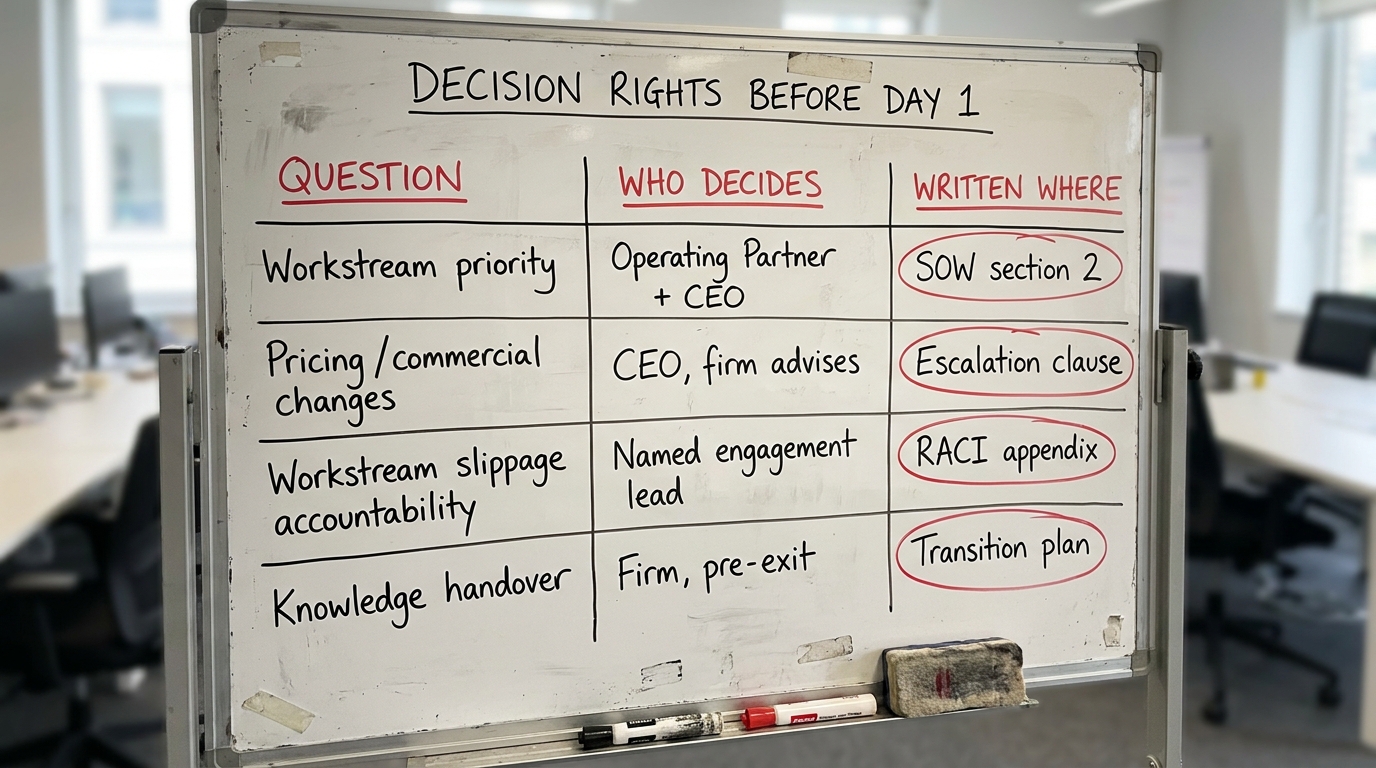
6. Decide who owns what, in writing, before Day 1
The single most expensive ambiguity in these engagements is the decision right. When the firm recommends a pricing change and the CEO disagrees, who decides? When a workstream slips, who is accountable, the firm's engagement lead or your functional VP? Vague answers here produce six months of polite paralysis.
Settle three things in the statement of work. First, the RACI for each workstream, named to real people, not roles. Second, the escalation path when the firm and management disagree, because they will. Third, the handover plan: what the firm leaves behind so the gain survives their exit, because a value improvement that walks out the door with the consultant was never realized in any durable sense.
7. Price the engagement against the value at stake, not the day rate
Day rates tell you what a firm charges, not what it costs you. A cheap diagnostic that misses the real margin leak is the most expensive thing you can buy. The right frame is the value at stake in the decision the engagement informs, measured against the fee.
A Portfolio Audit in the $15,000 to $25,000 range is calibrated to produce a prioritized, baseline-backed initiative list and a value-at-stake estimate, the input to a much larger execution decision. That is a sensible spend when the decision it informs is worth multiples of the fee, which in a portfolio company it almost always is. An embedded execution engagement is priced in a different order of magnitude and should be judged against the specific EBITDA target it owns, not against the diagnostic that scoped it.
PitchBook and S&P Global both publish hold-period and value-creation data that help you size what a given improvement is worth at your likely exit multiple; the research hubs at PitchBook and S&P Global Market Intelligence are where I start when I need a defensible range for value at stake.
8. Test the firm's independence from its own recommendations
A firm that recommends the solution it also sells has a conflict you need to price in. This is sharpest in the technical and digital tier, where a firm that finds a systems problem and then quotes you to build the system has every reason to find a bigger problem. It also shows up in interim leadership, where the interim executive may quietly prefer the permanent recruit who comes from their own network.
None of this disqualifies a firm, but it should be disclosed and structured. Ask directly what the firm sells downstream of the diagnostic, and whether its diagnostic fee is contingent on you buying the execution. The governance literature on conflicts and incentives in these arrangements, including material on the Harvard Law School Forum on Corporate Governance, is worth a read before you sign a multi-phase agreement with a single provider.
9. Judge the people, not the logo
You are buying the specific team assigned to your account, not the firm's brand or its best case study. The partner who sells the work is frequently not the person who delivers it, and the gap between the two is where engagements go quiet.
Ask to meet the actual engagement lead before you sign, and ask what else they are staffed on during your engagement window. A lead running four accounts at once is a part-time resource regardless of what the master services agreement says. For functional work, ask for the operator who has done this exact thing in your sector, and check whether they are proposed as a name on the SOW or merely as a reference.
The sales-side version of this test is laid out in the piece on what a sales enablement consultant should deliver inside a portfolio company, and the same logic, name the people, check their load, verify the sector reps, applies to every discipline you might hire.
10. Build the measurement into the contract, not after it
If you cannot say in advance how you will know the engagement worked, you will not know afterward, and the firm will tell you it worked. Agree the measurement framework before the work starts: the baseline metric, the target, the measurement window, the data source, and who computes the number.
Classify each claimed impact honestly. Realized improvement already shows in the actuals. Run-rate improvement is annualized from a partial period. Forecast improvement is modeled and not yet observed. Enabled improvement is capacity you created but have not yet converted, and risk avoided is a cost you did not incur. These are not interchangeable, and a firm that reports forecast or enabled value as if it were realized is inflating its own scorecard. The reporting standards material from the AICPA & CIMA is a useful reference for keeping the measurement defensible when it reaches your LPs.
Harvard Business Review's archive on mergers and acquisitions covers the integration-measurement problem well; the collection at HBR on M&A is a good primer for the board member who wants the research behind the discipline.
11. Check the technical and data foundation early
Most operating initiatives sit on top of systems and data that were built for a smaller, simpler company, and the foundation decides what is actually possible. A commercial team cannot execute dynamic pricing on data it cannot trust, and a finance transformation stalls when the ERP cannot produce margin by customer without a month of manual work.
This is why the technical layer belongs in the diagnostic, not as an afterthought once the commercial plan hits a wall. The connection between diligence findings and post-close execution is direct, and the practice area for private equity operating work is where that handoff either happens cleanly or gets lost between the deal team and the operators. Related operating problems like quote-to-cash optimization and supplier carbon data gaps are almost always data problems wearing a process costume, and they are worth checking before you assume the issue is the team.
12. A buyer's checklist before you sign
Run the shortlist through the same short set of questions, and give weight to the firms that answer them cleanly rather than the ones that answer them smoothly.
- Have you written down the specific decision this engagement informs and the date it is needed?
- Which of the four practices do you actually need, diagnostic, functional execution, interim leadership, or technical enablement?
- Does the firm match your stage in the hold, close versus recovery, or is it selling one playbook for both?
- Can the firm say where the value came from in its last three comparable engagements, by lever?
- Will the firm establish and reconcile a real baseline before it commits to any target?
- Are decision rights, escalation, and handover named to real people in the SOW?
- Is the fee sized against the value at stake in the decision? A firm charging $15,000 to shape a $40M operating plan is underpricing the risk; a firm charging $200,000 to validate a marketing stack the thesis does not depend on is overpriced regardless of the day rate.
- Has the firm disclosed what it sells downstream and whether its advice is contingent on that sale?
- Have you met the actual engagement lead and confirmed their availability? The selling partner often does not deliver the work, and the person who will matters more than the one who sold it.
- Is the measurement framework, including the realized versus forecast classification, agreed in writing before work begins?
- Does the diagnostic include the technical and data foundation that the commercial plan depends on?
For the recruiting-side discipline that sits behind interim and permanent hires, the hiring checklist for small teams and the guide to hiring an EBITDA growth consultant both translate well to the portfolio-company context, and the broader framing in revenue growth management advisory in private equity covers the commercial side in depth.
13. When this matters most
The cost of choosing badly varies across the hold. It is highest at two moments: the first board meeting after close, when you commit the operating plan the thesis depends on, and the first forecast that misses, when the board wants to know whether the plan or the execution failed. A firm chosen for one of those moments is often wrong for the other. That is the whole argument for scoping the decision first and the firm second.
The commercial due diligence that preceded close should have told you most of what the diagnostic will confirm, and the honest read on how well that worked is covered in how PE firms vet a commercial due diligence partner. If the diligence was thin, the post-close diagnostic is doing double duty, and you should scope it and fund it accordingly.
If you want the structured version of this as an engagement rather than a reading list, the Portfolio Company Audit is built to produce exactly the baseline, prioritized initiative list, and value-at-stake estimate this guide keeps pointing back to. You can review the audit and the broader operating work on the DevriX private equity practice page and bring a scoped decision to the conversation rather than an open question.
Send a brief
Send a brief on one portfolio company
Tell us which portfolio company. Growth Shuttle reads its website and replies by email with whether we fit and where we would start.
Thanks. We read the company's website and reply by email.