You are three months into the hold, the forecast is behind plan, and the board wants a margin story before the next quarterly. The reflex is to bring in a cost optimization consultant for the portfolio company and watch the overhead line come down. That reflex is also how you buy a 90-day spend cut that quietly breaks delivery, triggers churn in month seven, and shows up as a revenue miss nobody connected back to the cut. The question in front of you is which cost to reduce, who owns the change after the consultant leaves, and how you will know the saving was real rather than deferred.
This guide is written for the operating partner or portfolio company executive who already holds the budget and the mandate to commission cost-reduction work. The question it addresses is how to scope the engagement, judge the people pitching for it, and structure the deliverable so the saving survives contact with the business.
1. Name the problem before you name the vendor
Most cost engagements go wrong in the brief, not the delivery. A sponsor asks for "take out 15% of SG&A" and the consultant optimizes to that number, because that is what was bought. Six months later the company has lost two account managers it needed, renegotiated a software contract that now caps its growth, and the 15% has partly returned as emergency spend to fix what the cut removed.
Before you talk to anyone, write down the commercial consequence you are solving for. Short of covenant headroom and need cash out this quarter? Repositioning the business for a sale in 18 months and need a defensible, durable EBITDA step-up? Integrating an add-on and carrying duplicate function cost you always intended to remove? These are three different engagements with three different risk profiles, and a consultant who cannot tell them apart will sell you the same playbook regardless.
Bain's annual private equity report has tracked for several years how much of the industry's return now has to come from operational improvement rather than multiple expansion and leverage. You can read the current edition through Bain & Company's Global Private Equity Report. The practical read for you is that cost work is now part of the thesis, not a fire drill, which means it deserves the same rigor you apply to technology due diligence at the deal stage.
2. Separate the four kinds of cost a consultant can touch
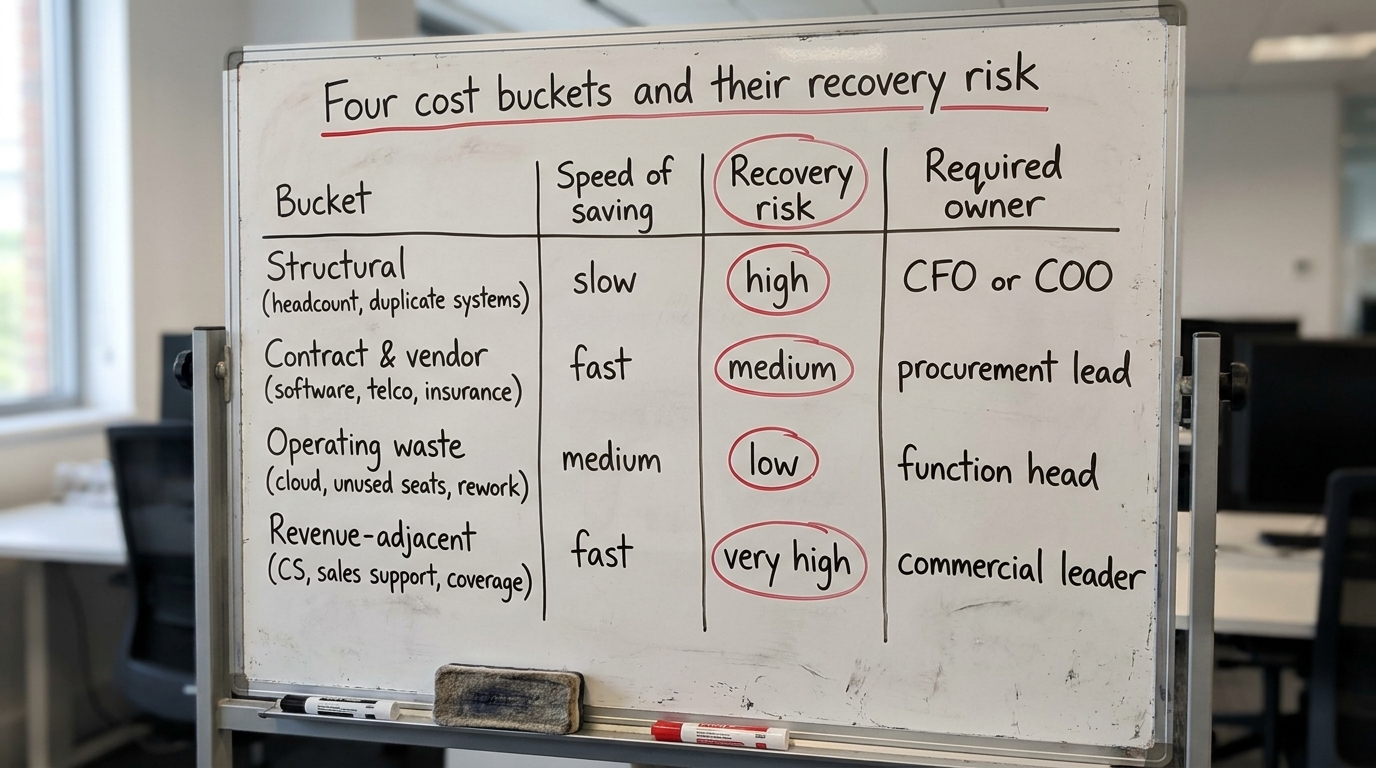
Not all cost lines carry the same risk when you cut them, and a serious consultant will segment before proposing anything. I group them into four buckets, because the decision rights and the recovery risk differ by bucket.
Structural cost
Headcount in support functions, duplicate systems after an acquisition, office footprint, management layers. This is where the durable EBITDA lives and where the blast radius is largest if you get it wrong. It needs the most diligence and the most senior owner inside the company.
Contract and vendor cost
Software licenses, telco, insurance, logistics, professional services. Often the fastest cash, often oversold. A renegotiation that trades a lower unit price for a three-year lock or a volume commitment can be a worse deal than the one it replaced.
Operating waste
Rework, over-provisioned cloud, unused seats, manual process that burns hours. Lower risk, real money, and frequently where IT spend hides. GrowthShuttle's own piece on IT cost optimization in private equity walks through how much of this sits in infrastructure and licensing that nobody has reviewed since the last platform change.
Revenue-adjacent cost
Sales support, customer success, marketing, the account coverage that protects renewals. Cut here and you are not optimizing cost, you are shrinking the top line on a delay. This is the bucket where a weak consultant does the most damage, because the saving is immediate and visible while the revenue loss is lagged and easy to misattribute.
3. Decide what you are actually buying before the pitch
A cost optimization consultant inside a portfolio company can be scoped as one of three things, and the price and the people you want differ by each.
The first is a diagnostic: a fixed-fee review that baselines spend, sizes the opportunity by bucket, and hands you a prioritized list with owners and timing. This is the portfolio audit shape, typically a few weeks, and it is the right starting point when you do not yet trust the numbers you have. The second is implementation: the consultant runs the change, negotiates the contracts, stands up the tracking. The third is interim capacity: a body in a seat doing the function while you hire. Confusing these is how you end up paying implementation rates for a diagnostic, or expecting a diagnostic team to execute.
For a first engagement on a company you are still getting to know, the diagnostic almost always sequences first. It is cheaper to be wrong in a scoping document than in a signed vendor contract. McKinsey and BCG both publish extensively on operational value creation in their private capital research and principal investors and private equity practices, and the consistent theme is that the saving that holds is the one tied to a named owner and a changed process, not the one tied to a one-time negotiation.
4. How to read the pitch, and what the deck will not show
Every cost consultant will show you a case page with a big savings number and a logo. The number is nearly always gross, nearly always point-in-time, and nearly always missing the cost to achieve and the recovery over the following year. Your job in the pitch is to get behind it.
Ask three questions about any claimed result. What was the baseline, and how was it measured? What did it cost to deliver the saving, including internal time? What did the saving look like 12 months later, net of anything that came back? A consultant who has done this work in a held company answers all three with the number and the method. GrowthShuttle covered the broader version of this problem in how PE firms vet a commercial due diligence partner, and the discipline transfers directly.
The adjacent skill sets are worth distinguishing too. A margin expansion consultant and an EBITDA improvement consultant overlap with cost work but are not the same hire, and GrowthShuttle has separate guides on how to judge a margin expansion consultant and how to judge an EBITDA improvement consultant. If a firm pitches you on all three interchangeably, treat that as a signal they have one playbook and are relabeling it.
5. The baseline is the whole game
You cannot judge a saving you cannot measure against a number you trust. The most common failure I see is a consultant who reports savings against a budget that was already padded, or against a run-rate from a month that was not representative. The saving looks real on the slide and vanishes in the management accounts.
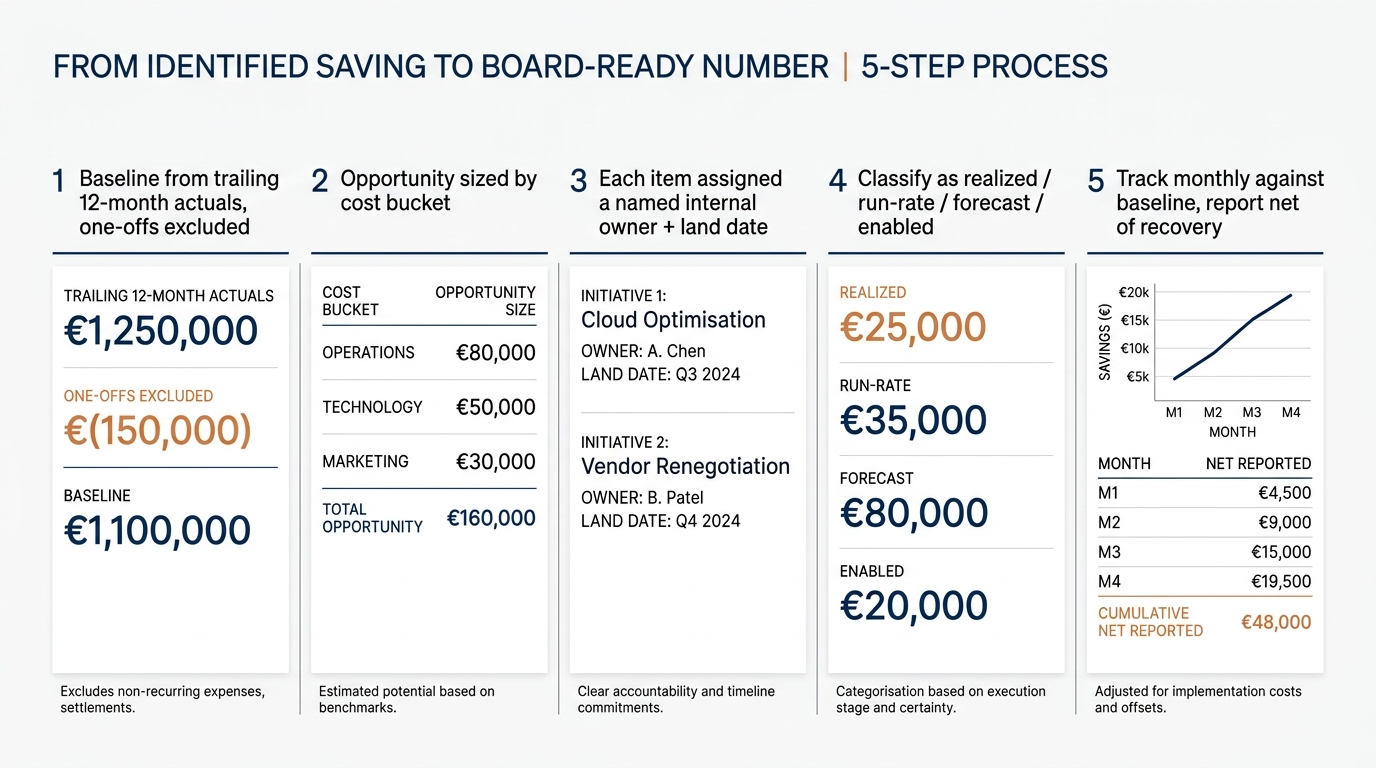
Insist on a baseline built from actuals, not budget, over a period long enough to smooth seasonality. For a company with any seasonal revenue, that means at least a trailing twelve months, with the one-offs identified and excluded. The consultant should document the baseline before proposing a single action, and you should sign off on it, because it is the number every later claim will be measured against.
If the business has weak cost allocation, the baseline work is itself valuable and partly explains why the engagement is worth doing. The AICPA and CIMA have practical material on cost and management accounting through their joint resources, and if your target cannot allocate cost to product, customer, or function, that gap is a finding in its own right.
6. Tie every saving to an owner and a classification
A number on a slide is not a saving. A saving is a line in the budget that a named person inside the company has agreed to hold, with a date by which it lands. The consultant's deliverable should force this, not leave it implied.
Classify each identified saving so the board conversation stays honest:
- Realized: already in the management accounts, measurable against the baseline.
- Run-rate: the change is made and the monthly impact is locked, even if the trailing accounts have not caught up.
- Forecast: the action is identified and owned but not yet executed.
- Enabled: a change that makes a future saving possible but does not itself move the number.
The reason to be strict here is that forecast savings have a way of being reported as realized in a board deck, and the gap surfaces at the worst possible time, usually when a buyer's quality of earnings team is in the data room. Keeping the classification clean from day one is cheaper than reconstructing it under confirmatory diligence.
7. The 100-day sequence that keeps cost work from breaking delivery
Timing matters as much as scope. Cutting revenue-adjacent cost in the first month, before you understand which accounts are actually at risk, is how a cost program turns into a churn problem. A workable sequence front-loads the low-risk buckets and buys time on the high-risk ones.
Start with operating waste and the clearly duplicate vendor spend, because those are fast, low-recovery-risk, and build credibility for the harder decisions. Move to structural and contract cost once the baseline is signed and owners are named. Hold revenue-adjacent changes until you have commercial data good enough to know what you are protecting. This ordering is the same discipline that makes a disciplined first 100 days work in any portfolio company: do the reversible things first, and buy evidence before the irreversible ones.
The Harvard Law School Forum on Corporate Governance regularly publishes on value creation and board oversight in sponsor-owned companies, and its archive is a useful check on how governance expectations have moved. The relevant point for your sequence is that a board now expects to see the owner and the method behind a cost number.
8. Watch the second-order costs the saving creates
Every cut has a downstream bill, and a good consultant prices it in. Cut cloud over-provisioning and you may need engineering time to right-size workloads. Reduce support headcount and your help desk response times move, which shows up in renewal behavior. If you are measuring your service function at all, GrowthShuttle's rundown of the best help desk metrics for team productivity is a reasonable baseline for watching whether a support cut degraded the thing customers actually pay for.
People cost has the longest tail. Removing a layer of management can save real money and also remove the person who held three customer relationships in their head. Before any headcount change, I want to know what the departing role actually did, not what the org chart said it did. The same applies to how you measure the people who remain. If you are leaning on performance data to decide who stays, the common errors in 360-degree feedback are worth avoiding, because a cost decision built on bad performance data is a lawsuit and a morale problem waiting to compound.
9. Judge the consultant on continuity, not just findings
The findings are the easy part. Any competent firm can find cost in a company that has not looked hard at its own spend. The difference between a saving that holds and one that unwinds is whether the change outlives the engagement.
Three things tell you a consultant takes continuity seriously. They insist on an internal owner for every action before they will claim it. They build the tracking into your existing management reporting rather than a parallel spreadsheet they maintain. And they are willing to be measured, in month nine, on the net saving that survived, not the gross saving they identified in month two. A firm that resists all three is selling you a report, and a report does not change a cost line.
Preqin and PitchBook both track how operating teams are being resourced across the industry, through Preqin's alternative assets data and PitchBook's research and data, and the direction is toward more embedded, accountable capacity rather than one-off advisory. Your consultant selection should reflect that shift.
10. Price the engagement against the decision it informs
A portfolio audit that baselines spend and sizes the opportunity by bucket typically sits in the $15,000 to $25,000 range for a mid-market portfolio company, and that is the right place to start when you want evidence before you commit to implementation. Implementation and interim work price higher because they carry delivery risk, and you should only buy them once the diagnostic has told you where the money actually is.
The economics favor sequencing. The audit is a small fraction of the saving a real structural or contract opportunity returns, and it protects you from spending implementation money chasing savings that recover within the year. S&P Global Market Intelligence maintains sector and company data that helps sanity-check whether a claimed vendor saving is in line with the market, available through S&P Global, and Harvard Business Review's archive on mergers and acquisitions is a useful corrective to the assumption that cost cuts in the first year reliably stick.
11. The decision checklist
Before you sign a cost optimization consultant into a portfolio company, confirm you can answer each of these.
- The commercial problem is named: cash this quarter, durable EBITDA for exit, or integration cost removal. The engagement is scoped to that, not to a generic percentage.
- You know whether you are buying a diagnostic, implementation, or interim capacity, and you are paying the right rate for it.
- The baseline is built from trailing twelve-month actuals, one-offs excluded, and you have signed it off before any action is proposed.
- Every claimed saving has a named internal owner and a land date, and is classified as realized, run-rate, forecast, or enabled.
- The sequence front-loads low-recovery-risk buckets and holds revenue-adjacent cuts until you have commercial data.
- Second-order costs are priced in, including engineering time, service degradation, and lost relationship knowledge from headcount changes.
- The consultant will be measured in month nine on the net saving that survived, which is the gross saving identified minus anything that was reversed, deferred, or offset by new spend.
- The tracking lives in your management reporting, not a parallel spreadsheet the consultant controls.
If you cannot answer those, the problem is the brief, and no consultant will fix a brief for you. The adjacent commercial disciplines are worth reading alongside this, including what a sales enablement consultant should deliver inside a PE portfolio company, because the revenue side and the cost side of a value creation plan have to be judged with the same evidence standard.
12. Where this fits in the broader value creation plan
Cost work is one lever, and it is the one most likely to be bought in isolation and regretted. It belongs inside the same operating plan that drives growth, integration, and risk reduction across the hold, which is the frame the full private equity operating approach takes. A cost program that ignores the revenue side, the data quality, and the second-order delivery risk is a timing bet. The saving has to land before the damage does.
The companies that come out of a hold with a defensible margin story are the ones that treated cost as a change-management problem with a named owner and a clean baseline, not as a spreadsheet exercise handed to an outside firm and forgotten until the next board meeting. That is the standard to hold any cost optimization consultant to inside a portfolio company you intend to sell.
If you want the diagnostic version of this done properly, with a signed baseline, savings classified the way a buyer's quality of earnings team will later test them, and every number tied to an internal owner, see how the DevriX portfolio audit is scoped for PE-backed companies.


