I’d fix the feedback process before collecting more ratings. Start with role-specific questions, reviewers who know the work, and clear privacy rules. Then turn the results into 2–3 measurable goals with an owner and a check-in within 30 days.
For small and midsize businesses, I’d check these seven mistakes first:
- Weak forms: Ask about observed actions, not personality.
- Poor reviewer selection: Choose people with direct, recent work experience with the employee.
- Weak confidentiality: Limit access and remove identifying details. Don’t promise anonymity you can’t protect.
- Vague scoring: Define each rating and let reviewers choose “not enough opportunity to observe.”
- Unclear purpose: Explain how feedback will be used before collecting it.
- Skipped debriefs: Schedule a conversation to sort through the results.
- Missing action plans: Put goals, support, deadlines, and follow-up in writing.
My rule: <u>measure changed behavior and work results - not just scores.</u> Fix the weakest step before your next review.
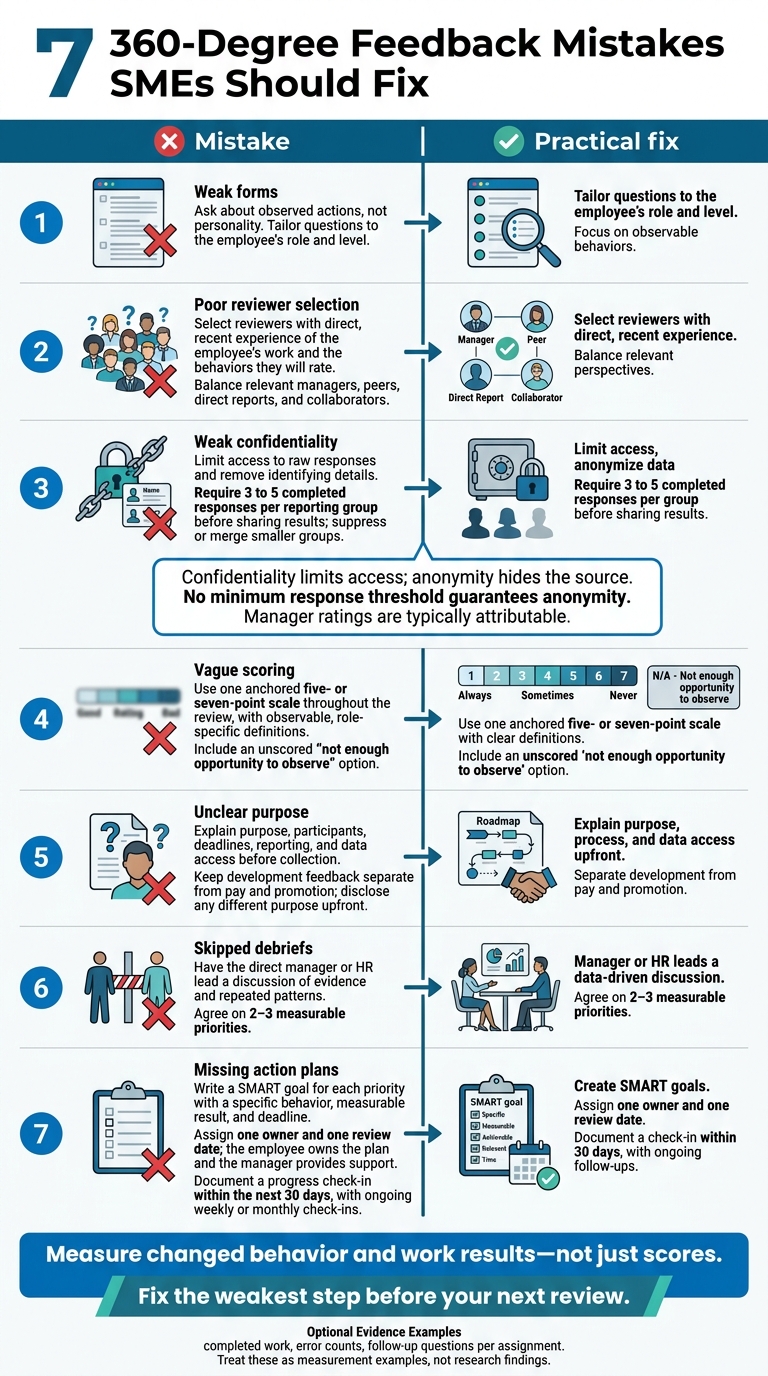
7 360-Degree Feedback Mistakes SMEs Should Fix
360 Degree Feedback Webcast | 5 Common Mistakes Made in 360 Degree Feedback Surveys
sbb-itb-c53a83b
What Effective 360-Degree Feedback Needs
360-degree feedback gathers observations from managers, peers, direct reports, and other relevant collaborators. Each sees a different side of the employee’s work.
KPIs track results. 360-degree feedback adds context about communication, collaboration, and other job-related behaviors. Use both, but treat reviewer ratings as context - not proof.
Ask reviewers about behavior they’ve observed, not personality or intent. Define ratings clearly so everyone scores against the same expectations for the employee’s role and level.
Protect reviewer identities. Without confidentiality safeguards, people become less willing to give honest feedback.
For a team of 15–40 employees, document feedback and review progress during weekly or monthly check-ins. Track changes in behavior alongside results. The first breakdown usually starts with the review form.
1. Weak Review Forms Measure Opinions, Not Behavior
Process Failure and SME-Specific Cause
The problem often starts with the form. SMEs tend to use one-size-fits-all forms because they haven’t fully documented what each role requires. When forms don’t account for departments or seniority levels, employees get assessed on items that don’t fit their work.
Impact on Team Output and Trust
Vague prompts take managers longer to answer and leave employees unsure what to change. Missed requirements lead to rework. Feedback focused on personality rather than behavior also weakens trust.
Practical Process Correction
Build forms with the people doing the work, and tailor each item to the role and level. Use SMART criteria and behavioral prompts, not subjective opinions.
Weak Question Better Question Is a good communicator Communicates changes in project priorities before they affect others’ work. Produces high-quality work Submits content pieces with no more than two spelling or grammar errors per draft. Shows great initiative Identifies one process gap and proposes a fix.
These changes give reviewers specific actions or thresholds to assess.
Manager Diagnostic Question
Keep only items that measure observable behavior or measurable outcomes.
Even a strong form fails if the wrong people fill it out.
2. Poor Reviewer Selection Skews Results
Once the form is set, the next weak spot is who fills it out.
Process Failure and SME-Specific Cause
Small teams often mistake knowing someone for seeing their work firsthand. The result is feedback based on anecdotes - or conflicting accounts - rather than observed behavior.
Impact on Team Output and Trust
Reviewers who lack the right context may give vague or off-target feedback. That can hide communication problems or gaps in handoffs, slow improvement, weaken cooperation, and erode trust in the feedback process.
Practical Process Correction
Set reviewer eligibility rules before the review starts. Choose only people who worked directly with the employee during the review period and saw the behaviors they’ll rate. Include a balanced mix of peers, managers, direct reports, and key collaborators so no single perspective dominates.
Manager Diagnostic Question
Does each selected reviewer have enough direct, recent experience with the employee’s specific work to assess the behaviors they are being asked to rate?
Even the right reviewer pool will produce weak feedback if people don’t trust the process.
3. Weak Confidentiality Safeguards Expose Reviewers
Process Failure and SME-Specific Cause
In small teams, removing names may not hide who wrote a comment. A small reviewer pool, a project name, or recognizable wording can give someone away. Confidentiality limits access; anonymity hides the source. Don’t promise anonymity unless the process can protect it. Without that clarity, reviewers hold back, and their feedback becomes less useful.
Impact on Team Output and Trust
Employees who fear exposure may soften criticism or give vague answers. Leaders then miss the details they need to fix problems quickly. Suspicion about who said what can also strain working relationships.
Practical Process Correction
Explain the safeguards before the review begins, including who can access raw responses and who sees only aggregated reports. Require 3 to 5 completed responses per reporting group before sharing results. If a group is too small, suppress its results or merge it with another group to protect reviewers’ identities.
Remove project names and other identifying details from comments without changing the behavior being described. Make clear that no minimum response threshold guarantees anonymity: wording and context can still reveal the source. Also explain that manager ratings are typically attributable because an employee often has only one direct supervisor.
After addressing identity protection, the next risk is ratings that vary too much to use.
Manager Diagnostic Question
Could the employee identify a reviewer from the group size or comment details, and have we clearly explained who can access responses and which ratings are attributable?
4. Vague Scoring Makes Ratings Hard to Use
Process Failure and SME-Specific Cause
Protecting confidentiality is only part of the process. The rating scale also needs to mean the same thing to everyone. Without shared anchors, labels like “above expectations” mean different things to different reviewers, and ratings become personal judgments. Employees lose trust when they can’t connect scores to observable work, especially when stakeholders set conflicting expectations.
Impact on Team Output and Trust
A lower score may point to a stricter reviewer - not weaker performance. That can lead managers to focus on the wrong development needs.
Practical Process Correction
Use one anchored five- or seven-point scale throughout the review. Define each score for each competency using observable behaviors, SMART goals, and role-specific competency frameworks. Test the scale on one role before rolling it out.
Include an unscored “not enough opportunity to observe” option for reviewers with limited visibility. Rate behavior observed during the review period. Before launch, walk reviewers through sample scenarios so they apply the same anchors.
Manager Diagnostic Question
Would two reviewers score the same behavior the same way?
5. An Unclear Purpose Discourages Honest Feedback
Process Failure and SME-Specific Cause
Reviewers go quiet when they don’t know whether feedback will shape development, pay, or a performance improvement plan (PIP). In small teams, mixed messages from leaders can leave people unsure how their feedback will be used. The review then becomes a debate about intent rather than performance.
Impact on Team Output and Trust
When feedback appears linked to pay or promotion, reviewers may inflate ratings or hold back criticism. That hides concerns and skews development priorities. Reputations spread fast on small teams, so using feedback differently than promised also damages trust in the process.
Practical Process Correction
Before launch, publish a written guide that explains the purpose, participants, deadlines, reporting, and data access. Set clear limits on how feedback can be used. State who sees raw responses, who sees aggregated reports, and when employees receive results. Allow access only where the stated purpose requires it, and involve the people doing the work in setting development goals.
Keep feedback separate from pay and promotion decisions. Put that boundary in writing and enforce it through access rules. If the process has another purpose, say so upfront - don’t label it development-only. Explain PIPs separately so employees don’t mistake a coaching review for a final warning.
With the purpose clear, the debrief can turn raw comments into next steps.
Manager Diagnostic Check
Before launch, confirm who can see the feedback and whether it affects pay or promotion.
6. Skipping the Debrief Leads to Misread Feedback
Process Failure and SME-Specific Cause
A clear purpose isn’t enough - the review still needs a live debrief. SMEs may see sending the report as the final step, leaving employees with conflicting interpretations and mismatched expectations.
Impact on Team Output and Trust
Without an explanation of the results, employees need repeated clarification. That slows work and weakens trust.
Practical Process Correction
Have the direct manager or HR lead the debrief. Use work records, role expectations, and measurable results to separate observed behavior from interpretation. Compare self-ratings against the same role-specific competencies, identify repeated patterns, and agree on 2–3 measurable priorities. End with named next steps, then use weekly or monthly check-ins to see whether those patterns are changing.
Manager Diagnostic Question
Who will help each employee interpret the results, and is that debrief scheduled before conclusions are drawn?
7. No Action Plan or Follow-Up Wastes Feedback
Process Failure and SME-Specific Cause
A debrief needs a written plan. SMEs often stop at the conversation without documenting what happens next. In smaller teams, feedback stays verbal rather than becoming a clear set of actions.
Impact on Team Output and Trust
Without follow-up, rework and coordination delays continue, and employees still need clarification. The same errors repeat. Reviewers then have less reason to trust the process or take part fully in the next review.
Practical Process Correction
Write an action plan for each priority. Replace vague feedback with a SMART goal that names one specific behavior, one measurable result, and one deadline.
Assign one owner and one review date. The employee owns the plan. The direct manager supports them and removes barriers. Schedule a check-in to review progress, with a 30-day follow-up window for more serious issues.
Track evidence, not impressions. Measure progress through completed work, error counts, or the number of follow-up questions per assignment.
If communication is the problem, keep follow-up questions to no more than two per task.
Add the plan to the review record so it becomes part of daily work. Document who owns it, who provides support, and when they’ll review progress within the next 30 days. Use that written record to measure progress at the next review.
Build a Repeatable Feedback Process
Turn the seven fixes above into a repeatable standard operating procedure (SOP). Write it first, then automate once the workflow runs consistently.
- Purpose and access: Before feedback starts, explain the review’s purpose and who can see raw responses, summaries, and development plans.
- Forms and scoring: Use role-specific competencies, observable behaviors, and a fixed scoring scale with clear anchors.
- Debrief and follow-through: Have the direct manager lead the debrief, document priorities, and review progress during weekly check-ins or monthly meetings.
Use the SOP as the standard for every review cycle.
Conclusion: Fix the Weakest Step Before the Next Review
A 360-degree review works only when the form, reviewers, scoring, purpose, debrief, and follow-up work together. The goal is better output and stronger trust.
For the fastest fix, start where the last review first broke down: unclear comments, exposed reviewers, or no follow-through. Address the step that most directly slows decisions, work, or trust. Give a named owner management responsibility for fixing it before you collect more feedback.
Then check whether the next cycle changes behavior. Track behavior and outcomes - not just scores. Turn vague comments into measurable goals, and monitor error rates or task completion time. Share aggregate progress without identifying reviewers, so people can see how their feedback leads to change.
FAQs
How often should we run 360-degree reviews?
Make 360-degree reviews part of your regular feedback routine, not a one-time task. Monthly check-ins or quarterly surveys help you track progress, spot bottlenecks, and address concerns before they grow. Collect feedback consistently, review it, and act on it to support steady improvement and build trust within your team.
Growth Shuttle offers business advisory services tailored to small and medium-sized enterprises (SMEs), helping you set up these processes and improve management workflows.
How should we handle conflicting feedback?
Address all stakeholders’ concerns and communicate openly to build trust. Don’t brush disagreements aside. Use them to work through solutions and improve plans.
Set clear escalation paths and train managers to address issues early. Audit current systems, define metrics precisely, and resolve conflicts between data sources. When needed, bring in external advisors to guide difficult conversations, maintain trust, and keep feedback productive and focused on results.
How can we prevent retaliation against reviewers?
Create psychological safety so team members can voice concerns and admit mistakes without fearing negative consequences. Use clear, standardized feedback systems and communication channels to keep the process objective and transparent. Put trust and teamwork first so feedback helps people grow instead of becoming a weapon.
Growth Shuttle helps SMEs put these management workflows into practice and build open, resilient workplace cultures where feedback works.


