You have a portfolio company that grew into the low tens of millions on founder instinct and one strong product, and now the forecast is missing by enough to matter. The board pack shows pipeline that never converts at the modeled rate, discounting that nobody signed off on, and a pricing structure that has not been touched since before you owned the asset. Somebody suggests bringing in revenue growth management advisory. Before you sign, you need to know what that phrase actually covers for a private equity buyer, what a good engagement is expected to move, and how you will tell in ninety days whether it worked.
This guide is written for the operating partner and the portfolio company executive holding the budget. I will stay on the commercial, operating, and data considerations, and leave valuation and deal structure to the people whose job that is.
1. What the phrase covers, and what you are actually paying for
Revenue growth management started in consumer goods as the discipline that ties pricing, promotion, mix, and trade spend into one number the CFO can defend. In a private equity context it has widened. When a sponsor or an operating partner asks for revenue growth management advisory, they usually mean a package that looks at pricing power, discount governance, sales productivity, customer retention, and the systems that report all four. The commercial fit is a portfolio company where revenue exists but the machine producing it is not legible.
You are not buying a growth strategy deck. A private equity owner is buying measurable enterprise-value improvement, which in this cluster means EBITDA that expands because price realization went up, discount leakage went down, or the same sales team closed more of the pipeline it already had. If an advisor cannot connect their work to one of those, you are paying for activity.
Bain's annual Global Private Equity Report has documented for several years that entry multiples have compressed the room for financial engineering, which pushes operational revenue work higher on the value-creation list. You can read the current edition at Bain & Company's Global Private Equity Report. The practical consequence for you is that this workstream is no longer optional in most mid-market theses.
2. Decide what problem you are actually solving before you scope the work
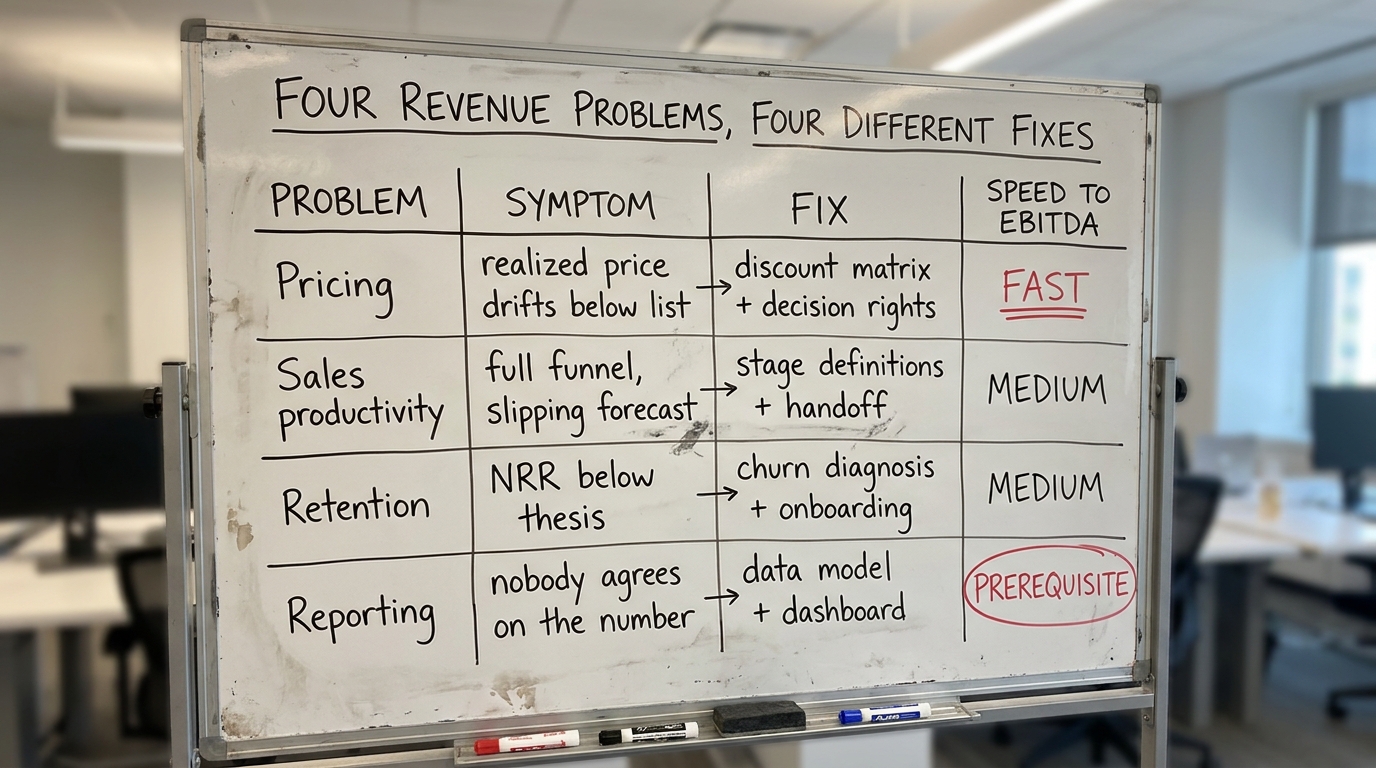
The word "revenue" hides at least four separate problems, and they need different owners and different advisors. Naming yours before the first call saves you from buying a generalist when you needed a specialist.
Pricing and discount governance
The symptom is realized price drifting below list with no approval trail. The fix is a pricing framework, a discount matrix with decision rights, and a report that shows list-to-net by deal. This is often the fastest EBITDA lever because it touches margin on revenue you already have.
Sales productivity and pipeline conversion
The symptom is a full top of funnel and a forecast that keeps slipping. The fix lives in the sales process, stage definitions, and the handoff between marketing and sales. I have written before on why the pipeline math does not survive a bad handoff, and that piece is a useful companion to this section.
Retention and expansion
The symptom is net revenue retention below the thesis assumption. The fix is churn diagnosis, onboarding, and the account management motion that produces expansion revenue.
Reporting and visibility
The symptom is that nobody in the building agrees on the number. The fix is data and systems, and it usually has to happen first because the other three cannot be measured without it.
3. Get the baseline before anyone proposes a plan
A revenue advisor who proposes initiatives before establishing a baseline is selling you a plan you cannot grade. The baseline is the set of numbers that existed on the day the engagement started, measured with a method you can repeat. Without it, every later claim of improvement is unfalsifiable.
For a revenue engagement the baseline is at minimum: realized price versus list by product and segment, discount distribution, win rate by stage, sales-cycle length, net revenue retention, and the actual-versus-plan variance for the last four quarters. Insist that these come from the source systems, not from a spreadsheet the CRO maintains by hand.
This is the same discipline that separates real diligence from a sales pitch. The GrowthShuttle guide on what operational due diligence consulting should deliver before you sign makes the point that the deliverable you should demand is evidence, not opinion. Apply the same test after close.
4. Check the data plumbing first, because everything else rides on it
In most mid-market portfolio companies the reason nobody agrees on the revenue number is that the CRM, the billing system, and the finance ledger were never reconciled. The pipeline lives in one place, the invoices in another, and the board pack is assembled by hand every month from both. That is why board reporting so often takes six people and still ships wrong numbers, a problem I covered in the piece on the monthly pack.
Before you fund pricing work or a sales-process rebuild, confirm that the data can support measurement. If the portfolio company runs on HubSpot or is standardizing onto it across the portfolio, treat that as a data decision first, which is the argument in the HubSpot standardization guide. A pricing framework built on a CRM nobody trusts will not survive its first board review.
This is also where the line between commercial advisory and technology due diligence gets blurry, and you want it clear. The advisor who tells you the revenue story and the advisor who can rebuild the system that produces it are not always the same firm. Decide which you are buying.
5. Sequence the work so the first ninety days produce something you can show a board
The engagement should be sequenced against real triggers, not a generic timeline. If you are inside the first 100 days after close, the sequence is different from a mid-hold correction on a company you have owned for two years.
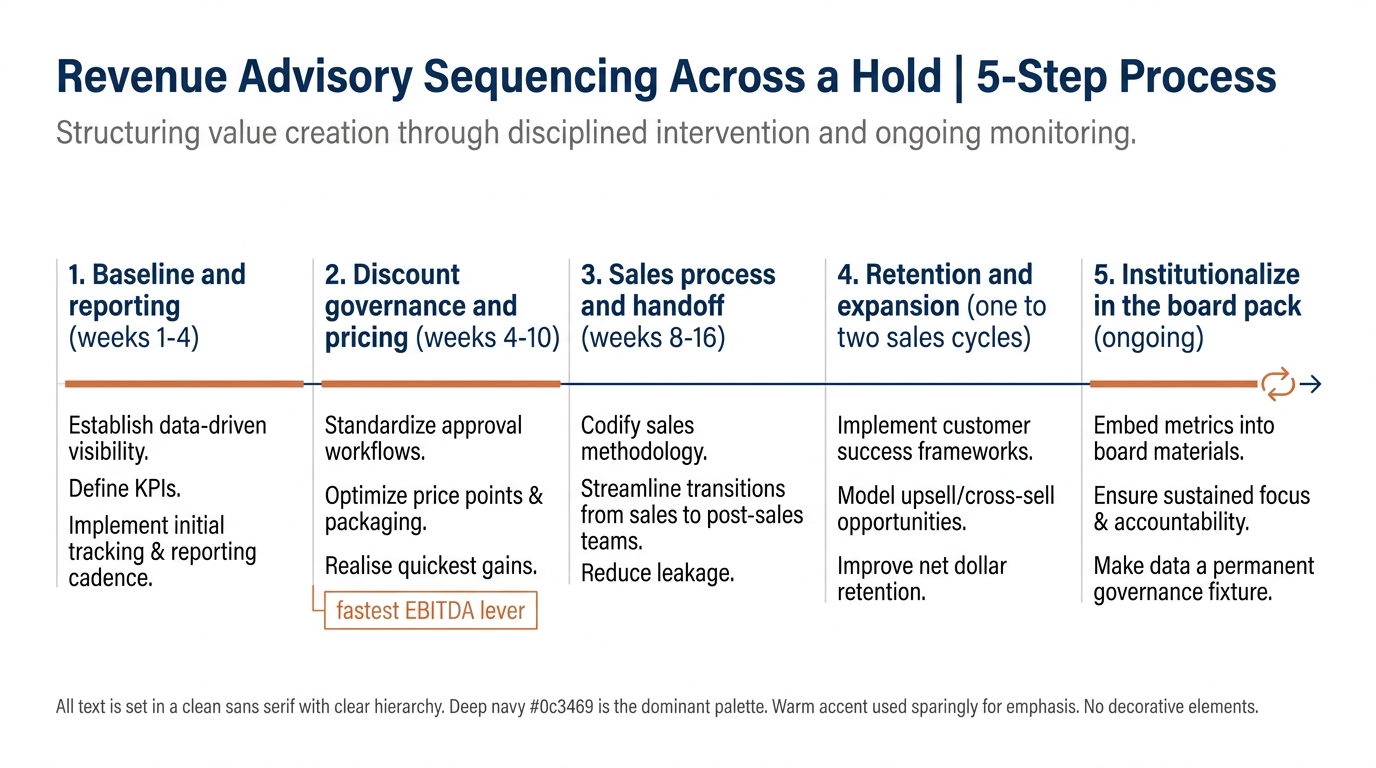
A defensible order of operations puts reporting and baseline first, pricing and discount governance second because it is the fastest margin lever, and the longer sales-process and retention rebuilds third. Retention and productivity changes take one or two full sales cycles to show in the numbers, so promising them inside a quarter is a tell that the advisor does not understand the mechanism.
The GrowthShuttle go-to-market timeline for the first 90 days lays out a sequence you can adapt for the first-quarter plan. The first board meeting after you engage an advisor should have at least one completed, measured deliverable on it, rather than a roadmap.
6. Choose the delivery model: fractional advisor or embedded team
The most consequential decision you make is not which firm but which delivery model. A fractional advisor who joins the executive team one or two days a week can diagnose and design, but cannot execute a CRM rebuild or run a pricing rollout across a sales force. An embedded team can execute but costs more and needs a clear decision right to be effective.
I have written a full treatment of where that line falls in the fractional CMO versus embedded team piece, and the short version is that the choice depends on whether the portfolio company has the internal capacity to execute what the advisor designs. If it does not, a fractional advisor produces a good plan that nobody implements, and you have bought a document.
The related question of how to hire and price the person or firm is covered in the guide on hiring an EBITDA growth consultant for a PE-backed business. Read it before you negotiate scope, because the scoping errors it names are the ones that turn a revenue engagement into a retainer with no exit.
7. Insist on the value-classification discipline in every claim
Not every number an advisor puts in front of you is the same kind of number, and treating them as equal is how forecasts miss. Before you accept any impact claim, make the advisor classify it.
- Realized value has already landed in the P&L and you can point to the invoice or the margin line.
- Run-rate value is realized on a monthly basis and annualized, which is legitimate but not the same as booked.
- Forecast value depends on a future action working as modeled.
- Enabled value is capacity you now have but have not used.
- Risk avoided is a loss that did not happen, which is real but the hardest to prove.
A pricing change that raised realized price on signed deals last month is realized. A discount policy that will raise margin if the sales team follows it is forecast. When an advisor blends the two into a single headline number, the board pack inherits the confusion, and the gap between the sponsor's view and the operator's view widens. That gap is the subject of the piece on why the sponsor pack and the operator's dashboard disagree, and revenue advisory is one of the places it opens up.
8. Know which financial line each lever moves
Judge a revenue advisor by whether they can name the line their work moves before they start. Pricing and discount governance move gross margin and therefore EBITDA quickly, because they touch revenue you already have. Sales productivity moves revenue growth but takes a cycle to show. Retention moves the multiple more than the current-year number, because a buyer at exit pays for durable revenue.
McKinsey's private capital research has documented that operational value creation has become the dominant source of returns as multiple expansion has weakened, and you can follow that work at McKinsey. BCG's principal investors practice makes a similar case in its published work at BCG. The practical takeaway for you is that revenue quality, not just revenue quantity, is what the next buyer will diligence, so build the engagement around durability.
For a wider frame on how these levers fit a value-creation plan, the GrowthShuttle overview of private equity value acceleration places revenue work alongside the other operating levers you are managing in parallel.
9. Set the reporting cadence and the decision rights up front
An advisory engagement that reports only in its own format, on its own schedule, becomes invisible to the board within two months. Agree at the start that the advisor's outputs feed the existing board pack and the operator dashboard, in the definitions those already use. If the engagement introduces new definitions of win rate or net retention, reconcile them to the old ones so the board can see continuity.
Decide who holds the decision right for each lever. Pricing changes usually need CFO and CEO sign-off; discount approvals need a clear threshold matrix; a sales-process change needs the CRO to own adoption. If the advisor holds the analysis but no one inside the company owns the decision, nothing ships. That ownership question is the single most common reason a well-designed revenue engagement produces no realized value.
10. Run diligence on the advisor the way you would on a target
You would not buy a company on a founder's word, so do not buy a revenue engagement on a pitch deck. Ask for the baseline they would establish in week one and the method they would use to measure it. Ask which of their prior engagements they can describe with an account, a period, and a measured result, and treat vague aggregate claims as unproven.
Check that the advisor understands your reporting reality. If they have never reconciled a CRM to a finance ledger, they will design a pricing framework that the data cannot support. The governance literature at the Harvard Law School Forum on Corporate Governance and the M&A work published by Harvard Business Review both make the broader point that post-close value depends on execution discipline more than on the thesis. Apply that lens to the advisor sitting across from you.
For sizing and market context on where operational advisory spend is going, the data hubs at PitchBook, Preqin, and S&P Global Market Intelligence are the sources professional buyers rely on, and reading their current material will keep your expectations aligned with what the market is actually pricing.
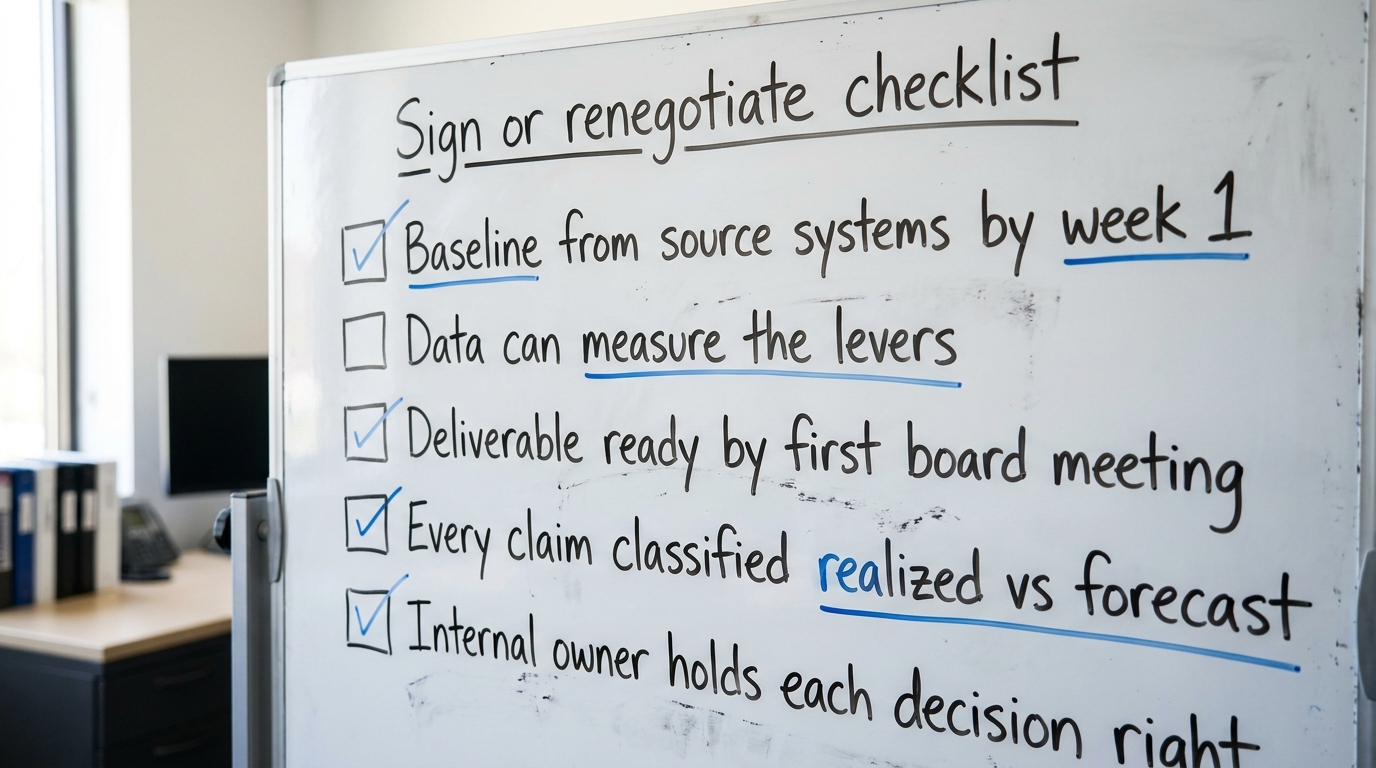
11. A checklist you can use before you sign
Run the proposed engagement against these questions. If more than a couple come back weak, renegotiate the scope before you commit budget.
- Which of the four revenue problems is this engagement actually solving, and is the advisor the right specialist for it?
- What baseline will the advisor establish in the first week, and does it come from source systems rather than a hand-kept spreadsheet?
- Is the data plumbing capable of measuring the levers, or does a reporting fix need to come first?
- Does the sequence produce a completed, measured deliverable by the first board meeting?
- Are we buying a fractional advisor to design or an embedded team to execute, and does the company have the internal capacity for whichever we chose?
- Is every impact claim classified as realized, run-rate, forecast, enabled, or risk avoided?
- Which financial line does each lever move, and how long until it shows?
- Do the advisor's outputs feed the existing board pack in the existing definitions?
- Who inside the company holds the decision right for each lever?
- Can the advisor describe a prior result with an account, a period, and a method?
12. What good looks like ninety days in
By the first quarterly board meeting after the engagement starts, you should be able to point to a source-of-truth reporting view that finance and sales both accept, at least one pricing or discount change that has produced realized margin you can trace to specific deals, and a sequenced plan for the sales-process and retention work with the expected timing stated in sales cycles rather than months. You should also have a clear internal owner named for each lever.
A strategy deck, a set of blended numbers you cannot decompose, and no named owners mean the engagement is drifting toward the vendor pattern where activity substitutes for outcome. That is the moment to reset the scope rather than the moment to renew.
Revenue growth management advisory earns its place in a private equity thesis when it turns a founder-built revenue machine into one the CFO can defend and the next buyer can diligence. Judge it on that, on the evidence it produces, and on whether someone inside the company owns the decisions it recommends.
If you are scoping this work for a portfolio company now and want a RevOps engagement built around a baseline, a reporting fix, and levers tied to EBITDA, review the DevriX private equity operating offer and bring the checklist above to the first conversation.


