You are three weeks past close, the value creation plan from the deal team reads like a wish list, and the management team has already asked you to approve four unrelated spending requests. You have budget and board patience for maybe two or three real initiatives in the first year. The question in front of you is which improvements carry enough margin or growth to matter, which are cheap to prove, and which the current team can actually execute. A portfolio company value creation diagnostic exists to answer exactly that, before you commit capital, headcount, or your own credibility to the wrong workstream.
This is written for the operating partner or the portfolio company executive who holds the decision, not for someone building a theory of value creation. I will name the framework, lay out its tiers, show how to score it, and walk a short illustrative example so you can judge whether a diagnostic you are about to buy or run is worth the money.
1. Why most value creation plans fail the first board meeting
The plan written during diligence is built on partial information, a compressed timeline, and the natural optimism that gets a deal to close. Bain's annual Global Private Equity Report has tracked for years how much of the industry's return now has to come from operational improvement rather than multiple expansion and leverage, which means the plan you inherit is carrying more weight than plans did a decade ago. Most of those plans fail when they meet the actual numbers inside the business.
Two things go wrong. The initiatives are sized on revenue potential with no honest view of execution cost or the team's capacity to deliver them. And the sequence is driven by what excited the deal team, not by what pays back fastest or de-risks the thesis first. A diagnostic fixes the second problem by forcing a ranking against evidence you can defend in a room.
If you want the cleaner, fix-this-first version of the same logic applied to a portfolio company, GrowthShuttle's piece on a portfolio company diagnostic that tells you what to fix first covers the triage mindset in detail.
2. What a value creation diagnostic actually decides
A diagnostic is a scoring exercise that produces a ranked shortlist of value creation initiatives, each with a size, a confidence level, a cost to execute, and a named owner. The output is a decision document, not a report that sits in a shared drive.
Concretely, it should let you answer four questions at the next board meeting with evidence rather than opinion:
- Which three or four initiatives carry the most defensible enterprise-value impact?
- For each, is that impact already realized, running at a measurable rate, forecast, or merely enabled by something else first?
- What does each cost to execute, and does the current team have the capacity to run it?
- What has to happen before you can start, and who owns that dependency?
Notice what is missing. There is no catalog of problems for their own sake. McKinsey's private capital research has repeatedly made the point that value is created by a short list of disciplined moves executed well, not by a long list of improvements attempted at once. The diagnostic's job is to produce that short list and defend the cut line.
3. The four tiers of the value creation diagnostic
The framework sorts every candidate initiative into one of four tiers based on how its value behaves and when it arrives. The tiers describe certainty and timing, which is what governs where you spend the first 90 days.
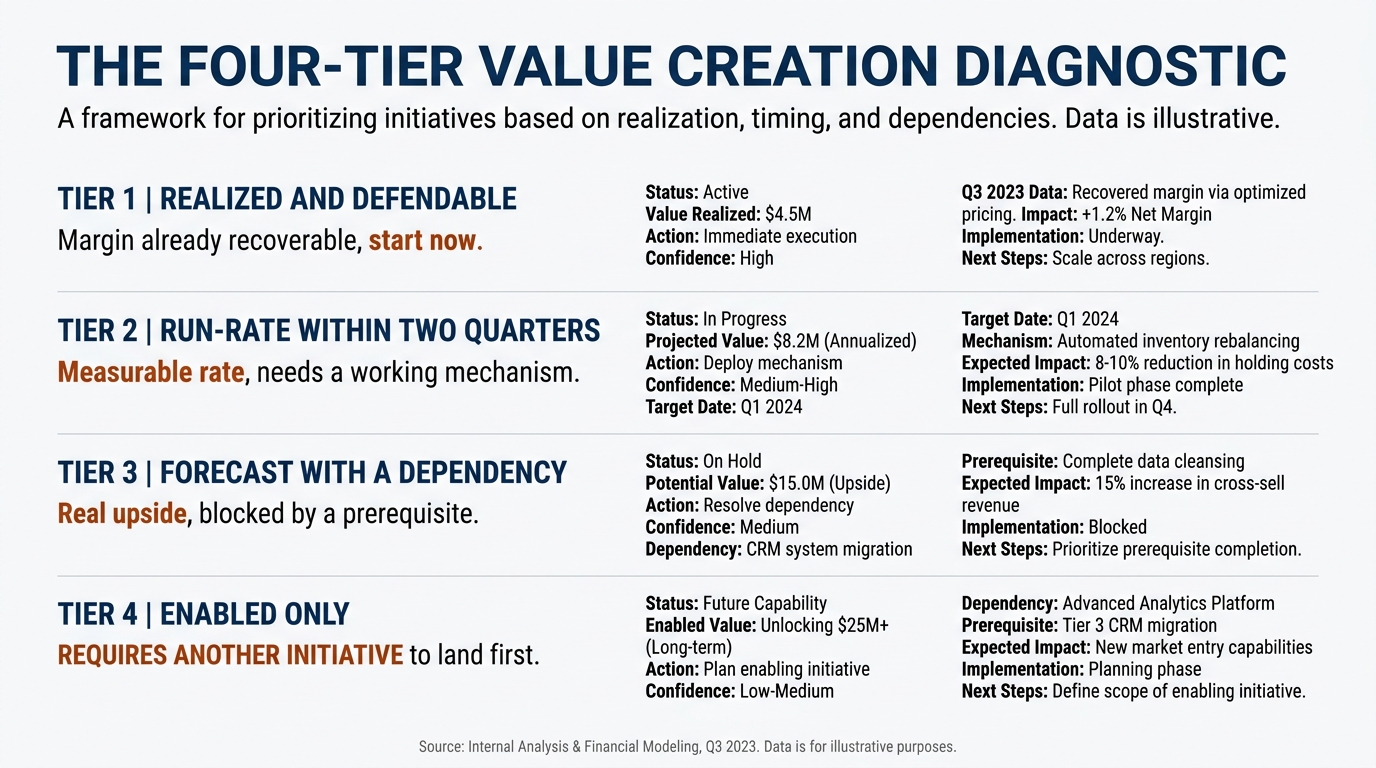
Tier 1: realized and defensible
Value you can recover now, with evidence that already exists. A pricing leakage you can quantify from the current order book. A duplicate vendor contract you can consolidate this quarter. These pay back inside a quarter or two and carry low execution risk. They fund the harder work and buy you credibility with management and the sponsor.
Tier 2: run-rate within two quarters
Value becomes measurable once a mechanism is in place and running. Sales pipeline hygiene lifts conversion, a help desk reorganization cuts cost-to-serve. The upside is real but it arrives as a rate rather than a lump, so you judge it on the run-rate you can demonstrate by the second or third board meeting.
Tier 3: forecast with a dependency
Genuine upside that is blocked by a prerequisite. A cross-sell motion that needs a unified customer record first. A new market entry that needs a hire you have not made. The value is forecast, not realized, and you should never let it read as realized in a board deck. Score it honestly and put the dependency on the risk register.
Tier 4: enabled only
Initiatives whose entire value depends on another initiative landing first. These belong on the roadmap, not in the first 90 days, and the most common mistake is funding them early because they are the exciting ones. The value creation plan nobody reviews until the exit memo is usually stuffed with Tier 4 work dressed up as Tier 1.
4. How to score each initiative
Each candidate gets four scores, and the discipline is to score all four before you rank anything. Teams that rank on value alone always over-invest in big, slow, blocked initiatives.
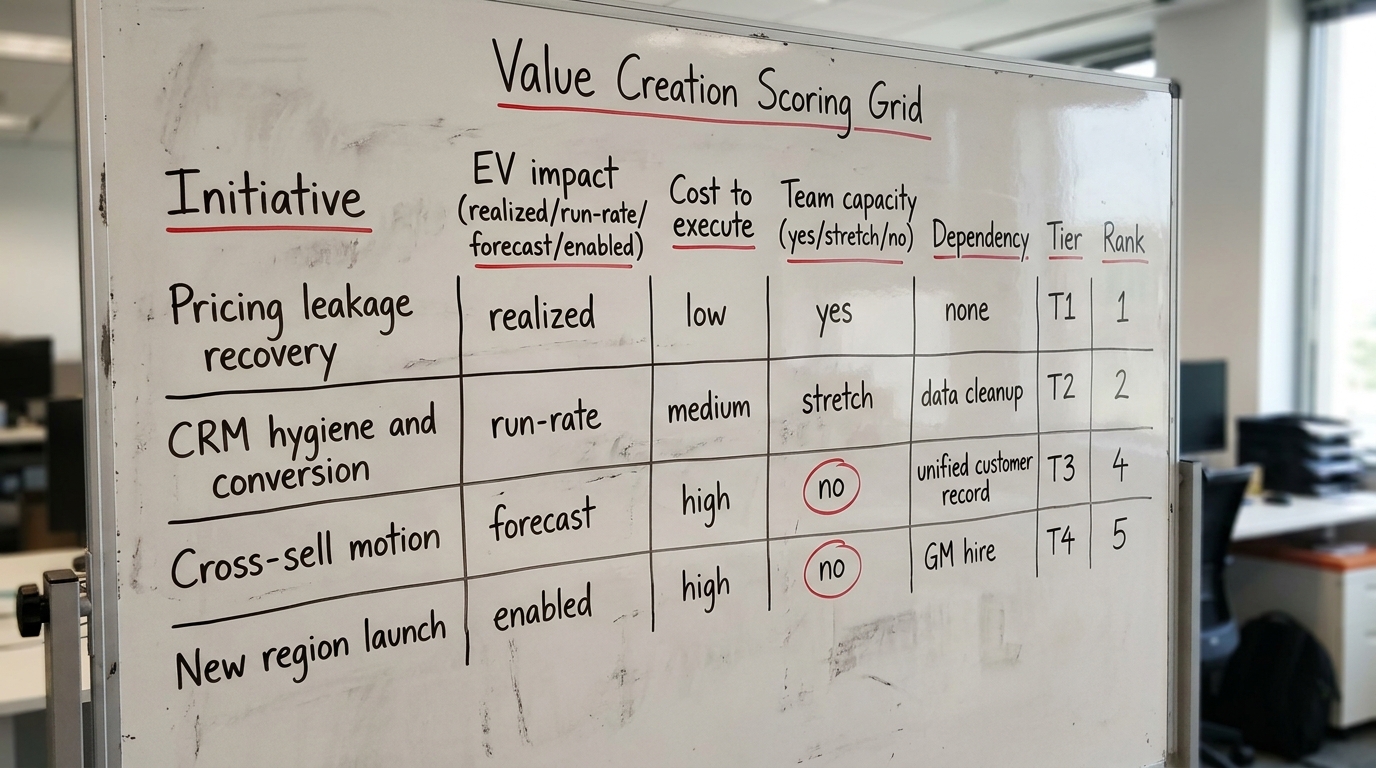
EV impact and its classification
Size the enterprise-value effect, then classify it as realized, run-rate, forecast, or enabled. The classification matters more than the number. A smaller realized gain beats a larger forecast one in the first year because it compounds your credibility and your cash position while the slower work develops.
Cost to execute
Not just the direct spend. Count management attention, system changes, and the opportunity cost of the people who will run it. A cheap-looking initiative that consumes your best operator for six months is not cheap.
Team capacity
Score honestly as yes, stretch, or no. If the honest answer is no, you are deciding something larger than this one initiative, you are deciding whether to hire, contract the capability, or defer. GrowthShuttle's guidance on choosing an operational value creation firm for a portfolio company is the right reference when capacity is the binding constraint rather than the idea.
Dependency
Name what has to be true first, and name who owns it. A dependency without an owner is how Tier 3 work quietly slips a year and shows up unfinished in the exit memo.
5. The data you need before you can score anything
The single most common reason a diagnostic stalls is that the business cannot see its own numbers. ERP, CRM, and finance systems are disconnected, the real reporting lives in a spreadsheet one person maintains, and nobody can tell you gross margin by customer or product without a week of manual work.
You do not need a data warehouse to run a diagnostic. You need read-only access to the systems that hold the truth, and enough of a unified view to size the top initiatives with real figures rather than management estimates. The gap between what management reports and what the systems actually say is often the first Tier 1 finding on its own.
When that gap is severe, treat data visibility as a prerequisite initiative with its own owner. S&P Global's market intelligence work and PitchBook's research and data are useful for benchmarking a portfolio company against its sector, but external benchmarks only help once you trust your own internal numbers.
6. Sequencing the first 90 days against the tiers
The sequence follows the tiers, not the enthusiasm. Start Tier 1 immediately because it is cheap, defensible, and it funds the rest. Begin the mechanism for the strongest Tier 2 initiative in parallel, since run-rate value only starts accruing once the mechanism exists. Resolve the dependency on your best Tier 3 candidate so it can move to Tier 2 in the following quarter. Leave Tier 4 on the roadmap with a named trigger.
This is where a diagnostic connects to the first 100 days playbook. The diagnostic tells you what to do, the first-100-days discipline tells you how fast and in what order to do it without breaking the business while you change it.
For the technology-dependent initiatives, the sequencing has to respect what the systems can actually support. If the thesis leans on a platform the business cannot scale, that belongs in technology due diligence findings carried forward into the plan, not discovered in month eight.
7. An illustrative scoring example
The following is an illustrative scenario. Take a mid-market distributor bought in a platform deal. The deal team's plan listed nine initiatives. Running the diagnostic produced this ranking.
- Pricing leakage recovery. Analysis of the order book showed a measurable band of discounting below policy with no approval trail. Realized value, low cost, team capacity yes, no dependency. Tier 1, rank 1, started week one.
- CRM hygiene and conversion lift. Pipeline data was inconsistent and conversion reporting used last-touch logic that hid the real picture. Run-rate value, medium cost, team capacity a stretch, dependent on a short data cleanup. Tier 2, rank 2, mechanism started in parallel.
- Cross-sell across two product lines. Real upside, but it required a single customer record that did not yet exist. Forecast value, high cost, no current capacity, dependent on data unification. Tier 3, rank 4, dependency assigned an owner.
- New region launch. Attractive to the deal team, entirely dependent on a general manager hire not yet made and on the cross-sell data work. Enabled only. Tier 4, rank 5, left on the roadmap with a hiring trigger.
The decision the diagnostic forced was uncomfortable and correct. The most exciting item on the deal team's list, the region launch, was the last thing to fund. The least glamorous item, pricing discipline, paid for the first two quarters of the harder work.
8. What separates a good diagnostic from an expensive report
You are likely paying somewhere in the range of a focused portfolio audit for this work, and the difference between a useful diagnostic and a shelf document comes down to a few traits you can check for.
- Every initiative is scored on value, cost, capacity, and dependency.
- Value is classified as realized, run-rate, forecast, or enabled, and the forecast items are not inflated to look like cash in hand.
- There is a cut line, with the initiatives below it named and explained.
- Each surviving initiative has a named owner inside the business.
- It uses the company's own numbers, with external benchmarks from sources like BCG's principal investors and private equity research used for context, not as a substitute for internal evidence.
A diagnostic that gives you a list of twenty opportunities and no ranking has done the easy half of the job. The hard, valuable half is the cut line and the sequence. The Harvard Law School Forum on Corporate Governance has published extensively on how governance and clear ownership shape outcomes in sponsor-backed companies, and the same discipline applies to how a diagnostic assigns accountability.
9. How this connects to the board and the exit
The diagnostic's ranking becomes the spine of your board reporting. A sponsor reads a deck in a few minutes and wants to see the ranked initiatives, where each sits against plan, and which dependencies are at risk. GrowthShuttle's breakdown of the one deck a sponsor reads in under five minutes is the natural companion, because a good diagnostic makes that deck almost write itself.
It also protects the exit narrative. When the value creation story is a ranked set of initiatives with classified value and tracked progress, the eventual exit memo tells a continuous story rather than a reconstructed one. Harvard Business Review's work on mergers and acquisitions and the deal coverage in PE Hub both reinforce how much buyers scrutinize the credibility of a seller's value creation claims. Classified, tracked value survives that scrutiny. A list of ambitions does not.
10. The cost and capability initiatives the diagnostic will surface
Two findings show up in almost every diagnostic and deserve their own note because they are easy to get wrong.
The first is cost optimization. The diagnostic will surface spend you can cut, and the risk is cutting in a way that breaks delivery. GrowthShuttle covers this directly in hiring a cost optimization consultant without buying a spend cut that breaks delivery, and the IT-specific angle in IT cost optimization in private equity. Cost cuts are tempting Tier 1 items precisely because they are fast, which makes it important to score their effect on delivery before you rank them high.
The second is margin. A margin initiative often looks like Tier 1 on the surface and turns out to be Tier 3 once you trace the dependency. GrowthShuttle's guide to judging a margin expansion consultant before you give one a portfolio company is a useful filter when the diagnostic hands you a margin thesis that needs execution help you do not have in-house.
11. Running the diagnostic yourself versus buying it
If you have an operating team with spare capacity and access to the systems, you can run the diagnostic internally, and you should, because the knowledge stays in the house. The case for buying it is specific: you need it done in weeks rather than months, you want an outside view that management cannot quietly steer, or your team is already fully committed to running the business.
A diagnostic bought as a service should arrive built for the company's actual business model. A framework designed for a software company applied to a distributor or a clinic group produces confident nonsense. The private equity operating work worth paying for starts from your business model and your numbers, and hands you a ranked, owned, sequenced plan you can defend in the next board meeting.
Preqin's alternative assets data and reporting in Private Equity International both show how much the industry's returns now rest on operational execution, which is the reason a disciplined diagnostic is worth the few weeks it takes.
12. A short checklist before you commit
Before you approve a diagnostic, run or buy, confirm it will deliver the following:
- A ranked shortlist of initiatives.
- Four scores per initiative: EV impact, cost to execute, team capacity, dependency.
- Value classified as realized, run-rate, forecast, or enabled, with forecast kept distinct from realized.
- A visible cut line and an explanation of what fell below it.
- A named owner inside the business for every surviving initiative and every dependency.
- Use of the company's own numbers, with external benchmarks for context only.
- A 90-day sequence that starts Tier 1, builds the top Tier 2 mechanism, and resolves the best Tier 3 dependency.
Get those seven things and the diagnostic earns its fee by telling you where not to spend as clearly as where to. Related discipline on measurement and feedback, from help desk metrics that reflect real productivity to the feedback mistakes SMEs make, matters once you are tracking the initiatives you chose, because a ranking is only useful if you can see whether it is working.
If you want a portfolio company value creation diagnostic run against your own numbers, scored, ranked, and sequenced for the first 90 days rather than handed back as a report, the DevriX and GrowthShuttle portfolio audit offer is built to produce exactly that output.


