The synergy deck says you'll consolidate marketing ops by month six and capture $4M in duplicate vendor savings. The reality is you've got two HubSpot instances, three analytics stacks, five domain registrars, and nobody can agree which CRM becomes canonical because the acquired company's Salesforce instance is wired into every revenue workflow they have. By month seven you're still running parallel systems, the CFO is asking why the vendor spend went up, and the integration lead who promised the $4M left for another fund.
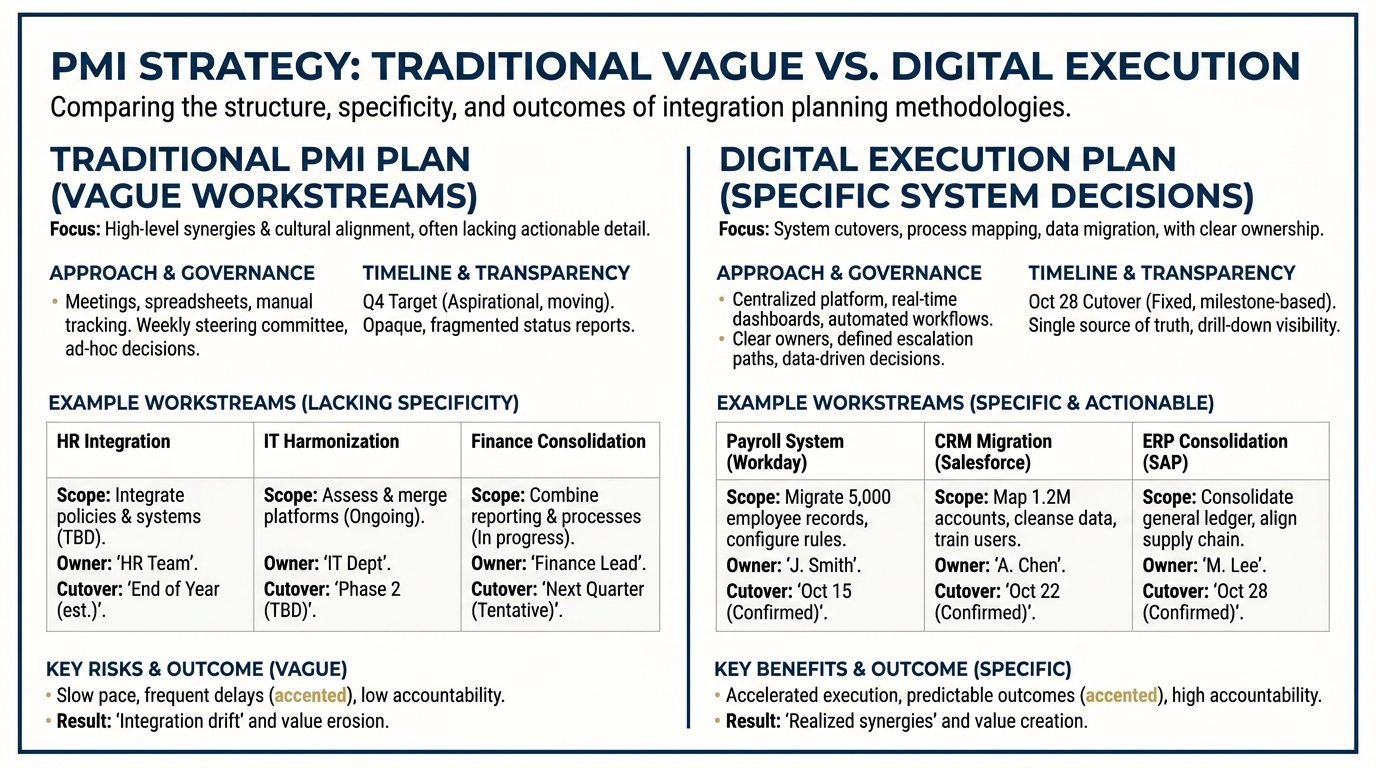
Most post-merger integration consulting focuses on org charts, synergy targets, and operating-model slides. The part that actually breaks is digital execution: which domain wins, which CRM survives, which analytics stack becomes the source of truth, and what the 30/60/90 cutover dates are. The plan that works is the one that maps every PMI initiative to a specific system decision with an assigned owner, a baseline, and a rollback procedure.
Why Most PMI Plans Break at the System Layer
The hundred-day plan approved by the board names all the right workstreams: brand consolidation, sales force integration, data unification, technology rationalization. What it doesn't name is which Salesforce org becomes the survivor, who decides whether to keep the target's GA4 property or migrate everything into the acquirer's existing measurement plan, or what happens to the acquired company's domain authority when you redirect fifteen high-ranking product pages to a new URL structure.
These aren't edge cases. They're the decisions that determine whether the synergy you modeled actually lands, and they all require a judgment call from someone who understands both the business logic and the technical consequence. The org chart says the VP of Marketing owns 'brand integration'. The reality is the VP inherited two conflicting HubSpot lifecycles, doesn't know which one converts better, and is three weeks from a board meeting where someone will ask why MQLs dropped 40% post-close.
The failure mode is treating digital consolidation as a vendor-managed project rather than a value-creation workstream with the same rigor you'd apply to pricing or procurement. When the integration lead can't answer 'which system wins and why', the default is to keep both running, duplicate the spend, and call it a phase-two decision. By phase two, the duplicate cost is embedded, the teams have picked sides, and the business case you sold to the IC is underwater.
The Digital Execution Version of a 100-Day Plan
A digital execution plan starts with the same hundred-day horizon but inverts the structure. Instead of naming workstreams and hoping the details resolve themselves, you lead with the system decisions that have to be made, assign them to specific people who can actually make them, and sequence the work so that later decisions inherit from earlier ones instead of creating parallel paths that never converge.
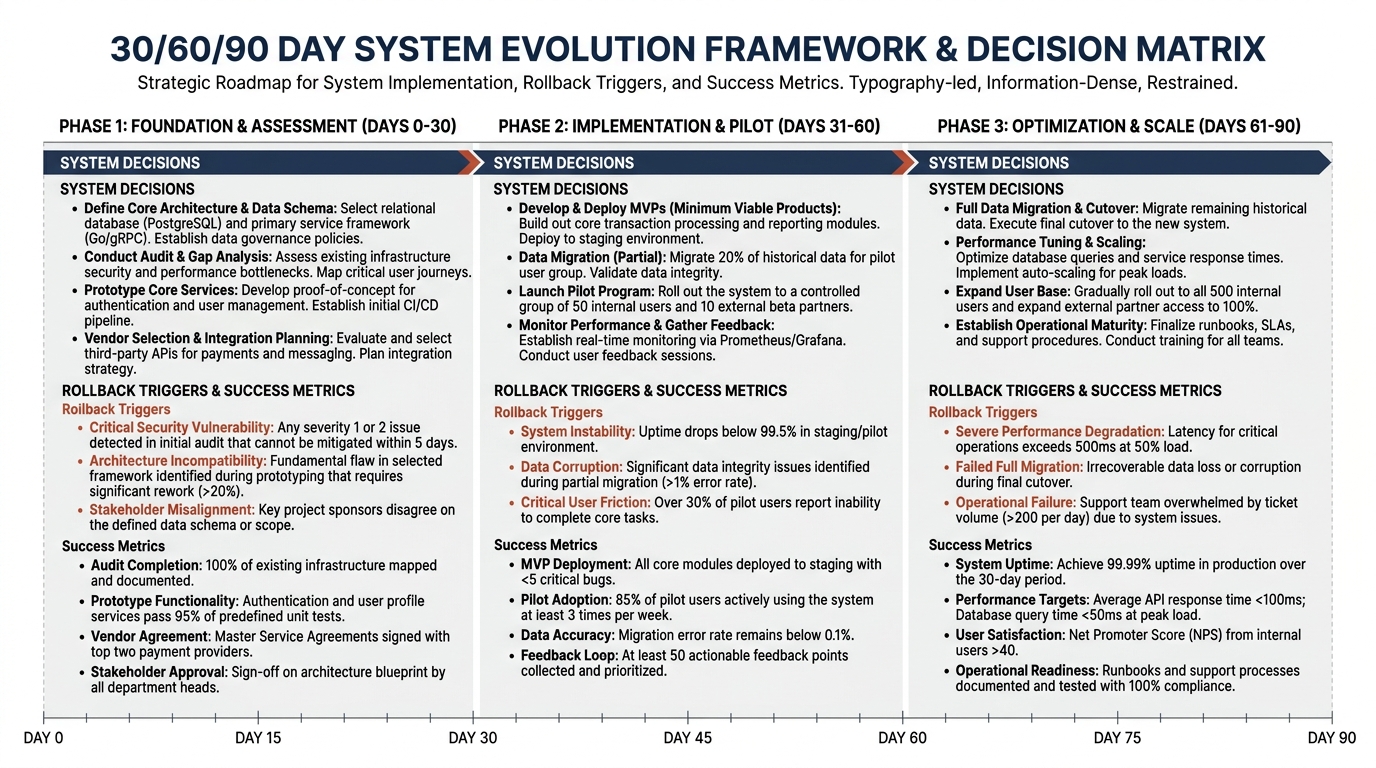
The baseline structure runs in three phases: first 30 days for assessment and decision rights, days 31-60 for high-confidence execution, and days 61-100 for integration and measurement. That's not novel. What makes it executable is that every line item maps to a real system, names the person deciding, states what gets measured, and includes the rollback plan if the decision breaks something load-bearing.
First 30 Days: System Inventory and Decision Rights
The first month is discovery, but not the kind that produces a slide deck. You're building a system map: every domain, every CRM instance, every analytics property, every marketing automation platform, every data warehouse, every third-party integration that touches customer data or revenue reporting. For each one you document the owner, the cost, the data it holds, what breaks if you turn it off, and whether it's contractually stuck for the next eighteen months.
The deliverable is a decision matrix with three columns: system, survivor or retire, and who decides. The 'who decides' column matters more than the decision itself, because most integration plans fail when five people think they own the CRM migration and nobody actually does. Assign one name per decision. If two people have to agree, name the tiebreaker.
This is also when you validate the investment thesis against what the systems actually do. If the thesis says you're buying a customer base and the target's CRM has eighteen months of unmigrated Salesforce data sitting in a legacy instance nobody's logged into since 2019, that's a day-one risk that needs a mitigation plan, not a phase-two backlog item.
Days 31-60: High-Confidence Execution
The second month is where you execute the decisions that are low-risk, high-confidence, and unlocking for everything else. Consolidate the domain registrars. Migrate the target's DNS to a single canonical provider. Standardize the analytics measurement plan so that both companies are tagging events the same way. Set up cross-domain tracking if you're running two brands during a transition period. Shut down the duplicate MarTech subscriptions where one platform clearly dominates and the contract allows an exit.
These moves don't require board approval, they don't touch revenue-critical workflows, and they reduce cost and complexity immediately. More importantly, they force the organization to make real decisions under pressure, which surfaces the friction points before you get to the hard calls like CRM consolidation or brand sunsetting.
This is also when you baseline everything you're about to change. Organic traffic by domain. Conversion rates by funnel. Lead volume by source. Average deal size. Sales cycle length. You need the before-state locked in with a timestamp, because in month four someone will claim the integration killed pipeline and you'll need to show them the number was already declining pre-close.
The System Decisions That Actually Matter
Every integration has its own specifics, but there are five system decisions that show up in almost every mid-market deal, and the order you make them determines whether the rest of the plan is executable or aspirational.
Domain Strategy and SEO Continuity
You've acquired a company with fifteen years of domain authority, 200 high-ranking pages, and organic traffic that represents 40% of their inbound pipeline. The board wants one brand. The marketing team wants to protect the SEO equity. The decision is whether to redirect the acquired domain to the parent, run it as a standalone property during a transition, or keep both indefinitely.
The wrong choice here costs you six months of organic traffic while Google re-crawls and re-ranks the redirected pages. The right choice depends on whether the acquired brand has standalone value, whether the parent domain can absorb the redirected authority without dilution, and whether you've got the technical capacity to set up 301 redirects correctly with proper canonical tags and preserved URL structures. This isn't a marketing decision or an IT decision, it's both, and it needs an owner who understands domain authority, redirect mechanics, and the P&L impact of a six-month traffic dip.
CRM Survivorship and Data Migration
Two Salesforce orgs, two HubSpot instances, or one of each. The synergy case says you'll consolidate to one system and eliminate the duplicate subscription cost. The reality is that one CRM is wired into the acquired company's entire revenue engine, the custom objects don't map cleanly to the parent's schema, and the API limits on the surviving instance weren't designed for double the contact volume.
The decision framework here is survivorship, migration, or coexistence. Survivorship means you pick one CRM, migrate the other, and retire it. Migration means you move all the data, re-map the workflows, retrain the users, and accept the three-month productivity hit while the sales team learns a new system. Coexistence means you run both, accept the duplicate cost, and integrate them at the reporting layer. None of these is free, and all of them have a different cash flow and risk profile.
What kills most CRM consolidations is treating it as a data migration project when it's actually a workflow redesign project. The acquired company's lead scoring model doesn't match yours. Their stage definitions are different. Their opportunity close reasons are different. Migrating the records is the easy part. Making the system work the same way for two sales cultures is the hard part, and that's a change management problem that needs executive sponsorship, not a Jira ticket assigned to IT.
Analytics and Reporting Unification
The CFO wants one number for revenue, one number for pipeline, and one number for CAC. Right now there are two GA4 properties, two HubSpot analytics dashboards, two Salesforce reporting instances, and three different definitions of what counts as a qualified lead. The post-merger integration consulting deliverable here is a canonical reporting stack with one source of truth for every number that goes into a board deck.
This means picking which analytics platform survives, migrating the historical data if you need comparables, setting up cross-property roll-ups if you're running multiple brands, and defining the events and conversions that feed into revenue reporting. It also means instrumenting the target's properties with the surviving measurement plan, which surfaces all the places where their tracking was incomplete or broken and you were flying blind on attribution.
The timeline matters. If you wait until month six to unify analytics, you've got no baseline for the first five months of ownership, and every performance claim is contested. If you do it in the first sixty days, you've got clean data from day one and you can measure the integration's impact rather than guessing at it.
What the Operating Partner Actually Needs to Decide
The operating partner's job is to make sure the value-creation plan doesn't stall at the system layer. That means forcing the survivor-or-retire decision on every platform, assigning owners who can't punt it to a steering committee, and defining what success looks like in measurable terms so that month four isn't a debate about whether the integration is working.
The decisions that need executive-level calls:
- Brand strategy: One brand, two brands, or a transition period? If transition, what's the sunsetting timeline and the trigger to accelerate or delay?
- Domain consolidation: Redirect, coexist, or keep separate? Who owns the SEO risk if organic traffic drops?
- CRM survivorship: Which instance wins, what's the migration timeline, and what's the acceptable sales-productivity hit during cutover?
- Customer data unification: Single customer record, federated view, or keep separate until you can build the integration properly?
- Tech stack rationalization: Immediate shutdowns, phased exits, or run both and consolidate at contract renewal?
These aren't IT decisions. They're commercial decisions with technical dependencies, and they all trace back to a line in the investment thesis. If the thesis says you're buying a customer base to cross-sell, you need unified customer records in month two, not month twelve. If the thesis says you're buying a product to bolt onto your platform, you need API integration and shared authentication, and that's a six-month engineering lift that should have been in the day-one plan.
The Baseline, the Milestone, and the Rollback
Every system decision in the hundred-day plan needs three things: a baseline before you change it, a milestone that defines success, and a rollback procedure if the change breaks something load-bearing. Most PMI plans have the milestone. Almost none have the baseline or the rollback.
The baseline is the before-state: organic traffic before the redirect, conversion rate before the CRM migration, lead volume before you consolidated the marketing automation platforms. You lock it in with a date and a screenshot, and you use it to separate integration impact from market dynamics. When someone says pipeline dropped because you migrated HubSpot, you pull the baseline and show them it was already declining.
The milestone is what success looks like and when you'll know. 'Consolidate CRM by month six' isn't a milestone; 'migrate 40,000 contacts and 12,000 opportunities to the surviving Salesforce org by 2026-03-15 with zero orphaned records and sales team trained' is a milestone. It's specific, it's dated, and it's measurable.
The rollback is the plan for when the change doesn't work. You redirected the acquired domain and organic traffic dropped 50%. Do you undo the redirect, wait it out, or invest in a recovery plan? You migrated CRM and half the workflows broke. Do you roll back to the old instance, run dual systems until you fix it, or push through the breakage? The answer depends on what else is load-bearing on the decision, and you can't make that call in real time under pressure unless you thought through the rollback beforehand.
How This Connects to the Broader PMI Workstream
The digital execution plan isn't separate from the rest of the integration, it's the substrate everything else runs on. You can't consolidate sales operations if the CRM migration isn't done. You can't measure cross-sell success if you don't have unified customer records. You can't report on synergy capture if the analytics stack is still producing two different pipeline numbers. The system decisions unlock or block everything downstream, which is why they belong in the critical path, not in the IT backlog.
This is also where the integration lead's background matters. If they came up through corporate development or finance, they'll understand the synergy model but they won't know why a CRM migration is a six-month project or what breaks when you redirect a domain. If they came up through operations or product, they'll understand the systems but they might not connect it back to the investment thesis or the value-creation scorecard. The post-merger integration consulting engagement that works pairs someone who knows the financial model with someone who knows the system dependencies, and gives both of them decision rights.
For additional perspective on how operational integration connects to broader value-creation planning, CEO-level discussions on integration strategy often surface the misalignment between board expectations and ground-level execution capacity. Similarly, commercial integration challenges highlight where digital consolidation directly impacts revenue systems.
The Real Output: A System Map, Not a Slide Deck
The deliverable from the first hundred days isn't a beautiful slide deck with waterfall charts and synergy bridges. It's a system map showing every platform, every decision made, every decision deferred, and every dependency that's blocking progress. It names the owner for each system, shows the current state and the target state, lists the milestones and the success metrics, and flags the risks that could derail the plan.
That system map becomes the operating document for the next twelve months. When the board asks why marketing spend went up instead of down, you show them the map and walk through which systems you consolidated, which ones you're still running in parallel because the contract doesn't expire until Q3, and which vendor you're paying twice because the acquired company's data is stuck in a legacy platform you can't migrate until you rebuild the API integration.
It's also the handoff document when the integration lead rotates off. Most integrations lose momentum between month six and month twelve because the person who understood all the decisions left and the new person has to reverse-engineer what was already decided. The system map prevents that. It's the durable artifact that survives leadership changes, and it's the difference between an integration that lands the synergy case and one that stalls out in year two because nobody remembered why we're still paying for two HubSpot instances.
Why the First Hundred Days Set the Next Thousand
The hundred-day plan matters because it's the window when you have executive attention, board patience, and organizational willingness to make hard calls before politics calcify. After month four, every system decision becomes a negotiation. After month six, the duplicate costs are embedded in the budget and the CFO stops asking why. After month twelve, you've institutionalized the workaround and the synergy case is permanently impaired.
The digital execution plan that works is the one that forces the decisions early, assigns them to people who can make them, measures the outcome, and builds in the flexibility to course-correct when the first plan hits reality. It's not visionary. It's not elegant. It's concrete, it's specific, and it survives contact with the real systems.
The integration that lands the value-creation plan is the one where someone decided which domain wins in week three, not month nine. Where the CRM migration had a start date, a success metric, and a rollback plan. Where the analytics stack got unified before the first board meeting so the CFO had one number for revenue instead of three competing forecasts. Those aren't the decisions that make the sizzle reel. They're the decisions that make the model work.
If you're an operating partner, a portco CEO, or an integration lead staring at two HubSpot instances and a synergy target you're not sure how to land, the question isn't whether you need a plan. The question is whether your plan maps to real systems with real owners and real cutover dates, or whether it's a list of workstreams you hope will resolve themselves. One of those survives the first hundred days. The other one becomes the explanation for why the value-creation plan is underwater in year two.
Need a 100-day digital execution plan that maps to real systems? The team that built this framework has run post-close integrations for PE-backed portcos consolidating CRMs, migrating domains, and unifying analytics under live board timelines. We'll map your synergy targets to the actual system decisions, assign the owners, set the milestones, and give you the rollback procedures before you need them. Reach out and we'll walk through what the first thirty days should actually produce.
Common Pitfalls That Sink First-Hundred-Day Plans
Most hundred-day plans fail in predictable ways, and the failure mode is usually visible by week two. The first is the plan that treats integration as a project plan instead of a decision-forcing process. You'll know you're looking at one when the deliverables are all documents — integration playbook, system inventory, stakeholder alignment deck — and none of them force a binding call on which platform stays and which one gets decommissioned.
The second is the plan that defers every hard decision to a future phase. The CRM migration is "scoped for Q2." The domain consolidation is "pending further analysis." The duplicate vendor contracts are "under review." By day ninety, you've produced a well-formatted list of things you haven't decided yet, and the CFO is asking why the cost synergies aren't showing up in the forecast.
The third is the plan built around vendor promises instead of internal capacity. The agency says they can migrate HubSpot in six weeks. The consultant says the Salesforce integration is straightforward. The MarTech vendor says their platform handles multi-brand setups natively. None of that matters if your team can't supply the data mappings, can't get API access from the acquired company's IT lead, or can't carve out the engineering time to build the middleware that nobody scoped in the original proposal.
And the fourth — the one that kills more integrations than any other — is the plan that assumes organizational alignment that doesn't exist. The portco CEO agreed to consolidate onto the parent brand, but the marketing lead at the acquired company is still running campaigns under the old domain because "the rebrand isn't final yet." The CFO signed off on a single Salesforce instance, but the sales team is still logging deals in the legacy CRM because "the data migration isn't complete." You can't execute a hundred-day plan when half the organization is still acting like the deal hasn't closed.
The plan that works is the one that names the decision, assigns it to someone with authority, sets a date, and escalates immediately when that date slips. Not "we'll consolidate domains" — "the acquired domain will 301 redirect to the parent domain on March 15, the DNS cutover is owned by the VP of Marketing, and if we're not ready by March 10 we escalate to the CEO." That level of specificity is what separates a real plan from a status update.
What Good Looks Like: A Real First-Thirty-Day Sequence
Day one through day seven: system access and baseline truth. Get read access to every platform — HubSpot, Salesforce, Google Analytics, the ESP, the ad accounts, the domain registrar, the hosting provider. Export the data. Count the records. Map the integrations. Identify which systems talk to each other and what breaks if you turn one off. This is not analysis. This is establishing ground truth so you're not making decisions based on what the seller said was true in diligence.
Day eight through day fourteen: decision forcing and ownership assignment. Which CRM wins. Which domain is primary. Which analytics property is the source of truth. Which marketing automation platform survives. Assign each decision to a single owner — not a committee, a name — and set the binding date. If the decision requires board approval, get it on the next board agenda. If it doesn't, make the call and communicate it.
Day fifteen through day thirty: execution starts and the first systems get shut down. The losing domain gets a 301 redirect and a public announcement. The duplicate HubSpot instance goes into read-only mode and you stop adding new contacts. The old Google Analytics property stops receiving new traffic and you archive the historical data. These are the forcing functions that prevent the integration from stalling out because nobody wanted to make the cutover feel real.
Day thirty through day sixty: migration, consolidation, and the first measurement. The CRM data migrates. The email lists consolidate. The ad accounts move under a single manager. The duplicate vendor contracts get terminated or renegotiated. You measure the cost delta — how much you're actually saving versus what you projected — and you update the synergy case with the real numbers. If you're behind, you escalate. If you're ahead, you accelerate the next phase.
Day sixty through day ninety: stabilization and handoff. The new systems are live, the old ones are decommissioned, and the baseline metrics are established so you can measure performance going forward. You document what worked, what didn't, and what you'd do differently on the next integration. You hand off the system map to the operating team with the ownership assignments, the success metrics, and the rollback procedures. That's the artifact that survives your tenure.
This sequence isn't glamorous and it doesn't make a good investment committee slide. But it's the sequence that actually lands the synergy case, and it's the one that gives you a defensible answer when the board asks why you're still running two instances of the same platform six months post-close.
The Systems That Kill Integrations (and the Alternatives That Work)
Most integration failures trace back to one of three system-level mistakes: choosing consensus over speed, deferring the data consolidation, or treating the technology stack as a second-phase problem. All three feel prudent in month one. All three compound into existential delays by month six.
The consensus trap shows up when you try to preserve optionality by running parallel systems "until the team is ready." Two CRMs, two domains, two analytics stacks, two sets of login credentials. The logic is that you'll minimize disruption and let adoption happen organically. What actually happens is that adoption never happens because nobody has to adopt anything. The sales team keeps using the CRM they know. The marketing team keeps reporting out of the analytics instance they've already wired to their dashboards. Six months later you're still paying for duplicate licenses and the CFO is asking why the integration budget is underwater.
The data consolidation mistake is the one where you migrate the systems but defer the data cleanup until "after we stabilize." You move the contacts into the surviving CRM but you don't deduplicate them. You point the DNS at the new domain but you don't canonicalize the URLs. You consolidate the ad accounts but you don't merge the audience segments. The result is that your attribution is wrong, your funnel metrics don't tie out, and your customer count is inflated by 30% because the same person exists in three different databases with three different IDs. You can't measure performance improvement when the baseline is fictional.
The technology-stack mistake is treating the platform decisions as an IT project instead of a value-creation dependency. The CRM migration goes on the IT roadmap with a twelve-month timeline because "we need to spec it properly." The website consolidation gets pushed to Q3 because "we want to do a full rebrand at the same time." The analytics migration doesn't even make the list because "we'll get to it once we finish the CRM." What you end up with is a value-creation plan that's blocked on systems work that hasn't started, and a board presentation where the operating partner has to explain why the organic growth target is off track because the marketing team still can't measure traffic by source.
The alternative is a forcing-function model: pick the surviving platform on day one, set the cutover date for day thirty, and make it irreversible. Decommission the losing system at the deadline even if the migration isn't perfect. Merge the data with the duplicates flagged but not deleted. Launch the consolidated site with the redirects in place even if some of the pages aren't final. Imperfect and live beats perfect and stalled, every time.
Where Private Equity Operating Partners Actually Add Value
An operating partner's edge in an integration is not showing up with a better process framework or a more detailed project plan. It's knowing which decisions have to be made in week one to avoid a six-month stall, having the credibility to overrule the VP who wants to "evaluate options for another quarter," and being able to tell the board that the integration is behind because the portfolio company CEO is blocking the CRM cutover — not because the plan was bad.
The value shows up in three specific places: decision forcing, escalation ownership, and ruthless milestone enforcement. Decision forcing is calling the meeting where the CRM decision gets made, putting the options on the table with the cost and risk spelled out, and walking out with a named owner and a binding date. Escalation ownership is being the person who tells the CEO that the website consolidation is three weeks behind and if it doesn't ship by Friday it's going on the board agenda as a portfolio-company-leadership issue. Milestone enforcement is tracking every cutover date, flagging every slip within 24 hours, and pulling forward the consequences when the slip turns into a pattern.
This is not the work that goes in the quarterly board deck. But it's the work that determines whether the revenue synergy you modeled in the IC memo actually shows up in the P&L, or whether it shows up as a footnote explaining why the integration is "still in progress" eighteen months post-close.
What to Do on Monday
If you're an operating partner or a portfolio company leader staring at a post-merger integration that's supposed to start next week, the playbook is this: build the system map in the first three days, make the platform decisions in the first ten, set the cutover dates with escalation paths, and decommission something irreversible in the first thirty. The quality of the migration matters less than the speed of the forcing function. Perfect data that arrives in month nine is worth less than imperfect data that's live in month two, because only the second one lets you start measuring performance improvement while you still have time to course-correct.
If you're a deal partner pricing a platform in diligence, the question is not "what's the tech stack" but "how much of the synergy case depends on integrating it, and what's the forcing function that makes the integration actually happen." A target with clean systems and bad leadership will stall the integration. A target with messy systems and a CEO who will make the call and own the cutover will land the synergy case. Price accordingly.