If you are three weeks from a confirmatory deadline and the commercial story still rests on a management deck and a growth rate nobody has pressure-tested, the quality of the commercial due diligence you commission will shape the price you pay and the plan you inherit. The question is which firm delivers a defensible view of demand, competitive position and revenue durability, and which produces a well-formatted document that restates the seller's narrative with more charts.
This guide is written for the operating partner or portfolio company executive who already has budget and a mandate. You know what CDD is. What you need is a way to scope it, judge the provider, and get an output you can carry into the investment committee and then into the first 100 days. When you hire commercial due diligence for a PE-backed deal, the test is simple: can the findings change a decision, and will they still be useful after close.
1. Start with the decision the CDD has to inform, not the deliverable
Most weak engagements begin with a request for a "commercial due diligence report." That framing produces a report. A better framing names the decisions the work has to inform: whether the base-case revenue growth survives independent scrutiny, whether the top accounts are at risk, whether the addressable market supports the entry multiple, and whether the integration or buy-and-build thesis holds.
Write those questions down before you brief anyone. A provider who reshapes your questions into their standard chapter list is telling you how they work. The firms worth hiring ask what you are worried about and build the workstreams around it. Bain's annual tracking of the industry, published in its Global Private Equity Report, has described a market where entry multiples leave little room for sloppy underwriting, which raises the cost of a CDD that confirms rather than tests.
The deliverable follows the decision. If the decision is a go or no-go on a platform, you need a view on market structure and durability. If the decision is how aggressively to price an add-on, you need customer-level and pricing-level evidence. Scope the work to the decision and you stop paying for pages you will never cite.
2. Decide what you are actually buying before you ask for a quote
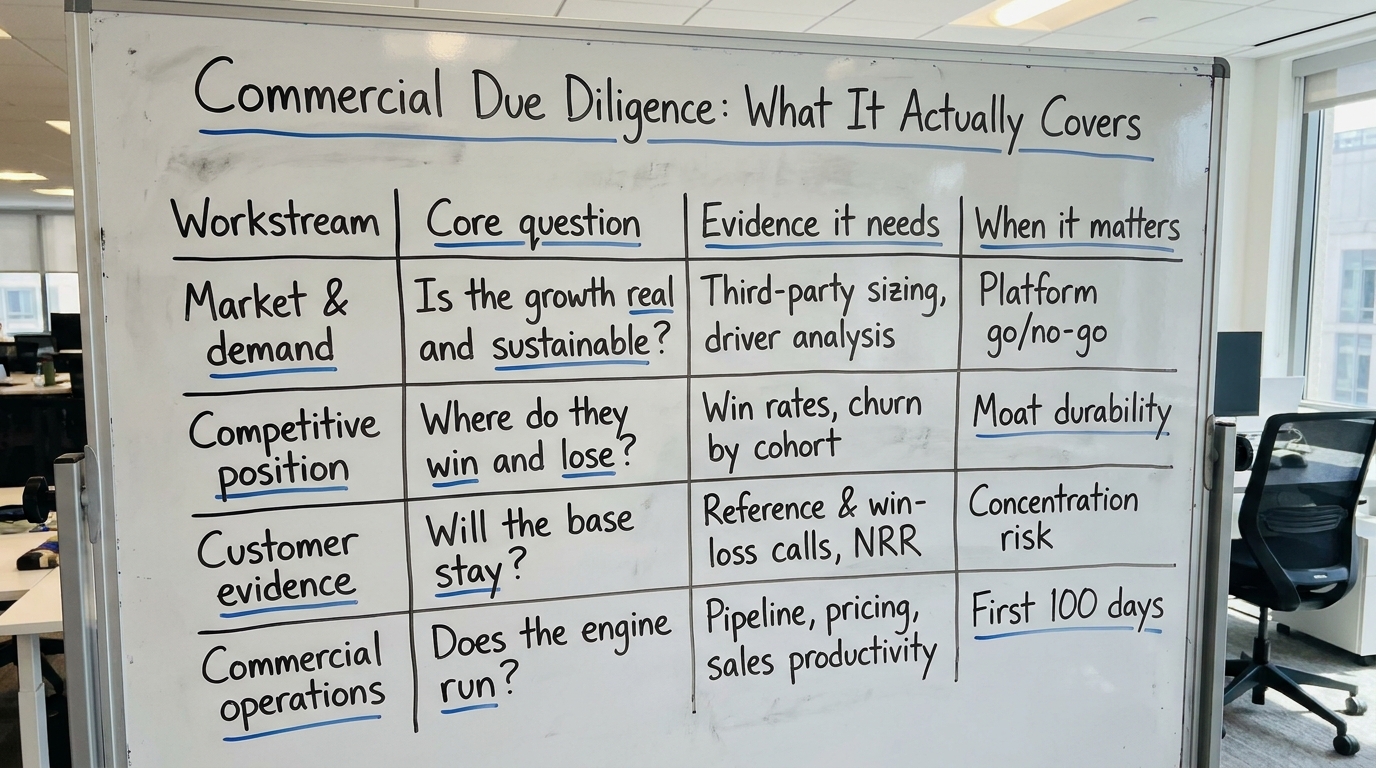
Commercial due diligence covers a wide range, and the word gets stretched to fit whatever the provider sells. Before you request proposals, decide which of these you are buying, because the skills and the price differ by a factor of several.
- Market and demand assessment. Size, growth, segmentation, and the drivers behind the growth rate. This is where most generic CDD lives, and where the least differentiated work gets done.
- Competitive position. Where the target actually wins and loses, win rates, churn by cohort, and whether the moat is real or a function of one large customer.
- Customer evidence. Reference calls, win-loss interviews, and a read on net revenue retention that does not rely on the seller's definitions.
- Commercial operations. Pipeline quality, sales productivity, pricing discipline, and the health of the revenue engine you will own on day one.
The last category is where CDD overlaps with the operating work you will need after close, and where a provider who understands revenue operations is worth more than a pure strategy house. For a deal where the thesis rests on fixing a leaky commercial engine, our guide on digital marketing due diligence that changes the price you pay covers the demand-side evidence that routinely moves the model.
3. Match the provider to the deal, not to the brand
There are three kinds of firms that handle CDD, and each fits a different situation. The large strategy consultancies bring depth on market structure and a brand your investment committee recognizes. The specialist CDD boutiques move faster and often know a vertical better than a generalist ever will. The operator-led firms, which sit closer to revenue operations and go-to-market execution, are weaker on grand market framing but stronger on the question of whether the commercial engine actually works.
Pick by what the deal needs. A first-time entry into an unfamiliar sector with a large check justifies the market depth of a strategy house. A bolt-on in a vertical your fund already owns rarely does, and paying strategy-house rates for a market you already understand is a common waste. McKinsey's private capital research and BCG's work on principal investors and private equity both document how value creation has shifted toward operational improvement, which argues for CDD that looks hard at commercial execution and not only at market size.
Ask the provider which deals they have declined and why. A firm that takes every brief in every sector offers volume, and the judgment has to come from somewhere else.
4. Scope the workstreams so the evidence base is defensible
The difference between CDD that survives investment committee and CDD that gets picked apart is the evidence base. A defensible engagement names its sources and its sample sizes up front. A weak one hides behind "proprietary expert interviews" and gives you a number without a method.
Primary research
Ask how many customer and competitor interviews are in scope, who conducts them, and whether you will see the interview guides. Twelve structured reference calls with the target's actual customers beat forty expert-network calls with people who once worked in the sector. The reference calls tell you whether the base will stay; the expert calls tell you what a stranger thinks about the market.
Data and analytics
Confirm the provider will work from the target's raw transaction data where it is available, not only from management's summarized views. The ARR-up-while-cash-flat problem is real and common: a growth number can be accurate while the revenue landing in the bank is flat, because the gap hides in the blend of new, expansion and churned accounts. CDD that only looks at the headline misses it. PitchBook's research and data and S&P Global's Market Intelligence are useful for independent market and transaction context, but the sharpest findings come from the target's own cohort-level data.
Synthesis
The synthesis step is where you find out whether you hired analysts or advisors. A list of findings is not a view. You want a provider who will state whether the base case holds and what they would want to see renegotiated.
5. How to judge the provider before you sign
Request two or three redacted work products, not case-study summaries. A real CDD chapter shows you how they handle ambiguity, how they source a claim, and whether their conclusions follow from their evidence. Marketing decks do not.
Interview the actual team, not the partner who sells the work. Ask who will run the customer calls and who will write the final synthesis. In diligence, the gap between the pitch team and the delivery team is where quality leaks out. The same discipline applies when you hire for adjacent roles, which our guide on buying fractional CIO services without overpaying for a title works through in detail.
Test their sector fluency in the first call. A provider worth hiring arrives having done the outside-in work and can describe your target's business model without being corrected three times. If you spend the kickoff teaching them what the company does, you are paying premium rates to educate a vendor. The Harvard Law School Forum on Corporate Governance publishes practitioner writing on deal process and governance that is worth reading on how diligence quality maps to decision quality.
6. Set the timeline and the exclusivity window honestly
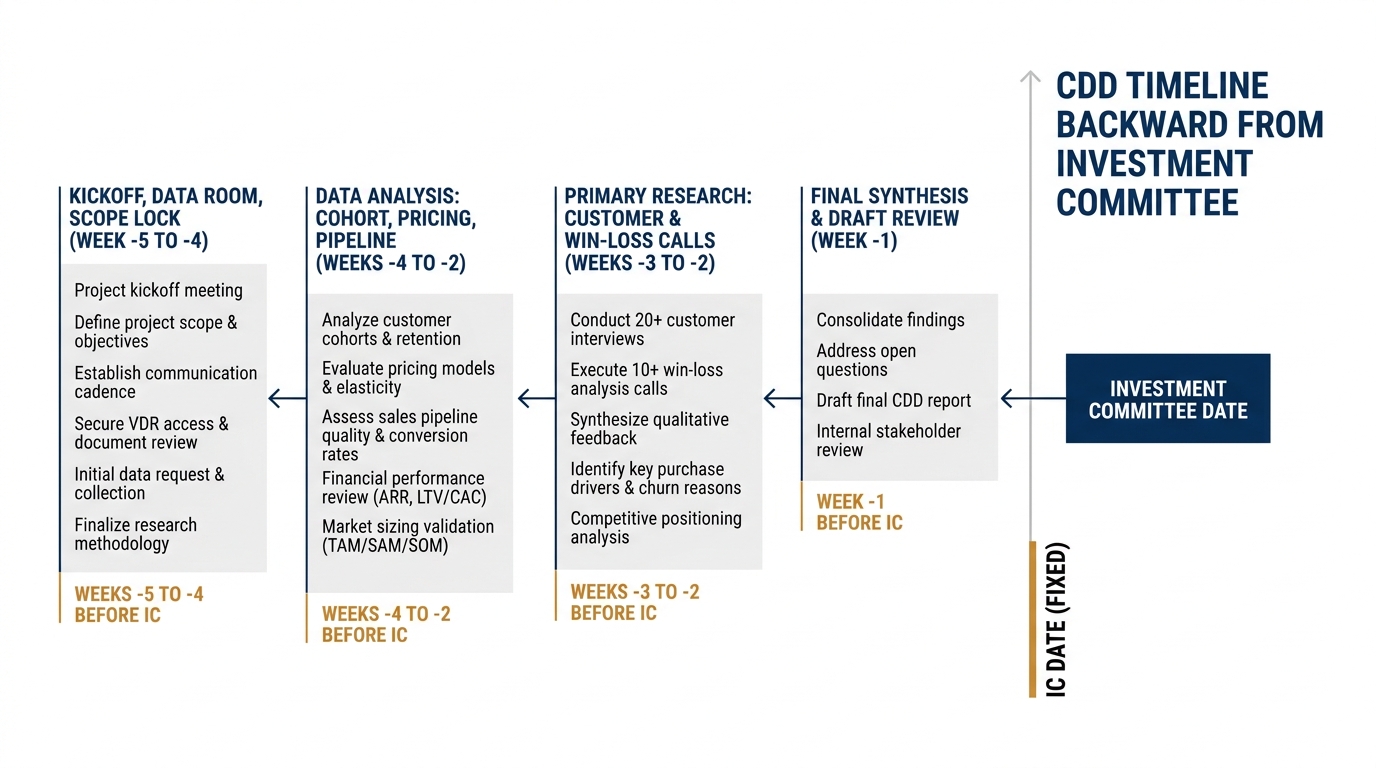
CDD timelines collapse under deal pressure, and the collapse costs you evidence. A full commercial diligence on a platform typically runs three to six weeks when the data room is complete. Compress it to ten days and you lose the primary research, which is the part you cannot buy later. Decide early whether you are running a full CDD or a focused confirmatory review, because they are different products at different prices.
Build the timeline backward from the investment committee date, not forward from today. Then add a buffer for the data room being incomplete, because it usually is. Private Equity International's coverage and Buyouts regularly document how compressed processes in a competitive market push diligence toward confirmation rather than discovery, which is exactly the outcome you are paying to avoid.
7. Connect the CDD to the operating plan you will actually run
A CDD report that ends at the signing is a report you overpaid for. The findings that matter most are the ones you carry into the operating plan: the churn risk you need to stabilize, the pricing power you underwrote and now have to realize, the pipeline gaps you have to fix before the first board meeting. Scope the engagement so the provider produces a findings-to-actions bridge, not just a verdict.
This is where operator-led diligence earns its premium. A firm that understands private equity value creation will flag the commercial risks that become day-one workstreams and tell you who owns each one. That continuity between diligence and execution is why some funds keep the same partner across both, and our guide on buying a value creation office as a service walks through how to structure that without overpaying for a full-time function.
If the deal involves a platform and add-ons, the CDD should feed directly into integration planning. Our post-merger integration checklist for add-ons and the longer 100-day integration plan tested against the real systems show how commercial findings become sequenced work once you own the asset.
8. Price it against AI-era build costs, not legacy rate cards
Commercial diligence quotes vary widely, and the range is no longer explained by quality alone. A chunk of the work that used to justify a six-figure strategy-house fee, market sizing, competitor mapping, data cleaning, is now faster and cheaper to produce. The judgment, the primary research and the synthesis are where the real value sits, and that is what you should be paying for.
When you get a quote, ask the provider to break it into research, analysis and synthesis. If the analysis line dominates and the primary-research line is thin, you are paying for commodity work and getting weak evidence. Our breakdown of what a portfolio company audit should cost and how to judge the quote applies the same test to adjacent diligence work.
Do not confuse a low price with a good deal. A cheap CDD that confirms the seller's story and misses a concentration risk is the most expensive document you will ever buy, because you find out after close. Price the work against the size of the decision it informs, not against a rate card.
9. Treat the sector as a variable, not a constant
The right CDD for a software platform looks nothing like the right CDD for a distribution business or an engineering firm. Templates built for recurring-revenue SaaS, applied to a project-delivery company or a services business, produce findings that sound rigorous and mean little. Net revenue retention is a sharp metric for a subscription business and a near-meaningless one for a firm that sells large one-off projects.
Ask the provider how they will adapt their framework to your target's revenue model. If they cannot answer in specifics, they will run their template and you will get a report that fits the slide layout rather than the business. For deals in industrial and engineering sectors, our guide on private equity buyers for engineering companies covers the commercial signals that actually matter in that model.
Harvard Business Review's coverage of mergers and acquisitions and Preqin's alternative assets data both offer useful context on how diligence practice differs by asset type, which is a reminder that the method has to match the business.
10. Line up CDD with the other diligence streams
Commercial due diligence does not run in isolation. It sits alongside financial quality of earnings, technology diligence and operational review, and the findings have to reconcile. A commercial team that forecasts twenty percent growth while the QoE shows flat collections has produced two reports that cannot both be right. The AICPA and CIMA's resources on financial diligence standards are a useful reference for how the commercial and financial views should tie out.
Where the thesis depends on product and platform, the commercial and technology due diligence streams need to talk to each other, because a commercial plan that assumes a scalable product sits on a technology base that may not support it. Insist that the streams share findings at the midpoint, not only at the end, so contradictions surface while you can still act on them.
The streams also need a shared owner on your side. Someone has to hold the full picture, reconcile the forecasts, and carry the risk register into close. Without that owner, you get three good reports and no integrated view.
11. Build the bridge into the first 100 days before close
The commercial findings you generate in diligence have a short shelf life if nobody converts them into owned workstreams. The best engagements end with a prioritized list of commercial actions, each with an owner and a sequence, ready to drop into the first 100 days plan. That is the output you can actually use, and it is what separates CDD that informs a decision from CDD that decorates a data room.
Where the diligence surfaces working-capital or revenue-collection issues, those become day-one priorities too, and our guide on hiring a working capital optimization consultant covers how to staff that fast. Where the thesis rests on brand strength or procurement savings, the diligence should quantify those claims so you are not funding a plan on faith. Our pieces on the brand capital diagnostic and procurement value creation both show how to arrive at the number before the close.
Ask for the bridge in the scoping conversation. A provider who agrees easily understands they are being hired to inform a decision and a plan, not to write a document.
12. A checklist for hiring commercial due diligence for a PE-backed deal
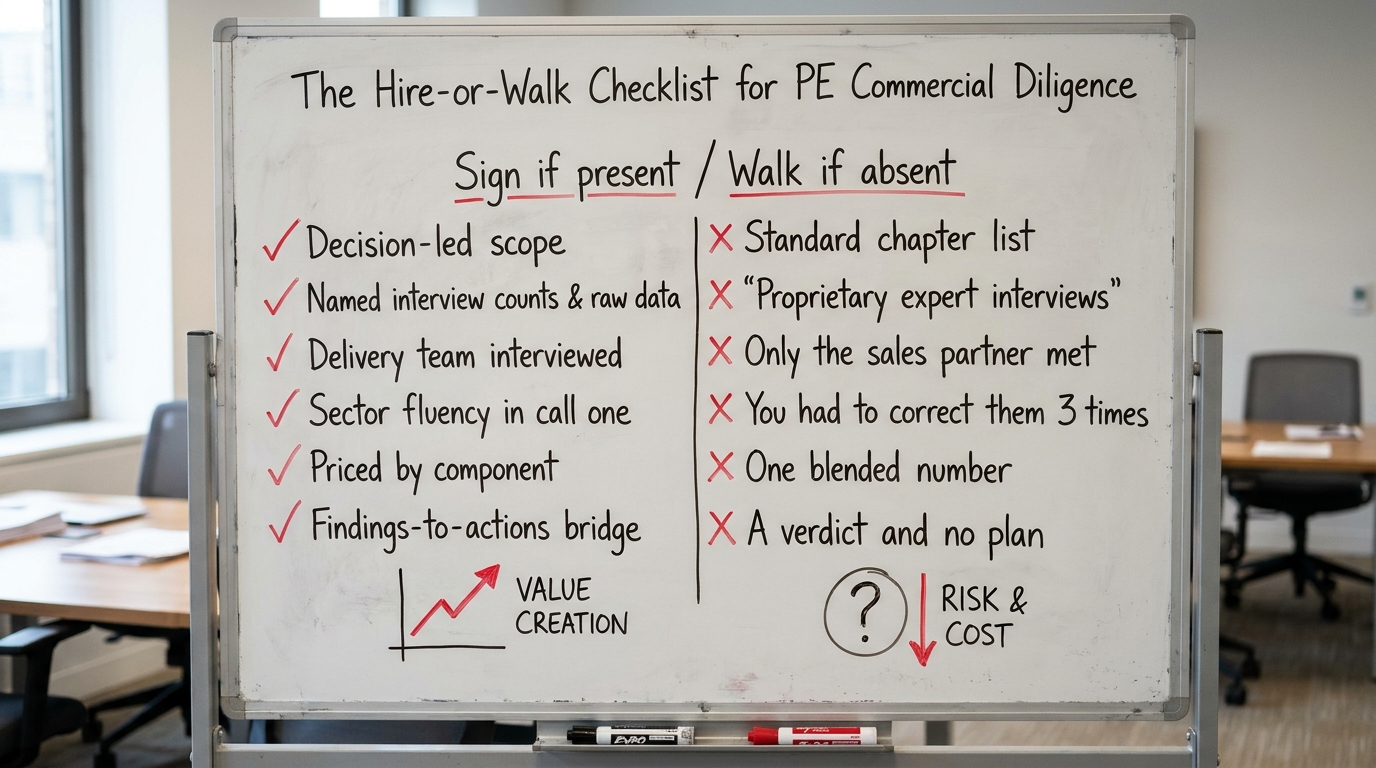
Before you sign, run the engagement against this list. If a provider fails more than two of these, you are buying a report you will struggle to use.
- Decision-led scope. The workstreams map to the specific decisions your investment committee has to make, not to a standard chapter list.
- Named evidence base. You know the number of customer and competitor interviews, who conducts them, and whether the work uses the target's raw data.
- Delivery team interviewed. You have met the people who will run the calls and write the synthesis, not only the partner selling the work.
- Sector fluency demonstrated. The provider described your target's business model correctly in the first call without being corrected.
- Timeline built backward. The schedule runs back from the investment committee date with a buffer for an incomplete data room.
- Priced by component. The quote separates research, analysis and synthesis, and the primary-research line is substantial.
- Model-matched method. The framework fits your target's revenue model rather than a default SaaS template.
- Reconciled with other streams. The commercial findings are set up to tie out with QoE, technology and operational diligence at the midpoint.
- Findings-to-actions bridge. The deliverable includes a prioritized, owned list of commercial actions ready for the first 100 days.
- Willingness to decline. The provider can name deals they turned down and why.
13. What good looks like when it lands on your desk
A commercial due diligence output you can use states a view on whether the base case holds, shows the evidence behind that view, names the risks that would change the price or the plan, and hands you a prioritized set of commercial actions with owners. You can carry it into investment committee and defend it, then carry it into the first board meeting and act on it.
The output you cannot use restates the seller's growth story with better charts, hedges every finding, and ends at the verdict without a bridge to execution. It looks thorough and informs nothing. The U.S. Securities and Exchange Commission's filings and guidance set the standard of evidence that serious diligence aims for, and a polished restatement of management's case does not meet it.
Hiring CDD well is less about finding the biggest name and more about scoping the work to the decision, judging the delivery team, and insisting the findings survive contact with the operating plan. Do that, and the diligence pays for itself in the price you negotiate and the first hundred days you run.
14. Where to go from here
If you are scoping commercial due diligence for a live deal or an add-on and want the findings built to carry into the operating plan rather than stop at the data room, review how DevriX structures diligence and value creation for PE-backed companies at the DevriX private equity practice, and bring the specific decision your investment committee has to make.


