You hold a portfolio company where third-party spend runs north of 40% of revenue, and the value-creation plan has a line that reads "procurement savings, 8%" with no owner, no baseline and no method behind it. That line is now in the model the deal team used to underwrite the return, and it will be in the exit memo whether or not anyone delivers it. If you are an operating partner approving the plan, a CFO being asked to forecast the savings into next year's budget, or a portfolio CEO who has to find the hours to run the work, procurement value creation in private equity is a decision you have to make concrete before you commit capital or headcount to it.
This guide is for people with budget and a mandate, not for people learning what procurement is. It covers what you actually have to decide, how to judge whether the plan in front of you is real, and where the usual claims fall apart under a quality-of-earnings lens.
1. Why procurement savings are the easiest number to promise and the hardest to bank
Procurement looks attractive in a value-creation plan for a simple reason: a percentage off a large spend base produces a big absolute number without requiring a new product, a new market or a headcount change that shows up in the org chart. A 6% reduction on €80M of addressable spend is €4.8M, and at a 10x multiple that is €48M of implied enterprise value. The arithmetic is why the line survives committee. Bain's annual private equity report has tracked for years how firms have shifted from financial engineering toward operational levers, and procurement sits near the top of that list precisely because the math is so clean on a slide.
The problem is that the slide describes a gross saving, and what reaches EBITDA is a net saving after someone pays to capture it, after suppliers push back, after a renegotiated rate gets quietly offset by higher volumes or looser specs. The gap between the two is where most procurement value-creation plans quietly fail. McKinsey's work on private capital value creation has made the same point repeatedly, that the difference between planned and realized operational savings is a leakage problem, not an identification problem.
So the first thing to decide is not whether procurement savings exist. They almost always do. The decision is whether this company can convert an identified saving into a banked one, on a timeline that matters for this hold, with the people it currently has.
2. Decide what spend is actually addressable before you believe any percentage
Every credible procurement number starts with a spend cube: total third-party spend, broken down by category, supplier, business unit and contract status. If the plan in front of you quotes a savings percentage without showing you the denominator it applies to, the percentage is a guess dressed as an estimate.
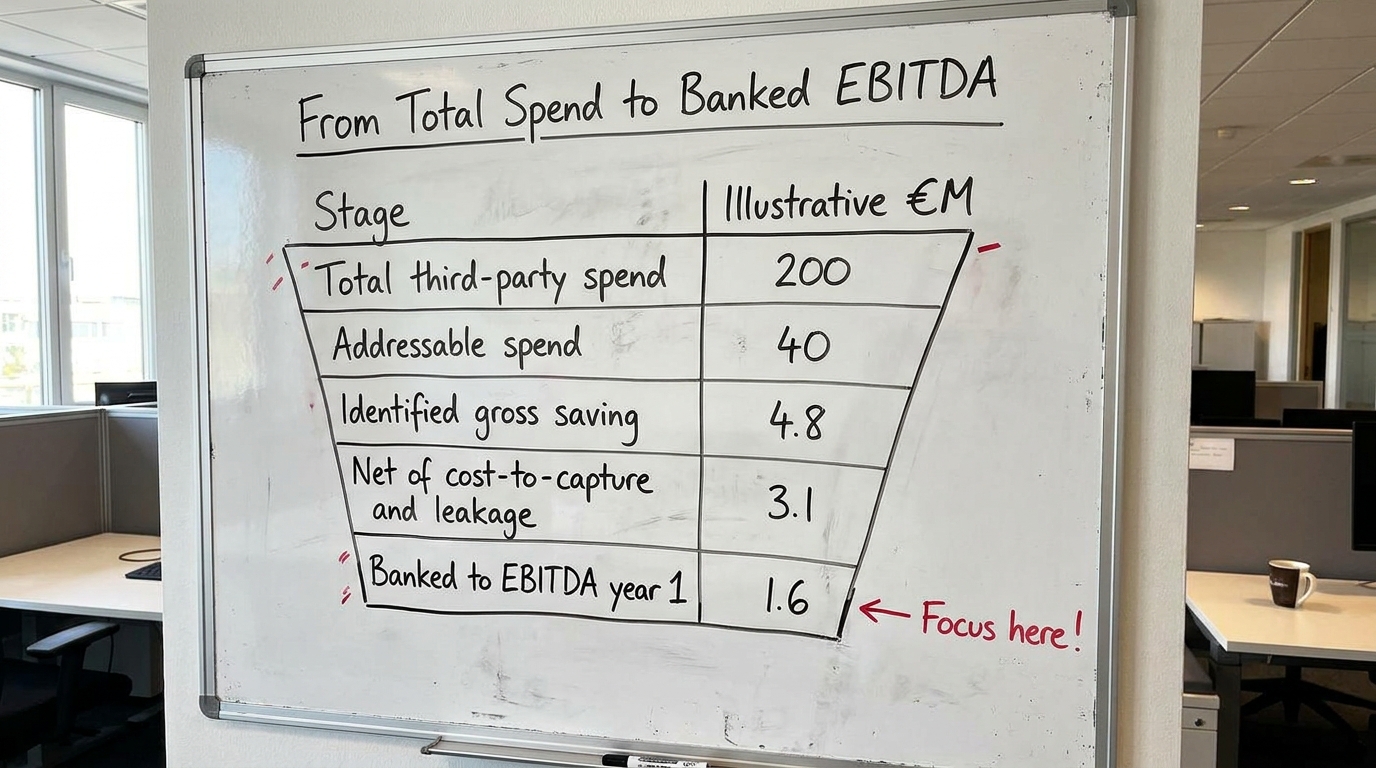
Addressable spend is smaller than total spend, and usually by a lot. Pass-through costs that are rebilled to customers, regulated inputs with a single qualified supplier, spend already under a long multi-year contract with a termination penalty, and intercompany charges all reduce what you can actually touch this year. A distributor with €200M of cost of goods may have only €30M to €40M that is genuinely renegotiable inside the hold period, and the rest is either locked or so core to the customer promise that moving it breaks delivery.
The decision here is narrow and worth being pedantic about. Ask for the spend base in euros, the share you have classified as addressable, and the evidence for why the rest is not. If no one can produce that breakdown in diligence, the savings line is a placeholder and should be treated as one in the model.
This is the same discipline that applies to technology due diligence, where a claimed efficiency means nothing until you can see the system, the data and the baseline it is measured against.
3. Separate the four kinds of procurement saving, because they do not behave the same
When a plan says "procurement savings," it is usually mixing four categories that carry very different risk and timing. Judging the plan means forcing them apart.
Price reduction on the same thing
The cleanest category. You buy the identical input and pay less, through renegotiation, re-tendering or supplier consolidation. It is verifiable against the prior invoice and it flows to EBITDA quickly. It is also the category suppliers fight hardest, so the realized figure is often below the quoted one.
Demand reduction and specification change
You buy less, or you buy a lower specification that still meets the requirement. Real, but it depends on behaviour change inside the business and it can quietly degrade the product if no one is watching the specification.
Payment terms and working capital
Extending payment terms improves cash flow but is not an EBITDA saving, and treating it as one is a common sleight of hand. It belongs in the cash bridge, not the margin bridge. A good plan labels it correctly.
Cost avoidance
A price increase you negotiated away. The weakest category for a value-creation plan, because it never appears in actuals and cannot be audited after the fact. Cost avoidance is legitimate for managing the P&L, but it should carry close to zero weight when you are underwriting a return.
Decide, per category, how much credit each gets in the model. A plan that lumps all four into one percentage is either naive or hopeful, and either way you cannot forecast off it.
4. Tie every euro of saving to an owner and a decision right
A procurement saving has no value until a named person can make the change happen and is measured on it. In most portfolio companies I see in audits, the procurement function reports somewhere ambiguous, half under finance and half under operations, with no single owner holding the category strategy. That ambiguity is where plans go to die.
For each material category, the plan should name who owns the supplier relationship, who has the decision right to switch or renegotiate, and who signs off on a specification change. If the person who can renegotiate the freight contract is the same operations head whose bonus depends on on-time delivery, you have a built-in conflict and the renegotiation will stall.
The first 100 days is the window to fix the ownership question, because a reporting line and a mandate you set on Day 1 costs nothing and compounds, while the same change made in month nine means you lost most of the first year. Our note on the value-creation plan nobody reviews until the exit memo covers the same failure in a broader setting: unowned lines do not get delivered, they get rediscovered at exit.
5. Judge the baseline, because a saving with no baseline is a story
You cannot claim a saving against a number you never established. The baseline is the agreed starting cost, in euros, for each category, for a defined period, signed off by finance before any initiative begins. Without it, every reported saving is arguable, and in practice the CFO and the procurement lead will argue about it for the entire hold.
Three baseline failures recur often enough to check for by default:
- Volume drift. A lower unit price on higher volume can show a per-unit saving while total spend rises. The baseline has to normalise for volume or the number is meaningless.
- Mix shift. Buying a different basket of goods makes a like-for-like comparison impossible. The baseline has to hold the basket constant.
- Inflation. In categories with real input-cost inflation, holding price flat is a saving against the market but a flat line in your actuals. Decide up front whether you credit cost avoidance against inflation, and if you do, cap it hard.
The AICPA and CIMA's work on management accounting discipline is the right reference point for how a savings baseline should be documented so it survives an audit. If the procurement number cannot be reconciled to the general ledger, it will not survive a quality-of-earnings review at exit, and a sophisticated buyer's diligence team will strip it out of the bridge.
6. Decide the sequence, because fixing everything at once fixes nothing
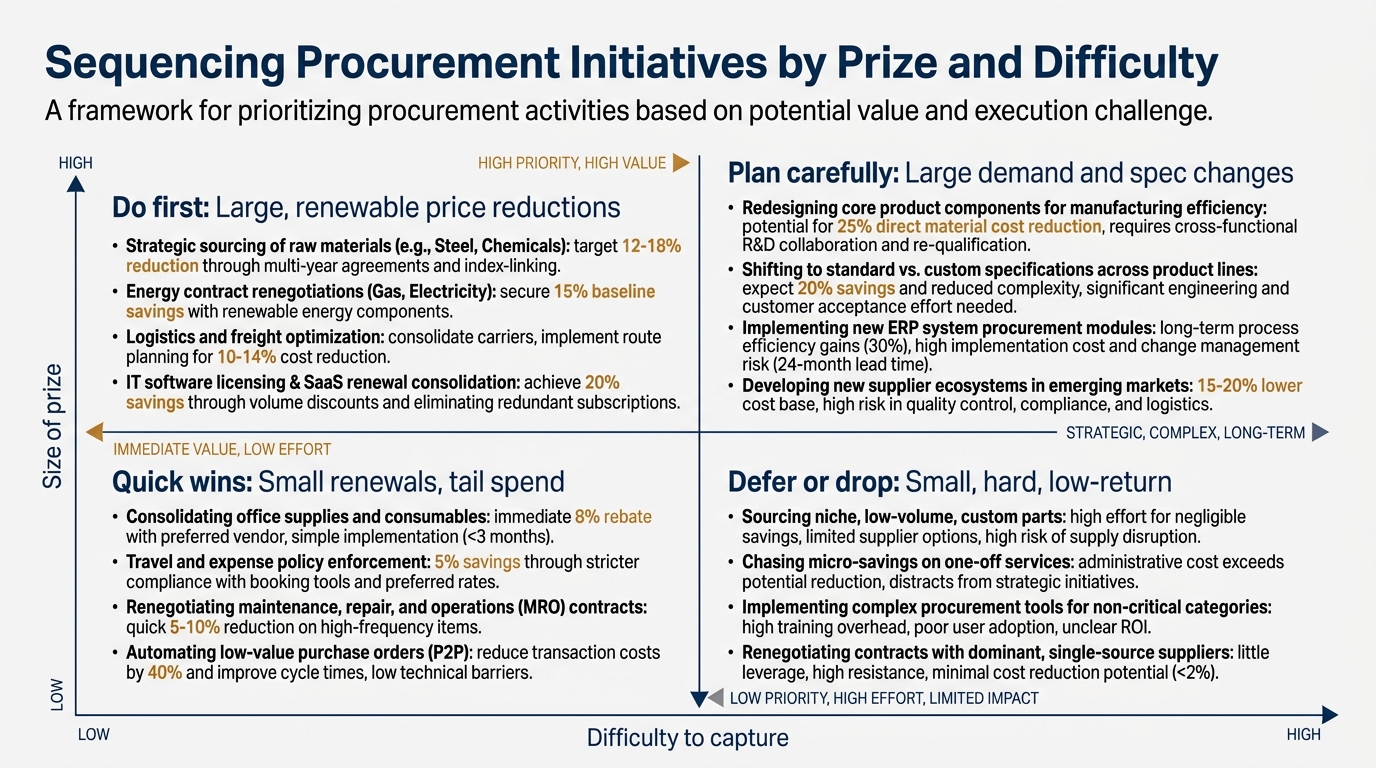
The instinct is to launch a company-wide procurement transformation. For a mid-market portfolio company with a lean team, that is how you get twelve half-finished initiatives and no banked savings at the first board meeting. Sequence by two axes: size of the addressable prize and difficulty of capture.
Start with large, low-difficulty categories where the saving is price reduction on the same thing and the contract is up for renewal inside the year. Those are the ones you can bank before the next reporting cycle, which buys credibility for the harder work later. Push demand reduction and specification changes to a second wave, because they need behaviour change and monitoring you will not have stood up in the first quarter.
Our portfolio company diagnostic that tells you what to fix first applies the same logic across the whole business, and procurement is one of the cleanest places to practise it because the prize and the difficulty are both measurable in advance.
7. What procurement value creation in private equity costs to capture
Procurement value creation in private equity is rarely free, and the plan should state the cost-to-capture openly. There are three kinds of cost, and a plan that hides any of them is understating the risk.
The first is internal time. Renegotiating forty supplier contracts is months of work for someone senior enough to have authority, and in a lean company that person already has a full job. The second is the switching cost: qualification of a new supplier, dual-running for a transition period, tooling and inventory write-offs. The third is advisory or interim cost if you bring in outside help to run the category work.
Net the whole thing. A €4.8M gross saving that costs €1.2M in internal time, switching and advisory to capture, and leaks another €1.1M to supplier pushback, is a €2.5M banked saving, and that is the number that belongs in the model. BCG's work on principal-investor value creation has made the point that cost-to-capture is routinely underestimated, which is exactly why planned savings outrun realized ones. When you bring in outside help, judge it the way our guide on hiring a cost optimization consultant without buying a spend cut that breaks delivery describes: the goal is net margin that holds, not a gross cut that someone reverses in month six.
8. The traps that make a procurement number look better than it is
A few patterns show up often enough that I treat them as red flags on sight in an audit.
- Payment terms counted as EBITDA. Covered above, and worth repeating because it is the most common one. A cash-flow improvement reported in the margin bridge inflates the number a buyer will later strip out.
- Savings with no end date. A one-time rebate is not a run-rate saving. The plan should classify each saving as one-time or recurring, and only the recurring ones belong in the multiple.
- Double counting across workstreams. The same supplier consolidation shows up in both the procurement line and the operations line. Each saving needs one home.
- Specification changes that degrade the product. The cheaper input shows up in the margin bridge this quarter and in churn or warranty claims two quarters later. Procurement savings that hurt the customer are borrowing from future revenue.
- Quality or delivery risk swapped for price. A single lower-cost supplier with no backup concentrates risk that belongs on the risk register, not just the savings slide.
PitchBook and S&P Global Market Intelligence both publish enough deal-level data to show how often operational theses underdeliver against underwriting; the pattern across that research is consistent enough that treating a clean-looking procurement number with suspicion is the correct default.
9. How procurement savings should show up in board reporting
A procurement initiative that cannot be reported in a form the sponsor reads in a few minutes will not get the attention it needs to stay on track. The board view should show, per category, the baseline, the identified saving, the banked saving to date, the forecast for the year, and a variance against plan. Nothing more at board level, with the detail available underneath for anyone who wants it.
The failure mode is a procurement report full of activity: number of contracts renegotiated, number of suppliers consolidated, number of RFPs run. Activity is not the saving, and a board that reads activity metrics ends up believing work is value. Our note on board reporting for a PE portfolio company sets out the one-deck standard, and procurement should fit inside it as a few lines of actual-versus-plan, not a workstream update of its own.
If you track operational functions with the same discipline, our piece on the best help desk metrics for team productivity shows the same principle in a different function: report the outcome and the trend, not the ticket count.
10. Judging whether the people in front of you can deliver it
The savings identification is the easy half. The capture depends on whether the company has, or can rent, a category manager who can hold a renegotiation, a finance function that can set and defend a baseline, and a CEO who will back a specification change against an operations head who resists it. If none of those exist, the plan is a wish.
When you are choosing outside support to run the work, apply the same test you would apply to any operating partner. Our guides on choosing an operational value creation firm for a portfolio company and on judging a margin expansion consultant before you give one a portfolio company both land on the same requirement: the partner has to tie their fee to banked, baselined savings, not to a slide of identified opportunity. A firm that will only commit to the gross number is telling you who carries the capture risk, and it is you.
The broader discipline sits inside the larger private equity value-creation agenda, where procurement is one of several operational levers that get easier to judge once you insist on a baseline and an owner for each one. For the technology side of the same spend question, our piece on IT cost optimization in private equity works through how to cut software and infrastructure spend without breaking the systems the business runs on.
11. A decision checklist before you fund the procurement line
Before the procurement savings line goes into the model you underwrite against, you should be able to answer every one of these. If you cannot, the line is a placeholder and should be discounted accordingly.
- What is total third-party spend in euros, and what share of it is genuinely addressable inside this hold?
- Is the savings figure split into price reduction, demand and specification, payment terms, and cost avoidance, with separate credit for each?
- Does every material category have a named owner and a clear decision right to renegotiate or switch?
- Is there a signed-off baseline per category, normalised for volume, mix and inflation, that reconciles to the general ledger?
- Are the initiatives sequenced by prize and difficulty, with the bankable wins scheduled first?
- Is the cost-to-capture stated in full, and is the number in the model net of it and net of leakage?
- Is each saving classified as one-time or recurring, with only recurring savings credited to the multiple?
- Is any of the number actually a cash-flow or payment-terms improvement wrongly placed in the margin bridge?
- Can the whole thing be reported to the board as actual-versus-plan in a few lines?
- Do the people who have to deliver it exist, inside the company or under contract, with the authority to act?
Procurement is one of the more reliable sources of enterprise-value improvement in a mid-market portfolio company, but only when the number is baselined, owned, sequenced and reported net of what it costs to capture. The version that fails is the clean percentage on a slide with none of that behind it. Treat the ten questions above as the test, and fund the line only to the extent it passes them. Bain, McKinsey and BCG have each documented the same gap between planned and realized operational value for long enough that the discipline is not optional, and the reference libraries at Bain's Global Private Equity Report, McKinsey and BCG are worth keeping open while you read a plan. For deal-level context, Private Equity International and Preqin track how operational theses perform across cycles.
12. Where a focused audit pays for itself
Most of the ten checklist answers come out of a short, evidence-based audit of the spend base and the capture plan, run before you commit the number to the model or to the first board. A Portfolio Company Audit that pressure-tests the procurement line, sets the baseline, assigns owners and nets the cost-to-capture is the difference between a savings figure you can defend at exit and one a buyer's quality-of-earnings team removes. If you want that work run on a specific company, see how the GrowthShuttle and DevriX Portfolio Company Audit is structured for private equity owners and take the next step from there.


