You are a few weeks past close on a services business, and the revenue line in the model is already drifting from the revenue line in the bank. The CFO reports bookings, the CRM reports pipeline, and the board deck reports annual recurring revenue, but none of the three reconcile to what landed as cash last quarter. When you ask a provider to run revenue diligence for a portfolio company, you are not buying a report. You are buying the ability to defend a forecast you will be held to at the next board meeting, and to decide whether a shortfall is a timing problem, a measurement problem, or a demand problem.
This guide is for the operating partner or portfolio company executive who already has budget and a problem, and needs to judge the provider rather than learn the field. I will walk through what the scope should actually cover, how to tell a competent provider from one selling you a template, and how to make the output usable past the first read.
1. The problem this work solves, stated plainly
Revenue diligence inside a holding is different from the commercial due diligence you ran before signing. Pre-deal work asked whether the thesis was buyable. Post-close work asks whether the revenue you underwrote is real, durable, and measured in a way you can forecast against. Those are not the same question, and a provider who answers the first when you asked the second has wasted your money.
The commercial consequence is concrete. If reported ARR is growing while cash collections are flat, you have a blend problem hiding in the number, and the next four quarters of forecast rest on it. Bain's annual private equity report has tracked for years how much of the industry's return now depends on operational improvement rather than multiple expansion, which means the accuracy of the revenue baseline is not a bookkeeping nicety. You can read Bain's tracking of that shift in its Global Private Equity Report.
So the decision this work informs is narrow and expensive: do you trust the forecast enough to leave it in the plan, or do you reset it now and absorb the board conversation early?
2. What providers revenue diligence for portfolio companies should actually scope
When you brief a provider on revenue diligence for portfolio companies, the scope should name the artifacts it will produce, not the activities it will perform. Hours and interviews are inputs. What you are paying for is a defensible revenue baseline, a short list of risks with owners, and a view on whether the forecast holds.
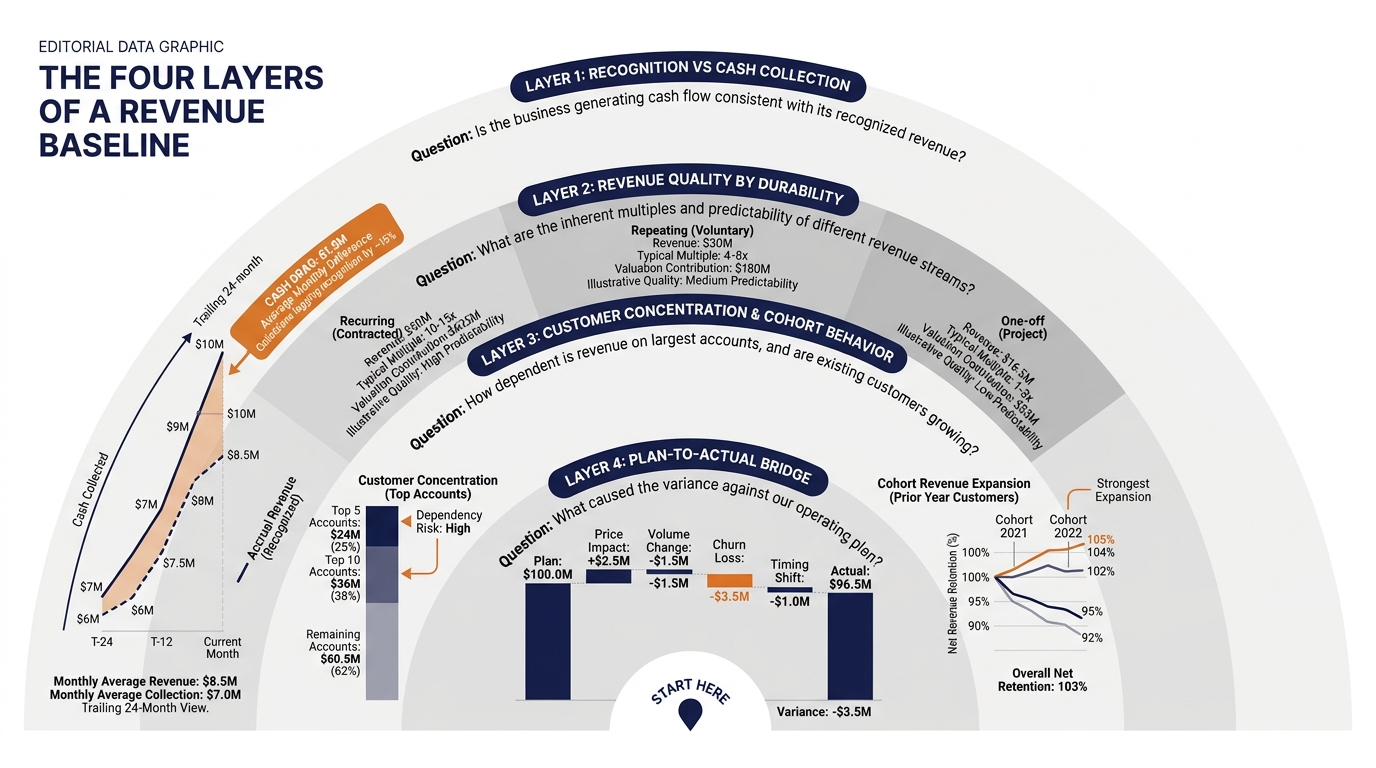
A competent scope covers four things at minimum.
Revenue recognition versus cash collection
The provider should reconcile what the business recognizes as revenue against what it collects, by month, for at least the trailing two years. The gap between the two, and whether that gap is widening, is often the single most useful output. The AICPA's work on revenue recognition under current standards is the reference most finance teams will already know; its guidance hub is at AICPA & CIMA.
Revenue quality by segment
Recurring, repeating, and one-off revenue carry different multiples and different forecast reliability. A provider who hands you a single revenue number without splitting it by durability has not done the job. For a services or project-delivery firm, the split between contracted retainers and one-time projects is usually where the forecast risk sits.
Customer concentration and cohort behavior
You need to know how much revenue depends on your largest few accounts, and whether cohorts of customers acquired in prior years are expanding or decaying. A concentration of forty percent of monthly recurring revenue in one account is a risk you price into every decision, not a footnote.
The bridge from last plan to current actual
The provider should rebuild the walk from the revenue the deal model assumed to the revenue actually landing, and attribute each variance to price, volume, churn, or timing. Without that bridge you cannot tell a demand problem from a measurement problem, and you will treat them the same when they need opposite responses.
3. Why the generic report fails and what it costs you
The most common failure is a provider applying a SaaS template to a business that is not SaaS. Net revenue retention, logo churn, and ARR math are the right lenses for a subscription software company. Applied to a distributor, a clinic group, or a project-delivery firm, they produce numbers that look rigorous and mean nothing, because the underlying revenue does not behave the way the template assumes.
I have watched a 22 percent ARR growth figure sit on a board deck while the cash actually collected for the year was flat, because the reported metric blended genuine recurring contracts with one-off work that would never repeat. Both numbers were real. The gap between them was the entire story, and a template built for SaaS would have reported the growth and missed the flat cash entirely.
The cost of accepting a generic report is that you carry a forecast you cannot defend into the next board meeting. When a director asks why Q3 missed, "the provider's model said" is not an answer. McKinsey's private capital research has repeatedly made the point that operational value creation depends on measurement the operating team actually owns; its work is collected at McKinsey.
4. How to judge a provider before you sign
You judge a revenue diligence provider the same way you judge any provider who will touch your forecast: on business-model fluency, on whether the output survives scrutiny, and on whether you can use it after they leave.
Do they understand your revenue model before the first meeting?
A provider worth hiring arrives having done the outside-in work and can describe how your portfolio company actually earns money before you explain it. A provider who needs the model explained, then builds a template around a model they just learned, will cost you correction time you do not have. The firms covered in this guide to judging private equity value creation firms before you sign one live or die on exactly this fluency.
Will the output reconcile to the general ledger?
Ask directly whether the revenue baseline will tie back to audited financials and the GL, line for line. A provider who hesitates is building off a management-reported number, which is the number you are trying to verify, not the one you can rely on. BCG's work on principal investors stresses this discipline of tying operating metrics to financial reality; see BCG.
Can they tell you what they will not do?
A provider who scopes everything is scoping nothing. Good revenue diligence has boundaries: revenue analysis for operational decisions, not a formal audit opinion, not a business valuation, and not tax or legal counsel. A provider who conflates revenue diligence with those other engagements either misunderstands the scope or is overselling it.
5. What this costs and how to right-size the engagement
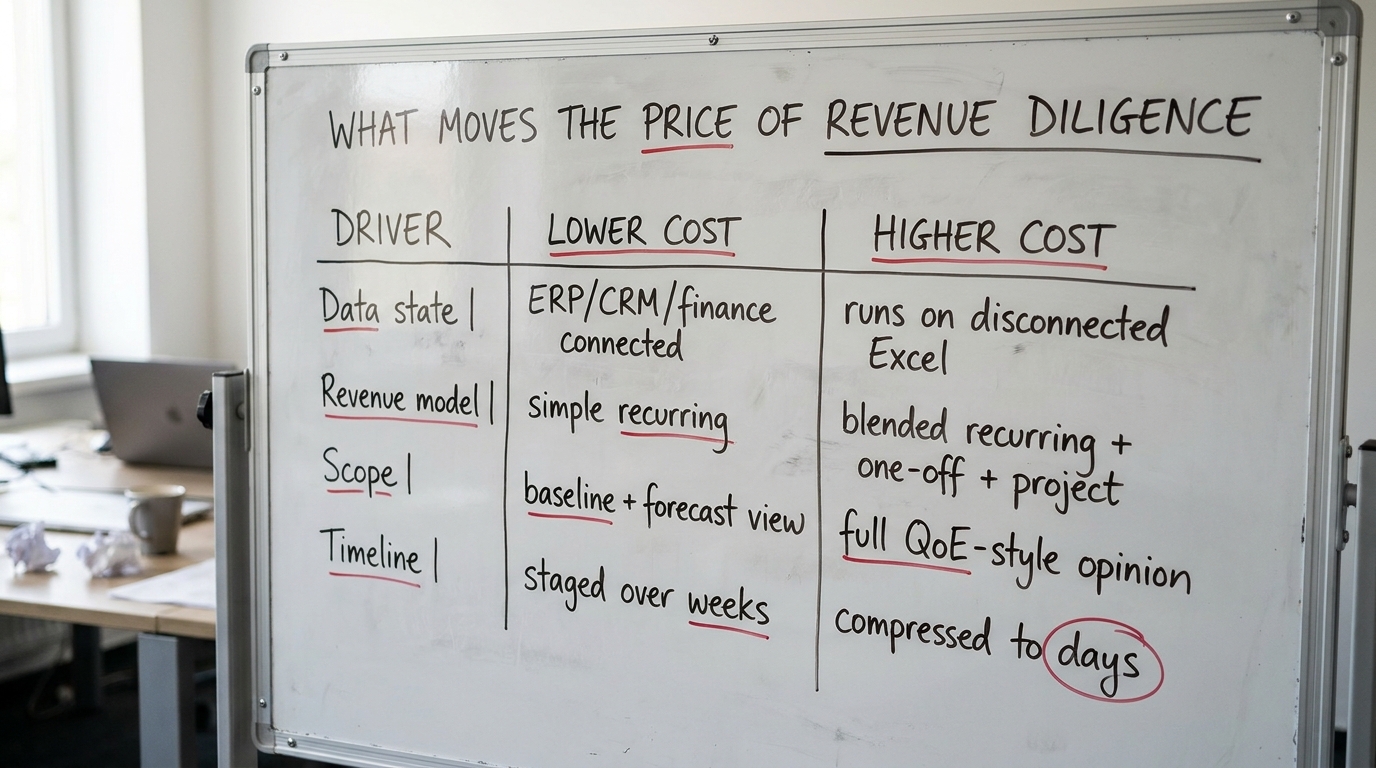
A focused revenue diligence pass on a single portfolio company, scoped to a defensible baseline and a forecast view rather than a full QoE, sits in the range of a portfolio company audit, roughly fifteen to twenty-five thousand dollars for most mid-market holdings. The price moves with the state of the data, not with the size of the report. A company whose ERP, CRM, and finance data are disconnected and run through spreadsheets costs more to diligence, because the provider rebuilds the connections before measuring anything.
If the business cannot see its own numbers because the systems do not talk to each other, that is a visibility problem the diligence will surface and partly fix. Benchmark the quote against what current build costs allow. Work that used to take months and start at six figures can now move in days and cost tens of thousands, and a provider quoting the old numbers for the new reality is pricing a process you no longer need to buy.
6. The sequence to run the engagement
Running this well is a short, ordered process, not an open-ended study. The sequence below keeps the provider accountable to artifacts and keeps you from paying for activity.
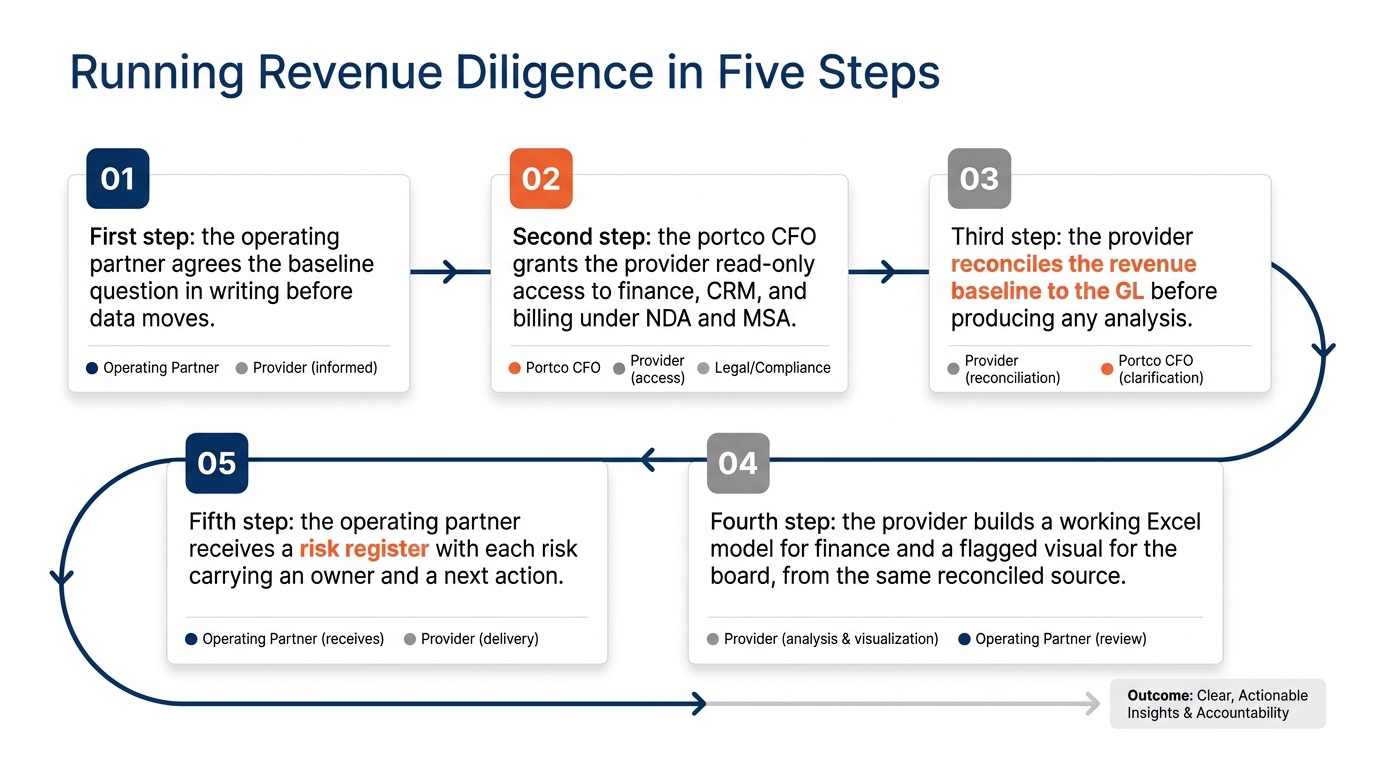
Step 1: Agree the baseline question in writing
Before any data moves, agree the single decision the work informs. For most holdings early in the hold it is whether the forecast in the plan is defensible. Write it down, because it governs what the provider measures and what they leave out.
Step 2: Grant read-only access under NDA
Give the provider read-only connections to the finance system, the CRM, and billing. Read-only access under an NDA and MSA is the low-risk way to let them work without handing over control, and a provider who asks for more than that early should explain why.
Step 3: Reconcile before you analyze
Insist the provider reconciles the revenue baseline to the GL before producing any analysis. Everything downstream, every cohort chart and concentration figure, is only as good as that reconciliation. This is the same discipline the better commercial due diligence engagements enforce before they draw a single conclusion.
Step 4: Build the two views finance and the board each need
Finance will want the model in a spreadsheet they can keep working in, on the same reconciled data. Leadership and the board want a short visual with the risks flagged. Ask for both from the same source, so the two never drift apart.
Step 5: Close with a risk register that has owners
The deliverable ends with a short list of revenue risks, each with an owner and a next action, not a narrative. A risk without an owner is a sentence, and you already have enough of those.
7. Where revenue diligence connects to the rest of the audit
Revenue diligence rarely travels alone. The revenue number depends on the systems that produce it, and those systems carry their own risk. If the CRM has no governance and the finance stack is disconnected, the revenue you are measuring is downstream of a data problem, and fixing the measurement without fixing the plumbing buys you a cleaner number for one quarter only.
This is where the engagement touches the broader audit. A technology due diligence pass tells you whether the systems can produce a reliable number at all, and the revenue work tells you whether the number they produce is real. The two are complementary, and a provider who understands both will tell you which problem to solve first.
The same logic applies to the revenue engine itself. If the diligence surfaces that pipeline data is unreliable because the CRM is ungoverned, you are looking at a RevOps hygiene problem, and the fix is foundational. The distinction between what you rent and what a portfolio company should staff is covered well in this piece on RevOps as a service for private equity.
8. Judging whether the revenue is durable, not just accurate
Accuracy and durability are different tests. A revenue number can reconcile perfectly to the GL and still be fragile, because it depends on a handful of accounts, a single channel, or a pricing structure that will not survive renewal. Diligence that stops at accuracy leaves the more important question unanswered.
Durability shows up in the cohort data. Customers acquired three years ago that have expanded their spend tell a different story than customers who are quietly shrinking each renewal. The provider should show you both, and should flag any cohort whose decay rate threatens the forecast. S&P Global Market Intelligence publishes work on credit and revenue durability across private-company portfolios that is worth knowing; its hub is at S&P Global.
Customer concentration is the other durability test. When a single account represents a large share of monthly recurring revenue, the forecast is really a bet on one relationship, and the diligence should say so in those terms. Pricing durability is the third: revenue that holds only because no one has repriced in three years is a forecast risk the moment a competitor does.
9. Reading the forecast after the diligence lands
The output is only useful if it changes what you do with the forecast. Once the baseline is reconciled and the durability tests are run, you are in one of three positions, and each calls for a different move.
If the revenue is accurate and durable, you leave the forecast in the plan and move on, having bought the ability to defend it. If the revenue is accurate but fragile because of concentration or decay, you keep the number but flag the dependency to the board and build the mitigation into the value creation plan. The reported metric sometimes blends one-off work into a recurring number, which overstates the revenue. When that is true, you reset the forecast now, early in the hold, rather than explaining a miss later.
That third case is the uncomfortable one, and it is also the one where doing the work early pays for itself. The Harvard Law School Forum on Corporate Governance has published extensively on how board-level forecast credibility shapes private-company governance; see the Harvard Law School Forum on Corporate Governance. Resetting a number in month two is a measurement decision. Explaining the same reset in month eight is a credibility problem.
10. Fitting revenue diligence into the first 100 days
Timing matters because the value of a reset decays with every board cycle it waits. The natural window is the first 100 days after close, when a forecast reset reads as diligence rather than a miss, and when the data access you need is easiest to arrange.
Run it too late and you inherit a forecast you did not set and cannot easily unwind. Run it as part of the opening audit and you set the baseline yourself, which is the number every subsequent quarter gets measured against. For deals built around an add-on strategy, the same discipline applies to each target before you fold it in; the post-merger integration checklist for private equity add-ons covers how revenue measurement has to survive the merge.
The sequencing also affects who you hire alongside the diligence. If the work surfaces that the finance function cannot produce a reliable monthly number, you may need interim finance leadership before anything else; this guide to hiring a fractional CFO for portfolio companies covers that decision without overbuying the title.
11. A checklist for buying revenue diligence you can use
Before you sign, run the brief against this list. Each item is a question a weak provider will dodge and a strong one will answer in a sentence.
- Does the scope name the artifacts (reconciled baseline, risk register, forecast view) rather than the hours?
- Will the revenue baseline reconcile to the general ledger, line for line?
- Is revenue split by durability (recurring, repeating, one-off) rather than reported as one number?
- Does the work include the plan-to-actual bridge, with each variance attributed to price, volume, churn, or timing?
- Does the provider describe your revenue model before you explain it?
- The baseline should include customer concentration and cohort behavior, in addition to the top-line figure.
- Will you get two outputs from one source: a working model for finance and a flagged visual for the board?
- Does the engagement end with a risk register that has owners and next actions?
- Has the provider told you clearly what this is not (not a QoE, not a valuation, not tax or legal advice)?
- Is read-only access under NDA and MSA enough for them to start?
Industry data on how often post-close forecasts drift is collected across PitchBook and the deal reporting at PE Hub, both worth monitoring if you want the context behind why this work keeps paying for itself. For the investor-side view on why revenue quality dominates mid-market underwriting, the reporting at Private Equity International is the usual reference.
12. How to connect the diligence to enterprise value
Everything above matters because the number you reconcile is the number the exit gets priced against. A revenue base that is accurate, durable, and measured in a way a buyer can verify supports a higher multiple and a shorter diligence at exit. A base that blends one-off work into a recurring metric gets discovered in the sale process, repriced by the buyer, and costs you more than any diligence fee would have.
Early measurement discipline affects the eventual exit price, which is why this work belongs in the first hundred days. This reference on private equity digital value creation from investment thesis to funded work maps where revenue measurement sits in the broader value creation sequence. If the base is wrong, you should catch it before the buyer across the table does.
If you want this run as a scoped private equity portfolio company audit with a reconciled revenue baseline and a forecast view your board can defend, start the audit engagement with the DevriX private equity team and set the baseline before the next board cycle does it for you.