Data migration is often the first step for businesses moving to modern systems, but 83% of these projects fail to meet goals, leading to costly delays and errors. Traditional methods rely on manual processes that struggle with complex data, outdated systems, and hidden dependencies. This results in poor data quality, downtime, and compliance risks, costing companies millions annually.
AI is changing the game by automating cleaning, validation, and schema mapping, reducing manual effort by up to 80% and speeding up timelines by 30–40%. It ensures data accuracy, handles large volumes, and strengthens security during migration. Businesses using AI see fewer errors, lower costs, and smoother transitions to modern platforms.
Key Points:
- Challenges: Poor data quality, complex structures, large volumes, and compliance risks.
- AI Solutions: Automated cleaning, schema mapping, faster transfers, and real-time compliance monitoring.
- Results: Reduced costs (up to 70%), faster timelines, and improved data integrity.
AI transforms migration from a risky task into a streamlined process, ensuring cleaner, more reliable data for future business growth.
Data Migration, Automation & MLOps: Scalable Solutions for AI Integration [6325.1814]
sbb-itb-c53a83b
Common Data Migration Challenges
A staggering 83% of data migration projects fail to meet their objectives. The hurdles often start with the data itself and grow as the volume, complexity, and security requirements increase. These challenges typically revolve around issues like data quality, structural compatibility, volume management, and security compliance.
Data Quality and Cleaning Issues
Poor data quality is a major roadblock to successful migrations. Problems like duplicate customer records, inconsistent naming conventions (e.g., "CH" versus "Switzerland"), and outdated information can wreak havoc during system integration. Shockingly, 30% of enterprise datasets are clogged with ROT data - Redundant, Obsolete, and Trivial information that serves no purpose but to slow down migration pipelines.
The cost of poor data quality is immense, with organizations losing an average of $13 million annually and draining 6% of their revenue. Legacy systems add another layer of complexity with outdated formats like fixed-width files and non-UTF encoding, which can corrupt data during transfers to modern cloud platforms.
Hidden dependencies often present the most frustrating challenges. Decade-old scripts with undocumented business logic can silently fail during migration, leading to mismatched data that may not surface until weeks later. As Graham Whitelaw from Datafold puts it:
"The edge cases are what kill migration projects–not the big, obvious problems, but the weird, unpredictable ones that no tool or playbook can fully anticipate."
Complex Data Structure Compatibility
Legacy systems often host entire ecosystems of applications with deeply embedded business rules, making migration a daunting task. Many organizations rely on databases packed with critical logic stored in procedures written by engineers who have long since left. Trying to untangle this logic without disrupting active production systems is no small feat.
Mergers and acquisitions introduce another headache: incompatible technology stacks - like Oracle, SQL Server, and on-premise PostgreSQL - must somehow be unified on a single cloud platform. Traditional rule-based tools often struggle here, particularly with vendor-specific translations and undocumented code. What’s meant to be a 6-month project can easily balloon to 18 months, draining budgets and eroding stakeholder trust.
| Challenge Type | Impact on Migration | Key Risk |
|---|---|---|
| Legacy Schemas | Requires extensive recoding | Data loss during conversion |
| Stored Procedures | Embedded business logic | Silent failures in production |
| Data Silos | Inconsistent governance | Mapping errors and mismatches |
| High Volume | Slow transfer speeds | Downtime and infrastructure limits |
This structural complexity often leads to even greater challenges when managing large datasets.
Large Data Volume Management
Massive datasets create bottlenecks that outdated methods simply can't handle. Slow transfer speeds and infrastructure limitations can result in extended downtime for essential systems like ERP or payroll. As data volumes grow, the potential for corruption and loss skyrockets.
Take the example of Coke One North America, which successfully migrated its SAP landscape from on-premise DB2 to Google Cloud. Serving 35,000 employees across multiple bottling partners, they used Change Data Capture (CDC) to replicate ongoing transactions in real time, ensuring a seamless cutover with zero business disruption.
Another example comes from a major healthcare organization that migrated 25 terabytes of data across four databases in just 5 months - all while maintaining 100% uptime. They utilized AI-powered hash values to deduplicate legacy HTML files, preventing unnecessary bloat in the new system.
Data Security and Compliance Requirements
As datasets grow, so do the risks during migration. Data in transit is especially vulnerable to breaches, and regulations like HIPAA, GDPR, and SOC 2 remain in effect throughout the process. Alarmingly, 42% of enterprise AI projects face delays because the data isn’t properly secured or prepared for migration.
The problem isn’t just technical - it’s also organizational. Departments often manage their own data silos with inconsistent security policies, which becomes a major obstacle during migration. In fact, 29% of organizations cite these silos as a top barrier to AI success. Reconciling these differences while maintaining continuous compliance is critical, as even a single mistake can lead to regulatory penalties, data breaches, or diminished customer trust.
How AI Solves Data Migration Problems
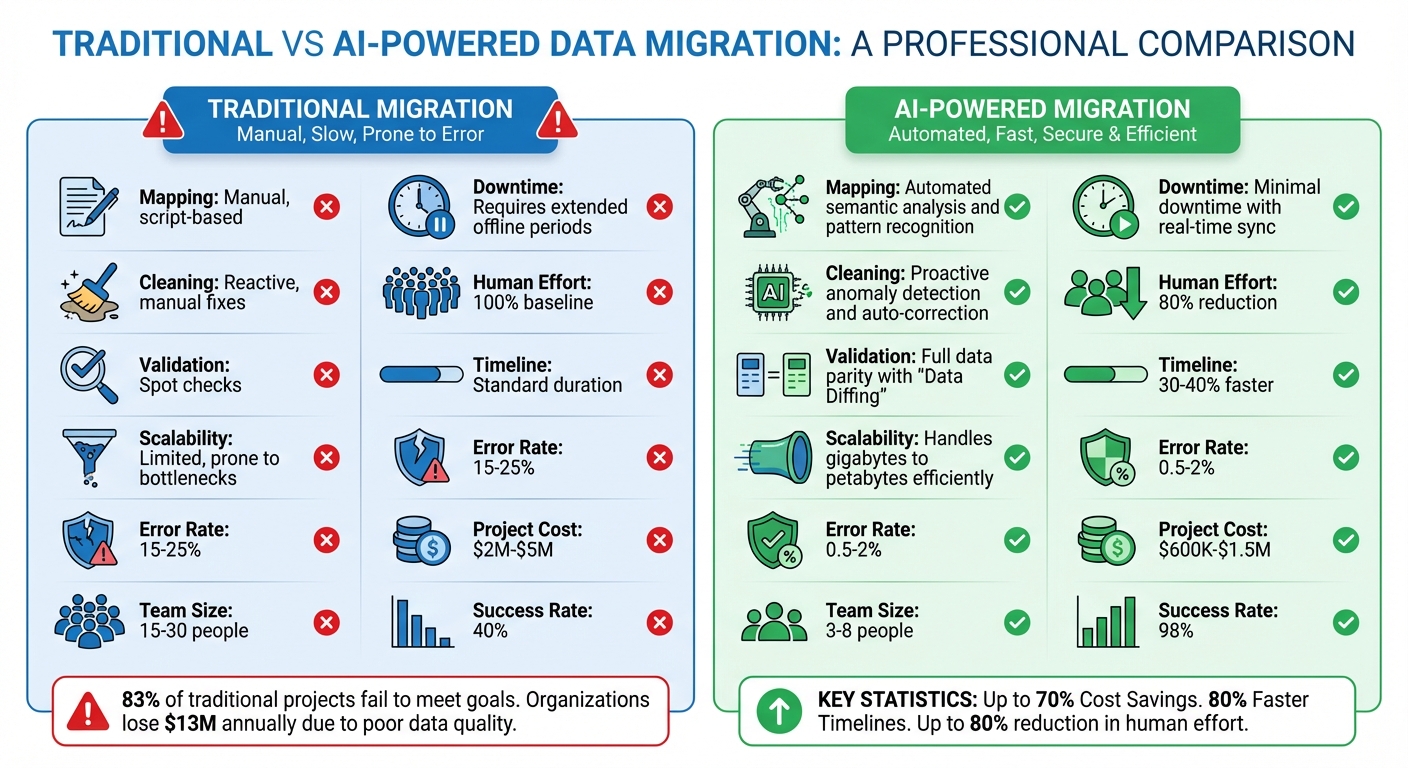
AI-Powered vs Traditional Data Migration: Key Differences and Benefits
AI transforms data migration from a tedious, manual task into an automated process that minimizes errors and boosts efficiency. Instead of relying on rigid scripts and constant human oversight, AI-powered tools analyze patterns, learn from mistakes, and adapt in real time. The results are impressive: AI and automation can cut human effort in data migration by up to 80% and speed up timelines by 30% to 40%. Here's how AI enhances each phase of data migration.
Automated Data Cleaning and Validation
AI excels at identifying inconsistencies, duplicates, and anomalies that traditional methods often miss. Using machine learning (ML) and natural language processing (NLP), it can correct misspellings and standardize terminology. For example, AI automatically recognizes that "CH" and "Switzerland" refer to the same place. It also uses probabilistic matching to compare names, addresses, and phone numbers, ensuring duplicates are merged or removed while maintaining data accuracy.
AI takes validation to the next level with "data diffing", which checks every data point between the source and target systems to ensure they match. Unlike static tools that rely on spot checks, AI continually learns from errors and refines its methods, achieving complete data integrity. This is crucial for tackling data quality issues, which cost organizations an average of $13 million annually.
"AI brings a higher level of intelligence and flexibility to data migration, making it more effective at improving data quality, supporting advanced mapping and validating activities." - Mykhailo Saienko, Senior Manager, Cloud & Digital, PwC Switzerland
Schema Mapping and Data Transformation
AI uses semantic analysis and large language models (LLMs) to understand the relationships between data fields in the context of business needs. This allows it to handle complex data transformations, such as translating SQL dialects, stored procedures, or workflows from legacy systems into formats compatible with modern cloud platforms. By automating this process, AI resolves compatibility issues that often turn short-term projects into years-long endeavors.
For instance, a retail giant used illumex's GenAI technology to migrate from SAP ECC to S/4 HANA, processing over 115,000 tables and 1.5 million data columns. What would have taken two years manually was completed in just one week thanks to AI’s ability to map schemas, translate technical terms, and document transformations.
Faster Data Transfer Processes
AI eliminates bottlenecks in large-scale migrations through advanced batch processing and predictive algorithms. Instead of sequential transfers that cause lengthy downtimes, AI orchestrates parallel data streams and optimizes routes based on network conditions and system capacity. This approach addresses volume-related challenges, ensuring faster and more efficient transfers.
A leading wearables manufacturer successfully migrated its supply chain and operational data to the cloud by leveraging AI-enabled accelerators and automated schema mapping. The result? A 40% reduction in migration timelines and 30% cost savings in managed services.
| Feature | Traditional Migration | AI-Powered Migration |
|---|---|---|
| Mapping | Manual, script-based | Automated semantic analysis and pattern recognition |
| Cleaning | Reactive, manual fixes | Proactive anomaly detection and auto-correction |
| Validation | Spot checks | Full data parity with "Data Diffing" |
| Scalability | Limited, prone to bottlenecks | Handles gigabytes to petabytes efficiently |
| Downtime | Requires extended offline periods | Minimal downtime with real-time sync |
Better Security and Compliance Monitoring
AI doesn’t just improve speed and accuracy - it also strengthens security and compliance. It scans datasets to identify sensitive information like Personally Identifiable Information (PII) or Protected Health Information (PHI) before migration begins. AI can anonymize or mask these fields to meet regulations like GDPR and HIPAA. Using Explainable AI (XAI), it also provides a clear, step-by-step record of every decision, creating an audit trail that satisfies regulatory requirements.
Real-time compliance monitoring further enhances security by flagging anomalies or unauthorized access, preventing breaches before they escalate. For example, HSBC used Google Cloud tools like BigQuery and Dataflow to speed up risk modeling by 10x while maintaining strict governance. By pairing AI models with human oversight, they ensured transparency for high-risk areas like Anti-Money Laundering (AML) compliance.
"AI not only checks data integrity but also creates clear audit trails explaining what changes were made and why. This transparency is vital for industries that require strict compliance, like healthcare and finance." - Manoj Kumar, Associate Director, BuzzClan
Steps to Implement AI for Data Migration
To successfully integrate AI into data migration, it's essential to follow a structured and supervised approach. This ensures automation works effectively while avoiding common pitfalls. Why is this important? Because 83% of data migration projects either fail or exceed budgets and timelines.
Planning and Preparation
Start by outlining your migration strategy. Decide between a "Big Bang" approach, where all data moves at once, or a phased migration, which progresses in stages. For AI-driven projects, phased migration is often better - it allows for step-by-step validation and minimizes disruptions. A great example is Netflix’s migration of its Hadoop data pipelines to AWS. By starting with non-critical systems and scaling over several years, they managed to grow from 50 million to over 230 million subscribers without infrastructure issues.
Before migration, conduct a thorough data audit using AI profiling tools. These tools can catalog your data sources, assess quality, and flag redundant or outdated information. Pre-migration data cleansing can reduce migration volumes by 20% to 40%. AI can also map system dependencies, helping you understand how changes may impact downstream processes like business analytics or machine learning models. Establish clear data ownership and governance early by assigning responsibility for each dataset.
For instance, Capital One adopted a "compliance-first" strategy when migrating sensitive financial records to AWS. They utilized end-to-end encryption and continuous replication through AWS Database Migration Service, ensuring faster analytics for fraud detection while meeting regulatory requirements.
Use this migration as an opportunity to streamline your data. Eliminate low-value or redundant data, and implement explainable AI to ensure automated suggestions for mapping or cleaning are reviewed by humans - especially for sensitive data like financial or healthcare records. If your internal team lacks expertise in configuring cloud platforms or managing AI pipelines, consider bringing in specialists.
"Technology pundits foresee a future where up to 80% of the data migration human effort in data migration will be reduced via AI and automation." - PwC
Once your plan is solid, move into a controlled testing phase to ensure everything works as expected.
Testing and Validation
AI can automate end-to-end parity checks, often referred to as "data diffing." This process compares every record between legacy and new systems to ensure 100% accuracy without manual effort. A multi-stage testing framework is key - this includes pre-migration schema analysis, pilot projects, real-time monitoring, and post-migration reconciliation. These steps not only validate performance but also refine AI configurations before the full migration.
Start with pilot projects using smaller, less critical datasets to test your AI model’s accuracy. Build quality gates into your migration pipeline to automatically check for issues like row count mismatches, null values, or data distribution shifts. If errors are detected, the process halts automatically. AI can also use self-correcting loops to adjust and improve its logic based on feedback from failed tests. Store all AI configurations and policies in Git for clear rollback options and a reliable audit trail.
Explainable AI (XAI) plays a crucial role here by documenting every AI decision. This transparency helps IT teams verify transformation logic and builds trust among stakeholders. While AI handles repetitive tasks, human experts should review and approve critical logic - this is especially important in regulated industries like finance and healthcare.
"AI provides speed. Automated mapping, cleaning, and validation accelerate projects. Orchestration provides control. Every step is connected, monitored, and auditable. Humans provide judgment." - Addepto
Post-Migration Support and Monitoring
Even after testing, continuous monitoring is essential. AI plays a key role in tracking system performance and identifying potential issues early. Machine learning models can monitor critical datasets like sales, transactions, or inventory, flagging anomalies that deviate from historical patterns.
For example, Vodafone migrated its SAP systems to Google Cloud by orchestrating the entire process as a single, coordinated cutover. This approach enabled them to transition over 300 SAP virtual machines without disrupting business operations. Similarly, a wearables manufacturer partnered with WNS to migrate supply chain data to the cloud, achieving a 40% reduction in migration timelines and 30% cost savings through AI-enabled tools.
AI also optimizes database performance by automatically fine-tuning indexes and partitions. Establish feedback loops to capture user experiences and system behavior post-migration, allowing for quick resolution of any issues. Automated parity reports ensure data consistency between old and new systems, both before and after the final cutover. Additionally, explainable AI generates audit trails to help meet compliance standards like GDPR and HIPAA.
| Post-Migration Strategy | AI Role | Business Benefit |
|---|---|---|
| Validation | Automated parity checks and semantic matching | Ensures 100% data accuracy and integrity |
| Monitoring | Real-time anomaly detection via ML models | Reduces downtime and prevents data corruption |
| Optimization | Automated database and index tuning | Maximizes system performance and ROI |
| Governance | XAI-generated audit trails and logs | Ensures compliance with regulations like GDPR and HIPAA |
| Support | Predictive risk analysis for future issues | Minimizes long-term maintenance costs |
AI’s role doesn’t stop at migration - it ensures long-term reliability, efficiency, and compliance. By automating repetitive tasks and providing real-time insights, AI allows businesses to focus on growth while maintaining data integrity.
Conclusion
Data migration doesn't have to be a headache. With AI, the process evolves from a simple "lift and shift" to a "move and improve" approach. This means data isn't just transferred - it’s cleaned, validated, and optimized along the way. For small and medium-sized enterprises (SMEs), this translates to up to 70% cost savings and 80% faster timelines compared to older methods, while drastically reducing error rates from 15–25% down to just 0.5–2%. These results tie directly to earlier discussions on how AI tackles migration challenges head-on.
AI-driven migrations also bring down project costs significantly - dropping from $2M–$5M to a far more manageable $600K–$1.5M. Team sizes shrink too, from 15–30 people to just 3–8. But the real game-changer lies in AI’s ability to address the root causes of migration failures: poor data quality, complex schema mapping, compliance risks, and the hurdles posed by legacy systems.
"AI doesn't replace expertise; it amplifies it. By taking on the heavy lifting of repetitive tasks and governance, it empowers IT teams to focus on the strategic decisions that drive transformation." - iLink Digital
For highly sensitive sectors like finance or healthcare, a hybrid approach combining AI's efficiency with human oversight is key. This balance ensures critical decisions are handled carefully, achieving a 98% success rate, compared to the 40% failure rate seen in traditional methods.
In the bigger picture, AI-powered migration lays the groundwork for SMEs to thrive. Clean, unified data isn't just an operational win - it’s the backbone for advanced analytics, machine learning projects, and the agility needed to stay competitive in today’s fast-paced markets. If your team is juggling 15–40 people while exploring infrastructure modernization, Growth Shuttle offers expert guidance in digital transformation and technology consulting to help you navigate these pivotal decisions.
FAQs
When should I use AI in a data migration project?
AI shines in data migration by improving accuracy, speeding up processes, and reducing risks. It automates critical tasks like data profiling, validation, and anomaly detection, which not only saves time but also cuts down on errors. It's particularly effective for data cleansing, working with outdated legacy systems, and tackling intricate migration scenarios. The result? High-quality data, smoother transitions, less downtime, and lower costs.
How do I validate data accuracy after an AI-led migration?
To ensure data remains accurate after an AI-driven migration, it's crucial to follow a detailed validation process. Start by verifying record counts and checksums to confirm that data has been transferred without discrepancies. Incorporate automated validation tools to minimize human error and streamline the process. Additionally, maintain a system for continuous monitoring to detect any schema drift or unexpected anomalies. These steps safeguard data integrity, reduce risks, and support compliance throughout the migration journey.
How can AI help with GDPR, HIPAA, or SOC 2 during migration?
AI makes navigating complex regulations like GDPR, HIPAA, and SOC 2 during data migration much easier by automating critical tasks. It can handle data governance, security protocols, and audit processes with precision. For instance, AI can enforce company policies, identify and mask sensitive information, and create detailed audit trails to safeguard privacy and meet compliance standards.
On top of that, AI offers real-time monitoring and data flow mapping, giving organizations the tools they need to stay compliant while managing regulatory demands more efficiently.


