Royalty agreements are critical for ensuring creators are compensated while allowing others to use their intellectual property (IP). These agreements lay out payment terms, usage rights, and legal protections to avoid disputes. A well-structured royalty agreement includes:
- Clear Party and IP Details: Identify the licensor, licensee, and the specific IP being licensed, with detailed descriptions and any use restrictions.
- Payment Terms: Define royalty rates (typically 2–10% of net sales), payment schedules, currency, and penalties for late payments.
- Reporting and Audits: Set requirements for sales reports, audit rights, and record-keeping to ensure transparency.
- Territory and Duration: Specify geographic limits, agreement length, renewal terms, and termination conditions.
- Legal Safeguards: Include confidentiality clauses, liability terms, and dispute resolution methods like mediation or arbitration.
Each component ensures both parties are protected, payments are consistent, and conflicts are minimized. These agreements are especially common in industries like music, software, publishing, and technology. Always consult with an attorney to finalize terms and avoid potential risks.
Contract and Copyright Drafting Skills: Royalties
Parties and IP Details
Clearly defining the parties involved and the intellectual property (IP) being licensed is the backbone of any effective royalty agreement. Without this clarity, misunderstandings or disputes can easily arise down the line.
Licensor and Licensee Information
The licensor is the entity that owns the intellectual property and grants the rights to use it under specific terms, typically in exchange for royalties. On the other side, the licensee is the party receiving the rights to use, produce, or sell the IP, with the obligation to pay royalties as agreed.
Your agreement should include the full legal names of both parties along with their complete business addresses - this means including the street address, city, state, and ZIP code.
It’s also critical to outline the roles and responsibilities of each party. For instance:
- The licensor often retains quality control responsibilities to ensure the licensed IP is used appropriately and maintains its value.
- The licensee is usually tasked with making timely royalty payments, adhering to quality standards, and using the IP within the agreed-upon scope.
If subsidiaries or affiliates are involved, the agreement must specify whether they are included. This helps avoid confusion about who can use the IP and who is responsible for payments.
IP Description and Registration
Intellectual property spans a wide range of creations, from inventions and artistic works to brand identifiers and trade secrets. Each type of IP requires detailed documentation to ensure clarity:
- Patents: Include the patent number, filing date, and a detailed description of the invention. Patents typically protect technical innovations like chemical formulas, mechanical processes, or machine designs.
- Copyrights: These protect creative works such as books, music, software, and artwork. Provide the copyright registration number (if available), the creation date, and a thorough description of the work.
- Trademarks: Trademarks distinguish goods or services through words, phrases, symbols, or designs. Be sure to include the registration number, classification, and a precise description of the goods or services covered.
- Trade Secrets: These include confidential information that provides a competitive edge. While trade secrets aren’t formally registered, the agreement should describe them in enough detail to identify the asset without disclosing sensitive information.
- Industrial Designs and Geographical Indications: Industrial designs focus on the ornamental aspects of products, while geographical indications highlight goods tied to specific locations. Provide detailed descriptions for these as well, if relevant.
The agreement should also outline any IP use restrictions. For example, field-of-use limitations might restrict patented technology to specific industries or markets. In the pharmaceutical industry, a patented drug might be licensed for cancer treatment in one agreement and for gastrointestinal conditions in another - each representing a distinct field of use. Additionally, territorial terms must clearly define where the licensee is permitted to operate and whether the license is exclusive or non-exclusive in each region.
Lastly, don’t overlook pending applications or related IP that could impact the licensed property. If the IP is part of a larger portfolio, specify exactly which elements are included in the agreement.
With the parties and IP details thoroughly documented, the next focus should be on crafting clear and precise payment terms.
Payment Structure and Terms
Establishing a clear payment structure is essential for avoiding disputes and ensuring both parties understand their obligations in royalty agreements.
Royalty Rate Calculation
The royalty rate determines how much the licensee pays for using your intellectual property (IP). As Licensing Consulting Group explains:
"The royalty rate represents the price a licensing partner will pay for the right to use your IP. But calculating it goes beyond simply setting an amount - it's about understanding how valuable your IP is in driving revenue and profitability."
Most royalty agreements use a percentage-based model, typically ranging from 2–10% of the licensee's net sales. In some cases, particularly with patents, rates can vary from as low as 0.1% to as high as 25% of net sales or profits.
| Industry | Average Royalty Rate (%) |
|---|---|
| Aerospace | 3.5–4.5% |
| Apparel | 5.5–7% |
| Automotive | 3–3.8% |
| Chemicals | 4–5% |
| Consumer Goods | 4.5–5.5% |
| Electronics | 4.8–5.5% |
| Energy & Environment | 7–9% |
| Healthcare Equipment | 5.5–7% |
| Industrial Goods | 5–6.5% |
| Pharmaceuticals & Biotech | 6–10% |
| Software | 8–12% |
Fixed-fee arrangements provide another option, offering predictable payments regardless of sales performance.
Several factors influence royalty rates. Market demand and brand reputation are key - strong brands often justify higher rates. Exclusive licenses typically command higher royalties, often tied to minimum sales requirements. The uniqueness of your IP and its importance to the licensee’s business also play a role. To set a fair rate, you can analyze comparable deals using licensing databases and assess the licensee's profit margins. A hybrid model, combining upfront fees with ongoing royalties, can help balance risks and rewards.
Once the royalty rate is set, it's equally important to establish a clear payment schedule to ensure consistent cash flow.
Payment Schedule and Currency
Payment schedules should align with your cash flow needs and the licensee's industry cycles. Payments can be structured quarterly, monthly, or annually, with specific due dates. For instance, you might state: "Royalty payments for each calendar quarter are due no later than 30 days after the quarter ends."
For agreements within the U.S., specifying payment in U.S. dollars (USD) helps avoid issues with currency conversion and exchange rate fluctuations. Clearly outline acceptable payment methods, such as wire transfers, checks, or electronic payments.
It’s also wise to include provisions for adjusting royalty rates based on changes in sales performance or industry conditions.
Additionally, the agreement should define minimum payments and penalties to encourage compliance and ensure consistent income.
Minimum Payments and Late Fees
Minimum royalty payments provide a guaranteed income, regardless of actual sales. For example, Jaguar Health, Inc. includes a clause requiring a minimum monthly royalty payment of $250,000.00 or the calculated royalty amount, whichever is greater, with this minimum increasing over time. Such provisions incentivize the licensee to actively use the licensed IP while offering financial stability to the licensor.
To prevent delays, late payment penalties should be clearly defined. Attorney Aaron Hall advises:
"Establish late payment penalties, grace periods, and notification procedures to enforce timely payments and reduce defaults."
Typically, a grace period of 10–15 days is allowed. After that, a penalty rate - often 1.5% per month or the maximum allowed by law - can be applied. For example, you might specify: "If payment is not received within 15 days of the due date, a late fee of 1.5% per month will be applied to the outstanding balance."
Advance payment clauses, where licensees pay estimated royalties upfront with adjustments made after actual sales are reported, can improve cash flow and reduce collection risks. Payment monitoring systems can also help track royalty inflows in real time, ensuring any issues are addressed promptly.
For international agreements, address currency exchange by specifying the conversion date (e.g., the last business day of the reporting period) and the source for exchange rates, such as those published by the Federal Reserve Bank.
Reporting and Audit Requirements
Once payment terms are established, maintaining transparency and accountability becomes essential. This is where thorough reporting and auditing processes come into play. Clear guidelines for these ensure accurate royalty calculations and build trust between all parties involved.
Sales Report Format and Timing
Sales reports should include comprehensive details such as sales data, total revenue, and the calculations used to determine royalty payments. For example, a quarterly report might show 5,000 units sold, with royalties calculated at 10% of $50,000 in sales. Similarly, in the case of a music producer licensing a song for a movie soundtrack, the studio’s report must outline revenue from digital downloads, physical sales, and streaming to ensure accurate compensation.
How Often Should Reports Be Submitted?
The frequency of sales reporting often aligns with industry norms, ranging from monthly to annual submissions. Quarterly reports strike a good balance between maintaining oversight and reducing administrative workload. However, in cases where sales are made directly to consumers, more frequent reporting might be necessary.
What Should Be Included?
Each royalty report should come with supporting documents like sales invoices, inventory records, and accounting statements. These details help verify the accuracy of the figures and minimize disputes. Such thorough documentation also lays the groundwork for effective audits and ensures royalty payments are accurate.
Audit Rights and Record Keeping
Audit provisions are a key part of licensing agreements, granting licensors the ability to confirm that royalty payments match the licensee’s actual use of the licensed property. These provisions should cover how often audits can occur, their scope, notice requirements, and confidentiality terms. Audits are typically scheduled annually or biannually to balance business efficiency with compliance needs.
| Audit Provision | Common Features |
|---|---|
| Audit Frequency | Conducted periodically (e.g., annually or biannually) to avoid excessive disruption |
| Scope Limitations | Focused on financial and usage records directly related to the licensed property |
| Notice Requirements | Advance written notice (usually 10–30 days) before the audit begins |
The agreement should also outline acceptable formats for records and how they should be organized to facilitate smooth audits.
When audits uncover discrepancies, licensees must promptly address any unpaid amounts and take steps to prevent similar issues in the future. Licensors, on their part, should back any claims for unpaid royalties with detailed reports. Regular audits not only help identify underreported or unpaid royalties but also contribute to a stronger business relationship. To ensure compliance, internal controls should be implemented to maintain clear and reliable audit trails.
Territory, Duration, and Ending the Agreement
Defining clear boundaries for where intellectual property (IP) can be used, how long an agreement lasts, and the conditions for ending it is essential to avoid future disputes. These provisions are the foundation of a well-structured royalty agreement and demand close attention. Alongside payment and audit terms, precise territorial and temporal boundaries ensure both parties are on the same page.
Geographic Limits and Usage Rights
The territory clause outlines where the IP can be used. It’s crucial to define these boundaries with precision to avoid misunderstandings. For instance, instead of broadly stating "North America", specify whether this includes just the United States and Canada or also Mexico and other regions. A software licensor might limit the use of their technology to specific enterprise functionalities, ensuring it isn’t applied in consumer markets that could compete with their own offerings.
Tailoring geographic scope based on market research can help maintain strategic control. For example, a trademark owner might license their brand to one company for North American markets and to another for Asian markets, ensuring the brand is represented appropriately in each region.
Usage Rights and Restrictions
"License agreements must clearly define the scope of usage rights, including specific applications, duration, and territorial limits."
– Attorney Aaron Hall
It’s essential to spell out usage categories, territories, and distribution channels in detail. For instance, a licensor of a luxury fashion brand might restrict sales to high-end retail channels in affluent regions while prohibiting distribution in areas known for counterfeiting. Agreements should also include strict prohibitions against unauthorized sales or distribution outside the defined region, along with internal compliance measures to enforce these terms.
Start Date, End Date, and Renewals
Clear timing provisions are critical to eliminate confusion about when the agreement starts, ends, and how it can be extended. Royalty agreements should explicitly state the term length and include a defined process for renewals or renegotiations. Adding a renewal clause can provide flexibility to adapt as markets evolve.
Renewal options allow the licensing relationship to continue under agreed terms. Key considerations include setting clear conditions and deadlines for renewal discussions, as well as addressing potential adjustments to royalty rates or licensing terms. Additionally, clauses for periodic performance reviews or renegotiations based on market changes can help both parties stay aligned. Termination conditions should also be clearly outlined to protect everyone involved.
Termination Triggers and Post-Agreement Duties
Termination clauses must clearly define the conditions under which either party can end the agreement. This ensures legal clarity and reduces the risk of disputes.
Types of Termination
An agreement can be terminated "for cause" (e.g., breach of contract) or "without cause" (e.g., for convenience). It’s important to define what constitutes a material breach, specify notice requirements, and include cure periods to allow the breaching party an opportunity to address issues before termination.
"Clearly define termination triggers to avoid ambiguity and ensure objective criteria for ending the IP license agreement."
– Attorney Aaron Hall
Notice Requirements and Cure Periods
Agreements should include clear notice requirements and allow a set cure period for the breaching party to correct any defaults before the agreement is terminated.
Post-Termination Obligations
Post-termination clauses should address what happens to the licensed IP and other shared assets. This typically includes stopping the use of the licensed IP, disposing of promotional materials, and returning confidential information. In some cases, a grace period might be granted to sell off existing inventory. To minimize conflicts, it’s a good idea to include mediation or arbitration clauses to resolve disputes related to termination. These provisions ensure both parties can transition smoothly after the agreement ends.
sbb-itb-c53a83b
Legal Protection and Dispute Handling
Having strong legal safeguards and clear processes for resolving disputes is crucial when structuring royalty agreements. These measures help protect both parties' interests and ensure conflicts are handled efficiently.
Confidentiality Requirements
Confidentiality clauses, often referred to as nondisclosure agreements (NDAs), are designed to protect sensitive business information shared during a licensing relationship. These clauses require both parties to keep certain information private and prohibit unauthorized sharing with third parties.
Defining Confidential Information
A well-crafted agreement must clearly define what qualifies as confidential information. This typically includes trade secrets, proprietary data, customer lists, financial details, strategic plans, and technical specifications. A precise definition helps eliminate potential misunderstandings later on.
Comprehensive definitions often cover a wide range of nonpublic information, such as product details, formulas, designs, processes, policies, employee information, legal matters, trademarks, patents, and relationships with suppliers or third parties.
Protection Measures and Duration
The agreement should outline the steps both parties must take to safeguard confidential information. This might include encrypted digital storage or limiting physical access to authorized personnel. Confidentiality obligations often extend beyond the end of the agreement, with a defined period - usually between two and five years - during which the information must remain protected.
Exceptions and Remedies
The agreement should also specify exceptions for lawful disclosures, such as sharing information with legal advisors, complying with court orders, or when the information is already public. Remedies for breaches should be detailed, including monetary damages and provisions for injunctive relief to prevent further misuse.
In addition to confidentiality, liability clauses play a key role in protecting both parties.
Liability and Indemnification Rules
Liability and indemnification clauses clarify each party's responsibilities in case of disputes, such as intellectual property infringement claims or other damages. Typically, the licensor indemnifies the licensee against third-party IP infringement claims, while the licensee agrees to hold the licensor harmless for any misuse beyond the agreed scope. These clauses often exclude consequential or punitive damages unless there’s willful misconduct or a breach of confidentiality involved.
Once these protections are in place, structured dispute resolution methods can help address conflicts effectively.
Dispute Resolution Methods
Establishing clear dispute resolution procedures can help avoid lengthy court battles while preserving business relationships. Royalty agreements often employ a tiered approach to resolving disputes.
Negotiation as the First Step
The initial step in resolving disputes is direct negotiation between the parties. This method encourages open communication and typically includes a set timeframe - usually 30 to 60 days - for reaching a resolution, helping to avoid indefinite delays [52, 53].
Mediation for a Collaborative Approach
If negotiation doesn’t work, mediation provides a collaborative option. A neutral third party facilitates discussions to help both sides reach an agreement. Mediation is particularly useful when maintaining a business relationship is important, and it’s most effective when the mediator has relevant industry expertise [50, 51, 53].
Arbitration for Binding Resolutions
When mediation fails, arbitration offers a binding and generally quicker resolution. A neutral arbitrator reviews the case and issues a decision that both parties must follow. Arbitration is typically more private and cost-effective than traditional litigation. To ensure clarity, arbitration clauses should specify the arbitrator’s qualifications and may include language to limit punitive damages. If the intent is for the Federal Arbitration Act to apply regardless of governing law, this must also be explicitly stated [50, 52, 53].
Governing Law and Jurisdiction
The agreement should clearly define which state’s laws will govern the arrangement and specify the jurisdiction for resolving disputes. Delaware law is a common choice due to its well-established corporate legal framework. However, parties may select a jurisdiction that aligns with their primary business operations.
US Format Requirements
Ensuring your royalty agreement adheres to US business and legal formatting standards is crucial for maintaining clarity and professionalism. Proper formatting not only prevents misunderstandings but also reflects legal expertise.
Currency and Date Standards
Dollar Formatting Rules
When mentioning monetary amounts in your royalty agreement, stick to US formatting conventions. Always use numerals instead of spelling out amounts, and include a dollar sign with commas as thousand separators (e.g., $1,250,000.50).
For formal agreements, consider using both numeral and written forms for clarity: "The minimum annual royalty payment shall be $25,000 (twenty-five thousand dollars)". This approach minimizes the risk of disputes over amounts.
If specifying the currency code, use USD rather than US$. Consistency in formatting throughout the document is essential.
Date Format Standards
Write dates with the full month name, day, and four-digit year (e.g., January 15, 2025). If numerical formats are necessary, use MM/DD/YYYY.
Avoid abbreviating the year to two digits, as this can lead to confusion. For example, "effective March 1, 25" could raise questions about the intended century. Using the full year ensures clarity and professionalism.
These conventions establish a solid foundation for a well-structured and legally sound agreement.
US English and Legal Terms
Spelling and Language Conventions
Your document should consistently use American English spellings, such as "license", "analyze", and "organization." Align legal terminology with US standards by using terms like "attorney" instead of "solicitor" or "barrister." Similarly, refer to "corporations" and "LLCs" rather than "companies limited by shares." When discussing intellectual property, stick to terminology familiar in US patent and trademark law.
Measurement and Technical Standards
Incorporate US measurement systems where applicable. Use imperial units (e.g., feet, inches, pounds), and include metric conversions only if necessary. For temperature, use Fahrenheit (e.g., "stored at 68°F").
Legal Compliance Language
Ensure references to legal frameworks are specific to the US. Mention "federal and state laws" rather than general terms like "national and local regulations." For tax-related matters, refer to "IRS requirements" and "federal tax obligations" to demonstrate familiarity with US systems.
Clearly state the governing law in your agreement, such as: "This Agreement shall be governed by the laws of the State of [State Name]."
Growth Shuttle Advisory Support
When it comes to royalty agreements, blending strategic insight with legal expertise is essential. These agreements demand more than just legal knowledge - they require a clear, strategic vision to address the challenges that often arise in licensing. This is where expert advisory support becomes invaluable.
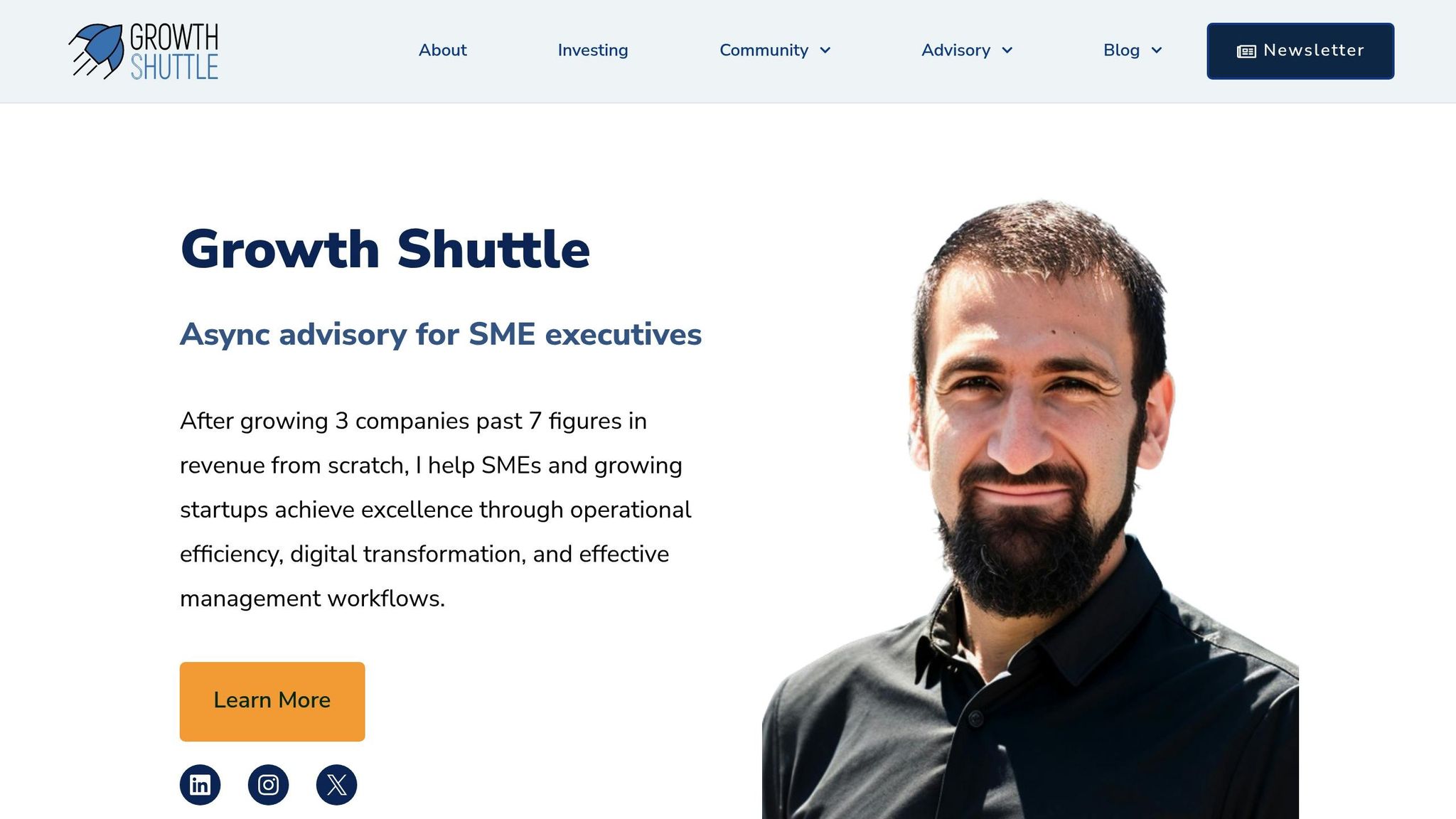
Founded in 2018 by Mario Peshev, Growth Shuttle combines over 15 years of entrepreneurial experience with a decade of business management expertise. The company specializes in advisory services designed to tackle the complexities of royalty agreements. Their team works closely with CEOs managing teams of 15–40 people, focusing on areas like digital transformation, process optimization, and go-to-market strategies. By emphasizing operational efficiency and effective management workflows, Growth Shuttle ensures that royalty agreements align seamlessly with broader business goals.
For businesses navigating royalty agreements, Growth Shuttle offers three tailored advisory plans:
| Plan | Monthly Investment | Key Features | Best For |
|---|---|---|---|
| Direction | $600 | 1-hour strategic call with an actionable plan | Initial royalty agreement review and basic structuring |
| Strategy | $1,800 | Monthly call with implementation support, brand representation, and email/Slack access | Ongoing royalty management and compliance monitoring |
| Growth | $7,500 | Weekly meetings, fractional CXO services, and active participation in negotiations | Complex licensing deals and dispute resolution |
The Strategy Plan is ideal for companies managing multiple royalty agreements, offering hands-on support to apply Growth Shuttle's tools and strategies during licensing discussions. For businesses facing more intricate challenges, the Growth Plan provides end-to-end assistance, including regular meetings, training sessions, and direct involvement in negotiations and partnerships.
Growth Shuttle’s expertise extends beyond royalty agreements. Their team excels in competitor research, digital strategy, and relationship management, helping businesses negotiate more effectively. For bootstrapped startups, they provide guidance on scaling operations and recruitment, ensuring royalty income streams contribute to growth rather than creating obstacles.
Additionally, Growth Shuttle supports digital agencies and professional service firms by helping them establish new departmental structures and responsibilities. For small and medium-sized enterprises (SMEs) lacking technical resources, they offer solutions to scale automation, streamline reporting, and improve payment tracking and compliance systems - all critical for managing complex royalty agreements.
These advisory services are designed to integrate seamlessly with the broader framework of royalty agreement management, ensuring every detail is optimized for success. Growth Shuttle’s approach ensures businesses are not only compliant but also strategically positioned for long-term growth.
Final Checklist Summary
Creating a solid royalty agreement is key to ensuring both parties' interests are safeguarded and operations run smoothly. This streamlined checklist is your go-to tool for verifying all critical elements before signing.
Verify Party and IP Details thoroughly. Make sure both the licensor and licensee are clearly identified with their full legal names and contact information. The intellectual property (IP) should be described in detail, including its scope and any restrictions.
"Clearly define the scope, territory, and ownership rights to avoid ambiguity and potential disputes in the IP royalty agreement".
Once the parties and IP are clearly outlined, turn your attention to the financial terms.
Confirm Payment Structure Accuracy by carefully reviewing all monetary details. Ensure the royalty rates align with industry standards, and payment schedules are practical, balancing industry norms with your cash flow needs. Double-check that royalty formulas are transparent and free of errors.
Ensure Reporting and Audit Provisions are in place. Outline the required format for sales reports, timing for submissions, and the licensor's rights to conduct audits. These provisions help maintain financial accountability and reduce the risk of underpayment through regular checks.
Next, address the agreement's geographic, temporal, and legal parameters.
Define Geographic and Temporal Boundaries clearly. Specify where the IP can be used, the contract's duration, renewal terms, and termination conditions. Including definitive start and end dates ensures there’s no confusion about the agreement's validity.
Establish Legal Protection Measures by incorporating confidentiality clauses, indemnification terms, and dispute resolution processes.
"Legal best practices for structuring licensing agreements involve clearly defining the scope of licensed rights, including geographic and temporal limits, and protecting intellectual property ownership to prevent unauthorized use".
Set up procedures for mediation, arbitration, or legal action to handle disputes. Additionally, outline what happens to the IP and any confidential information after the agreement ends.
Finally, have a licensed attorney review all the terms, particularly those related to IP rights and liabilities, before the agreement is finalized. Their expertise can help identify potential risks and prevent costly disagreements down the line.
"A well-written royalty agreement is important for the licensor and licensee to build a successful and mutually profitable partnership".
FAQs
What mistakes should I avoid when creating a royalty agreement?
When putting together a royalty agreement, clarity is everything. Be specific about payment schedules, the scope of the license, and performance obligations. If these terms are left open to interpretation, it can lead to confusion - or worse, legal disputes down the line.
It's also a mistake to skip over compliance mechanisms. Include provisions like regular reporting requirements or audit rights. These tools make it easier to confirm that all parties are sticking to the agreed terms.
Finally, don’t ignore the possibility of future challenges. Market conditions and technology evolve, and an agreement that doesn’t account for these changes can quickly become outdated. Build in flexibility to keep the agreement relevant and effective over time.
How do I determine the right royalty rate for my industry?
To figure out the right royalty rate, start by diving into what’s standard in your industry. Look at market norms, how valuable and distinctive your intellectual property is, and the demand for the product or technology you’re licensing. Royalty rates can swing widely - from as low as 0.1% to as high as 25% - depending on the type of intellectual property and what’s typical in your field.
It’s also a good idea to check out similar licensing agreements or get advice from a professional. This way, you can make sure your rate stays in line with industry standards while accurately reflecting the worth of your IP. Taking these steps will help you set a royalty rate that’s both fair and competitive.
What should I do if there’s a disagreement over royalty payments or intellectual property usage?
If disagreements come up regarding royalty payments or intellectual property (IP) usage, the first step is to review the agreement. This helps to clarify the terms and confirm that all parties are meeting their obligations. Contracts that include audit rights and clear reporting requirements can minimize confusion and prevent disputes from escalating.
When the issue can't be resolved through direct communication, mediation or arbitration can provide a neutral path to a solution. These approaches are often quicker and less expensive than going to court. Including a dispute resolution clause in your agreement is a smart way to make the process smoother if conflicts arise down the road.


