
Why does workplace culture matter? Because it directly impacts your business results. Improved culture leads to higher productivity, better employee retention, and stronger financial performance. For small and medium enterprises (SMEs), tracking culture change metrics is essential to ensure your efforts are driving measurable success.
Here’s the key takeaway: Metrics like employee engagement, turnover rates, and value alignment act as early indicators of business outcomes like profitability, customer satisfaction, and innovation. Combining quantitative data (e.g., surveys, HR analytics) with qualitative feedback (e.g., interviews, focus groups) provides a full picture of your progress.
To see results, align your culture goals with your business objectives, track key performance indicators (KPIs), and use frameworks like the Competing Values Framework (CVF) or Organizational Culture Profile (OCP). This approach ensures you’re not just guessing but making informed decisions that connect employee experience to business success.
Quick highlights:
- Key metrics to track: Engagement scores, turnover rates, value alignment, promotion rates, and absenteeism.
- Business results to monitor: Productivity, customer satisfaction, retention, and profitability.
- Actionable steps for SMEs: Tie culture goals to business KPIs, use structured frameworks, and prioritize leadership involvement.
Bottom line: A strong workplace culture isn’t just “nice to have” – it’s a measurable driver of business performance.
Measure the Value of Your Company Culture. April 14, 2025
Culture Change Metrics: What to Track and How to Measure
Tracking culture change effectively requires the right mix of metrics and methods to capture both the numbers and the stories behind them. By focusing on key indicators and using structured approaches, organizations can monitor progress and make informed decisions. Let’s break it down.
Key Culture Metrics to Monitor
Several metrics can offer a clear picture of how employees experience and engage with your organization. These include:
- Employee engagement scores: These scores reflect how emotionally invested employees are in their work and the company’s success. Regular surveys that assess satisfaction, commitment, and whether employees would recommend the company as a great place to work are common tools for gathering this data.
- Retention and turnover rates: High turnover often signals cultural misalignment, while strong retention suggests employees feel valued and connected to the organization’s mission. Pay close attention to voluntary and involuntary turnover, especially among high performers and new hires within their first 90 days.
- Value alignment metrics: These measure how well employees understand and live out the company’s core values. For example, behaviors like collaboration, submitting new ideas, or participating in initiatives can reflect alignment. As Dieter Veldsman, Chief Scientist (HR and OD) at AIHR, explains:
"Before measuring and tracking culture, it is important to be clear on what type of culture you want in the organization, and more importantly, what are the behaviors that characterize that culture. For example, a high-performance culture might be measured by metrics related to market results, while a high innovation culture will require measures related to a number of ideas, improvements, and new patents".
- Promotion and advancement rates: Internal promotion rates and average time-to-promotion can reveal whether employees have equitable opportunities for growth within the organization.
- Absenteeism and wellness indicators: Chronic absenteeism can point to stress or poor cultural fit, while low absenteeism often reflects a supportive work environment.
- New hire alignment scores: With 46% of job seekers and 91% of U.S. managers prioritizing cultural fit, tracking how quickly new employees integrate and stay engaged after onboarding is a valuable measure.
Numbers vs. Feedback: Two Ways to Measure
To get a full picture of culture, you need both hard data and human stories. Here’s how these two approaches complement each other:
- Quantitative data: Tools like employee surveys, HR analytics, and performance metrics provide objective insights. They help track trends, identify patterns, and set benchmarks. For instance, engagement scores or absenteeism rates can highlight areas needing attention. However, numbers alone often lack context.
- Qualitative insights: Focus groups, one-on-one interviews, and open-ended survey questions fill in the gaps by uncovering the "why" behind the data. For example, if engagement scores drop, qualitative feedback can reveal whether the cause is poor management, resource shortages, or external pressures.
A great example of this balanced approach is Microsoft’s cultural shift under CEO Satya Nadella. In 2014, Kathleen Hogan and her team combined employee engagement surveys with focus groups and interviews to understand both the scale of cultural issues and their root causes. This helped transform Microsoft from a "know-it-all" to a "learn-it-all" culture.
The best strategy is to use quantitative data to spot trends and challenges, then dive deeper with qualitative methods to uncover causes and craft solutions. Regular pulse surveys can track progress, while periodic focus groups provide ongoing context.
Frameworks for Measuring Culture
Once you’ve balanced numbers and feedback, structured frameworks can help you assess culture systematically over time. Here are a few widely used options:
| Cultural Type | Focus | Orientation |
|---|---|---|
| Adhocracy Culture | External | Flexibility |
| Clan Culture | Internal | Flexibility |
| Hierarchy Culture | Internal | Stability/Control |
| Market Culture | External | Stability/Control |
The Competing Values Framework (CVF) is a popular tool that categorizes culture into four types based on whether the focus is internal or external and whether the organization values flexibility or stability. For example, a company aiming to encourage innovation might track shifts from a Hierarchy culture to an Adhocracy culture by monitoring increases in risk-taking and idea generation.
Another option is the Organizational Culture Profile (OCP), which evaluates culture through seven values: detail-oriented, innovative, aggressive, outcome-oriented, stable, people-oriented, and team-oriented. This framework allows for a more detailed analysis of how cultural elements align with business goals.
For small and medium-sized enterprises (SMEs), the Business Needs Scorecard (BNS) is a comprehensive tool. It maps culture across dimensions like financial performance, external stakeholder relations, organizational fitness, and societal contribution. This approach ties culture metrics directly to business outcomes.
Advanced tools like sentiment analysis and natural language processing now allow organizations to monitor culture in real time by analyzing employee communications, survey responses, and feedback platforms. These technologies can detect subtle cultural shifts, enabling timely interventions.
The key is to choose a framework that aligns with your organization’s goals. Start with one main framework to establish a baseline, and add more tools as your culture measurement program evolves. This ensures consistent tracking and actionable insights for continuous improvement.
Business Results: What Success Looks Like and How to Track It
While metrics about workplace culture provide insight into your organization’s internal dynamics, business results highlight the tangible outcomes of those cultural shifts. Knowing which results matter and how to measure them bridges the gap between employee experience and overall company performance.
Main Business Results Affected by Culture
Culture change has a direct influence on several core business metrics. The most noticeable areas of impact include productivity, employee retention, customer satisfaction, and financial performance. These metrics clearly demonstrate how a strong workplace culture connects employee experiences to business success.
Productivity gains are often the first sign of a cultural shift. Companies with highly engaged employees see 21% higher profitability and 17% greater productivity. Why? Engaged employees tend to work harder, collaborate more effectively, and approach challenges with creative problem-solving.
Employee retention also improves significantly with a positive culture. Organizations with top-tier employee engagement report nearly 60% lower turnover rates. For small and medium-sized enterprises (SMEs), this is especially critical since losing key talent can disrupt operations and rack up significant hiring costs. On average, replacing an employee costs about $4,700, and voluntary turnover costs U.S. businesses a staggering $1 trillion annually.
Customer satisfaction follows when employees feel more connected to their work. A survey found that 74% of employees believe workplace culture directly affects customer service. For instance, IBM revamped its performance management system to emphasize regular feedback and open communication. This cultural shift cut voluntary turnover rates by 50%, allowing employees to better serve customers.
Financial performance ties all these elements together. Companies with engaged employees are 21% more profitable than those with disengaged teams. Additionally, businesses that leverage people analytics see a three-year average profit 82% higher than others. For SMEs, these gains can be the difference between just surviving and truly thriving.
Next, let’s look at the metrics that make these outcomes measurable.
Key Performance Indicators (KPIs) for Business Results
The right KPIs help you track whether cultural changes are translating into measurable business success. Focus on metrics that reflect areas where culture has the biggest influence.
Revenue and profitability metrics are essential indicators of business health. Monitor monthly revenue, profit margins, and revenue per employee to see if cultural improvements are driving better outcomes. Companies that embrace HR metrics often experience an 80% boost in recruiting efficiency, a 25% rise in productivity, and a 50% drop in attrition rates.
Employee-related KPIs provide insight into the human side of business performance. Keep an eye on voluntary turnover rates, time-to-fill for open positions, internal promotion rates, and employee net promoter scores (eNPS). These numbers reveal whether your culture is helping you attract, develop, and retain top talent.
Operational efficiency indicators measure how smoothly your teams work together. Key metrics include project completion rates, time-to-market for new products, customer response times, and quality scores. For example, Google’s use of OKRs (Objectives and Key Results) with a focus on transparency and teamwork led to a 25% increase in employee productivity.
Customer-focused metrics highlight your culture’s external impact. Metrics like customer satisfaction scores, repeat purchase rates, customer lifetime value, and referral rates are crucial. Zappos, for instance, ties its customer service culture directly to performance metrics, resulting in 75% of customers making repeat purchases.
Innovation and growth KPIs track your organization’s ability to evolve and improve. These include the number of employee-submitted ideas, successful process improvements, new product launches, and market share growth. Such metrics reveal whether your culture encourages the creativity and risk-taking needed to stay competitive.
Matching Results with Company Goals
To maximize the impact of cultural changes, align the results with your company’s strategic objectives. This ensures that your cultural initiatives support what matters most to your organization’s success.
Start with your strategic priorities and identify which cultural elements will drive those outcomes. For instance, if rapid growth is your goal, focus on collaboration, innovation, and engagement metrics. If operational excellence is the priority, emphasize quality, efficiency, and process improvement indicators.
Link cultural behaviors to business outcomes by pinpointing specific actions that lead to results. For example, if customer satisfaction is key, track how often employees go above and beyond for customers, participate in feedback sessions, or suggest service improvements. Patagonia excels at this by aligning employee goals with its broader environmental mission, empowering teams to propose initiatives that reflect company values.
Set realistic timelines for seeing results. Some changes, like improved collaboration, may show up in productivity metrics within months. Others, like increased innovation or stronger customer loyalty, might take a year or more. While 63% of employees believe workplace culture directly impacts their organization’s success, it’s important to recognize that these effects often unfold gradually.
Establish feedback loops between culture metrics and business outcomes. For example, if engagement scores rise, look for corresponding gains in productivity or customer satisfaction. Conversely, if business metrics lag, revisit your cultural initiatives to see if adjustments or more time are needed.
Adapt based on data to fine-tune your approach. If retention improves but productivity remains stagnant, focus on performance management or skills development. If customer satisfaction rises but profitability doesn’t, examine pricing strategies or operational efficiency.
The key is maintaining a clear connection between the culture you’re building and the results you want to achieve. This alignment not only justifies investments in culture but also ensures they deliver meaningful value for your business.
sbb-itb-c53a83b
Culture Metrics vs. Business Results: Side-by-Side Analysis
This section dives into the relationship between internal cultural metrics and external business performance. By examining how these indicators connect, we can better understand how workplace culture influences success. While the link between culture and results may not always be immediate or obvious, consistent patterns emerge when you focus on the right metrics.
How Metrics Connect to Results
Culture metrics often act as predictors of business outcomes. For instance, higher employee engagement typically leads to increased productivity. Improved communication can streamline project completion, and alignment with company values often enhances customer satisfaction.
Research supports these connections. Engaged employees tend to show lower absenteeism, higher productivity, and greater profitability. High-trust environments encourage innovation and reduce turnover. According to Great Place to Work, companies with high-trust cultures experience about half the turnover of their competitors and innovate faster.
- Values alignment plays a crucial role in decision-making and customer interactions. Employees who fully embrace company values are more likely to act in ways that improve customer satisfaction.
- Effective communication drives operational success. Teams that communicate well can finish projects faster, make fewer errors, and adapt more easily to changes.
The timeline for these effects varies. Gains in engagement might quickly improve productivity, while building trust or embedding values alignment can take longer to influence measurable outcomes. These dynamics highlight both the potential benefits and challenges of linking culture to business results.
Benefits and Drawbacks of This Connection
Connecting culture metrics to business performance has clear advantages but also presents challenges for organizations, particularly small and medium-sized enterprises (SMEs).
Advantages
Culture metrics often act as early indicators of future performance. For example, a drop in engagement scores might signal upcoming productivity issues, while rising trust levels could indicate a boost in innovation. Understanding these connections allows companies to allocate resources more effectively. Instead of guessing which cultural initiatives will yield results, businesses can focus on areas with proven links to success. Employees are also more likely to support such initiatives when they see how these efforts contribute to the organization’s goals.
Challenges
Measuring culture is inherently complex. Culture metrics are typically qualitative, gathered from surveys and feedback, while business results are quantitative and tracked through objective key performance indicators (KPIs). This difference makes it hard to establish direct cause-and-effect relationships, especially when multiple factors influence outcomes.
Timing is another hurdle. Culture-driven changes often take time to show measurable results. As Kelly Byrnes, founder and CEO of Voyage Consulting Group, explains:
"Year-round monitoring enables proactive leadership rather than reactive responses".
External factors like market conditions, competition, regulations, and economic shifts can further complicate efforts to link cultural initiatives directly to business outcomes.
Comparison Table
A side-by-side comparison sheds more light on these dynamics:
| Culture Metric | Related Business Result | Typical Timeline | Measurement Issue |
|---|---|---|---|
| Employee Engagement Score | Productivity & Profitability | Varies | Qualitative feedback vs. quantitative performance metrics |
| Trust Index | Innovation and Retention | Varies | Subjective assessments vs. measurable turnover and innovation |
| Values Alignment Rating | Customer Satisfaction | Varies | Employee perceptions vs. external customer feedback |
| Communication Effectiveness | Project Completion & Efficiency | Varies | Qualitative feedback vs. objective delivery metrics |
| Recognition Frequency | Employee Retention | Varies | Frequency of recognition vs. actual retention data |
| Learning & Development Participation | Revenue per Employee | Varies | Participation rates vs. observable performance improvements |
| Psychological Safety Score | Error Reduction & Quality | Varies | Self-reported safety vs. objective quality/error metrics |
| Cross-Department Collaboration | Time-to-Market | Varies | Observed collaboration vs. measurable time-to-market outcomes |
This table highlights why organizations often find it challenging to directly connect culture investments to business results. Culture metrics serve as early indicators, offering insights into potential future performance, while business outcomes tend to reflect these efforts after a delay. Recognizing this lag helps businesses better interpret the value of cultural initiatives.
Recommendations for SMEs
Small and medium-sized enterprises (SMEs) face unique challenges when it comes to connecting culture metrics with business outcomes. Unlike larger corporations with dedicated HR teams and abundant resources, SMEs have to be more deliberate about where they focus their efforts. That said, smaller organizations often have the advantage of being able to implement changes quickly and see results sooner.
Building Metrics Into Business Plans
The starting point for effective culture measurement is having a clear purpose. Define the kind of culture you want by identifying behaviors that align with your business objectives. For SMEs, this means tying culture initiatives to specific, measurable KPIs. Instead of vague goals like "improve company culture", set concrete targets – such as increasing employee engagement scores or lowering turnover rates within a set timeframe.
Tracking progress regularly is key to understanding how your culture evolves over time. Sentiment analysis, conducted on a routine basis, can help identify potential concerns early, allowing for swift adjustments. Tools like the Organizational Culture Assessment Instrument (OCAI) can help classify your company’s culture as one of four types: Create (Adhocracy), Collaborate (Clan), Control (Hierarchy), or Compete (Market).
For SMEs, it’s essential to balance quantitative data, such as turnover rates, productivity metrics, and revenue per employee, with qualitative insights gathered from employee surveys, exit interviews, and feedback sessions. The goal is to collect data that leads to actionable insights without overburdening your resources.
Additionally, external indicators like Glassdoor ratings can complement internal sentiment analysis, offering a fuller picture of employee perceptions. Once these metrics are integrated into the business plan, leadership must take the reins to drive meaningful change.
Leadership and Communication
The success of culture measurement hinges on the leadership team’s commitment and accountability – this is especially true for SMEs. Leaders play a critical role in shaping culture, yet research shows a disconnect: while 83% of leaders believe they are responsible for influencing culture, only 19% of employees strongly agree that their manager effectively explains how company values connect to their day-to-day work.
Embedding cultural values into every decision, communication, and recognition moment is vital. When leaders consistently model these values, employees are nearly 10 times more likely to rate the organization’s culture as excellent.
Mikala Friedrich, Chief Human Resources Officer at Scooter’s Coffee, highlights the importance of living by core values:
"Your core values should be more than just words describing your culture. They must serve as a decision filter, and living by them can’t be optional. They’re the price of admission."
Regular, transparent communication is another crucial element. It helps align employees’ daily work with broader strategic goals, creating a stronger connection to cultural initiatives. Encouraging shared accountability across all levels – not just within HR – and fostering autonomy and risk-taking can further enhance adaptability and performance. For SMEs with limited internal resources, external advisors can provide the frameworks needed to sustain cultural change.
Working with Growth Shuttle
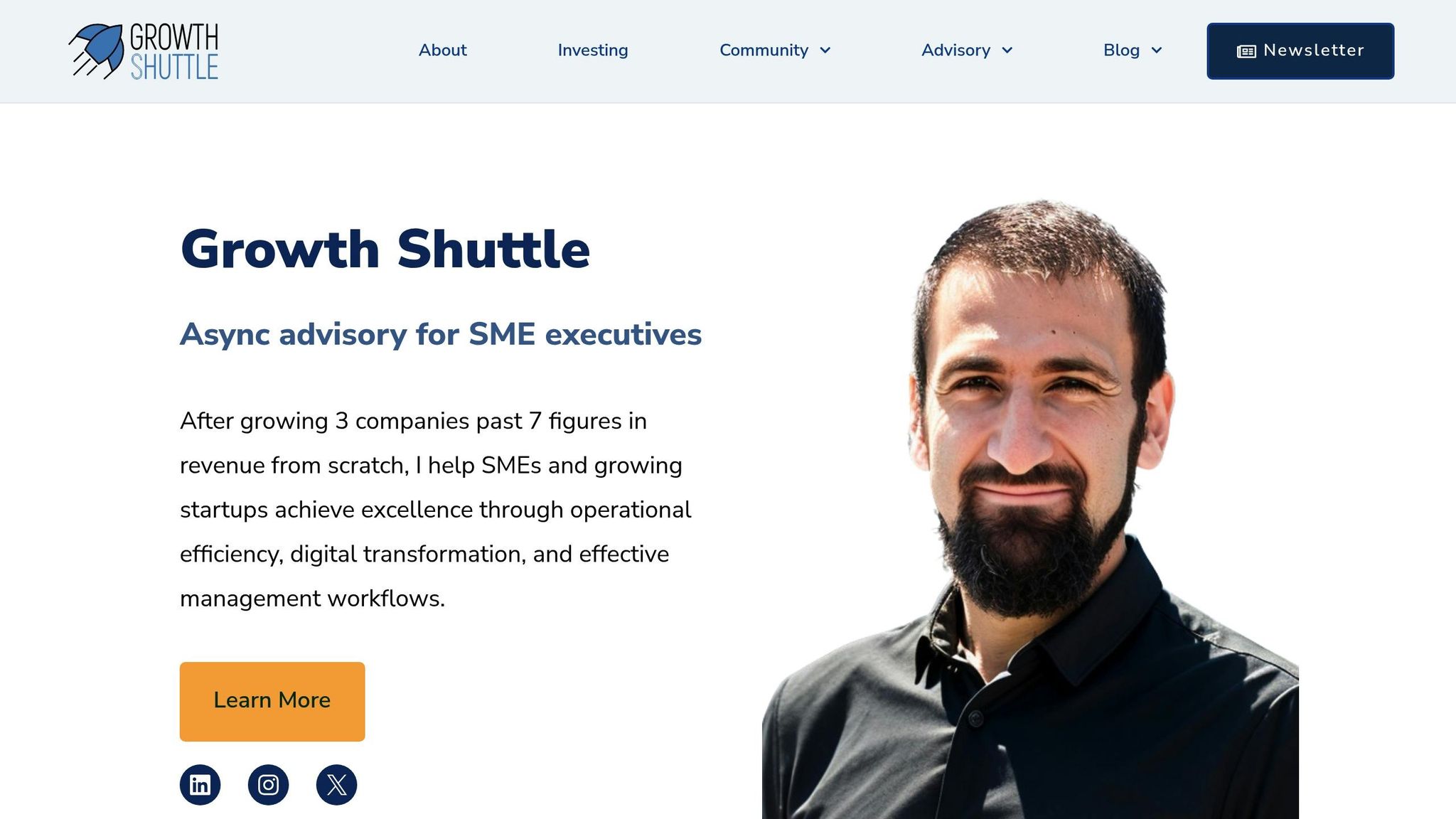
For SMEs managing teams of 15–40 people, balancing culture metrics with day-to-day operations can feel overwhelming. This is where strategic advisory support can make a real difference, particularly for CEOs navigating digital transformation and process improvements that align with culture measurement strategies.
Growth Shuttle offers tailored advisory services designed to support business leaders. Their plans are structured to provide ongoing guidance, focusing on operational efficiency and management workflows that help track culture metrics systematically.
- Strategy plan ($1,800/month): Includes tools and frameworks for implementing culture measurement strategies, along with brand representation support and ongoing communication via email and Slack to keep cultural initiatives on track.
- Growth plan ($7,500/month): Offers weekly calls and meetings, along with training on culture measurement frameworks, ensuring alignment across departments with overall business goals.
- Direction plan ($600/month): Ideal for SMEs just starting their culture measurement journey, this plan provides guidance on setting up frameworks and prioritizing metrics that align with business objectives.
An external perspective from experienced advisors like Mario Peshev, Growth Shuttle’s CEO, can help SMEs identify the most relevant metrics for their industry and growth stage. By focusing on digital transformation and efficient processes, Growth Shuttle helps businesses establish the systems needed to consistently collect, analyze, and act on culture metrics. Whether your organization is just starting out or aiming for broader transformation, these advisory services offer a structured approach to building a strong, measurable company culture.
Conclusion: Connecting Culture and Business Success
The link between a thriving workplace culture and business success is undeniable. Companies with engaged employees outperform their competitors by a staggering 147% in earnings per share. Those that align their culture with their goals see a 30% boost in employee performance and a 20% jump in revenue growth. Additionally, organizations that prioritize culture report up to 30% higher levels of innovation. Executives leading companies with exceptionally healthy cultures are 1.5 times more likely to achieve revenue growth exceeding 15% over three years. These numbers highlight why culture should be a core element of strategic business planning.
Cultural transformation isn’t an overnight process – it often takes three to five years to see measurable results. However, the benefits are well worth the effort. Employees in positive workplace cultures are nearly four times more likely to stay with their employer. Engaged employees also experience 41% lower absenteeism and deliver 17% higher performance. These metrics underline the importance of tracking cultural initiatives to turn them into tangible outcomes.
To achieve this, businesses should monitor both quantitative metrics – like turnover rates and productivity – and qualitative insights from employee feedback and engagement surveys. This dual approach provides a clear roadmap for sustainable growth. As Dieter Veldsman, Chief Scientist at AIHR, puts it:
"Culture is a living, breathing thing that changes and moves over time. It’s crucial for leaders to keep their eyes on the pulse and heartbeat of organizational culture, proactively monitoring it to see whether it’s enabling or inhibiting organizational progress."
The most successful small and medium-sized enterprises (SMEs) recognize the inseparable bond between culture and performance. They invest in leadership development, robust measurement systems, and frameworks that cultivate an environment where employees can excel – and where strong business outcomes naturally follow.
FAQs
How can small and medium businesses align culture change metrics with their business goals?
Small and medium businesses can tie culture change metrics to their business goals by focusing on key performance indicators (KPIs) that directly connect to their objectives. Examples of these KPIs might include employee engagement levels, retention rates, overall productivity, and the effectiveness of internal communication. Keeping track of these metrics regularly helps ensure that cultural efforts lead to tangible business results.
To gain a clearer picture, companies can leverage tools like cultural assessments and sentiment analysis. These tools provide valuable data, enabling businesses to evaluate their progress and make informed adjustments. Aligning cultural metrics with strategic goals not only boosts operational performance but also sets the stage for sustained success.
How can organizations effectively measure the qualitative aspects of workplace culture?
Understanding workplace culture requires blending both numbers and narratives. To get a clear picture, businesses often rely on tools like employee surveys, focus groups, and pulse surveys for quick, real-time feedback. These methods help capture the thoughts and feelings of employees in a structured way.
Beyond surveys, observing daily interactions and tracking metrics like employee engagement scores or Net Promoter Scores (NPS) can reveal trends and areas that need attention. Exit interviews also provide a goldmine of insights, shedding light on why employees leave and what might be improved. For a deeper dive, ethnographic research – studying workplace behaviors and dynamics – can uncover subtler patterns.
By weaving together these approaches, organizations can get a fuller understanding of their culture and how it influences both employee happiness and overall performance.
How does the Competing Values Framework (CVF) support tracking cultural transformation within an organization?
The Competing Values Framework (CVF) serves as a practical tool for analyzing and monitoring an organization’s culture over time. By presenting cultural elements in a visual and measurable format, it allows leaders to pinpoint changes, measure progress, and ensure that cultural shifts align with the company’s objectives.
With this framework, organizations can regularly evaluate their culture, making sure that any changes are guided by data and focused on specific goals. These insights empower leaders to make strategic adjustments that boost productivity, improve employee retention, and elevate overall performance.