When your team grows from 50 to 500 employees, informal processes break down. Scaling requires structured frameworks to keep goals clear, performance measurable, and communication effective. Here’s what you need to know:
- Why Frameworks Matter: High-performing employees can be 400–800% more productive than average, but without systems, top talent can be overlooked. Frameworks align strategy with daily goals and prevent inefficiencies as teams grow.
- Popular Frameworks:
- Balanced Scorecard: Focuses on financial, customer, internal processes, and growth metrics.
- OKRs: Encourages ambitious goals with measurable results, ideal for fast-moving environments.
- MBO: Prioritizes individual accountability with clear, measurable objectives.
- Performance Tracking Essentials: Use clear KPIs, centralized data, and automated reporting to monitor progress. Avoid vanity metrics and focus on actionable insights.
- Key Tools: Platforms like Salesforce, Google Analytics, and Power BI streamline data tracking and decision-making.
Start small, test with a pilot group, and scale frameworks gradually to ensure alignment and avoid chaos. A structured approach ensures that as your team grows, your goals stay on track.
How Skyscanner Scales Performance Monitoring (and What You Can Learn) | @perfology
Scaling Frameworks: Selecting the Right Method
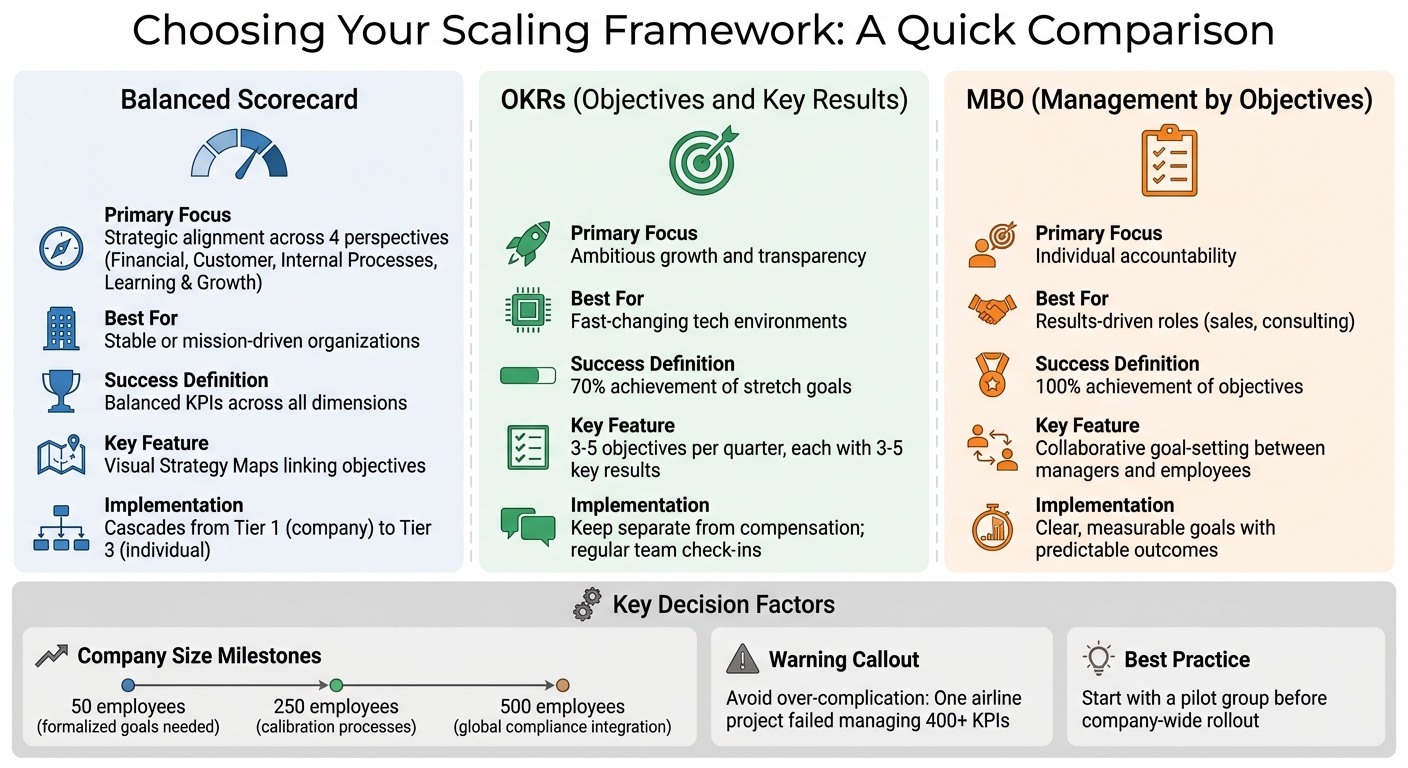
Comparison of Scaling Frameworks: Balanced Scorecard vs OKRs vs MBO
Picking the right framework for scaling depends on your company’s operating model, team dynamics, and stage of growth. A fast-paced tech startup rolling out features every quarter will need a very different approach compared to a consulting firm focused on billable hours and client outcomes.
Three commonly used frameworks during scaling are Balanced Scorecard, OKRs, and MBO. Each offers a unique way to manage growth:
- Balanced Scorecard: Ideal for translating big-picture vision into daily operations across four key areas.
- OKRs: Suited for dynamic environments where transparency and ambitious goals are essential.
- MBO: Works best when accountability and measurable results are top priorities.
When choosing, simpler is better. Overcomplicating things can backfire - like an airline project that failed due to juggling over 400 KPIs. Your framework should also discourage "gaming the system." For example, cutting repair costs by outsourcing may temporarily improve metrics but could lead to longer downtimes.
Timing is another critical factor. At around 50 employees, formalized goal cycles become necessary. By 250, calibration processes and competency libraries should be in place. Once you hit 500, you’ll need to integrate performance management with global compliance and compensation systems. Start small - test with a pilot group before rolling it out company-wide. And don’t forget to define what success looks like before committing to any framework.
Balanced Scorecard Framework
The Balanced Scorecard is like a dashboard for your business, focusing on four key perspectives: Financial, Customer, Internal Processes, and Learning & Growth. Instead of focusing solely on revenue, it balances internal operations, customer satisfaction, and team development to ensure long-term financial health.
"The Balanced Scorecard is not just a tool; it's a strategic management system that translates an organization's mission and vision into tangible objectives." - Growth Shuttle
This framework uses visual Strategy Maps to link objectives across these perspectives, helping employees clearly see how their work contributes to overall goals. It cascades from high-level company objectives (Tier 1) down to individual action plans (Tier 3), making it especially useful for connecting executive vision with day-to-day execution.
Balanced Scorecard works well for stable or mission-focused organizations. Private companies often prioritize financial outcomes, while non-profits or public sector organizations may emphasize stakeholder satisfaction or mission impact. However, forcing every department to fill out all four perspectives can lead to artificial metrics that erode trust.
Objectives and Key Results (OKRs)
OKRs combine bold, qualitative objectives with measurable key results. This framework encourages setting ambitious "moonshot" goals, where hitting 70–80% completion is considered a success - achieving 100% often means the goals weren’t challenging enough. Google famously used OKRs during its hyper-growth phase to maintain focus and transparency across teams.
"Ideas are easy. Execution is everything." - John Doerr, Venture Capitalist
OKRs cascade from company-level goals to individual teams, ensuring alignment across the organization. To avoid distractions, limit yourself to 3–5 objectives per quarter, each with 3–5 key results. A critical rule: keep OKRs separate from compensation and performance reviews. Tying pay to OKRs can discourage risk-taking, as employees may aim for safe, easily achievable goals. Regular team check-ins and monthly reviews help keep the process dynamic and prevent it from becoming a "set it and forget it" exercise.
Management by Objectives (MBO)
MBO emphasizes clear, measurable goals defined collaboratively by managers and employees. It’s all about individual accountability, making it a great fit for industries like sales, consulting, or project-based work. Unlike OKRs, MBO focuses on achieving 100% of agreed-upon goals, which is ideal for roles requiring predictable, measurable outcomes.
For example, a sales team might set quarterly revenue targets, client acquisition goals, and activity metrics. A consulting team might focus on project completion rates, client satisfaction scores, and billable hours. While the collaborative process fosters buy-in, it requires discipline to avoid setting goals that are too easy or disconnected from broader business objectives.
| Framework | Primary Focus | Best For | Success Definition |
|---|---|---|---|
| Balanced Scorecard | Strategic alignment across 4 perspectives | Stable or mission-driven organizations | Balanced KPIs across all dimensions |
| OKRs | Ambitious growth and transparency | Fast-changing tech environments | 70% achievement of stretch goals |
| MBO | Individual accountability | Results-driven roles (sales, consulting) | 100% achievement of objectives |
Performance Tracking: Creating Effective Measurement Systems
Building a performance tracking system that truly delivers results is essential. Consider this: nearly 50% of small businesses fail within five years, often due to inadequate performance monitoring. The ability to measure progress effectively and act on insights often separates thriving companies from those that struggle to grow.
A reliable tracking system rests on three main pillars: clear KPIs, centralized data, and automated reporting. Start by defining success metrics for every objective and identifying the numbers that reflect your progress. Use a standardized data definition table to ensure consistency in metric calculations across all reporting periods.
Establish regular performance reviews, such as weekly one-on-ones and quarterly check-ins, and integrate these processes into compensation and compliance systems as your company expands. Data-driven businesses tend to outperform competitors, achieving 6% higher profitability and 5% greater productivity - but only when they track the right metrics.
Avoid the chaos of "tool sprawl" by choosing a scalable system that integrates seamlessly with your existing HRIS, CRM, and accounting platforms. This creates a single source of truth, eliminating the need for scattered spreadsheets. For example, United Way Northwest Indiana saved 80 hours monthly and around $20,000 annually by automating marketing performance tracking.
Combine hard data with qualitative insights for a fuller picture. Financial metrics and productivity data reveal what is happening, while tools like employee pulse surveys and Net Promoter Scores provide the why. Companies that focus on 15 or fewer KPIs make decisions 3.2x faster than those tracking 40+ metrics.
Key Performance Indicators (KPIs)
Scaling a business requires evolving KPIs to match its growth stage. For startups, metrics like WAU/MAU (Weekly Active Users/Monthly Active Users) focus on product-market fit. As companies grow, they shift to efficiency metrics like the Rule of 40 - where revenue growth rate plus profit margin should exceed 40%, a key benchmark for SaaS companies.
"The most successful CEOs track fewer metrics, not more. The difference between a struggling startup and a unicorn isn't the quantity of data they monitor - it's the precision of their metric selection." - Darren, CFO IQ
Every KPI should answer this question: What decision does this enable? If a metric, such as total page views, doesn’t guide actionable decisions, it’s likely a vanity metric and should be excluded.
Use the SMART framework to define KPIs: Specific, Measurable, Achievable, Relevant, and Time-bound. For instance, replace vague goals like "improve customer loyalty" with something precise like "increase gross retention from 88% to 92% by Q4". This clarity ensures accountability and easier progress tracking.
Balance leading indicators (predict future performance) with lagging indicators (reflect past outcomes). Aim for 70% leading indicators and 30% lagging indicators on dashboards. For example, qualified pipeline value (leading) predicts closed revenue (lagging), while product engagement scores (leading) help forecast churn rates.
Consider Tradezella, a trading habit platform, which automated data flows into BigQuery and Google Sheets. By defining funnel stages and tracking leading indicators, they reactivated 2.5x more users in one month and improved signup activation rates from 28% to 65%.
| Metric Category | Key KPI Examples | Typical Benchmark |
|---|---|---|
| Financial | Gross Profit Margin, Operating Cash Flow | 20–60% Gross Margin (varies) |
| Customer | Net Promoter Score (NPS), Churn Rate | NPS 30+ is good; Churn <5% for SaaS |
| Marketing | Customer Acquisition Cost (CAC), ROAS | CAC should be < 1/3 of Lifetime Value |
| Sales | Sales Growth, Sales Cycle Length | 10–20% YoY growth for scaling firms |
| Employee | eNPS, Revenue per Employee | eNPS 30+ is healthy; $100k-$300k/employee |
Retention metrics are particularly crucial. Increasing customer retention by just 5% can boost profits by 25% to 95%. For sustainable growth, aim for a Customer Lifetime Value (LTV) that’s at least 3x your Customer Acquisition Cost (CAC). Returning customers also spend 67% more on average than first-time buyers, making retention a key driver of profitability.
Technology and Tools for Performance Management
Once your KPIs are set, the next step is adopting tools to automate and visualize them. Manual spreadsheets may suffice early on, but they lack scalability. Growing teams need platforms that automate data collection, centralize reporting, and provide real-time insights. Tools like Coupler.io unify data from finance systems (QuickBooks), CRMs (HubSpot, Salesforce), and marketing platforms (Google Analytics) into a single dashboard.
"You can't improve what you don't measure. Without a clear view of how each part of your business is performing, you're essentially steering without a compass." - Coupler.io
Choose tools tailored to your needs:
- Financial tracking: QuickBooks, Xero
- Sales and CRM: Pipedrive, Salesforce
- Operations and productivity: Clockify, Asana
Automating data integration saves time and ensures accuracy. Instead of manually copying data, set up connectors that refresh every 15 minutes. This can save mid-sized organizations up to 80 hours per month. Dashboards like Looker Studio or Power BI provide real-time insights while reducing manual effort.
Consistency is critical. Standardize KPI definitions across departments to avoid conflicting reports. Misaligned metrics can lead to costly errors, and U.S. companies lose around $75 billion annually due to untracked performance gaps.
To address these challenges, many businesses turn to fractional Revenue Operations (RevOps) experts, who implement enterprise-grade tools without the cost of full-time executive hires. The right tech stack doesn’t just improve efficiency - it prevents costly blind spots and sets the foundation for long-term growth.
sbb-itb-c53a83b
Implementing Frameworks for Long-Term Success
Choosing the right framework depends on your company’s growth stage, product complexity, target audience, and sales strategy. Many companies opt for a hybrid approach - offering self-service options for smaller accounts while using sales engagement to target larger opportunities.
For example, frameworks like OKRs thrive in fast-moving tech spaces by promoting innovation and openness. On the other hand, MBOs work well in environments where individual accountability is key. For remote teams or those navigating constant change, continuous performance management ensures timely adjustments. The key is to align the framework with your operational needs and realities, ensuring it supports your business goals effectively.
Framework Selection Based on Business Needs
As your company grows, your performance systems should adapt. Smaller teams might focus on formalizing goals, but as you scale to 500 employees, you’ll need to incorporate more complex elements like compensation planning and compliance. This evolution ensures your operations remain agile and measurable.
The 7 Pillars of Scaling - covering Sales, Continuous Delivery, Agility, Finance, Organizational Design, Talent, and Product - offers a holistic approach. Instead of isolated fixes, this methodology integrates seamlessly with frameworks to address scaling challenges. Implement changes in focused 90-day cycles, delivering quick wins while tackling bottlenecks that limit growth. Communication plays a central role here: daily huddles for tactical updates, weekly meetings for team coordination, and monthly reviews for strategic planning.
For teams of 15–40 people needing support with digital transformation or go-to-market strategies, Growth Shuttle provides asynchronous advisory services. Plans start at $1,800 per month for standard options, with mid-market advisory priced at $2,100 per month (discounted from $3,500).
Overcoming Implementation Challenges
Selecting a framework is only the first step - smooth implementation is the real challenge. Start by auditing your existing tools, data workflows, and handoffs to identify inefficiencies or redundancies. Launch the framework with a small, representative group to gather feedback and refine it before rolling it out company-wide.
"Meeting Luca was providential. He enabled us to immediately apply the OKR methodology effectively and reach full adoption in just a few quarters." - Andrea Di Vincenzo, CEO of Prestiter
Centralize your systems into a single data source with standardized naming conventions and strong governance practices. Companies that use predictive capacity models experience 28% higher operational reliability during growth phases compared to those relying on static planning.
Automation is crucial for scaling. Repetitive, rule-based tasks - like lead routing, renewal alerts, or data entry - should be automated. Instead of creating one-off integrations, standardize APIs to maintain flexibility as you add or replace tools.
Finally, invest in training managers to reduce biases and improve coaching skills. This ensures fair performance evaluations, which are critical as teams expand. Without proper training, even the most well-designed framework can fail during execution.
For companies not ready to hire full-time executives, fractional RevOps or advisory roles offer a cost-effective way to establish strong foundational processes before scaling up.
Conclusion: Driving Growth With Frameworks and Performance Tracking
Scaling without structure often leads to failure. In fact, two-thirds of the fastest-growing companies fall short because they lack strategies that can support sustainable growth. The key to avoiding this pitfall lies in adopting frameworks and performance tracking - tools that act as your organization's operating system, guiding decisions even when leadership can't oversee every detail. This is why having a solid framework is essential for long-term growth.
Frameworks like OKRs, the Balanced Scorecard, and MBO provide the structure needed to maintain operational efficiency as your business evolves from a small team to a larger enterprise. These systems help ensure that revenue grows faster than costs - a critical marker of successful scaling. Without them, companies often find themselves adding headcount at a pace that outstrips revenue growth, damaging their unit economics.
"A well-run system aligns everyone to company priorities, raises engagement through clear expectations and coaching, improves retention by linking growth, feedback, and recognition, and enables fair, consistent decisions on pay, promotion, and mobility." - Lorelei Trisca, Content Marketing Manager, Deel
Strong unit economics are non-negotiable. For SaaS companies, this means aiming for a Gross Margin of 70% or more and an LTV/CAC ratio of at least 3:1 before scaling further. Once these basics are in place, the right frameworks ensure that growth goes hand-in-hand with operational stability.
Begin by testing a framework with a small, representative team. Gather feedback, refine the approach, and automate repetitive tasks wherever possible. And always keep in mind: the true measure of your company’s culture is how employees act when no one is watching. A well-chosen framework weaves that culture into everyday operations, turning small wins into scalable, lasting success. Structured strategies like these lay the groundwork for sustained growth and operational excellence.
FAQs
How can I select the best framework to support my company's growth and performance goals?
Finding the right framework for your business begins with clearly understanding your goals, current growth stage, and the challenges you face. Start by evaluating your strengths and pinpointing areas that need improvement - whether it’s simplifying workflows, boosting team accountability, or ensuring your strategy aligns with day-to-day execution.
Think about how fast your business is growing and the complexity of that growth. For companies scaling at a rapid pace, agile frameworks can help you stay flexible and track progress efficiently. On the other hand, if your focus is on broader strategic goals, such as improving operational efficiency or managing resources better, you might benefit from frameworks designed specifically for small to mid-sized businesses. The key is selecting a framework that matches your vision, supports steady growth, and keeps your performance on track.
What are the biggest challenges when setting up performance tracking systems?
Setting up performance tracking systems can come with its fair share of hurdles. One major obstacle is unclear metrics. When metrics aren't well-defined, it becomes tough to gauge actual performance, leading to inconsistent evaluations. This confusion not only hampers decision-making but can also leave employees feeling frustrated and undervalued.
Another issue is bias in evaluations, which can stem from either intentional or unconscious behaviors. Such bias can erode trust, dampen motivation, and hurt overall engagement by creating a sense of unfairness among employees.
There's also resistance to change, which can emerge from both employees and management. This hesitation often slows down the adoption process, resulting in incomplete or uneven data collection. On top of that, tracking the wrong metrics - like emphasizing output over quality or impact - can steer the system in the wrong direction. Finally, neglecting to provide consistent feedback or proper training for managers can undermine the entire process.
Tackling these challenges early is key to creating a performance tracking system that is not only reliable but also encourages growth and motivation.
How can I make sure my KPIs are driving smart business decisions?
To make sure your KPIs truly support smart business decisions, focus on picking metrics that are relevant, measurable, and closely tied to your strategic objectives. Opt for KPIs that offer actionable insights - like customer retention rates or revenue growth - so you can prioritize effectively and adjust operations as needed.
Create a well-structured KPI framework that links your company’s overall vision to specific team-level goals. This ensures seamless tracking and enables continuous feedback loops. Tools like mobile-friendly dashboards can make it easier to monitor performance in real time and respond quickly. Regular reviews and updates to your KPIs are essential to keep pace with shifting market conditions and long-term objectives, helping to nurture a data-driven mindset across your organization.


