Transparency builds trust, lowers risks, and improves funding opportunities for businesses. By sharing clear, honest updates on finances and operations, companies can strengthen investor relationships and reduce speculation. Transparency is especially important for small and medium-sized enterprises (SMEs), which often face skepticism due to limited public records.
Key takeaways:
- Companies with strong investor communication are 40% more likely to secure follow-on funding.
- Transparent financial reporting reduces stock volatility and increases confidence during market stress.
- Regular updates and real-time data access help investors make informed decisions, improving long-term partnerships.
- ESG disclosures and governance transparency attract investors, with 93% prioritizing reliable, integrated reporting.
To implement transparency:
- Use real-time reporting tools for metrics like cash flow and churn.
- Share governance details and strategic updates openly.
- Seek advisory services to automate reporting and improve communication systems.
Transparency isn’t just about compliance - it’s a practical way to build stronger investor relationships and achieve sustainable growth.
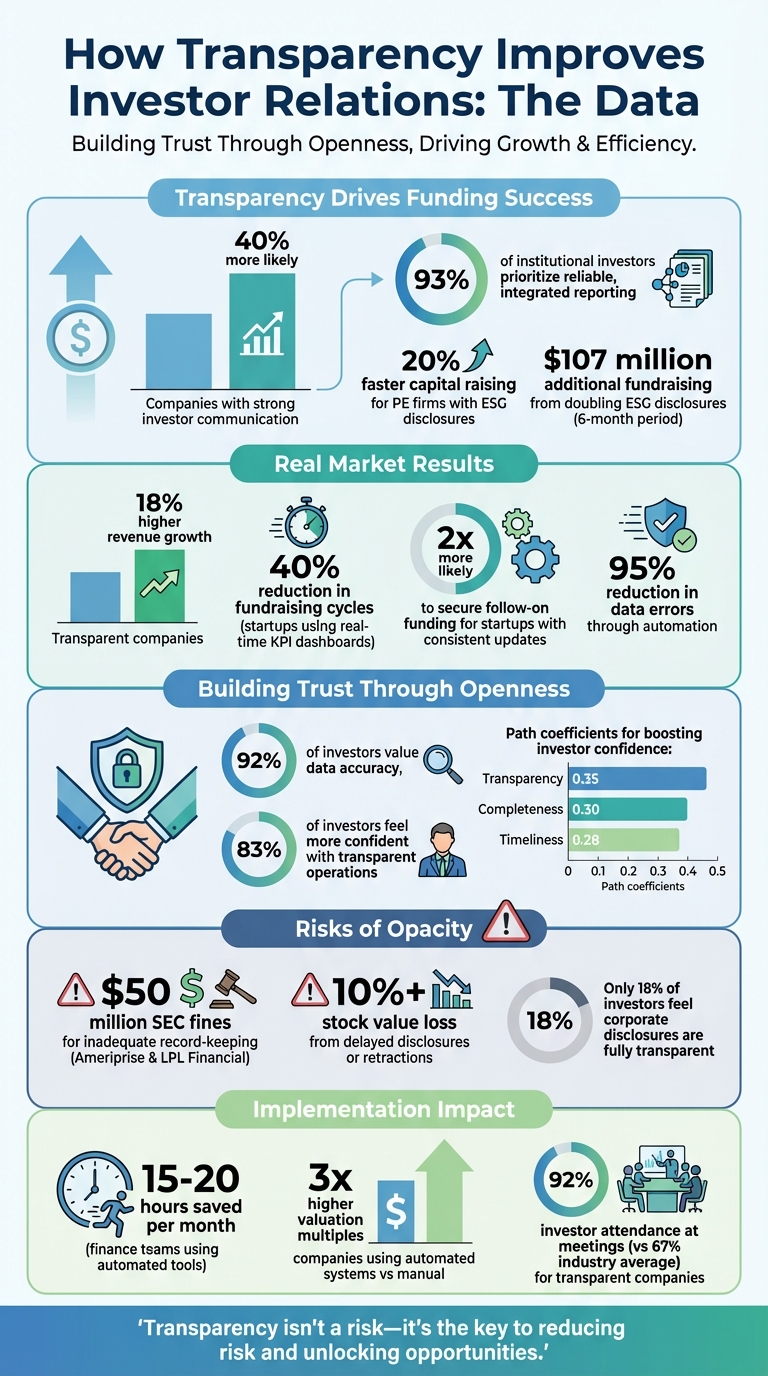
How Transparency Impacts Investor Relations: Key Statistics and Benefits
How Transparency Affects Investor Trust: What Research Shows
Major Studies on Transparency Benefits
Research highlights transparency as a cornerstone for building investor confidence. A 2024 study involving 142 investors and analysts revealed that transparency had a path coefficient of 0.35 for boosting investor confidence. This outpaced other factors like completeness (0.30) and timeliness (0.28). These results align with global market trends.
"Financial reporting transparency impacts investor decisions. It boosts confidence, reduces information gaps, enhances stock liquidity, and encourages long-term investments." - Mahesh Yoro, Researcher
The effects are evident in real-world markets. For instance, Kenya's stock market saw a 12% average annual increase in trading volume between 2017 and 2022, a period marked by regulatory reforms that improved disclosure standards. Similarly, India's National Stock Exchange experienced a 23% jump in trading volumes during the same timeframe, partly due to better access to transparent financial data. In the United States, stock trading volume grew by 8% annually from 2014 to 2019, driven by improved information accessibility through technology.
Private equity firms that focus on ESG-related disclosures also see notable benefits. They raise capital about 20% faster than firms with lower levels of transparency. Doubling ESG disclosures on a company's website can result in an additional $107 million in fundraising over a six-month period. Furthermore, 93% of institutional investors are more inclined to invest in companies offering assured integrated reporting - combining financial and non-financial data verified by third parties.
Data on Investor Outcomes
Market data further underscores the advantages of transparency. Companies that prioritize clear financial reporting often experience reduced stock price volatility. For example, South Africa's Johannesburg Stock Exchange reported an average volatility of 20% from 2017 to 2022, compared to Brazil's 25% during the same period, showcasing the stabilizing effect of transparency. During the COVID-19 pandemic, Japan's stock price volatility increased by 15%, highlighting how transparency can help mitigate market stress.
On the flip side, poor transparency can lead to steep consequences. In August 2024, the SEC fined Ameriprise Financial Services and LPL Financial $50 million each for inadequate record-keeping, resulting in immediate declines in their stock values. Similarly, Charles Schwab faced a $10 million SEC penalty in January 2025 for record-keeping issues, which also led to a drop in its stock price. Companies that delay disclosures or issue retractions risk losing over 10% in stock value.
"Investor reporting is where trust either compounds or quietly erodes... great reporting buys you confidence when markets are calm and grace when they are not." - Sagar Agrawal, Qubit Capital
Transparency also benefits smaller companies. Small and medium enterprises (SMEs) with detailed sustainability reporting enjoy higher Return on Assets (ROA) and greater operational efficiency compared to their peers with minimal disclosures. Additionally, over two-thirds of investors prioritize socially responsible investments, with 25% exclusively investing in companies that align with their values. Transparency not only helps avoid losses but actively drives stronger financial performance, cementing its role as a strategic tool for maintaining strong investor relationships.
sbb-itb-c53a83b
How Transparency Strengthens Investor Relationships
Reducing Information Gaps
Being upfront about financial and operational data bridges the information divide between insiders and external stakeholders, cutting down on speculation and uncertainty. By sharing key details, companies create a more level playing field, which fosters trust among investors.
Clear and detailed reporting also connects current decisions to future strategies, helping stakeholders evaluate risks and opportunities with greater confidence. For example, Fidelis Private Fund openly shares its 60% average loan-to-value (LTV) ratio to emphasize its focus on risk management.
"Transparency transforms uncertainty into informed anticipation rather than concern." - Michael Christopher Venturino, Financial Professional
This openness builds what some refer to as a "trust moat" - a unique advantage that encourages investors to stick around, reinvest, and even recommend the company to others. Additionally, the shift toward real-time data access through tools like digital dashboards and portals addresses the growing demand for continuous updates, moving beyond the traditional quarterly reports. By committing to this level of transparency, companies not only keep investors informed but also strengthen their reputation for accountability.
Increasing Accountability and Credibility
Transparency also highlights ethical leadership and a willingness to take responsibility, which reassures investors and reduces perceived risks. When companies quickly acknowledge mistakes and outline solutions, they demonstrate a level of maturity that investors respect - often more than an illusion of perfection.
"Investors are far more forgiving of errors than of dishonesty." - Michael Christopher Venturino, Financial Professional
From a business perspective, high-quality companies use transparency as a way to set themselves apart from less reliable competitors. This practice, known as "signaling value", reduces investment uncertainty and often leads to better financing terms. It also aligns expectations between companies and their investors, reducing the likelihood of misunderstandings about goals, timelines, or returns.
Younger investors, particularly Millennials and Gen Z, place a high value on authenticity and ethical practices alongside financial results. Companies that openly address both financial and non-financial factors, such as ESG (Environmental, Social, and Governance) metrics, are better positioned to attract this growing demographic. By doing so, they create stronger, more resilient investor relationships that can weather market fluctuations.
How SMEs Can Implement Transparency
Setting Up Real-Time Reporting Systems
Shifting from quarterly reports to real-time data access transforms how investors interact with your business. The first step? Integrate your accounting software, CRM, and payment systems into a single FP&A platform. This eliminates manual errors and creates what finance teams call a "single source of truth."
The benefits are hard to ignore: startups that provide consistent investor updates are twice as likely to secure follow-on funding, and those using real-time KPI dashboards cut their fundraising cycles by 40%. Plus, automated tools reduce data errors by 95% and save finance teams 15–20 hours per month.
Focus on 5–7 key metrics that truly matter, like Monthly Recurring Revenue (MRR), burn rate, cash runway, Customer Acquisition Cost (CAC), and churn. Use interactive dashboards that let investors monitor these KPIs in real time. To build trust, stick to a predictable schedule - say, sending updates on the 10th of each month.
"A short update on time beats a long update that never gets sent." - Matt Preuss, Marketing Manager, Visible.vc
Each report should start with a concise executive summary: highlight 2–3 wins, mention 1–2 challenges, and share your current cash position. Include a clear "ask", whether it’s introductions to potential customers or feedback on a pricing strategy. This approach turns passive investors into active allies.
Transparency also extends beyond metrics - it includes clear ownership disclosures.
Disclosing Ownership Information
Governance transparency plays a crucial role in earning investor trust. Sharing ownership and governance details signals integrity and a commitment to accountability. While regulations like Sarbanes-Oxley and Dodd-Frank set baseline standards, going beyond these requirements shows investors you’re serious about transparency.
Be open about your decision-making processes, board oversight structure, and any material developments that could impact performance, such as strategic pivots or market challenges. This level of openness matters - 83% of investors feel more confident in companies with transparent operations. That confidence often translates into better investment terms and stronger relationships.
Take inspiration from Complete Controller’s "Open-Book Fridays." In 2023, they invited investors to explore their financial systems and hosted 90-minute "Ask Me Anything" sessions. The results? 92% investor attendance at meetings - well above the industry average of 67% - and $2.3 million raised despite a challenging market.
Using Advisory Services to Improve Transparency
Building these systems takes expertise, and SMEs often lack the resources to do it alone. This is where advisory services come in. They help automate workflows, deploy FP&A tools, and establish effective communication frameworks.
For instance, Growth Shuttle specializes in helping SMEs implement digital tools and improve operational efficiency. For teams of 15–40 people, advisory support can streamline the move from manual reporting to automated, real-time transparency. This includes integrating financial software, defining critical metrics, and setting up regular communication schedules to keep investors engaged.
The payoff is substantial: companies using automated systems often achieve valuation multiples three times higher than those sticking with manual processes. Advisors also prepare businesses for crises by scripting response strategies and running stress tests - steps that 83% of Series B+ investors now expect before negotiating term sheets. By tapping into expert advice, SMEs can create a transparent foundation that not only builds investor trust but also supports long-term growth.
Corporate Transparency Best Practices
Research Gaps and New Trends
While transparency has proven benefits, current research highlights some key gaps and trends that directly impact small and medium-sized enterprises (SMEs). Most existing studies focus on large, publicly traded companies in major markets like the U.S., China, and Singapore. This leaves SMEs - especially those with 15–40 employees - largely overlooked when it comes to tailored strategies for transparency during early growth stages or digital transformation. As a result, many SMEs lack relevant benchmarks or actionable advice, making it harder to adopt transparency practices that truly fit their needs.
Another issue lies in how transparency is perceived. Many companies still approach it as a compliance task rather than a strategic tool to strengthen investor relationships. For example, while 80% of companies engage with investors on a quarterly basis, only 18% of investors feel that corporate disclosures are fully transparent. There's also a disconnect in priorities: 25% of investors rank company strategy as their top concern, yet only 14% of corporations acknowledge this as a priority. This misalignment erodes trust, which is critical for the investor relationships discussed earlier.
On the trend front, climate finance transparency is reshaping investor expectations. By early 2026, 83% of investors are incorporating sustainability data into their financial decisions, and 85% of institutional investors express skepticism over corporate sustainability claims due to concerns about greenwashing. This has led companies to adopt third-party verification and detailed ESG (Environmental, Social, and Governance) disclosures to stand out as trustworthy.
Technology is also playing a big role in addressing transparency issues. AI tools like ClimateBERT and ESG-BERT are making it easier to analyze complex narratives, while blockchain technology ensures reliable, tamper-proof records. By early 2026, 54% of institutional investors view Generative AI as "important" or "very important" for investment research, and 84% believe it allows them to process more information while focusing on deeper, high-value analysis.
Future research should focus on SMEs and explore how tools like AI dashboards and blockchain can help close transparency gaps. These technologies hold the potential to not only improve reporting accuracy but also foster stronger investor engagement.
Conclusion: Transparency as a Business Advantage
Transparency can be a game-changer for businesses, especially when it comes to securing investor confidence and improving funding prospects. With 92% of investors valuing data accuracy and 93% more likely to invest in companies with reliable integrated reporting, open communication isn't just a nice-to-have - it's a critical factor for attracting capital and reducing funding costs.
For small and medium enterprises (SMEs), the streamlined nature of their operations makes adopting transparency more manageable. And the rewards are hard to ignore: transparent companies see 18% higher revenue growth and consistently achieve stronger market valuations. Beyond just numbers, transparency fosters genuine partnerships with investors, who often provide mentorship and strategic support during tough times.
"Transparency isn't a risk - it's the key to reducing risk and unlocking opportunities."
– Micheal Barker, Micheal's Arch
So, how can SMEs turn this concept into action? It starts with practical steps like embracing real-time reporting systems, maintaining regular communication, and being upfront about both wins and setbacks. Whether you're navigating a digital shift or refining your market approach, integrating transparency early can set the stage for smoother funding rounds and steady growth.
For those looking to take the leap, Growth Shuttle offers tailored advisory services to help SMEs move from basic compliance to a transparency-driven approach that builds trust and competitive strength. Start small - with monthly updates, clear financial summaries, and open investor calls - and build from there. By 2026, businesses that tackle challenges head-on with clarity and actionable plans will stand out, earning investor trust and paving the way for long-term success.
FAQs
How much transparency is too much?
Balancing transparency means finding the right mix between openness and strategic decision-making. While being transparent fosters trust and strengthens relationships with investors, sharing too much can backfire - revealing sensitive details or overwhelming stakeholders with excessive information. The key is to focus on providing updates that are relevant, accurate, and timely. This approach builds confidence without jeopardizing competitive edges. Align your communication with investor expectations and strategic objectives, ensuring it remains clear, consistent, and free from unnecessary details that might distract or create risks.
Which 5–7 KPIs should I share with investors?
Focus on KPIs that showcase your company’s financial health, efficiency, and growth trajectory. Some essential metrics to track and share include:
- MRR/ARR: Monthly and annual recurring revenue to demonstrate revenue consistency.
- Burn rate and cash runway: How fast you're spending cash and how long your funds will last.
- CAC/LTV: Customer acquisition cost compared to lifetime value, reflecting profitability per customer.
- Operational metrics: Indicators like user growth to highlight business momentum.
- Ownership concentration: The distribution of equity among stakeholders.
- Financial ratios: Metrics like EBITDA to provide insight into profitability and financial performance.
- Key milestones: Achievements such as product launches or market expansions.
Sharing these metrics promotes transparency and trust, helping strengthen relationships with investors and align them with your company’s vision. This openness can pave the way for future funding opportunities.
How can SMEs start real-time investor reporting fast?
SMEs can make investor reporting faster and more efficient by using AI-powered financial tools and digital platforms. These technologies help automate cash flow analysis and reporting, ensuring updates are accurate and delivered on time. By adopting a structured framework and utilizing readily available tools, businesses can cut down on manual work and communicate effectively with investors - without lengthy setup processes.


