Table of Contents
- Key Highlights
- Introduction
- Price Performance Analysis
- Factors Favoring Nabors Industries
- Pressures Impacting Nabors Industries’ Stock
- Final Verdict on NBR Stock
Key Highlights
- Nabors Industries has experienced a significant decline of 56.7% in stock price over the past year, drastically underperforming its peers.
- Despite financial struggles, the company reported strong revenue growth, driven by operational performance and the successful integration of recent acquisitions.
- Investors face a mixed scenario characterized by ongoing net losses and heavy debt, making careful assessment crucial for future strategies.
Introduction
Nabors Industries Ltd. has established itself as a formidable player in the drilling and drilling-related services sector, providing solutions for both onshore and offshore oil and gas wells. Rooted in advanced technologies and a diverse service portfolio, the Hamilton-based company encounters a complex landscape influenced by fluctuating oil prices, changing regulations, and evolving market dynamics. Recent challenges, notably a steep decline in share price, have prompted investors to reassess the viability of holding or acquiring stock in this established leader. This article delves into Nabors’ current performance, financial health, and strategic initiatives to determine the best investment approach going forward.
Price Performance Analysis
An evaluation of Nabors Industries’ stock performance reveals a sobering narrative. Over the last year, Nabors’s shares plummeted by 56.7%, starkly contrasting with the 34.4% drop of the broader Oil & Gas Drilling sub-industry and the mere 0.4% dip in the overall oil and energy sector. When compared to its peers like Precision Drilling Corporation and Helmerich & Payne, the stock underperformance shines through, necessitating a closer examination of the underlying causes.
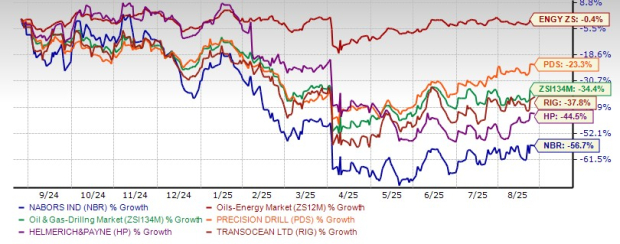
Image Source: Zacks Investment Research
In light of these conditions, the Zacks Consensus Estimate indicates that while Nabors is expected to narrow its losses in 2025—from $20.28 per share last year to projected losses of $4.18—the estimates for revenues have also turned positive, with expectations for a 10.6% year-over-year increase to $3.2 billion. The contrasting outlook against other industry players underscores both the challenges and potential recovery paths available for investors.
Factors Favoring Nabors Industries
Strong Revenue Growth
Nabors Industries showcased resilience by reporting operating revenues of $833 million in Q2 2025, an increase from $735 million the same quarter the prior year. The uptick can be attributed to enhanced rig deployments and a surge in international drilling operations. These trends reflect the company's ability to effectively capitalize on various market opportunities, thereby boosting confidence among investors.
Strategic Partnerships: The SANAD Joint Venture
A notable driving force behind Nabors' potential growth is the SANAD joint venture with Saudi Aramco, recognized for its long-term benefits. The addition of two new rigs in Saudi Arabia, bringing the fleet to 12, demonstrates the robust nature of this strategic alliance. The awarding of additional rigs promises to enhance revenue predictability and stability throughout the coming years, making Nabors a key player in a volatile but strategically significant region.
Integration of Parker Wellbore Acquisition
Nabors' acquisition of Parker Wellbore in March 2025 has proven profitable faster than anticipated, positively impacting margins and cash flow metrics. The enhanced capabilities from Parker's technologies and services, particularly in areas like Alaska and the Gulf of Mexico, have amplified Nabors’ global reach and strategic positioning. With early successes in the integration process, Nabors has projected considerable synergies, laying a promising foundation for future performance.
Technological Advancements and Milestones
The company's innovative drive is evident in the record-setting performance of its PACE series rigs across various basins in the U.S. Notable achievements, including a four-mile lateral drilling in the Bakken and the longest Eagle Ford well at over 32,500 feet, exhibit Nabors’ technological leadership and dedication to efficiency. Such accomplishments not only address client needs for operational improvement but also establish Nabors as a preferred choice within the industry, strengthening its competitive edge.
Pressures Impacting Nabors Industries’ Stock
Ongoing Net Losses
Despite operational successes, Nabors has been unable to translate revenue gains into net income, reporting an adjusted loss of $6.67 per share by year-end 2024, and further losses in subsequent quarters. This trend raises concerns regarding the efficacy of cost management strategies and the potential for future capital investment, casting a shadow over its attractiveness as a long-term investment.
High Debt Levels
The company's long-term debt reached $2.7 billion as of June 30, 2025, which constitutes a staggering 80.7% of its total capital. This high debt level significantly increases risk, especially with interest expenses of approximately $56 million for Q2 2025. Although Nabors' management pursues refinancing options and has recently divested its Quail Tools business to alleviate debt, the implications of such financial pressure remain an ongoing concern for cautious investors.
Challenges in the Lower 48 Rig Market
While Nabors has stabilized its rig count in the Lower 48, it faces margin pressures due to reduced demand and pricing competition in oil-focused operations. Management forecasts a decrease in daily adjusted gross margins amid lower oil activity, raising alarms regarding the company’s near-term growth potential. Comparatively, peers like Helmerich & Payne show stronger performance metrics, highlighting Nabors’ vulnerabilities within this critical segment of the market.
Capital-Intensive Growth Approach
Nabors' aggressive capital expenditure plan for 2025 — estimated between $700-$710 million — adds further strain on its cash flow and increases execution risks. Although these investments are designed for long-term growth, they pose challenges in maintaining liquidity, particularly if anticipated revenues from the SANAD joint venture or other projects are delayed.
Final Verdict on NBR Stock
Nabors Industries presents investors with a dual-edged perspective characterized by some positive indicators amid a backdrop of persistent challenges. The company's strong revenue growth, competitive position bolstered through strategic acquisitions, and investments in their technology infrastructure are promising. Yet, these positives are tempered by the liabilities posed by ongoing losses, high debt levels, and pressures in essential markets.
As a result, the prevailing recommendation is to adopt a cautious stance, suggesting that investors hold their positions to closely evaluate Nabors’ management of debts and operational performance. While the significant downside may already be reflected in current share prices, future gains hinge upon improved execution of strategic initiatives and capital management.
FAQ
What is the current financial outlook for Nabors Industries?
Nabors is expected to narrow its losses in 2025, with revenue forecasts indicating a 10.6% growth. However, ongoing debt management and operational efficiency will be pivotal in shaping the company’s financial trajectory.
How does Nabors compare to its competitors in the drilling industry?
While Nabors has recently struggled with a significant stock price decline, other companies like Helmerich & Payne and Transocean display stronger performance metrics, pointing to Nabors' need for strategic improvement to regain competitive ground.
What strategic moves has Nabors Industries recently made?
Nabors has made significant strides with the SANAD joint venture and the integration of Parker Wellbore, both of which are expected to enhance its market presence and financial stability in the long run.
Are there risks associated with investing in Nabors Industries?
Yes, risks include persistent net losses, heavy debt, and pressures in the Lower 48 rig market, which could impact financial flexibility and future growth potential.
What should investors look out for regarding Nabors’ shares?
Investors should monitor Nabors’ debt reduction strategies, progress in operational efficiency, and developments within strategic partnerships, as these factors will play a crucial role in the company’s ability to enhance shareholder value over time.


