
Most process change problems start with one mix-up: power and burden are not the same thing. In plain terms, influence is who can approve, delay, fund, or block the change. Impact is who has to change how they work each day.
If I were boiling this article down to the part that matters most, it would be this:
- Use two separate scores for each stakeholder: one for influence, one for impact
- High influence stakeholders need alignment, decision checkpoints, and clear ownership
- High impact stakeholders need training, support, pilots, and feedback channels
- Do not assume the most affected people have the most power
- Recheck your map at kickoff, pilot, and launch
A simple example makes the difference clear. A COO may sign off on a rollout but barely use the new process. A frontline supervisor may have no formal authority, yet their whole team may follow their lead. One shapes decisions. The other shapes day-to-day use. Treating them the same is where teams get into trouble.
One stat in the article stands out: 70% of change initiatives fail, and weak stakeholder engagement is often a main reason. That usually shows up in two ways: leaders miss people who can stall the work, or they miss people who carry most of the day-to-day strain.
Quick comparison:
| Area | Influence | Impact |
|---|---|---|
| What it means | Power to shape decisions | Degree of work change |
| Main question | Can this person approve, block, or delay it? | How much will this change their daily work? |
| Main risk if missed | Delays, vetoes, loss of support | Resistance, low use, errors after rollout |
| What to do | Set governance and approval points | Plan training and rollout support |
So if I’m reviewing stakeholders for process change, I don’t ask just who matters. I ask two separate questions: Who can change the decision? and Who will feel the change the most? That split gives me a much cleaner plan.
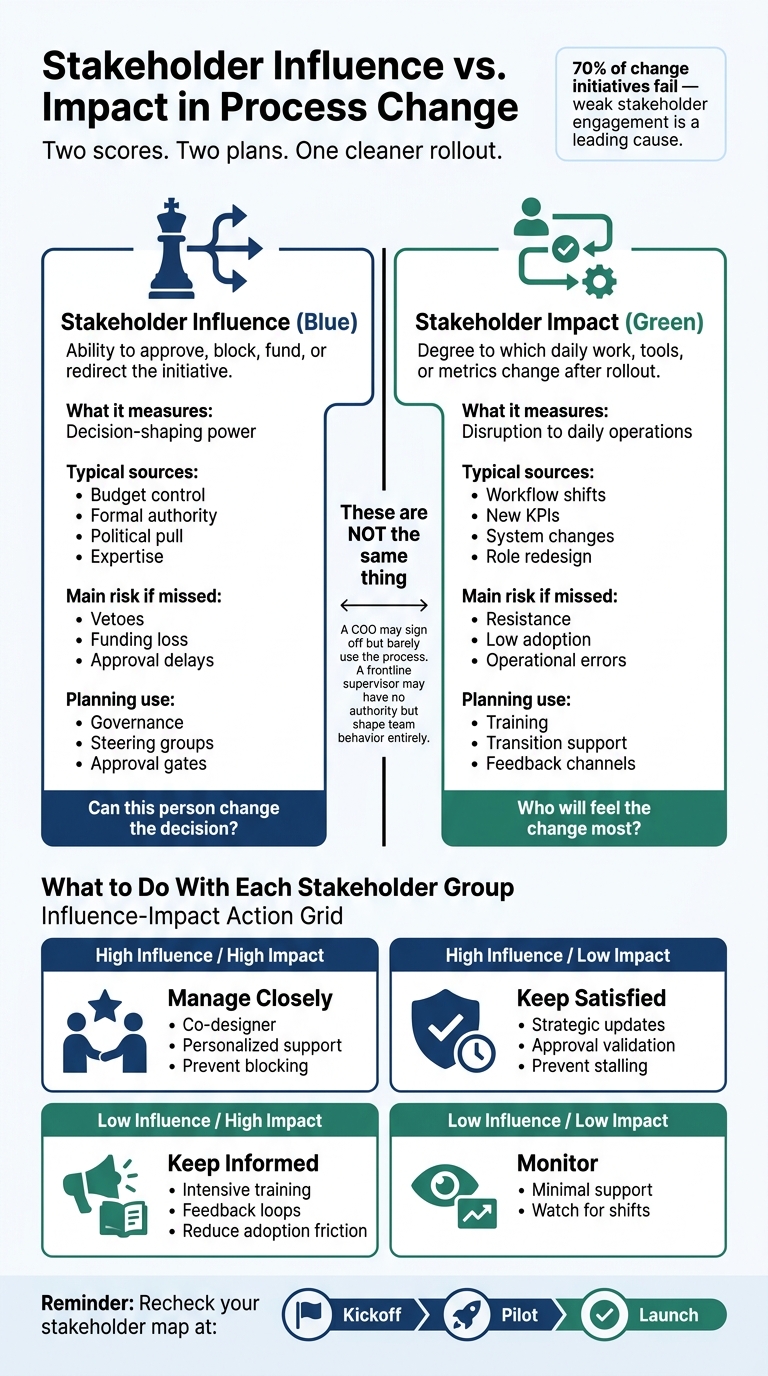
Stakeholder Influence vs. Impact: Key Differences & Action Guide
How to Make a Stakeholder Map in Excel | Impact Over Influence | Change Management Tools
sbb-itb-c53a83b
Stakeholder Influence vs. Impact: Definitions and Direct Comparison
In stakeholder review, influence and impact answer two different things.
Stakeholder influence is a person’s ability to shape what happens to a project – who approves it, who funds it, and who can slow it down or stop it.
Stakeholder impact is about what the change does to that person – how much their daily work, responsibilities, or performance metrics shift because of the initiative.
A stakeholder can have high influence and low impact, or high impact and low influence. That’s why teams use the influence-impact grid and the Power-Interest Matrix. They help split decision power from change burden. And that split shapes how you plan communication, support, and adoption.
| Feature | Stakeholder Influence | Stakeholder Impact |
|---|---|---|
| Definition | Ability to shape decisions, resources, or approvals | Degree to which work, metrics, or roles change |
| What It Measures | Power to accelerate or block the initiative | Disruption to daily operations and workload |
| Typical Sources | Budget control, formal authority, expertise, political pull | Workflow shifts, new KPIs, system changes, role redesign |
| Main Risk If Missed | Project is vetoed or loses funding and resources | High resistance, low adoption, and operational failure |
| Primary Planning Use | Governance, decision rights, and strategic alignment | Training, support, and resistance management |
What Stakeholder Influence Means in Process Change
Authority is formal decision rights. Power is control over resources. Influence is the ability to shape decisions without either.
Here’s what that looks like in practice: a VP of Operations may have formal authority over her department. But a long-tenured frontline supervisor, the person everyone trusts and checks with, may have more sway over whether a new system actually gets used. Both matter. They just call for different ways of working with them.
When you score influence, look for plain signals:
- Who controls the budget line for this initiative?
- Who has veto power over the final decision?
- Who owns the systems being changed?
- Who do people turn to when they’re unsure how to respond to something new?
That last point matters a lot. Informal influencers often won’t show up on an org chart, but they can make or break adoption. These signals show who needs governance-level attention.
What Stakeholder Impact Means in Process Change
Impact is about disruption – how much a stakeholder’s working life changes because of what you’re putting in place. Sometimes that change is direct, like a new software interface replacing one they know well. Sometimes it’s indirect, like a new reporting structure that changes who a team member answers to.
Impact includes workflow changes, KPI shifts, added workload, and reduced autonomy. Early planning often gives these less weight than they deserve.
It also helps to split short-term impact from long-term impact. A frontline employee may deal with a steep learning curve at first, then settle into a smoother routine later. That early disruption is still high impact and still needs planning. If you brush it off just because the long-term result looks good, trouble tends to show up fast.
Complexity and impact are separate. Score them separately, because they lead to different planning responses.
Where Leaders Confuse the Two and What Goes Wrong
A common mistake is treating influence and impact like they mean the same thing. They don’t.
When leaders blur those lines, they put attention in the wrong places. They spend governance time on people who mostly need training. And they give support-focused attention to people who actually need tighter strategic alignment. That distinction matters most when leaders decide:
- who to involve
- who to train
- who can slow down or stop rollout
Common Misreads in Digital Transformation and Workflow Redesign
The two errors that show up most often are almost opposites.
The first is assuming the most affected people are also the most powerful. Leaders also overlook informal influencers, like long-tenured employees or technical experts who shape team opinion without holding formal titles. When leaders mistake high impact for high influence, they give those groups the wrong kind of attention. Instead of training, transition support, and clear feedback channels, those people get pulled into the wrong conversations. The result is plain: low adoption and resistance that no one is managing.
The second error goes the other way: focusing almost entirely on senior sponsors while treating heavily affected teams as people expected to comply. A COO, legal stakeholder, or finance stakeholder may have high influence but face little day-to-day disruption. If those are the only people leaders focus on, the initiative may look approved on paper and still fall apart in practice. Then the costs start piling up: late vetoes from overlooked influencers, weak adoption from unsupported high-impact teams, and holes in the stakeholder risk register because key handoff points never had an owner.
Diagnostic Questions to Tell Influence Apart From Impact
The fastest fix is simple: score each stakeholder on separate influence and impact scales. Use a 1–5 scale for every stakeholder group.
For influence, ask:
- Can this person approve, block, delay, or redirect this initiative?
- Do they control the budget or the team needed for implementation?
- Are they someone others turn to when they need direction during uncertainty?
For impact, ask:
- How much will their daily responsibilities, tools, or workflows change after rollout?
- Will this initiative affect their personal performance metrics or job security?
- How often will they interact with the new system or process?
Teams often skip these questions and settle for a quick stakeholder list. That kind of list shows who people are, not what they must do. A status map shows titles. An action map shows who must do what, by when, and what breaks if they don’t. That’s often where stakeholder risk registers come up short.
Score influence and impact separately. Then look at both scores together to decide what each stakeholder group needs before the next planning phase.
How Influence and Impact Shape Planning, Risk Review, and Team Response
Use the scores to decide what happens next. A score matters only when it changes who has decision rights and who needs support.
Planning and Governance Decisions Driven by Influence
Use influence to set governance: steering groups, approval gates, and clear owners.
When you communicate with high-influence stakeholders, keep the message at the right altitude. Focus on strategic ROI, high-level progress, and risk exposure. Brief them before decisions are announced so alignment stays in place and confidence doesn’t wobble. What usually backfires? Pulling them into long training sessions or loading them up with technical detail they don’t need.
If a high-influence stakeholder gets missed, the fallout tends to show up fast:
- Mixed leadership messages
- Slower approvals
- Political pushback
Give these stakeholders a clear escalation role, plus approval checkpoints and milestone sign-offs. That helps cut approval delays and last-minute vetoes.
That handles governance. Impact is what shapes rollout support.
Adoption and Delivery Risks Driven by Impact
Use impact to decide rollout support, training, and sequencing.
High-impact, low-influence stakeholders create adoption risk. High-influence, low-impact stakeholders shape the story around the work. That difference matters.
High-impact stakeholders usually need:
- Pilot rollouts
- Phased transitions
- Superuser support
- Intensive task-based training
Their risks are more operational. You might see service errors at cutover, compliance gaps when new workflows aren’t fully understood, and burnout when transition work piles up without enough support. The goal is simple: reduce resistance, errors, and burnout.
Build feedback loops early so high-impact groups can flag operational problems that senior leaders may not spot from the top. Problems often bunch up at handoffs, so don’t rely on messaging alone. Use automated escalations or SLA timers.
Using an Influence-Impact Grid to Set Stakeholder Actions
Use both scores together to assign a clear action to each group. Map the scores to action, not just labels.
| Quadrant | Engagement Priority | Role | Support | Risk Mitigation Focus |
|---|---|---|---|---|
| High Influence / High Impact | Manage Closely | Co-designer and decision owner | High – personalized | Preventing active blocking or major scope shifts |
| High Influence / Low Impact | Keep Satisfied | Approval authority and milestone validator | Low – strategic updates only | Ensuring they don’t inadvertently stall progress |
| Low Influence / High Impact | Keep Informed | Feedback provider and process tester | High – intensive training and transition support | Reducing adoption friction and morale decline |
| Low Influence / Low Impact | Monitor | Awareness only | Minimal – self-service resources | Watching for shifts in influence or impact over time |
Stakeholder positions can move. A neutral stakeholder can turn resistant as rollout gets closer and the impact starts to feel more concrete. Revisit the grid at each major rollout milestone. Recheck it at kickoff, pilot, and launch.
Conclusion: A Practical Stakeholder Review Model for SME Process Change
That grid only does its job when influence and impact are treated as two different things. Influence shapes decisions; impact shapes adoption.
Keep influence tied to governance, and keep impact tied to support. High-influence stakeholders should be part of steering decisions, approval gates, and milestone reviews. High-impact stakeholders need training, feedback channels, and transition support. When you separate those two groups, rollout decisions tend to get a lot cleaner.
In small teams, informal influence can matter more than org charts suggest. Research shows that 70% of change initiatives fail, with inadequate stakeholder engagement cited as the primary reason.
"Stakeholder analysis is not an administrative exercise or a one-off deliverable. It is a strategic input that informs change approach, engagement planning, sponsorship activity and risk management." – Project One
Use this model as a final check before rollout.
- Define both terms before any stakeholder review. Influence = decision-shaping power. Impact = degree of daily workflow change. Score them separately with one scale, such as High/Medium/Low or 1–5.
- Review risks by type. Political and approval risks follow influence. Adoption and day-to-day operating risks follow impact.
- Match actions to the right group. Governance and approvals go to high-influence stakeholders. Training and transition support go to high-impact stakeholders.
- Recheck at kickoff, pilot, and launch.
FAQs
How do I score influence and impact?
Use a standard 2×2 matrix with either High/Medium/Low or a 1–5 scale.
Score influence based on a stakeholder’s ability to affect decisions, resources, or progress. Score impact based on how much the change affects their work, responsibilities, or performance.
Then plot both scores to guide engagement:
- High influence calls for close alignment
- High impact calls for added support and clear communication
It’s a simple way to see who can shape the work, who feels the change most, and where your time should go.
Can one stakeholder be high in both?
Yes. In a process change, a stakeholder can rank high in both influence and impact.
These are often the people you need to watch most closely. They can shape decisions, and they’ll also feel the change directly in their role, day-to-day work, or level of responsibility.
That means they need focused, frequent, and personal engagement.
When should I update the stakeholder map?
Update your stakeholder map whenever project or process conditions change, not just at the start.
A few moments should put this on your radar:
- A stakeholder’s authority changes
- The process starts affecting someone’s role in a different way
- You hit a major milestone, like a handoff, approval gate, or governance change
Keeping the map current helps you avoid stale assumptions, wasted effort, and resistance that sneaks up on you.