Most process rollouts fail in the message, not the workflow. If I want people to follow a new process, I need to explain why it is changing now, what stays the same, what each group needs to do, and where questions go.
Here’s the short version:
- I start with the problem in plain English, without blaming people.
- I explain why the old process no longer fits the business.
- I make the message role-specific for staff, managers, and cross-team leads.
- I use one order every time: why → business impact → new process → support.
- I show the shift with simple before-and-after examples, like moving from an $8,000 deal model to a $45,000 deal model, or from a 14-day sales cycle to a 60–90 day cycle.
- I keep one place for blockers so confusion does not spread.
A few facts stand out from the article:
- Process issues often show up at handoffs between teams.
- New habits can take 6 to 9 months to stick.
- A process built for short, single-buyer deals can fail when sales move to longer, multi-person buying.
Quick comparison:
| Group | What they need to hear | Main concern | What I want them to do |
|---|---|---|---|
| Staff | Why it matters and what changes in daily work | Day-to-day clarity | Follow new steps and flag blockers |
| Managers | How to turn the change into team habits | Team execution | Coach, reinforce, and track behavior |
| Cross-team leads | How handoffs and timing will work | Shared ownership | Align workflows across teams |
If I keep the story simple, repeat the same logic, and tie it to each person’s work, the rollout has a much better shot.
The Art of Storytelling to Drive Organizational Change with TED Speaker and Author Karen Eber
sbb-itb-c53a83b
Start With the Current Process Story
Start with the friction people feel every day. Show how the process works in practice - not just the clean version in a doc or flowchart. That includes the workarounds, the side messages, and the unwritten know-how people rely on to keep things moving.
The goal is simple: name the problem in plain English without turning it into a blame game.
Define the Problem in Plain Language
Talk about the system, not the people.
So instead of saying a team is slow, say that decisions are delayed because data lives in separate systems or customer follow-up gets lost between sales and implementation. That shift matters. It keeps the focus on process design instead of pointing fingers.
Leaders need one clear version of this problem story that managers can repeat the same way across teams. If every manager tells a different story, confusion spreads fast.
"Revenue leaks at transitions. The handoff from marketing to sales. From sales to implementation. From implementation to customer success. Each transition point is an opportunity for context to evaporate and momentum to stall." - Mario Peshev, Author of MBA Disrupted
Some friction points show up again and again:
- Duplicated approval steps
- Unclear ownership between departments
- Data spread across separate systems
- Handoffs that depend on informal know-how
These are process problems, not people problems.
Explain Why the Business Is Changing Now
Timing matters.
People are more likely to accept a new process when they understand why the old one no longer fits. In many cases, the workflow was built for a different stage of the business, a different market, or a different buying pattern. Now it gets in the way.
For example, a workflow built for fast, single-decision deals can fall apart when the company moves into slower, multi-step buying. What used to work now slows sales, delivery, or growth. The old process no longer matches how the company sells, serves, or scales.
That framing does a lot of work. It ties the change to a clear business condition, so the move feels reasoned instead of random.
Once people understand why now, the next thing they need is clarity on what is not moving.
State What Stays the Same and What Changes
Before leaders explain what will change, they should say what will stay the same. That kind of clarity lowers stress and helps people focus on the new steps instead of guessing what else might shift.
| What Stays the Same | What Changes |
|---|---|
| Goals and KPIs | CRM fields, approval steps, or handoff rules |
| Customer standards and service quality | Onboarding sequences and tool workflows |
| Team roles and reporting lines | Meeting cadence and review process |
| Company direction | Rules for qualifying or escalating deals |
With that baseline in place, leaders can explain the change in a way each audience can understand.
Frame the Change for Staff, Managers, and Cross-Team Leads
Once the business case is clear, leaders need to tailor the message to each group’s day-to-day decisions.
| Comparison Point | Staff | Managers | Cross-Team Leads |
|---|---|---|---|
| Core Message Focus | Role impact, immediate expectations, and business reason | Daily action, habit building, and team alignment | Handoffs, dependencies, and shared workflows |
| Primary Concern | Role impact and daily clarity | Team performance and steady execution | Shared handoffs and ownership |
| Required Action | Adopt new sequences, CRM fields, and daily habits | Translate the rollout into weekly action plans and 1:1 coaching | Map handoffs in the customer journey and align cross-functional workflows |
| Communication Tool | All-hands meetings and simple prompts | 1:1s, team meetings, and checklists | Cross-functional workshops and dependency maps |
How CEOs and Department Heads Should Speak to Staff
Staff need plain, concrete language tied to process adoption. Start with what gets easier, what changes on Monday morning, and where people should flag blockers.
"Without a consistent message, you risk an upcoming trend of 'abandoning the ship' unless you communicate the situation proactively." - Mario Peshev, CEO and Operator
A simple way to say it:
- "Here is what will be easier for you."
- "Here is what you need to do starting Monday."
- "Here is where to raise blockers."
That kind of message cuts through noise. People don’t need a big speech here. They need clear next steps.
How Managers Should Turn the Story Into Daily Action
Managers take the CEO’s message and turn it into team behavior. In practice, that means setting up 1:1s and walking each direct report through the change in a personal way.
They also need to tie the new process to the metrics the team already owns. If old habits start creeping back in, managers should spot them early and coach on them fast. That’s where change either sticks or slips.
How Cross-Team Leads Should Align Handoffs and Timing
For cross-team leads, the aim is simple: fewer handoff misses and less rework between functions. Their message has to center on shared outcomes, not just team-by-team tasks.
That starts with mapping every workflow connected to the customer journey so teams can spot where handoffs break down, or where automations built for an older buyer profile no longer fit. A sales-to-implementation handoff built for a 14-day close cycle can break when that cycle stretches to 60 to 90 days.
"The companies that execute well in the first 100 days treat process architecture as seriously as the financial model. Both need to support the same growth thesis." - Mario Peshev, CEO and Operator
Ownership needs to be set before rollout begins, not in the middle of it.
With each audience framed, the rollout can move to message order: why, impact, then execution.
Use the Right Message Order for Rollout
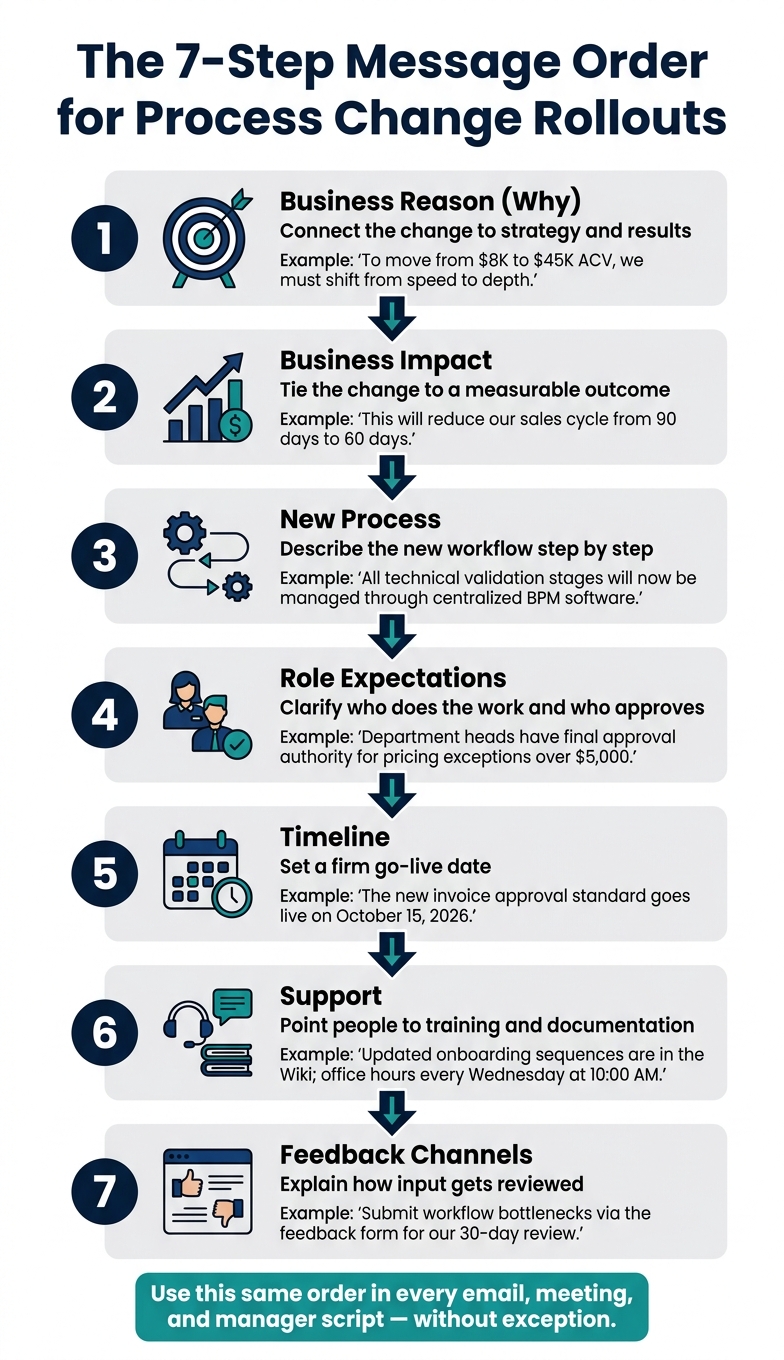
Process Change Rollout Framework: Why → Impact → Process → Support
Message order can make or break a rollout. If the sequence is off, people fill in the gaps on their own. That’s when confusion starts.
Use the same order in every version of the message: why, impact, process, then support. Stick with that flow before you tailor anything for each audience.
Lead With Why, Then Business Impact
Start with the business reason first. Not the new software. Not the updated approval flow. Start with why the organization is making this move now. Tie that reason to strategy and results.
Then spell out the measurable outcome. For example: "Reduce the sales cycle from 90 days to 60 days."
Then Describe the New Process and Role Expectations
Once the "why" is clear, explain what the new workflow looks like in practice. Walk people through it step by step: what changes, who owns each step, and who approves what. Make the link back to the business reason you opened with.
Be specific about ownership and approval. Say who does the work and who signs off. For example: "The Account Executive executes, while the VP of Sales approves discounts." That kind of clarity helps stop the freeze that often shows up during rollout.
End With Timeline, Support, and Feedback Channels
Wrap up with what people need in order to act: rollout dates, training schedule, where the documentation lives, and where to escalate blockers. Use this same order in emails, meetings, and manager scripts.
| Message Step | Purpose | Example Line |
|---|---|---|
| Business Reason (Why) | Connect the change to strategy and results | "To move from $8K to $45K ACV, we must shift from speed to depth." |
| Business Impact | Tie the change to a measurable outcome | "This new architecture will reduce our sales cycle from 90 days to 60 days to support our $45K ACV target." |
| New Process | Describe the new workflow | "All technical validation stages will now be managed through the centralized BPM software." |
| Role Expectations | Clarify who does the work and who approves | "Department heads now have final approval authority for all pricing exceptions over $5,000." |
| Timeline | Set a firm go-live date | "The new invoice approval standard goes live on October 15, 2026." |
| Support | Point people to training and documentation | "Updated onboarding sequences are now in the Wiki, and office hours will be held every Wednesday at 10:00 AM." |
| Feedback Channels | Explain how input gets reviewed | "Please submit any workflow bottlenecks via the feedback form for our 30-day review." |
Pick one place for blockers and questions. If people know exactly where to go, leaders can deal with actual friction instead of rewriting the message every week.
Next, show leaders how to turn this order into before-and-after examples.
Before-and-After Examples and How to Adjust the Story During Rollout
Before-and-After Examples Leaders Can Use
A before-and-after example helps teams see the shift fast. In one rollout, the business moved upmarket from an $8,000 ACV to $45,000 ACV, but the CRM workflows and onboarding sequences were still built for a 14-day speed-based cycle instead of a 60–90 day multi-stakeholder cycle.
That kind of contrast works well in staff updates, manager coaching, and cross-team handoff meetings. It gives people a clear picture of what changed and why the old setup no longer fits.
| Process Element | Before | After |
|---|---|---|
| Sales Cycle | 14-day speed-based cycle | 60–90 day depth-based cycle |
| Stakeholder Count | Single decision-maker | Multi-stakeholder buying committee |
| Handoff Style | Siloed, reactive outreach | Shared cross-functional cadence with common data |
| System Use | Manual workarounds outside the system | Automated workflows inside core systems |
If the process still fits the old cycle, teams will say it's broken. Rebuild it for the new cycle, then retrain the team.
Use the before state to show staff what isn't working. Use the after state to set manager expectations. Then use the handoff changes to get cross-team leads on the same page.
Plain Language Prompts for Difficult Conversations
When pushback starts, use plain questions to reset the discussion:
- What specific problem is this change solving for our team?
- Which handoff or approval step is slowing us down today?
- What stays the same, and what actually changes in this rollout?
- If the new process adds work without reducing errors, what do we need to fix?
If a rollout stalls mid-cycle, go back to the "why" before changing the timeline or the tools. In many cases, resistance comes from teams that know what changed but don't yet see why it matters to their day-to-day output.
"Then you train the team on why the change matters, not just what changed." - Mario Peshev, CEO and Founder, Growth Shuttle
Conclusion: Keep the Story Simple, Consistent, and Role-Specific
Use the same plain language in every rollout update so the message stays consistent.
Start with the current problem. Explain why the change is happening now. Define the future state. Then repeat that core story at every level. The language and detail can change by role, but the logic should stay the same.
"Predictability takes time (often 6 to 9 months) for a new system to properly sink in and staff building the right habits in place." - Mario Peshev, CEO and Founder, Growth Shuttle
FAQs
How do I explain process change without blaming teams?
Frame the shift as a needed step for growth, not as a reaction to past mistakes. A process that worked well with a smaller team can start to creak once the company gets bigger. That’s normal. Growth changes the day-to-day, and the way people work has to change with it.
Put the focus on why the change is happening. Maybe the company has hit new growth milestones. Maybe more teams, more clients, or more moving parts have made the old workflow harder to manage. In that light, the change isn’t about fixing failure. It’s about making work smoother and setting the business up for what comes next.
Be open about the vision. Spell out where the company is headed, what this change is meant to support, and how it should help the team work better over time. At the same time, invite feedback. People are more likely to get on board when they can see the bigger picture and feel like their input matters.
What should I say first in a rollout message?
Start with why the change matters, not just what is changing. Lead with the root issue or the situation that made the change necessary. That context helps people make sense of the message and see the point of the shift.
Then show how the change supports the organization’s long-term health and role security. When people can connect the new process to where the company is headed, the message feels less like a rule change and more like a clear step toward shared goals.
How long does it take for a new process to stick?
A new process usually sticks when teams treat it as a structured 100-day initiative, not a quick fix.
During that stretch, leaders need to move from mapping workflows and spotting bottlenecks to building steady operating rhythms tied to business metrics. Skip those steps, and operational friction tends to build over time.


