Most deal problems start after close, not during valuation. If leadership teams do not match on decision pace, reporting, meeting rhythm, conflict handling, and role ownership, the first 90 to 180 days can stall.
I’d boil the article down to this: check how leaders work before the deal closes, write the rules down, and use that plan on Day 1. That matters because fewer than 30% of acquirers hit their stated synergy targets, and gaps in decision rights and accountability are a common reason.
Here’s the short version of what I’d look at before close:
- Decision pace: Who makes the call, who gets input, and how long approval takes
- Reporting lines: Where duplicate roles may clash after close
- Meeting rhythm: How often leaders meet, how agendas work, and whether action items get tracked
- Conflict handling: How issues move up the chain and who settles them
- Role ownership: Who owns budget, headcount, and milestone follow-up
And here’s the core action list:
- Map decision rights for the first 90 days
- Put future reporting lines in writing before close
- Set a shared weekly, monthly, and quarterly meeting rhythm
- Define escalation paths for disputes and missed targets
- Use one written charter for the first 90 to 180 days
- Set unified KPI definitions by Day 30
- Launch one shared dashboard by Day 60
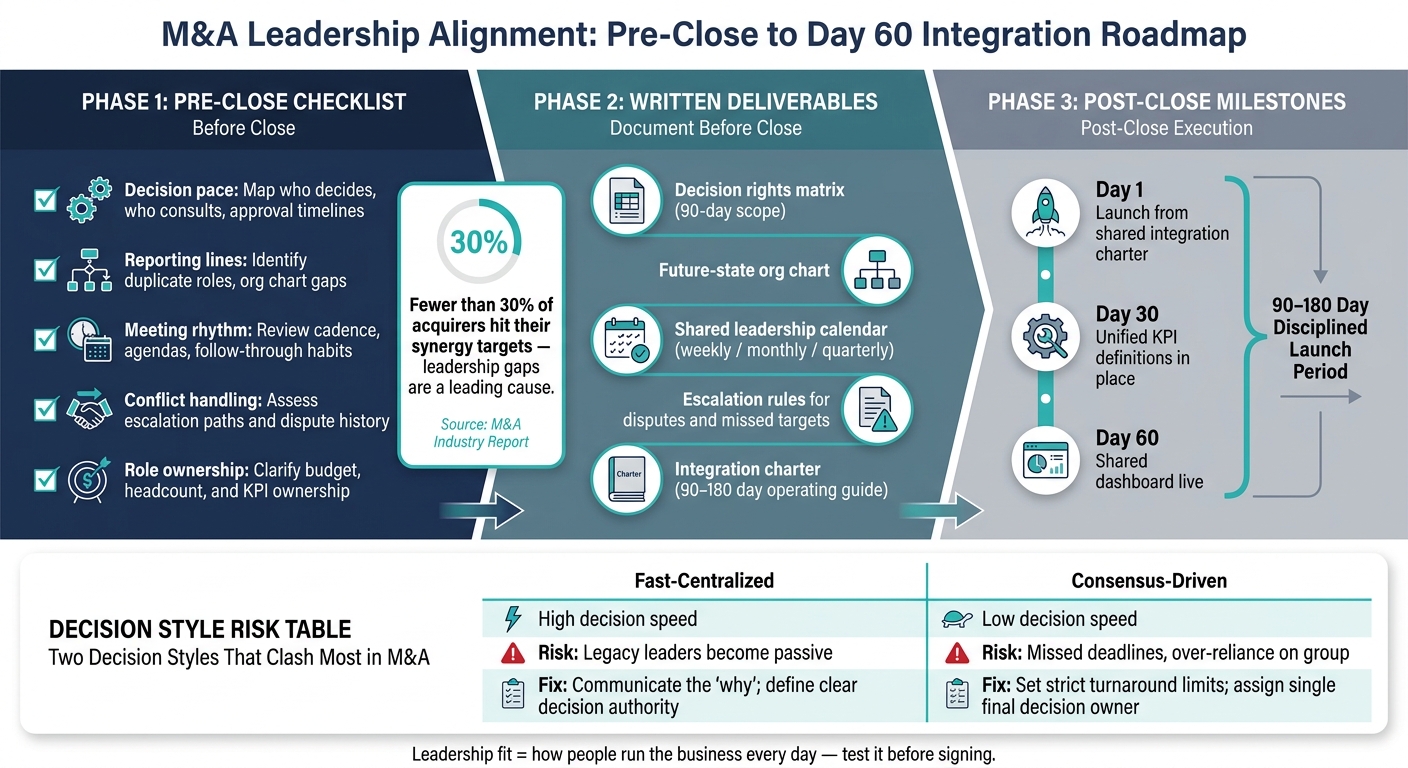
M&A Leadership Alignment: Pre-Close to Day 60 Integration Roadmap
Leadership Alignment in M&A: Why Integration Agility Starts with Your Executive Team
sbb-itb-c53a83b
Quick comparison
| Area | What to check before close | Main risk if missed | What I’d put in writing |
|---|---|---|---|
| Decision pace | Approval paths, spending limits, founder dependency | Delays and bottlenecks | Decision rights matrix |
| Reporting lines | Duplicate roles, org chart gaps | Confusion on Day 1 | Future-state org chart |
| Meeting rhythm | Weekly reviews, agendas, follow-up habits | Poor handoffs and slow execution | Shared leadership calendar |
| Conflict handling | Past disputes, escalation path, final decision maker | Private workarounds and trust issues | Escalation rules |
| Role ownership | Budget, headcount, KPI ownership | Overlap and missed tasks | Integration charter |
If you want one takeaway, it’s this: leadership fit is not about values alone. It’s about how people run the business every day. That’s the part I’d test before signing, not after close.
Problem 1: Mismatched decision speeds slow down integration
When a founder-led seller joins a larger buyer, decision-making can hit friction fast. One side may be used to quick calls from a single leader. The other may rely on a slower chain of approvals across teams. Neither method is wrong. But when those two styles meet, integration can drag.
The main problem is simple: if people don't know who can approve what, work stops. That's why this gap needs to be mapped before close.
How to review decision-making before close
Look at how decisions get made in practice, not just how the company says they get made on paper. Start with structured interviews with leaders. Then review who can approve discounts, budget shifts, and headcount changes. After that, compare those answers with approval records, org charts, and policy documents.
For each major decision area - budget reallocations, headcount changes, pricing, and IT changes - document four things so the first 90 days don't get jammed up:
- Decision owner: Who makes the final call
- Consults: Who needs to weigh in before the call is made
- Turnaround time: How long the process usually takes
- Escalation point: When the issue moves to the CEO, board, or functional head
You should also check for founder dependency. If pipeline creation or major calls sit mostly with the founder or one key salesperson, that can turn into a bottleneck after close if that person leaves or their role shifts.
Use this map to build the first 90-day decision rights matrix.
Set a shared decision model for the first 90 days
Before the deal closes, both sides should agree on a decision rights matrix. Keep it simple. It should show who decides, who gets consulted, and who needs to be informed. Think of it as the operating guide for the first 90 days.
The two decision styles that tend to clash most in M&A are:
| Style | Decision Speed | Integration Risk | Mitigation Step |
|---|---|---|---|
| Fast-Centralized | High | Legacy leaders may become passive if excluded | Communicate openly; define the clear "why" behind decisions |
| Consensus-Driven | Low | Missed deadlines; over-reliance on group input | Set strict turnaround limits; assign a single leader to own the final call |
At the same time, set clear spending thresholds. For example, any budget reallocation above an agreed dollar amount should follow a defined approval path, with the Integration Lead as decision owner and the CFO plus workstream leads consulted. Smaller decisions should stay with workstream leads so teams can keep moving without extra escalation.
Once decision rights are set, the next step is to look at reporting lines and meeting cadence.
Problem 2: Unclear reporting lines and meeting habits create confusion
Once decision rights are mapped, the next risk is role overlap and clashing operating rhythms. Leadership style fit can still fall apart when decision rights look clear on paper but day-to-day management does not. If one company runs on informal founder check-ins and the other expects structured reviews, execution tends to slow down.
Map reporting lines and overlapping leadership roles
Put both org charts next to each other and flag every duplicate role. Two Sales leaders or two CTOs can create Day 1 confusion if future ownership is not settled before close. The aim is simple: clear ownership before close.
The right setup depends on the integration archetype:
| Archetype | Reporting line impact |
|---|---|
| Full Absorption | Immediate migration to platform leadership |
| Federated Model | Shared back-office; separate brand/ops leaders |
| Capability Bolt-on | Target leadership often wound down or divested |
| Holding Structure | Shared reporting and capital allocation only |
Even so, reporting clarity by itself is not enough. Leaders also need to work on the same rhythm.
Compare meeting cadence, agendas, and follow-through
Org charts tell part of the story. The other part is how each company runs its week. A founder-led seller may rely on informal messages and ad hoc calls, while the buyer may want formal agendas and tracked action items after every meeting. That gap can cause friction fast.
During due diligence, review the target's current meeting setup. How often does the leadership team meet? Are there monthly operating reviews or quarterly planning sessions? Who joins, and who gets a summary afterward? Also look at whether follow-through is written down or just assumed. A CRM audit can expose weak follow-through. That CRM check sits inside the commercial workstream, while the leadership read usually has no owner at all. Mapping how the diligence workstreams connect gets findings like this one into the integration charter instead of leaving them in the function that found them.
Build a post-close operating rhythm
The fix is a shared leadership calendar agreed on before close. A practical place to start is a three-tier review rhythm:
- Weekly: 30-minute blocker check-ins
- Monthly: 90-minute operating reviews
- Quarterly: Half-day strategy reviews
Along with that calendar, set plain response-time rules for email and Slack as part of the post-close operating agreement.
Once cadence is in place, the next test is how leaders deal with disagreement and escalation.
Problem 3: Conflicting conflict styles and vague roles weaken trust
Clear reporting lines and a steady meeting rhythm help. But integration can still slow to a crawl when leaders deal with disagreement in very different ways.
A founder who avoids conflict will often clash with a buyer team that expects direct escalation. The problem isn’t just one person’s style. It’s the collision between styles.
When escalation paths are fuzzy, people default to personal habits instead of a repeatable process. Problems get handled in private, not through a shared process, and trust can fade fast.
Assess how leaders handle disagreement and escalation
The best signal is what happened recently. Ask the target’s leadership team how they dealt with a budget dispute, a missed target, or a staffing disagreement.
Look for plain details:
- Did the issue come up in a team meeting, through manager mediation, or in a one-on-one with the CEO?
- Was it settled in days or weeks?
- Who made the final call?
Also watch for one founder serving as the only escalation point. That can turn into a bottleneck after close.
Define role clarity and expected leadership behavior
Clarity matters because unclear roles can turn normal disagreement into integration drag. Before close, put together a one-page integration charter that spells out scope, authority, and escalation paths.
That should cover:
- who can approve material budget changes
- who must be consulted on headcount
- who needs to be informed
It also helps to spell out expected leadership behavior: how disagreements should be raised and how decisions move up the chain. That way, conflict doesn’t become a Day 1 surprise.
When decision speed, reporting, cadence, and conflict rules are lined up before close, integration planning can turn leadership fit into Day 1 operating discipline.
Conclusion: A pre-close framework for leadership alignment
The real test before close isn’t whether leaders agree in theory. It’s whether they can work from the same playbook on Day 1.
Leadership fit doesn’t sort itself out after close. You need to review and document decision speed, reporting lines, meeting habits, conflict handling, and role clarity before close.
Decision rights should also be in writing before close. Integration works better when both sides approve a written charter ahead of time. That charter should guide the first 90 to 180 days and spell out:
- decision authority
- reporting lines
- role clarity
- meeting cadence
- risk escalation
- milestone tracking
That way, both leadership teams start from the same operating plan, not two different assumptions.
Those observations should then turn into a short integration plan.
Key actions to carry into integration planning
The pre-close work comes down to a few concrete moves. Compare how each side makes decisions, escalates issues, and runs meetings so leadership mismatches show up early. Then document future-state authority in a single decision rights matrix.
From there, lock in a shared meeting cadence and escalation norms through a post-close operating agreement. Assign clear owners across both firms, and track ownership and milestone follow-up so nothing slips through the cracks.
The first 90 to 180 days should function as a disciplined launch period. Unified KPI definitions should be in place by Day 30, and a unified dashboard should be live by Day 60. That cadence turns pre-close planning into post-close discipline and makes leadership alignment a pre-close deliverable, not a post-close repair.
FAQs
How do we assess leadership fit before close?
Assess leadership fit before close with a leadership-focused organizational audit. Look at how fast decisions get made, where authority sits, reporting lines, and role clarity so everyone knows exactly who they report to on Day 1.
During site visits, watch how people communicate, how meetings run, and what happens when teams disagree. Then use structured employee surveys to check leadership preferences and spot trust gaps. From there, document decision rights, governance cadence, and escalation paths in the integration charter.
What should be included in a 90-day integration charter?
A 90-day integration charter is the team’s working agreement for the first stretch after a deal closes. It helps the deal team, portfolio leadership, and functional leads stay aligned and avoid slow decisions, mixed signals, and clashing priorities.
It should spell out the scope of the integration, set clear decision rights for budgets, headcount, and brand choices, and lay out a governance cadence for standups and board updates. It should also document synergy targets and include a formal path for risk escalation to the board.
Which leadership gaps hurt M&A integration most?
The most damaging gaps often start with misaligned decision-making authority and reporting structures. When leaders aren’t on the same page about who decides what, how authority is split, or how teams should operate inside current systems, integration tends to slow down. That’s when day-to-day friction starts to pile up.
Trouble also shows up when decision rights are vague and leadership communication doesn’t connect across the organization. The result is conflicting priorities, team strain, employee turnover, and missed synergy targets.


