You have signed a letter of intent, agreed on exclusivity, and now have 45 days to confirm that the business you are buying is actually the business the seller described. The clock is running. Your legal counsel is requesting documents. Your accountant is building a quality of earnings model. And somewhere in the background, you are wondering whether anyone is checking if the customer concentration you saw in the CIM is actually 38% or closer to 55%.
This is the moment where most SME acquisitions either build conviction or quietly unravel. A Bain 2023 survey found that 60% of deals that underperform do so because of issues that were knowable during diligence but were not surfaced or acted upon. The problem is rarely a lack of effort. It is a lack of coordination across workstreams.
This article provides an M&A due diligence checklist structured not as a document request list, but as a connected decision system. The goal is to help SME acquirers, whether owner-operators or private equity market intelligence teams, see how findings in one workstream should alter decisions in another. I will walk through how diligence scopes connect, where cross-functional red flags emerge, and how findings translate into price adjustments, deal structures, and post-close operating plans.
I am not offering legal or tax advice here. Those are specialist domains, and I will point you to resources for each. What I am offering is the operator's map: how to run diligence as a coordinated effort rather than a collection of parallel activities that never quite inform each other.
1. Diligence as a Connected Decision System
The traditional approach to due diligence treats each workstream as an independent verification exercise. Legal reviews contracts. Finance builds a QofE. IT checks the servers. Each team produces a report. Someone consolidates the findings into a memo. The deal team makes a decision.
This approach misses the point. Diligence is not about producing reports. It is about answering a series of interconnected questions: Is this business what it appears to be? Can we operate it? What risks exist, and can we price or mitigate them? What must happen in the first 100 days to protect and capture value?
Each workstream generates evidence that should inform every other workstream. A customer concentration finding in commercial diligence should trigger questions in financial diligence about revenue quality and in legal diligence about contract terms. A technology debt finding should alter your 100-day capital expenditure assumptions. A tax structure issue might change your acquisition entity and financing approach.
According to McKinsey research on deal failures, transactions that treat diligence as a coordinated decision process rather than a compliance exercise are significantly more likely to achieve projected synergies.
The Evidence Chain Principle
Every diligence finding should flow through three questions:
- What does this tell us about the business as described? Confirmation, clarification, or contradiction?
- What other workstreams need to know about this finding? Who else should investigate further?
- How does this affect price, structure, or the operating plan? What decision does it inform?
When diligence teams answer these questions explicitly, findings become decisions rather than observations.
2. The Five Core Diligence Scopes and Their Interdependencies
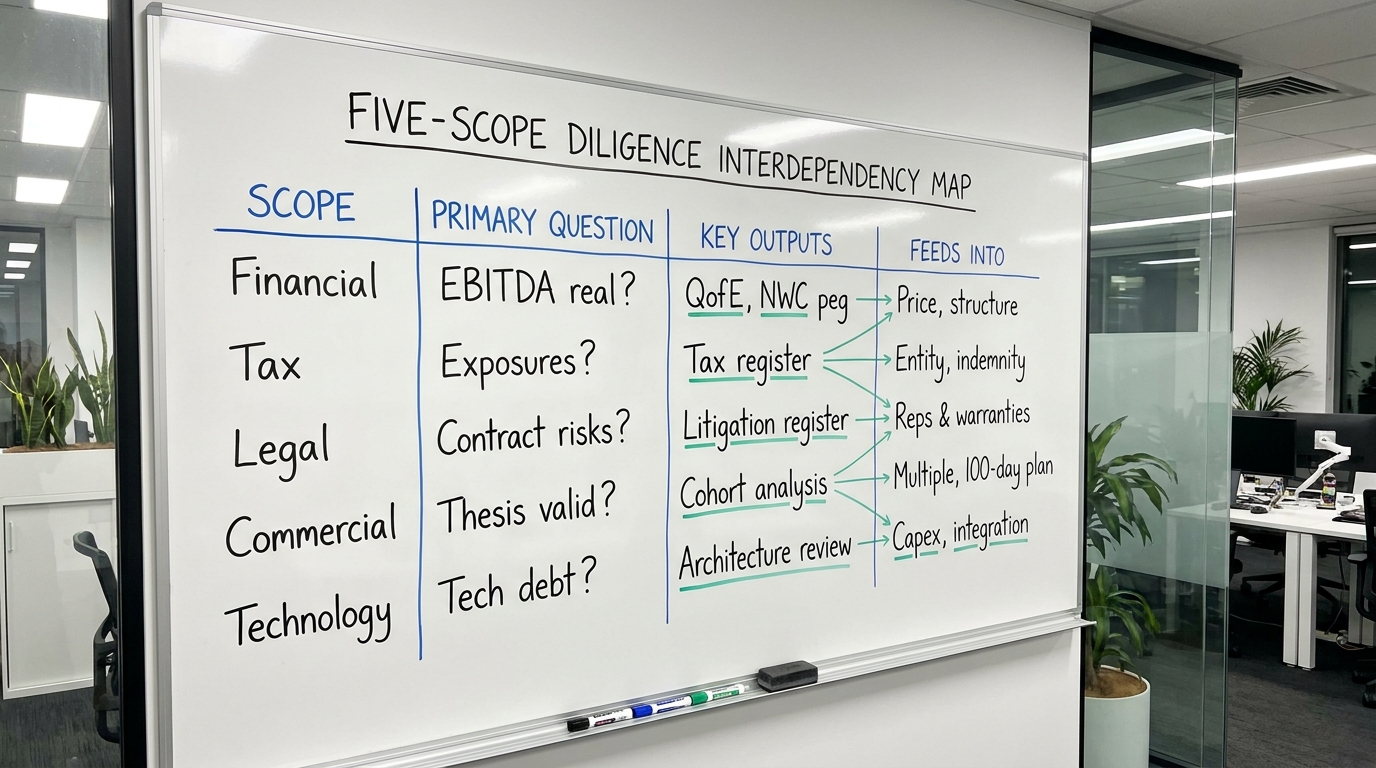
An M&A due diligence checklist for SME transactions typically covers five interconnected scopes. Each has a distinct purpose, but none operates in isolation.
Financial Diligence
Answers: Are the historical financials accurate? Is EBITDA sustainable and recurring? What are the real working capital requirements?
Key outputs: Quality of earnings analysis, normalized EBITDA, net working capital peg, debt-like items, capex requirements.
Feeds into: Deal pricing, earn-out structures, working capital mechanisms, and closing conditions.
Tax Diligence
Answers: Are there historical tax exposures? Is the current structure efficient for the transaction? What post-close structuring is required?
Key outputs: Tax exposure quantification, transaction structure recommendations, step-up opportunities, and post-close integration requirements.
Feeds into: Purchase price allocation, acquisition entity selection, closing conditions, and seller indemnification.
For detailed coverage of tax-specific considerations, see the tax due diligence checklist on this site.
Legal Diligence
Answers: Are there material contract risks? Litigation exposure? IP ownership issues? Employment liabilities?
Key outputs: Contract summaries, litigation register, IP chain of title, employment liability quantification, and required consents.
Feeds into: Deal structure (asset vs. stock), representations and warranties, indemnification caps, and closing conditions.
Commercial Diligence
Answers: Is the market thesis valid? Are customer relationships durable? Is the competitive position defensible? Can we grow this business?
Key outputs: Market sizing, customer cohort analysis, churn drivers, competitive positioning, and growth roadmap validation.
Feeds into: Investment thesis confirmation, valuation multiple, management retention requirements, and the 100-day commercial plan.
For a detailed framework, see the commercial due diligence playbook.
Technology Diligence
Answers: Does the technology work? Is it scalable? What is the technical debt burden? Are there cybersecurity risks?
Key outputs: Architecture assessment, technical debt quantification, security posture evaluation, and integration complexity scoring.
Feeds into: Capital expenditure requirements, integration timelines, value creation plan priorities, and operational risk register.
For technology-specific methodology, see the technology due diligence playbook.
3. How Diligence Findings Alter Price, Structure, and the 100-Day Plan
The purpose of diligence is not to produce a report that says "proceed" or "walk away." Most deals fall somewhere in between. The real work is translating findings into specific adjustments.
Price Adjustments
Findings that affect recurring EBITDA or working capital should flow directly into valuation. A BCG study found that post-close EBITDA misses of more than 10% could often be traced to diligence findings that were noted but not translated into price adjustments.
Common price-affecting findings:
- Revenue quality issues (non-recurring items, related-party transactions)
- Expense normalization (owner compensation, one-time costs)
- Working capital anomalies (seasonal patterns, aging receivables)
- Customer concentration or churn patterns
- Technical debt requiring near-term capital expenditure
Structure Adjustments
Some findings are better addressed through deal structure than price. An escrow account for uncertain litigation. An earn-out tied to customer retention. A deferred payment contingent on tax authority rulings.
Structure adjustments protect both parties when findings create uncertainty that cannot be precisely quantified but can be reasonably bounded.
100-Day Plan Adjustments
Findings that do not affect price or structure still matter if they affect what you need to do after close. Technology debt that is acceptable at current scale but will limit growth. Commercial concentration that requires immediate diversification effort. Talent gaps that require recruiting before integration.
These findings should flow directly into your value creation plan (VCP) and integration workstreams.
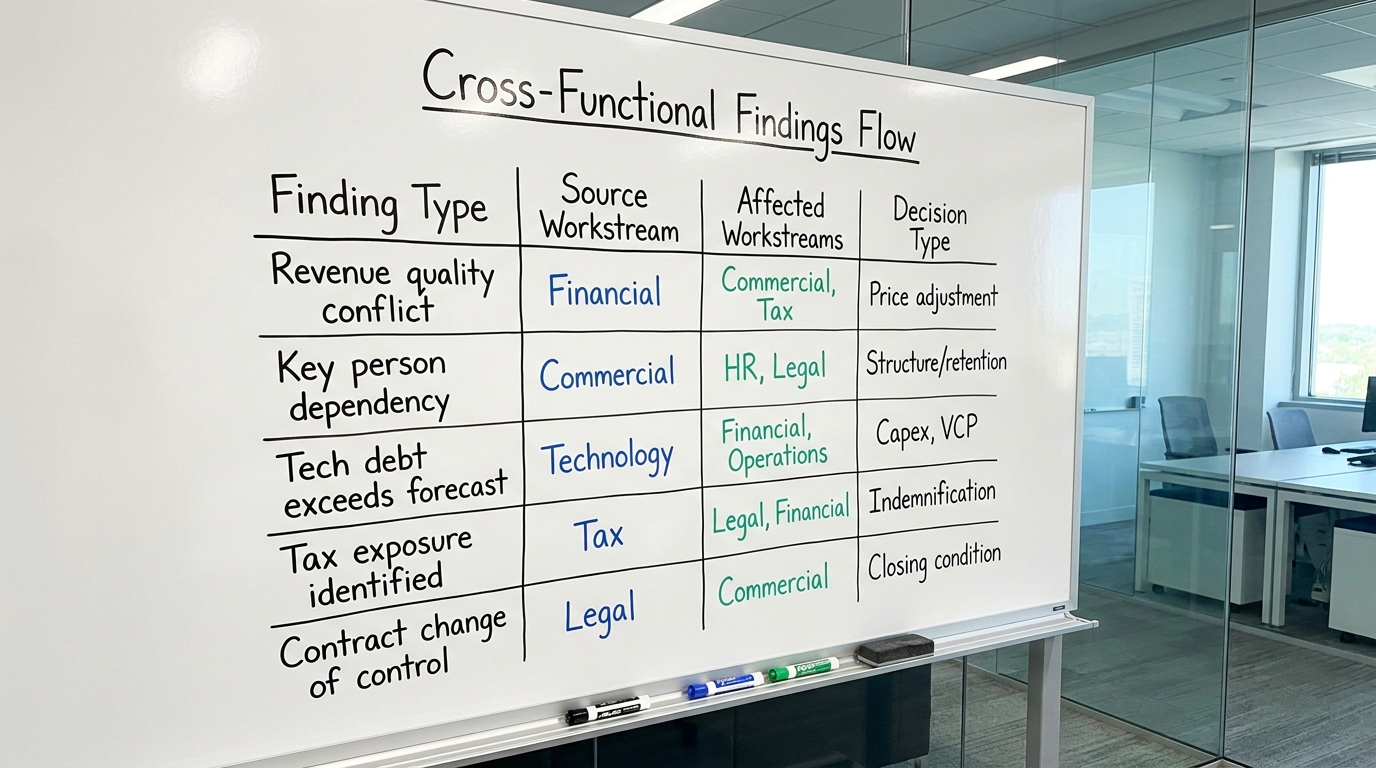
4. Cross-Functional Red Flags That Require Escalation
Some findings are workstream-specific. Others cut across multiple scopes and require immediate escalation to the deal team. Here are the patterns I have seen most frequently in SME transactions.
Revenue Quality Conflicts
When financial diligence shows strong revenue growth but commercial diligence reveals declining customer satisfaction or rising churn, you have a conflict. Often this indicates sales practices that are acquiring customers who will not retain, or pricing changes that are accelerating near-term revenue at the expense of long-term relationships.
Resolution: Cohort analysis by acquisition period. Customer interviews. Sales compensation review.
Technology Liabilities Hidden as Assets
The platform that is positioned as proprietary IP may actually be a liability if it requires constant maintenance, cannot scale, or depends on frameworks that are no longer supported. Gartner research suggests that technical debt in mid-market software businesses typically consumes 20-40% of ongoing development capacity.
Resolution: Architecture review by independent technical assessors. Developer interviews. Codebase quality metrics.
Key Person Dependencies
When commercial diligence reveals that major customer relationships are tied to specific individuals, and HR diligence shows those individuals have no non-competes or retention arrangements, you have a key person risk that spans multiple workstreams.
Resolution: Customer reference calls specifically testing relationship portability. Retention package negotiation as closing condition.
Tax and Legal Structure Mismatches
The seller's preferred structure may optimize for their tax position but create liabilities for you. Historical tax positions may be aggressive in ways that affect asset vs. stock decisions.
Resolution: Joint tax and legal review of transaction structure. Quantified exposure analysis. Indemnification negotiation.
5. The Diligence Workstream Map
The following table provides a workstream-by-workstream framework for coordinating diligence activities. This is not a document request list or a legal checklist. It is an operating map for ensuring that findings flow to decisions.
| Workstream | Owner | Key Deliverables | Cross-Functional Dependencies | Decision Outputs | Timing (from LOI) |
|---|---|---|---|---|---|
| Financial | Transaction accountant or QofE provider | Quality of earnings, NWC analysis, debt-like items | Commercial (revenue quality), Tax (structure), Technology (capex) | Price adjustments, working capital peg, earn-out triggers | Weeks 1-4 |
| Tax | Tax advisor (buyer-side) | Exposure register, structure recommendation, step-up analysis | Legal (entity structure), Financial (allocation) | Transaction structure, indemnification, closing conditions | Weeks 1-4 |
| Legal | Transaction counsel | Contract review, litigation register, IP chain, employment review | Tax (structure), Commercial (customer contracts), HR (employment) | Asset vs. stock, reps and warranties, required consents | Weeks 1-5 |
| Commercial | Deal team or external advisor | Market analysis, customer cohorts, competitive assessment, churn analysis | Financial (revenue quality), Technology (product roadmap) | Thesis confirmation, multiple validation, 100-day commercial plan | Weeks 2-5 |
| Technology | Technical assessor (internal or external) | Architecture review, tech debt quantification, security posture, scalability | Financial (capex), Commercial (product roadmap), Operations (integration) | Capex requirements, integration timeline, VCP priorities | Weeks 2-5 |
| Operations | Deal team or operating partner | Process documentation, key person mapping, integration complexity | All workstreams | 100-day plan, integration risk register, retention requirements | Weeks 3-6 |
| HR / People | HR lead or advisor | Org chart validation, compensation benchmarking, retention risk | Commercial (key relationships), Operations (key person) | Retention packages, management agreements, cultural assessment | Weeks 2-5 |
6. When to Use External Specialists
SME acquirers often face the question of whether to handle diligence internally or engage external specialists. The answer depends on three factors: complexity, expertise gap, and credibility requirements.
Always Use Specialists
Tax diligence: Tax exposure quantification and structure optimization require specialist knowledge. The cost of missing a historical exposure or suboptimal structure far exceeds advisory fees.
Legal diligence: Transaction counsel is non-negotiable for purchase agreement negotiation. The question is whether you also need specialist IP counsel, employment counsel, or regulatory counsel depending on the business.
Usually Use Specialists
Quality of earnings: For transactions above $5M in enterprise value, an independent QofE provider brings credibility with lenders and surfaces issues that internal analysis may miss. Harvard Business School research on deal outcomes suggests that independent QofE providers identify material adjustments in more than 70% of middle-market transactions.
Technology diligence: If technology is core to the business model, external technical assessment is worth the investment. Internal IT teams often lack the M&A-specific framing to translate technical findings into deal decisions.
Sometimes Use Specialists
Commercial diligence: If you have deep domain expertise in the target's market, you may be able to conduct commercial diligence internally. If the market is unfamiliar, external expertise accelerates the learning curve and provides independent validation.
HR / People diligence: For smaller transactions, deal team members can often handle organizational assessment. For larger transactions or those with significant people risk, HR specialists add value.
7. The Value Creation Plan Connection
Diligence findings that do not affect price or structure should flow directly into your value creation plan. This is where I see the most significant gap in SME transactions. Teams complete diligence, close the deal, and then build a 100-day plan from scratch as if the diligence findings never existed.
Every diligence workstream should produce inputs for the VCP:
- Financial: Working capital management priorities, cost optimization opportunities, reporting improvements
- Tax: Post-close restructuring requirements, ongoing compliance needs
- Legal: Contract renegotiation priorities, compliance remediation, IP registration needs
- Commercial: Customer retention initiatives, cross-sell opportunities, pricing optimization, sales capacity needs
- Technology: Technical debt remediation priorities, security improvements, scalability investments
- Operations: Process documentation, system integration, key person retention
For acquirers pursuing a buy-and-build strategy, diligence findings also inform add-on targeting. Customer gaps, geographic limitations, and capability needs identified in platform diligence become criteria for subsequent acquisitions.
8. Managing Diligence Across Multiple Workstreams
Coordinating five to seven workstreams with different owners, timelines, and deliverables requires explicit process management. Here is a practical approach.
Weekly Cross-Functional Check-Ins
A 30-minute weekly call with all workstream owners, focused on three questions:
- What findings have emerged this week?
- What cross-functional questions do they raise?
- What decisions are they informing?
This cadence ensures findings do not sit in workstream silos until the final memo.
Shared Risk Register
A living document that captures identified risks, their quantification (or uncertainty), the workstream owner, and the proposed mitigation (price, structure, or 100-day plan). This becomes the primary input for deal team decision-making.
Red Flag Escalation Protocol
Define in advance what findings require immediate escalation to the deal lead: material financial misstatement, unquantifiable legal exposure, thesis-breaking commercial findings, critical technology failures. Teams should know when to escalate rather than waiting for the next scheduled check-in.
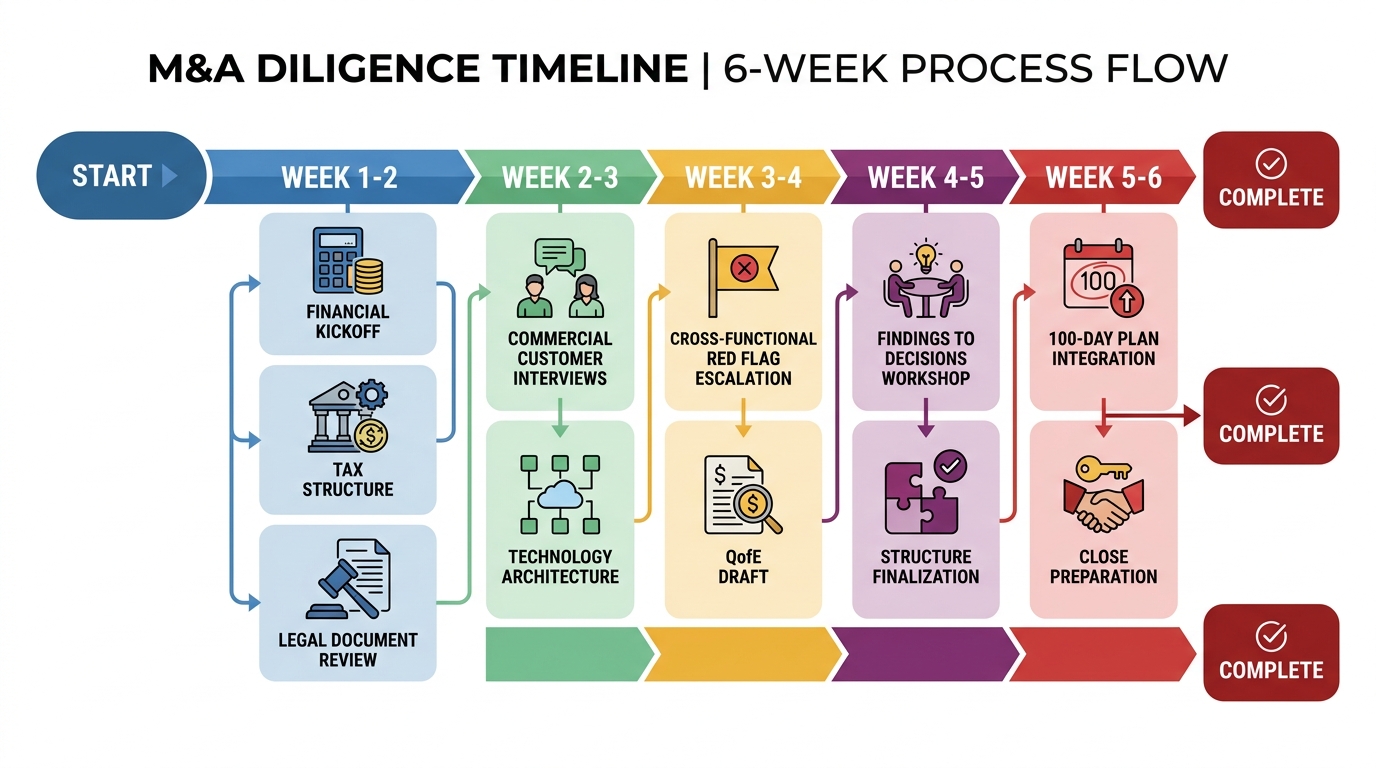
9. Timing Considerations for SME Transactions
Most SME transactions operate on 45-60 day exclusivity windows. This timeline requires parallel execution rather than sequential workstreams.
A workable approach:
Days 1-14: Financial and tax diligence kickoff (data room population is the critical path). Legal document review begins. Commercial hypothesis development.
Days 14-28: QofE first draft. Tax structure recommendation. Commercial customer interviews and market validation. Technology architecture review.
Days 28-42: Cross-functional findings synthesis. Red flag escalation and resolution. Pricing, structure, and 100-day plan implications documented.
Days 42-56: Final diligence reports. Deal negotiation on open items. Closing preparation.
This timeline assumes reasonable data room quality and seller cooperation. Delays in document production are the most common cause of timeline slippage.
10. Common SME Diligence Mistakes
Over multiple transactions, I have seen the same patterns cause problems. Here are the most common.
Treating Diligence as Document Collection
Requesting documents is not diligence. Analysis of documents, follow-up questions, and translation of findings to decisions is diligence. A fully populated data room with unread documents creates false confidence.
Underweighting Commercial Diligence
SME acquirers often rely heavily on financial and legal diligence while underinvesting in commercial validation. This is backwards. Financial statements tell you what happened. Commercial diligence tells you whether it will continue.
Failing to Quantify Technology Debt
Technology findings often remain qualitative ("the codebase needs work") rather than quantified ("remediation will require $X investment over Y months"). Unquantified findings cannot inform pricing or VCP budgeting.
Disconnected 100-Day Planning
Building the integration plan after close rather than during diligence means repeating analysis and missing the window to address issues proactively. The 100-day plan should be drafted in parallel with diligence, updated as findings emerge.
11. The Resource Matrix for SME Acquirers
This article provides the coordination framework. Detailed guidance for specific workstreams is available through dedicated resources:
Tax diligence: The tax due diligence checklist covers exposure identification, structure optimization, and post-close requirements. Note that this is operational guidance, not tax advice; work with your tax advisors on specific transactions.
Commercial diligence: The commercial due diligence playbook provides methodology for customer validation, market assessment, and competitive positioning analysis.
Technology diligence: The technology due diligence playbook covers architecture assessment, technical debt quantification, and integration complexity scoring.
Implementation support: For teams that need execution capacity for technology diligence or post-close integration, diligence implementation support is available through DevriX.
12. Summary and Action Items
An effective M&A due diligence checklist is not a document request template. It is a decision system that connects findings across workstreams to inform pricing, structure, and post-close operating plans.
For SME acquirers preparing for or currently in diligence, here are the key action items:
- Establish cross-functional coordination from day one. Weekly workstream check-ins, a shared risk register, and clear escalation protocols.
- Staff appropriately for the transaction. Tax and legal specialists are non-negotiable. QofE providers and technology assessors add significant value for most transactions.
- Translate every finding to a decision. Price adjustment, structure modification, or 100-day plan item. Findings that inform no decision are noise.
- Build the VCP in parallel with diligence. Do not wait until post-close to discover what the first 100 days require.
- Use the workstream map above as a coordination tool. Adapt it to your specific transaction, but maintain the cross-functional dependency tracking.
Diligence is not about checking boxes. It is about building conviction, identifying risks, and preparing to operate. The M&A due diligence checklist framework above provides the structure. The execution is yours.
If you’re preparing for an acquisition, download the M&A Due Diligence Workstream Tracker to coordinate financial, tax, legal, commercial, technology, and operational diligence within a single decision framework. The template includes responsibility mapping, cross-functional dependencies, red-flag escalation criteria, and a practical 45-day diligence timeline designed for middle-market transactions.


