If you run an engineering business that a private equity firm has approached, or you sit on the operating side of a fund looking at one, a buyer's ability to finance the deal is rarely the constraint. The constraint is whether the business these buyers are underwriting is the same business you actually run. Engineering companies, whether that means civil and structural consultancies, industrial design-and-build firms, or software engineering shops, carry revenue structures that behave differently from the SaaS templates most funds know by heart. Private equity buyers for engineering companies tend to misprice two things: how much of the backlog is real contracted work, and how much of the margin depends on named people who can leave.
This guide is for the operator or portfolio executive who has budget and a decision in front of them, not for someone learning what a bolt-on is. The question it answers is practical: when a buyer puts a thesis on the table, how do you judge whether it holds, and where will it break during the first 100 days.
1. Why engineering companies confuse the standard PE model
Most private equity underwriting assumes a recurring-revenue spine, a cohort of customers, and gross margin that scales as you add seats or units. Engineering firms rarely fit that shape. A structural consultancy bills against project milestones, a fabrication business recognizes revenue as it ships, and a software engineering outfit sells capacity that resets every time a contract ends. The numbers can look strong in a given year and still carry no recurring floor.
Bain's annual private equity report has tracked how the industry's playbook was built around software and consumer assets with predictable retention. You can see that bias in how deals get screened on the Bain & Company Global Private Equity Report. When a buyer applies that lens to an engineering firm, the first thing that breaks is the revenue quality assumption, because backlog is not the same as contracted recurring revenue, and utilization is not the same as retention.
I have watched the gap between booked revenue and billed revenue tell the whole story in a services business where the annual growth number looked healthy and the cash landing in the bank was flat. In engineering, that gap hides in the blend between fixed-price projects, time-and-materials work, and change orders that may or may not get approved. A buyer who does not separate those three is pricing a business they have not seen.
2. What the buyer is really purchasing, and it is not your headcount
A PE-backed buyer is not purchasing your engineering team, your project pipeline, or your CAD seats. It is purchasing a measurable improvement in enterprise value between entry and exit. That improvement has to come from somewhere specific: margin expansion, faster integration of add-ons, lower delivery risk, better visibility into project profitability, or a higher exit multiple than the entry.
For the portfolio executive, this matters because it tells you which workstreams the fund will actually fund. If the thesis rests on margin expansion through better project controls, expect pressure on your estimating and resourcing discipline. If it rests on a buy-and-build, expect the integration machine to arrive on Day 1. The thesis is a claim about where value hides in your business, and your job is to test whether that claim survives contact with how the work actually gets delivered.
McKinsey's private capital research has documented how value creation has shifted from financial engineering toward operational improvement, which you can follow through McKinsey private capital research. For engineering firms the operational lever is almost always the same one: the distance between what a project was priced at and what it cost to deliver.
3. The four things a buyer must decide, and what each one tells you
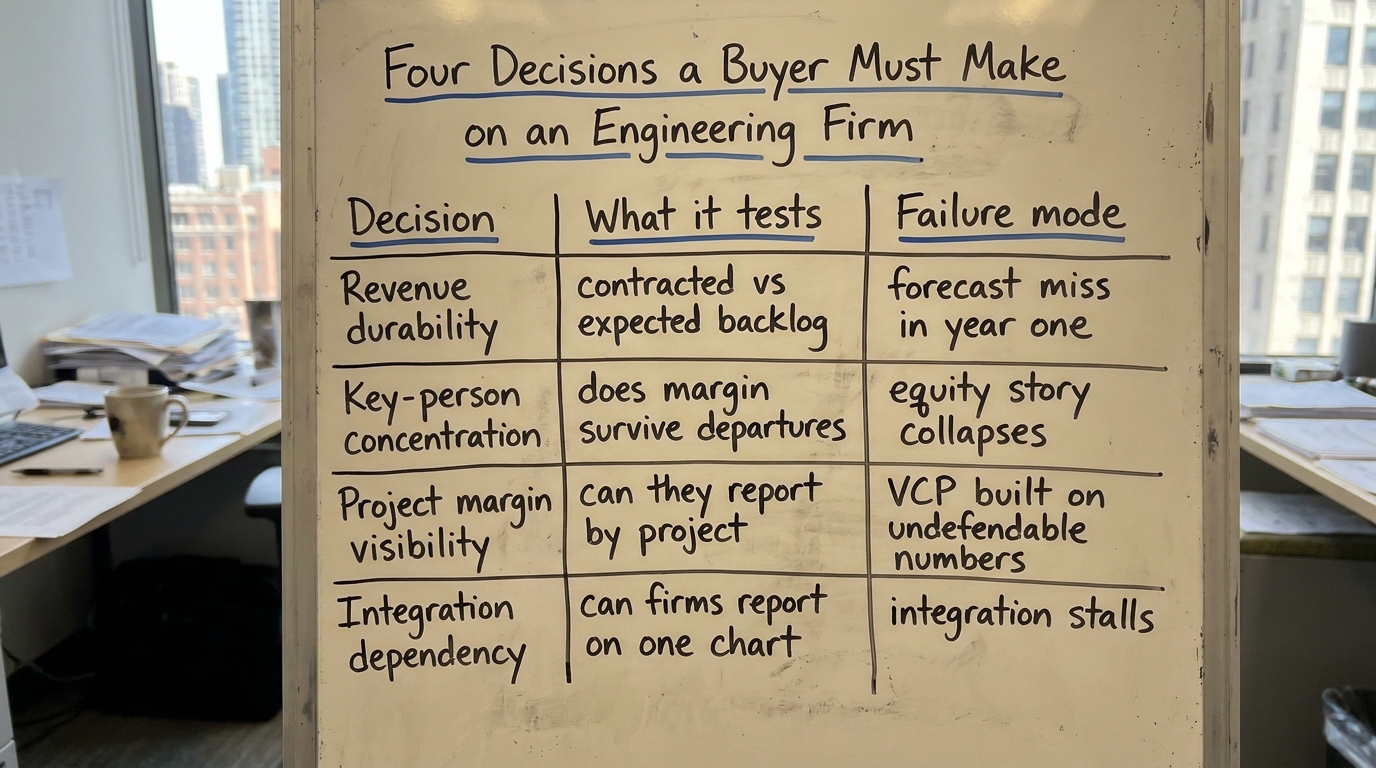
When private equity buyers for engineering companies build their case, four decisions sit underneath everything else. Reading the buyer's answer to each tells you what kind of owner they will be.
Revenue durability
Is the backlog contracted, or is it a pipeline of likely-but-unsigned work? A buyer who underwrites the backlog as if it were revenue is setting up a forecast miss in the first year. Ask how they treat change orders, framework agreements, and multi-year programs with annual renewal clauses. If they cannot distinguish signed work from expected work, they have not done the diligence.
Key-person concentration
In many engineering firms, a handful of principals carry the client relationships, the technical sign-off, and the margin. A buyer must decide how much of the equity story depends on those people staying, and what retention and succession look like. This is where a lot of deals quietly weaken, because the standalone equity story assumes continuity the firm has never had to prove.
Project margin visibility
Can the firm report margin by project, by client, and by delivery team, or only at the company level? If reporting stops at the top line, the value creation plan is being built on numbers nobody can defend. The buyer needs to decide whether fixing that visibility is a Day 1 task or a precondition to closing.
Integration dependency
If the thesis is a buy-and-build, the buyer must decide how engineering firms with different estimating systems, project codes, and cost structures will actually report on one chart of accounts. That is a systems and data decision as much as a commercial one, and it usually gets underestimated.
4. How to read the revenue quality yourself
Before you accept the buyer's revenue number, rebuild it from the project ledger. For a services or engineering firm, the number that matters is not bookings and it is not recognized revenue in isolation. It is the relationship between the two over time, and whether cash follows at a predictable lag.
Start by separating revenue into three buckets: fixed-price projects where you carry completion risk, time-and-materials work where the client carries it, and recurring or framework income that renews. Each has a different quality. A firm that looks like it is growing because a few large fixed-price projects landed in one period is not the same as a firm growing its recurring and framework base.
S&P Global Market Intelligence and PitchBook both publish revenue-quality and sector data that help you benchmark what durable looks like in a given engineering vertical. You can reach them at S&P Global Market Intelligence and PitchBook research and data. The point of the benchmark is to see whether the buyer's growth assumption is normal for the vertical or heroic, not to copy another firm's mix.
For the mechanics of reconstructing revenue and testing it against cash, the discipline is the same one a quality-of-earnings review applies, and it is worth reading how to judge that work before you commission it in what a portfolio company audit should cost and how to judge the quote you get.
5. The technology and data questions that decide integration speed
Engineering firms accumulate systems the way they accumulate projects: one at a time, each chosen to solve a local problem. By the time a fund looks at them, there is usually a project management tool, a separate time-and-cost system, a finance package that does not talk to either, and a pile of spreadsheets that hold the real operating logic. Nobody can see the whole picture, which is exactly the problem an operating partner inherits.
Serious technology due diligence answers three questions before close: can the firm's systems produce project-level margin without manual rework, how much of the business logic lives in spreadsheets that one person maintains, and what it would take to put an add-on onto the same reporting spine. If the answer to the first is no, the value creation plan starts with plumbing, not with growth.
This is the most common thing I see underpriced. A buyer builds a thesis on margin expansion through better project controls, then discovers the firm cannot report margin by project without a week of spreadsheet surgery each month. The fix is doable, it is a Day 1 workstream with an owner and a budget.
When systems are the gating item, the connective work of getting ERP, project, and finance data into one model is where the first wins come from. That is the sequence set out in the broader approach to private equity operating support, and in the specifics of the CRM you inherit on Day 1 and the three things you fix before touching pipeline.
6. Judging key-person risk without insulting the people who hold it
The hardest conversation in an engineering deal is about the people the whole thing depends on. A buyer who ignores the exposure is naive. A buyer who hammers it clumsily can trigger the departures they are trying to prevent. As the portfolio executive, you want a buyer who treats this as an underwriting fact to manage.
The test is specific. For each principal who carries meaningful client relationships or technical sign-off authority, what share of revenue and margin flows through them, who could cover if they left, and what the retention structure actually commits them to. A buyer who can answer that at the individual level has done real work. A buyer who waves at an incentive plan has not.
Harvard Law School's governance forum has published extensively on management incentives and retention in PE deals, collected at the Harvard Law School Forum on Corporate Governance. The useful reading there is less about structure and more about how retention that looks solid on paper fails when the earn-out and the day job pull in different directions.
7. What the first 100 days should commit to, and what it should leave alone
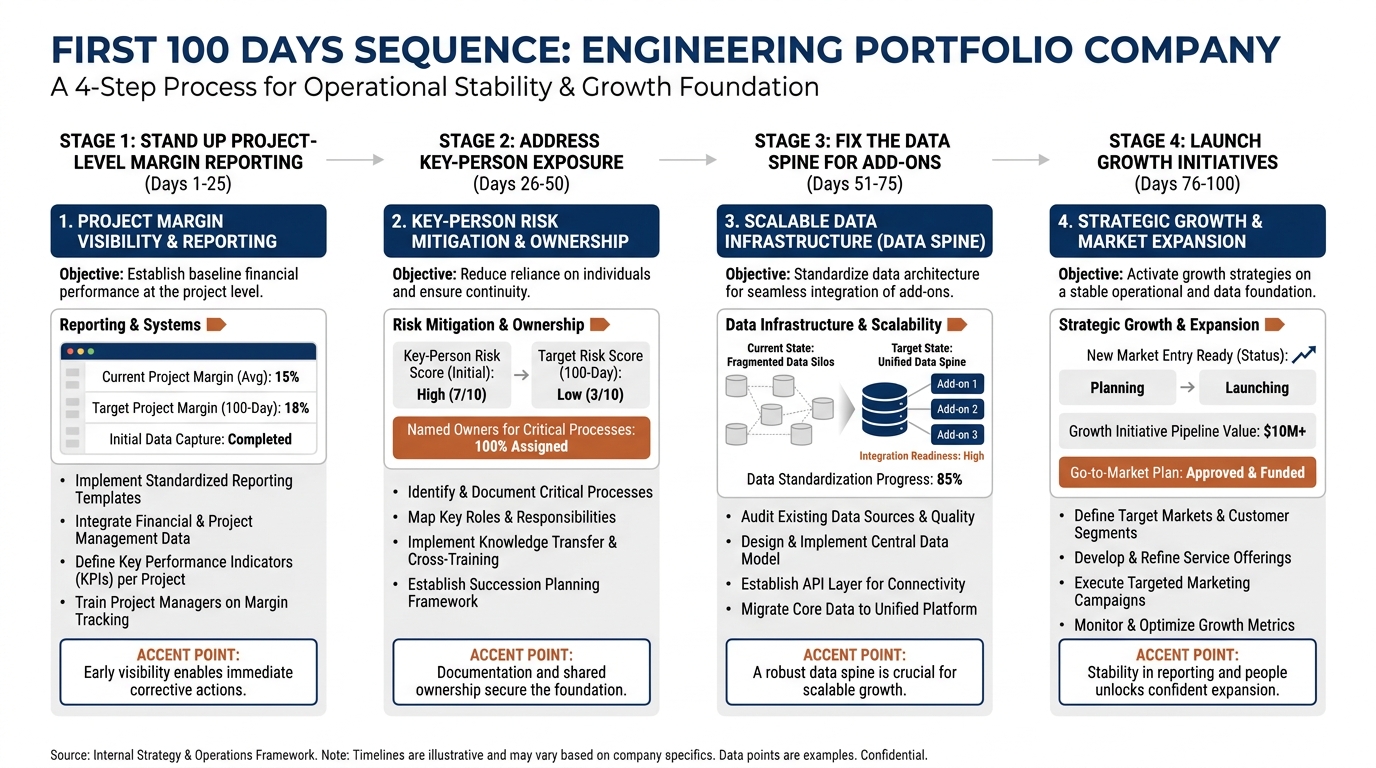
The first 100 days after close set the operating relationship for the hold. For an engineering firm, the temptation is to fix everything that showed up in diligence at once. That overloads the delivery teams who still have projects to ship, and it is how a good thesis stalls in month two.
The disciplined version picks a small number of things that unlock the rest. Usually that means standing up project-level margin reporting first, because almost every other decision depends on being able to see it. Then addressing whatever key-person exposure the diligence surfaced, with named owners and real commitments. Growth initiatives that require the organization to absorb change come after the reporting and the people questions are stable.
A 100-day plan that survives the real systems is specific about sequence and about what it deliberately does not touch yet. The approach is laid out in detail in a 100-day digital plan that survives the real systems, and the operating-partner version of where to spend the opening weeks is in the diagnostic that tells an operating partner where to spend the first 90 days.
8. The working capital trap in project businesses
Engineering firms that bill against milestones live and die on working capital. Work-in-progress that has not been invoiced, retentions held until project completion, and payment terms that stretch past 60 days can tie up more cash than a buyer's model assumes. A business can be profitable on paper and starved of cash at the same time, and in a project business that is the normal state.
For the buyer, this decides how much of the entry financing gets eaten by the working capital swing in the first year. For the portfolio executive, it decides how much headroom you actually have to invest in the value creation plan. Both need the same thing: a clear view of the cash conversion cycle by project type, not a blended average that hides the slow-paying work.
BCG's work on operational value creation in private equity, available through BCG principal investors & private equity, has consistently put working capital among the fastest levers in asset-heavy and project-based businesses. The practical steps to tighten it are in how to hire a working capital optimization consultant for a PE portfolio company.
9. How to judge the buyer's operating capability, not just their cheque
Not every private equity buyer who can finance an engineering company can operate one. The capability you want to judge is whether the fund has operators who understand project-based delivery, or whether their operating bench was built entirely around software and consumer assets. A buyer whose only playbook is the SaaS one will push levers that do not exist in your business.
Ask directly what the operating team has done in services or engineering firms before. Ask who owns the value creation plan on their side, and whether that person has run project margin reporting in anger. A fund that answers with portfolio logos and no named operator is selling you the brand.
Preqin's data on fund operating teams and performance, at Preqin alternative assets data, and the deal reporting in PE Hub, let you check whether a buyer has a track record in your sector or is making a first move into it. Neither answer is disqualifying, but you should price the difference. What a strong operating partner actually does is set out in what a portfolio operations advisor for private equity should actually do for your deal.
10. The brand and commercial questions nobody puts in the model
Engineering firms often carry more commercial value in reputation and relationships than the financial model captures. A structural practice known for a specific building type, or a software engineering firm trusted in a regulated vertical, has pricing power that does not show up as a line item. A buyer who ignores this prices the firm as a body shop, and an owner who cannot articulate it leaves value on the table.
The decision for the buyer is whether that reputation is transferable or whether it is another form of key-person risk wearing a brand name. The decision for the portfolio executive is how to protect and extend the reputation through an ownership change that clients will notice. A structured way to put a number on it is in a brand capital diagnostic for PE portfolio companies that tells you what the brand is actually worth.
Harvard Business Review's coverage of mergers and acquisitions, collected at Harvard Business Review, M&A, has documented how often post-deal value leaks through commercial and cultural factors that the financial diligence never examined. In engineering firms, where the relationship is often with a named principal rather than the firm, that leak is easy to trigger and hard to reverse.
11. Running the value creation plan without waiting for the board cycle
Once the deal closes, the value creation plan is the document that keeps the thesis honest against reality. In engineering firms the plan drifts fastest, because project outcomes move quarter to quarter and a plan reviewed once a year is reporting on a business that no longer exists. The operators who hold value tie the plan to the project data and revisit it every quarter.
That cadence matters more than the plan's initial precision. A plan that is refreshed against actuals every quarter catches a slipping margin thesis in month four, not at the next annual board review. The argument for the shorter loop, and how to run it without drowning the team in reporting, is in the value-creation plan you refresh every quarter, not every board cycle.
If the fund wants value creation capability without hiring a full office for it, the economics of renting that function are set out in how to buy a value creation office as a service without overpaying for a function you only need part-time. For an engineering firm with one or two bolt-ons planned, that part-time model often fits better than a standing team.
12. A checklist for judging the fit before you sign
Run the buyer and the thesis through these before you commit. If more than a couple come back weak, the deal is priced on assumptions that have not been tested against how your firm actually delivers.
- Has the buyer separated contracted backlog from expected pipeline, and priced only the contracted part as revenue?
- Can they state, for each key principal, the share of revenue and margin that depends on them staying?
- Does the firm's own system produce project-level margin without monthly spreadsheet rework, or is that a Day 1 build?
- Has the buyer modeled the working capital swing by project type rather than as a blended average?
- Does the operating team include someone who has run project-based delivery, not only software or consumer assets?
- Is the reputation and relationship value treated as transferable, or quietly as another form of key-person risk?
- Does the thesis name which lever drives the exit multiple, and can you see it in the data today?
- If there is a buy-and-build, is there a plan to put add-ons onto one reporting spine, with an owner and a budget?
- Is the value creation plan built to refresh against actuals quarterly?
- Does the 100-day plan sequence the work, and name what it deliberately leaves alone until the foundation is stable?
The AICPA and CIMA guidance on earnings quality and project accounting, at AICPA & CIMA, is a useful reference for the revenue-quality items above, and the SEC's materials at the U.S. Securities and Exchange Commission are worth a read on disclosure where the firm or an acquirer is anywhere near public reporting.
13. Where the judgment actually lands
Private equity buyers for engineering companies win or lose on two numbers that rarely appear cleanly in the first model they show you: how much of the revenue is genuinely contracted, and how much of the margin survives the departure of a few named people. Everything in this guide is a way of getting those two numbers into the open before you sign, because they decide whether the thesis is underwriting the business you run or a cleaner version of it that does not exist.
If you are weighing an approach, close to a deal, or already inside the first 100 days of an engineering portfolio company and want the technology, data, and reporting foundations judged and built against this standard, see how the DevriX private equity team structures that work and bring the specific firm you are looking at.


