Leadership transitions can make or break an organization’s progress. Poor communication is one of the main reasons why up to 46% of leadership changes fail within two years. A clear messaging plan is essential to manage stakeholder expectations, avoid misunderstandings, and maintain trust.
Key takeaways include:
- Craft a clear narrative: Address what happened, its impact, and the future direction. Balance stability with change.
- Tailor messages for stakeholders: Employees, investors, customers, and partners need different levels of detail and tone.
- Plan your rollout: Sequence communications in phases - pre-departure, announcement, progress updates, and introduction.
- Prepare managers: Equip them with FAQs and talking points to address concerns effectively.
- Maintain trust post-announcement: Provide regular updates, act on feedback, and ensure consistent messaging.
Leadership changes aren’t just announcements - they’re opportunities to reinforce stability and set the stage for long-term success.
A Board's Guide to Communicating a CEO Transition
Building a Clear and Consistent Transition Narrative
Creating a strong transition narrative takes careful planning. It’s not just about what you say - it’s about ensuring that stakeholders understand the message, feel reassured, and know how to act. Without a solid foundation, your communication risks leaving people confused or anxious. Let’s break down the key elements of crafting a cohesive and effective narrative.
Key Questions Your Messaging Must Answer
Before drafting your message, focus on the core questions stakeholders will ask: What happened? What does this mean for me? What comes next? If you leave any of these unanswered, people will fill the blanks themselves - often with worst-case scenarios.
Your narrative should also clearly explain the board’s expectations for the new leader. Are they stepping in to stabilize operations or to lead a major strategic shift? This distinction shapes the tone and timing of your communication.
"The CEO - not the HR executive - should formally communicate the departure to the company. This signals that the transition has full C-suite support." - JRG Partners
Balancing Continuity With Change
A common misstep in transition messaging is focusing solely on change while neglecting to affirm what’s already working. Effective narratives lead with stability. Begin by acknowledging the outgoing leader’s contributions and confirming that the organization’s core values remain intact. Only then should you introduce the incoming leader’s vision and priorities.
Take Alan Lafley’s return to Procter & Gamble in 2000, for example. Instead of vague promises, he immediately provided clarity by halting nearly $200 million in projects. That decisive action demonstrated his leadership’s direction and priorities. Over the next five years, P&G saw a 70% rise in profits and a 30% increase in revenue. The takeaway? Honoring the past and setting a future course go hand in hand.
When a departure is planned and positive, involving the outgoing leader in the messaging - such as through a joint statement - can reinforce stability and signal a smooth, intentional handoff.
Defining Your Core Messaging Pillars
Once you’ve addressed the key questions and struck the right balance between continuity and change, it’s time to define the central themes of your communication. These 3 to 5 messaging pillars will serve as the backbone of your narrative over the coming weeks or months.
Common themes include stability, growth, alignment with values, and operational focus. Tailor these pillars to your organization’s unique situation, but make sure they’re established before any announcements are made. This ensures that everyone, from the board to team leaders, communicates consistently.
A helpful tool for structuring these pillars is the "Know, Feel, Do" model:
- Know: What facts do stakeholders need to understand?
- Feel: How should they feel - reassured, motivated, or informed?
- Do: What actions should they take next?
This approach keeps your messaging clear and actionable, avoiding vague corporate jargon.
| Message Element | Purpose | Focus |
|---|---|---|
| The "Why" | Explains business reasons for the change | Logic-based trust |
| The "Who" | Shares the new leader's personal story | Emotional connection |
| The "Where" | Paints a picture of the future vision | Inspiration and direction |
| The "How" | Outlines next steps and 90-day expectations | Reducing uncertainty |
Tailoring Messages to Each Stakeholder Group
Once you've established your messaging pillars, the next step is to tailor your communication for each audience. Every stakeholder group has its own set of concerns. For instance, employees may worry about job security, investors need reassurance about the stability of the strategy, and customers want to know their service won't be affected.
Mapping Your Stakeholders and Their Concerns
Start by categorizing your stakeholders into three main groups: internal (executives, managers, frontline staff), external commercial (customers, partners, vendors, lenders), and public (press, social media). Each group has its own priorities and concerns:
- Frontline employees: They want clarity on job security and how their day-to-day responsibilities might change.
- Senior leaders: They need specifics about reporting structures and decision-making authority.
- Investors: Their focus is on the board's oversight of the transition and whether financial guidance remains stable.
- Customers and partners: They need assurance that their services or relationships won’t be disrupted.
- Vendors and lenders: They want confirmation that payment terms and contracts will be honored.
It's critical to communicate with employees before any public announcements. If staff learn about changes from external sources like press releases or social media, it can severely damage trust. In fact, poor internal communication is cited by 58% of U.S. workers as a major reason for wanting to leave their jobs.
Once stakeholders are grouped, refine your messages to address their specific needs and concerns.
Writing Targeted Messages for Each Group
The "Know, Feel, Do" model is a helpful framework for crafting messages. For each stakeholder group, outline what they need to know, how you want them to feel, and what actions they should take.
- Frontline employees: They need to feel secure and stay focused on their roles.
- Investors: Build their confidence in the smoothness of the transition.
- Key customers: Reassure them and reinforce strong partnerships.
The tone and level of detail should vary depending on the audience. For example, investors may prefer formal updates through letters or webcasts, with a focus on governance and financial continuity. Meanwhile, frontline employees may respond better to manager-led discussions with a personal, approachable tone. By tailoring your communication, you can strengthen trust and support across all groups.
Using a Stakeholder Communication Table
A stakeholder communication table is a simple way to ensure that you systematically address the needs of each audience. It helps you organize concerns, core messages, and the best communication channels for each group.
| Stakeholder Group | Primary Concern | Key Message Focus | Recommended Channel |
|---|---|---|---|
| Frontline Employees | Job security & daily routine | Stability, continuity, role impact | Town halls, manager huddles, internal news feed |
| Senior Leaders | Authority & governance | Reporting lines, decision-making frameworks | Private briefings, 1:1 meetings |
| Middle Managers | Operational details & team impact | Toolkits, FAQs, talking points | Briefing sessions 48 hours before announcement |
| Investors | Strategy & ROI | Orderly transition, board confidence, unchanged guidance | Investor calls within 24 hours, IR scripts |
| Key Customers | Service continuity | Service-level guarantees, relationship stability | Personal calls or emails for top accounts |
| Vendors/Suppliers | Contractual terms | Payment continuity, single point of contact | Formal letters, direct email |
Middle managers need special attention since they are the first point of contact for many employees' questions. If they are unprepared, your entire internal communication plan could fall apart. Make sure they are briefed at least 48 hours before any public announcement and provide them with written FAQs and talking points to address concerns immediately.
sbb-itb-c53a83b
Timing and Delivery: Planning Your Communication Rollout
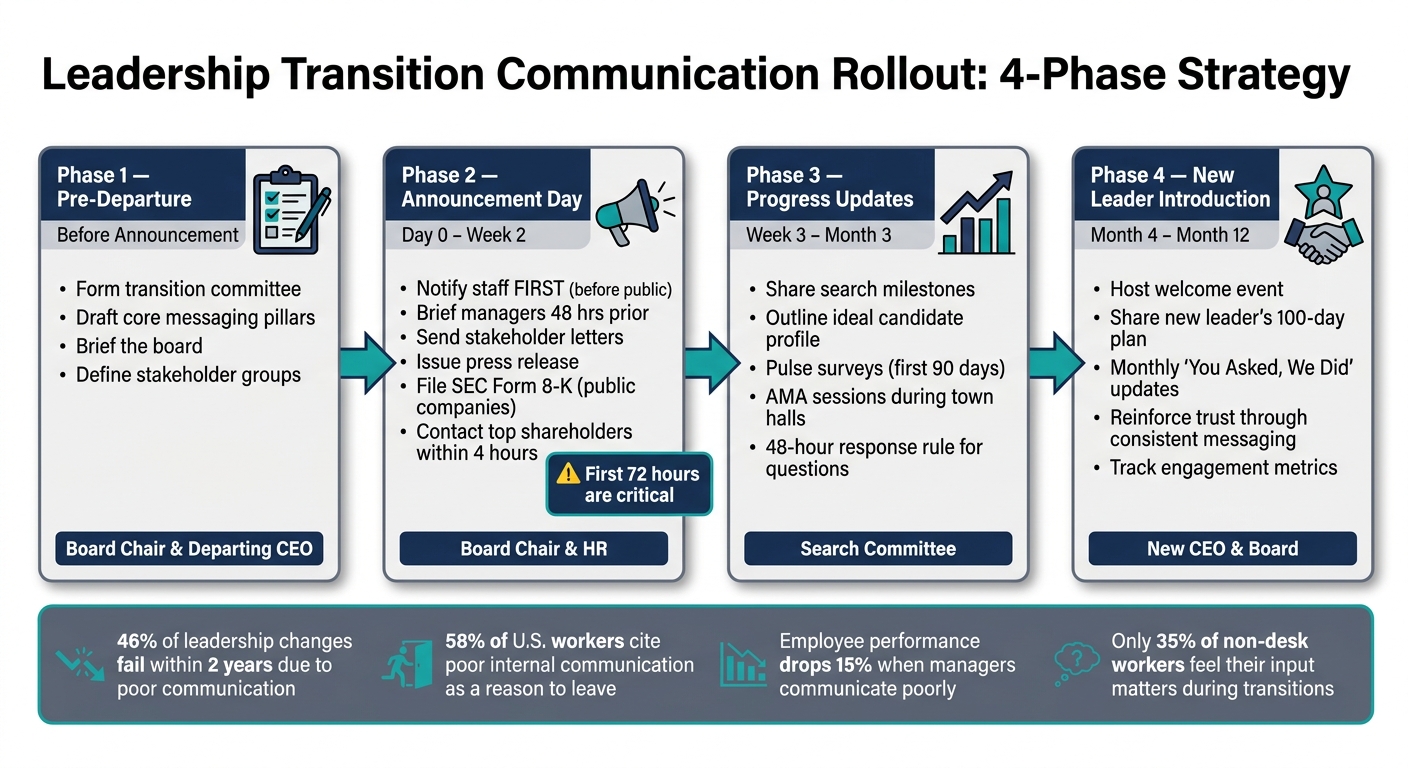
Leadership Transition Communication Rollout: 4-Phase Strategy
Once you've crafted tailored messages, the next step is determining the when and how of delivery. Timing is everything. Even the most perfectly worded announcement will fall flat if it’s delivered too early or too late. A premature statement can undo months of preparation, while a late one might leave stakeholders feeling blindsided.
Sequencing Your Communications in Phases
Breaking your communication into clear phases ensures a smoother rollout and keeps everyone aligned. Think of it in four parts: pre-departure preparation, announcement day execution, progress updates, and new leader introduction. Each phase comes with specific tasks and designated leaders, ensuring accountability and a steady flow of information.
| Transition Phase | Key Communication Actions | Primary Responsibility |
|---|---|---|
| Pre-Departure | Form transition committee; draft key messages; brief the board | Board Chair & Departing CEO |
| Announcement | Notify staff first; send stakeholder letters; issue press release | Board Chair & HR |
| Progress Updates | Share updates on search milestones; outline the "ideal candidate" profile | Search Committee |
| Introduction | Host a welcome event; share the new leader's 100-day plan | New CEO & Board |
The first 72 hours after a major announcement are crucial. For public companies, this includes filing necessary regulatory documents - like an SEC Form 8-K - alongside the press release. It's also essential to contact top institutional shareholders within four hours. Private companies face similar time pressures internally: senior leaders and direct reports should be briefed within the first two weeks, while less immediate audiences, like vendors, can be addressed within 30 to 60 days.
Choosing the Right Channel for Each Message
The way you deliver a message matters just as much as the message itself. Some news deserves the personal touch. For example, sensitive updates should be shared face-to-face or via live video, not through a cold email. Dan Schulman, CEO of Verizon, summed it up well:
"You have to treat people like humans, not like accounts."
For employees without desks, SMS or employee apps often work better than intranet updates. Town halls are great for fostering open dialogue, while detailed governance briefings should remain limited to senior leadership.
Once you’ve determined the best channels, consistency is key. Every platform should reflect the same core message.
Maintaining a Consistent Tone Across Channels
One of the biggest pitfalls in multi-channel communication is message drift - when the tone of a press release doesn’t match what managers are saying in internal meetings. To avoid this, create a single, approved messaging document. This document should include key phrases, central themes, and FAQs to guide everyone from the board chair to frontline managers.
Additionally, use inclusive language to foster a sense of shared purpose. Words like "we" and "our" help create a collective sense of ownership over the transition.
Maintaining Trust After the Announcement
Once the initial rollout is complete, the real challenge begins: keeping trust alive through steady and transparent communication.
As Emma Stockman, PR Account Manager at TMC, wisely notes:
"The announcement should form the beginning of the story, not the conclusion."
In the weeks and months after the announcement, how you communicate will determine whether stakeholders feel confident or start to second-guess their involvement.
Reinforcing Your Core Messages Over Time
Think of your communication strategy as an ongoing campaign, not a one-time event. Break it into three key phases:
- Announcement (Day 0–Week 2): Focus on immediate next steps.
- Transition (Week 3–Month 3): Share details about initiatives and progress.
- Stabilization (Month 4–Month 12): Maintain responsiveness and reinforce trust.
A standout tool during the Stabilization phase is the "You Asked, We Did" update. This monthly summary connects employee feedback to leadership actions, showing that input isn’t just collected - it drives decisions. It’s an effective way to demonstrate accountability and reduce turnover by proving that employees’ voices matter. Regular updates also empower managers to echo these messages within their teams, keeping everyone aligned.
Preparing Managers to Carry the Message Forward
Managers play a pivotal role in shaping how employees perceive change. They’re often the first point of contact for questions like, “How does this affect me?” And when managers struggle to communicate effectively, their teams can suffer - data shows that employee performance drops 15% in these cases.
The solution? Equip managers with the tools they need. Brief them 48 hours before any public announcement, and provide resources like FAQs, approved talking points, and role-specific guidance. For example, in 2025, a scientific organization briefed 95 leaders ahead of a digital transformation. This preparation led to over 100 employees volunteering for "solution teams" to help implement the changes. When managers are well-prepared, they can transform a message into a movement, creating momentum and clarity across the organization.
Tracking Feedback and Refining Your Approach
A lack of feedback doesn’t mean all is well - it often signals disengagement. This is especially true for non-desk workers, only 35% of whom feel their input matters during organizational changes, compared to 50% of desk-based employees. Closing this gap requires intentional listening.
Use tools like pulse surveys during the first 90 days, anonymous digital forms for ongoing concerns, and live AMA (Ask Me Anything) sessions during town halls. The secret is acting on feedback quickly. A 48-hour response rule, where every employee question is addressed within two business days, shows leadership is both attentive and accountable. Keep an eye on engagement metrics - low survey participation or silence from specific teams can be early indicators of deeper issues. Regularly refining your approach based on this feedback ensures employees feel heard and valued.
Conclusion: Setting the Stage for Leadership Success
Leadership transitions thrive or falter based on how the change is communicated. When done right, communication quells uncertainty and preserves trust. When mishandled, it fuels speculation and undermines confidence.
Key Takeaways
As we've explored, effective messaging is more than just a box to check - it's a core responsibility of governance. A well-crafted narrative, agreed upon behind closed doors before any public announcement, is crucial. Without it, the rumor mill can spiral, creating far more damage than the leadership change itself.
"The greatest risk is not leadership change itself, but what happens in the vacuum around it." - Karin Bonev, Managing Director, Dix & Eaton
Three key principles emerge as essential. First, sequence deliberately - internal teams must always hear the news before it reaches the public. Second, customize your message for each stakeholder group using the "Know, Feel, Do" framework. This ensures every audience receives the information they need in a way that resonates. Third, treat the announcement as the starting point, not the conclusion. Communication should unfold in phases - announcement, transition, and stabilization - to sustain clarity and trust throughout the process.
Providing managers with clear toolkits, responding to questions within 48 hours, and acting on feedback promptly are all hallmarks of a well-executed transition.
By adhering to these principles, organizations can pave the way for smoother leadership transitions.
How Growth Shuttle Can Support Your Leadership Transition
Applying these communication strategies effectively can be daunting. Leadership teams are often operational experts, not messaging specialists, and transitions require a blend of both.
Growth Shuttle partners with CEOs and executive teams to bring clarity and structure to this process. From crafting your core narrative to planning stakeholder communication sequences, Growth Shuttle provides hands-on support tailored to your unique needs. Their services range from $600/month for focused strategy sessions to $7,500/month for comprehensive, cross-departmental engagement, which includes participation in key discussions and negotiations.
Effective communication during leadership transitions isn't just about managing change - it's about laying the groundwork for long-term success. For leaders managing teams of 15–40 people, having an experienced advisor who understands the common pitfalls can mean the difference between a seamless transition and a disruptive one.
FAQs
What should we say if the reason for the departure can’t be shared?
When a departure's reason cannot be shared, steer clear of ambiguous statements or excessive details that might invite speculation. Instead, provide a straightforward explanation tied to business priorities - such as shifting goals or strategic adjustments. Be clear about the transition plan, including who will step into the role, and highlight the organization's continued stability. This approach helps maintain trust and reassures stakeholders that operations remain on track.
How do we ensure consistent messaging across managers, email, and press?
To keep communication consistent, develop a central messaging matrix that includes approved facts, key phrases, and a set of Q&A responses. Tailor the tone and focus for different audiences, but ensure the core messages remain aligned. Make sure managers are briefed at least 48 hours before any announcements. Provide them with toolkits and FAQs to prepare them for questions. Always inform employees first about any changes to build trust and ensure accurate, unified messaging across all communication channels.
What metrics show our transition communications are working?
To measure how well your transition communications are landing, it’s important to track key metrics and milestones - not just right after the announcement, but over time. Use pulse surveys at strategic intervals, such as at the announcement, 30 days later, and again at 90 days. These surveys can help you assess employee sentiment by focusing on critical areas: Do employees understand the change? Do they trust the new leader? Do they know where to find answers to their questions?
Tools like Growth Shuttle can play a crucial role in this process. By tracking metrics, OKRs, and gathering consistent feedback, you can ensure your leadership transition stays on the right path.


