If you are advising a portfolio company board, sourcing deals for a mid-market fund, or sitting on a family-owned business weighing a sale, the volume of undeployed private equity capital shapes every conversation you will have in the next 18 months. Bain & Company's 2024 Global Private Equity Report pegged global private equity dry powder at roughly $2.59 trillion at the end of 2023, a record. That figure is not merely a curiosity for fund accountants. It translates into deployment pressure, which in turn influences entry multiples, auction dynamics, hold-period decisions, and the strategic posture your board should adopt toward inbound interest. This article unpacks what the dry-powder overhang signals, how it changes competitive behavior in deal processes, and where it concentrates by fund size and strategy. I have spent years working with operators navigating sponsor-backed transactions, and the patterns are consistent: capital abundance does not guarantee value creation, but it does change the rules of engagement.
Why an uncalled-capital overhang is a signal, not just a number
Dry powder, defined as committed but undeployed capital, represents a promise that general partners made to their limited partners. That promise carries a clock. Most funds operate within a 5-year investment period, after which undeployed capital typically cannot be called. When dry powder accumulates faster than deployment, the signal is not that sponsors are cautious. The signal is that deployment pressure is building, and that pressure will eventually release into deal activity, pricing behavior, or both.
McKinsey's 2024 Private Markets Annual Review noted that while fundraising slowed in 2023, the overhang actually increased because deal volume fell faster than new commitments. This dynamic matters for anyone building a private equity investment thesis: the capital is not disappearing. It is waiting, and waiting sponsors face LP pressure, fee drag on undeployed capital, and reputational risk if they fail to put money to work before the investment period expires.
The Fee Clock and LP Pressure
Most fund structures charge management fees on committed capital during the investment period. A sponsor sitting on $500 million in uncalled capital is collecting fees on that capital while generating no returns. LPs, particularly sophisticated institutional investors, notice. They ask questions in quarterly letters. They consider re-up decisions. This creates a quiet but persistent incentive to deploy, even when entry multiples are elevated.
Vintage-Year Concentration
A disproportionate share of current dry powder came from funds raised in 2021 and 2022, when fundraising hit record levels. Those funds are now 2-3 years into their investment periods. The next 24 months will see intensified deployment activity from these vintages, regardless of macroeconomic conditions. For sellers evaluating timing, this is a tailwind. For buyers competing in auctions, it is a headwind.
How deployment pressure changes entry pricing and competitive process behavior
When sponsors face deployment pressure, their behavior in competitive processes shifts in predictable ways. Understanding these shifts matters whether you are a board considering an unsolicited offer, a management team preparing for a sponsor-backed buyout, or an operator assessing private equity deal flow in your sector.
Entry Multiple Inflation
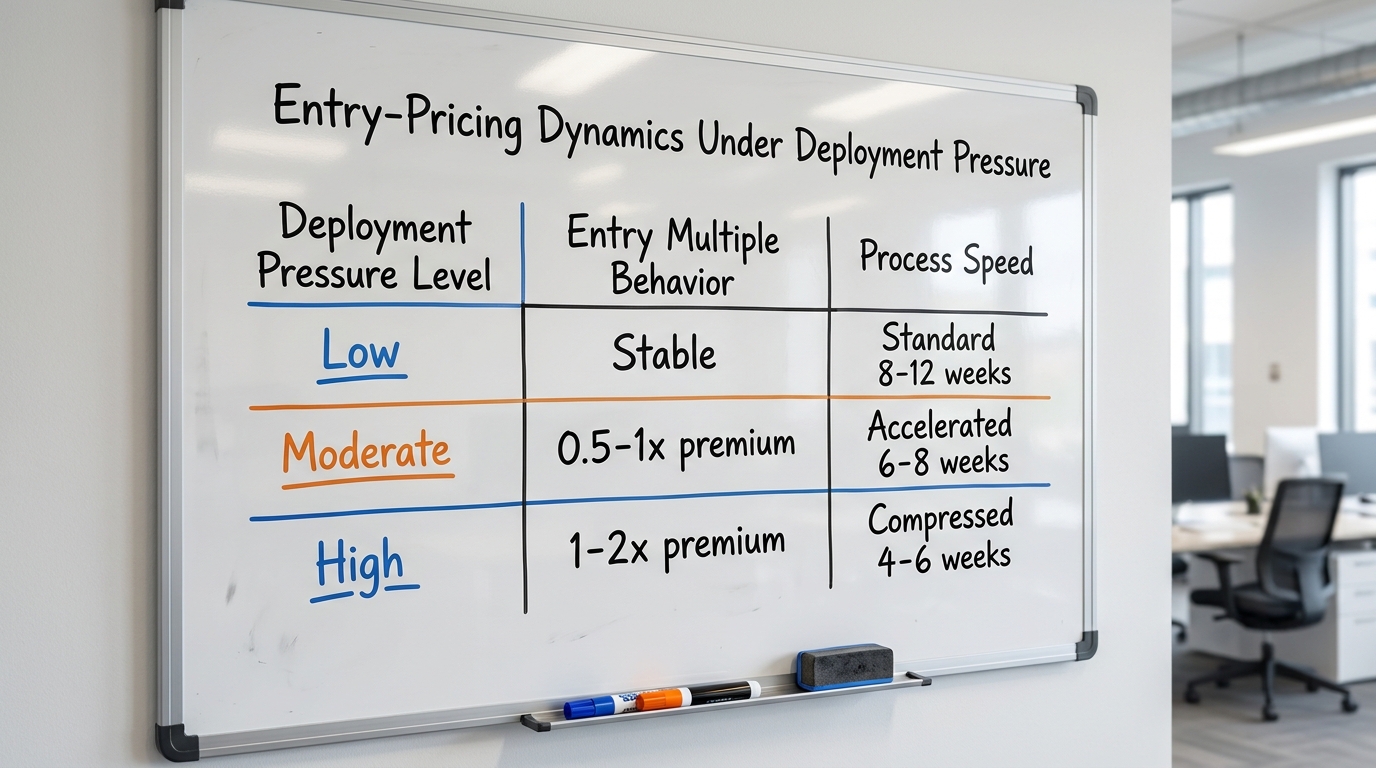
The first and most visible effect is upward pressure on entry multiples. S&P Global Market Intelligence reported that median EV/EBITDA multiples for US buyouts remained above 11x through late 2023, despite higher interest rates that should theoretically compress valuations. The disconnect is partially explained by dry-powder deployment pressure: sponsors with capital to deploy will pay more to win auctions, particularly for quality assets in defensible sectors.
This does not mean every asset attracts premium pricing. Deployment pressure is selective. It concentrates on assets that fit sponsor mandates, have clear growth levers, and can absorb leverage at current debt costs. Assets outside these parameters may see muted demand even in a capital-abundant environment.
Process Speed and Exclusivity Requests
The second effect is accelerated process timelines. Sponsors with deployment pressure are more willing to move quickly, waive conditions, and offer exclusivity premiums to avoid drawn-out auctions. For sellers, this can be advantageous if managed correctly. For competing buyers, it raises execution risk. If you are a smaller fund competing against larger sponsors with more pressing deployment clocks, you may find yourself outpaced even when your operational thesis is stronger.
Platform Versus Add-On Dynamics
Deployment pressure also shifts sponsor preferences between platform and add-on acquisitions. Platform deals consume more capital per transaction, helping sponsors deploy larger checks more efficiently. When dry powder is elevated, expect increased competition for platform-scale assets and relative softness in smaller add-on transactions that sponsors view as capital-inefficient for deployment purposes.
Where dry powder concentrates by fund size and strategy
Not all dry powder is created equal. The distribution by fund size and strategy determines which market segments face the most intense deployment pressure and which remain relatively insulated.
Mega-Funds and Upper Mid-Market
Preqin data shows that funds larger than $5 billion hold a disproportionate share of global dry powder. This concentration has implications for deal activity: mega-funds need large transactions to deploy capital efficiently, which intensifies competition for $500 million+ enterprise-value targets. Upper mid-market companies (enterprise values between $200 million and $500 million) benefit from spillover demand as mega-funds stretch down or pursue platforms for roll-up strategies.
Growth Equity and Lower Mid-Market
Growth equity funds, which typically invest in earlier-stage or faster-growing companies with less leverage, also accumulated significant dry powder during the 2021-2022 fundraising cycle. However, their deployment challenges differ: growth assets are more sensitive to revenue momentum, and the 2023 slowdown in growth-company performance created a backlog of capital waiting for fundamentals to stabilize. Lower mid-market buyout funds ($50 million to $200 million enterprise value) face less intense deployment pressure because the fragmented nature of their target market provides more deployment options, albeit smaller.
Sector-Specific Funds
Healthcare-focused, technology-focused, and industrials-focused funds each have their own dry-powder dynamics. Healthcare funds, in particular, raised substantial capital in 2021-2022 and face pressure to deploy into a sector experiencing regulatory uncertainty and margin compression. Technology funds face valuation reset challenges. Industrials funds, by contrast, benefit from nearshoring and infrastructure tailwinds that provide deployment opportunities. Understanding private equity market trends by sector is essential for boards evaluating sponsor interest.
The interaction with debt cost and hold-period extension
Dry powder does not deploy in a vacuum. It interacts with debt availability, debt cost, and existing portfolio dynamics. The current environment, characterized by elevated base rates and tighter credit spreads than 2022 peaks, creates a complex deployment landscape.
Leverage Constraints on Entry Multiples
Higher debt costs reduce the amount of leverage sponsors can apply to transactions while maintaining target equity returns. In a lower-rate environment, a sponsor might lever a deal at 6x EBITDA. In the current environment, 4x-5x is more common for performing credits. This leverage constraint should theoretically compress entry multiples, but dry-powder deployment pressure counteracts it by pushing sponsors to accept lower levered returns or to pay more equity out of their dry powder. The net effect is elevated entry multiples funded with more equity and less debt.
Hold-Period Extension
Existing portfolio companies interact with dry-powder deployment. PitchBook data shows median hold periods extended to approximately 5.5 years in 2023, up from 4.5 years in 2019. Longer hold periods mean slower capital recycling, which compounds dry-powder accumulation. Sponsors cannot deploy new capital into deals that recycle proceeds from prior exits if exits are not happening. This creates a feedback loop: deployment pressure builds, but deployment options narrow because quality assets are either owned by sponsors unwilling to sell at current valuations or priced beyond levered-return thresholds.
Private Credit as a Release Valve
The growth of private credit, which Blackstone and other managers have scaled significantly, provides partial relief for deployment challenges. Private credit funds can provide bespoke financing that traditional leveraged-loan markets cannot, enabling some transactions that would otherwise fail to clear. Understanding private credit trends is increasingly relevant for operators evaluating sponsor-backed transactions, as the availability and cost of private credit directly affects deal feasibility.
Sectors and situations that absorb capital versus those that inflate
Not all sectors respond to dry-powder deployment pressure identically. Some absorb capital productively. Others inflate, creating valuation risk for late entrants and eventual correction risk for sponsors who overpaid.
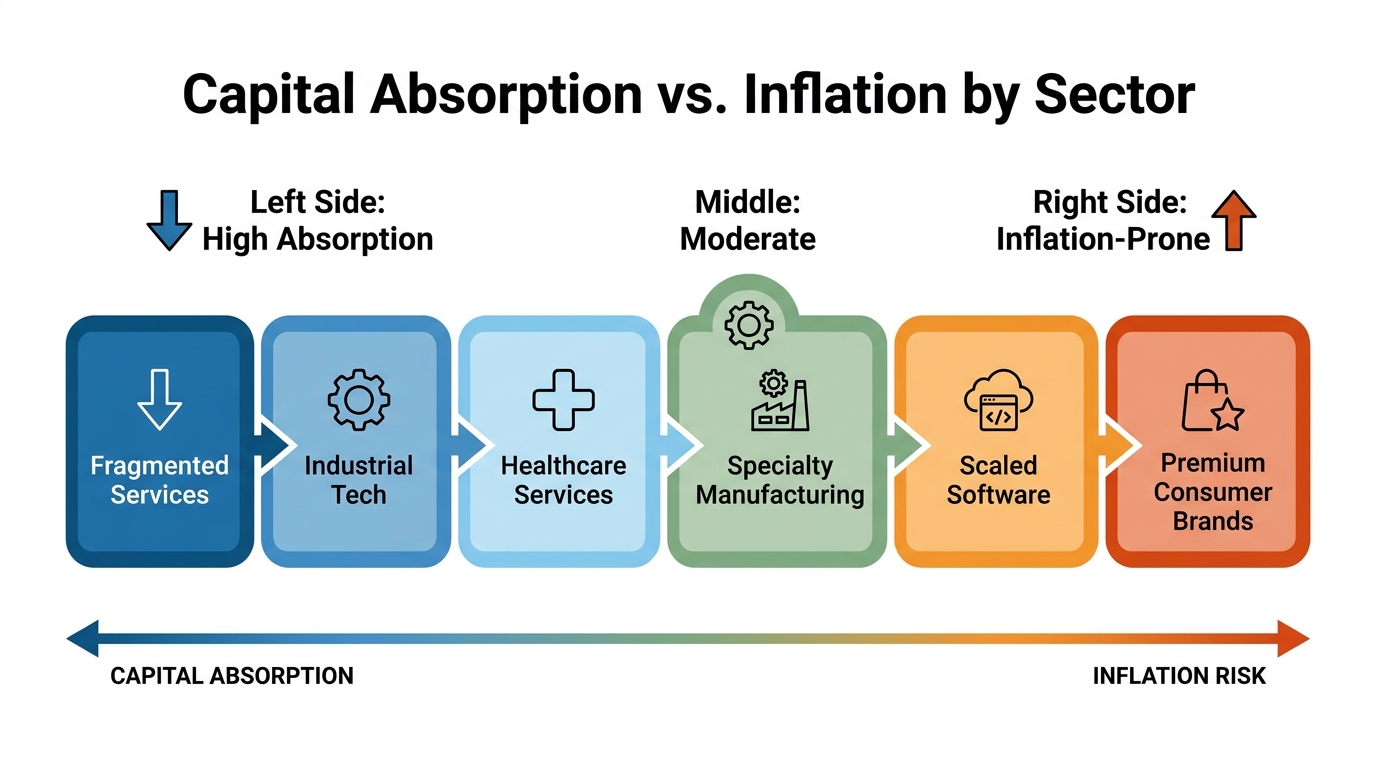
Capital-Absorptive Sectors
Sectors that absorb capital productively tend to share common characteristics: fragmented industry structures that support consolidation, recurring or contracted revenue models that provide visibility, and operational improvement opportunities that justify entry multiples through margin expansion. Examples include:
- Business services: Fragmented, low capital intensity, recurring revenue, operational improvement opportunities through technology and process standardization.
- Healthcare services: Despite regulatory complexity, fragmentation in physician practices, dental, veterinary, and ancillary services supports roll-up strategies.
- Industrial technology: Mission-critical software and services embedded in industrial workflows, high switching costs, subscription revenue.
Inflation-Prone Sectors
Sectors prone to valuation inflation typically feature limited available targets, high sponsor competition, and growth narratives that extend multiples beyond fundamentals. Examples include:
- Software platforms at scale: The scarcity of $100 million+ ARR software platforms with defensible positioning creates intense bidding. Entry multiples above 10x revenue are not uncommon, supported more by capital availability than by underlying cash-flow economics.
- Consumer businesses with brand premiums: Consumer brands with perceived millennial or Gen-Z appeal attract sponsor interest disproportionate to their cash-generation profiles.
Situation-Specific Dynamics
Beyond sectors, specific transaction situations absorb capital more or less productively. Carve-outs from large corporations, where complexity discourages some bidders, often represent better deployment opportunities than auction-ready platforms that have been groomed for sale. Founder-transition situations, where relationship and speed matter as much as price, also absorb capital more efficiently than competitive processes.
Countercase: capital abundance with disciplined underwriting
Not every sponsor facing deployment pressure abandons underwriting discipline. The countercase to the inflation narrative is that sophisticated sponsors, particularly those with strong track records and patient LP bases, can maintain discipline despite deployment pressure. Understanding this countercase is important for operators who might otherwise assume all inbound sponsor interest reflects desperation to deploy.
Reputation and Re-Up Considerations
Top-quartile sponsors derive significant value from their track records. An overpaying vintage that underperforms will damage re-up rates and LP relationships far more than missing deployment targets. These sponsors can afford to return uncommitted capital rather than deploy into inferior opportunities. For sellers engaging with these sponsors, expect rigorous diligence, disciplined bidding, and unwillingness to chase pricing beyond fundamentals.
Sector Specialization as a Deployment Advantage
Sponsors with deep sector expertise can underwrite opportunities that generalist buyers cannot. This expertise enables deployment at entry multiples that would appear aggressive to generalists but are justified by specific operational-improvement plans. For operators in sectors with specialist sponsors, understanding that sponsor's track record and operational playbook is essential context for evaluating inbound interest.
LP Sophistication and Vintage Flexibility
Some LP bases, particularly endowments and sovereign wealth funds, take longer views on deployment timelines. Sponsors with these LP bases face less acute deployment pressure and can wait for appropriate opportunities. This LP composition is not always visible externally but matters for understanding sponsor behavior.
Implications for sponsors sourcing and for portfolio-company boards
The dry-powder overhang creates distinct implications for different market participants. Sponsors sourcing deals face one set of challenges. Portfolio-company boards and management teams face another.
For Sponsors Sourcing Deals
Sponsors with deployment pressure should expect competitive processes to remain intense through at least 2025. Strategies to navigate this environment include:
- Proprietary sourcing: Building relationships with founders, families, and corporate development teams to access opportunities before formal processes begin.
- Carve-out capability: Developing operational infrastructure to execute complex carve-outs that deter less capable bidders.
- Add-on acceleration: Deploying capital into existing platforms through add-on acquisitions rather than competing for new platforms.
- Geographic or situational arbitrage: Focusing on geographies or situations (distressed, turnaround, succession) where competition is less intense.
For a deeper understanding of market dynamics, reviewing private equity market intelligence regularly helps calibrate sourcing strategies against current conditions. Carve-out capability is the one item on that list that needs standing technical capacity, and few mid-market sponsors carry a CTO in-house. A fractional CTO retainer gives the deal team someone to scope separation cost during diligence and then run the stand-up after close, so the complex-deal advantage holds up in execution.
For Portfolio-Company Boards
Boards of sponsor-backed companies should recognize that the deployment overhang affects their strategic options. Implications include:
- Exit timing: Elevated dry powder creates a seller-friendly environment for quality assets. Boards should evaluate exit readiness and consider whether current conditions represent a favorable window.
- Recapitalization opportunities: Sponsors with deployment pressure may offer recapitalizations that provide liquidity to existing shareholders while enabling continued ownership.
- Add-on competition: If your company is pursuing add-on acquisitions, expect competition from other sponsor-backed platforms with similar deployment pressures.
- Unsolicited interest: Boards should establish protocols for evaluating unsolicited inbound interest, which may increase as sponsors seek deployment opportunities outside formal processes.
Dry powder deployment-pressure reference table
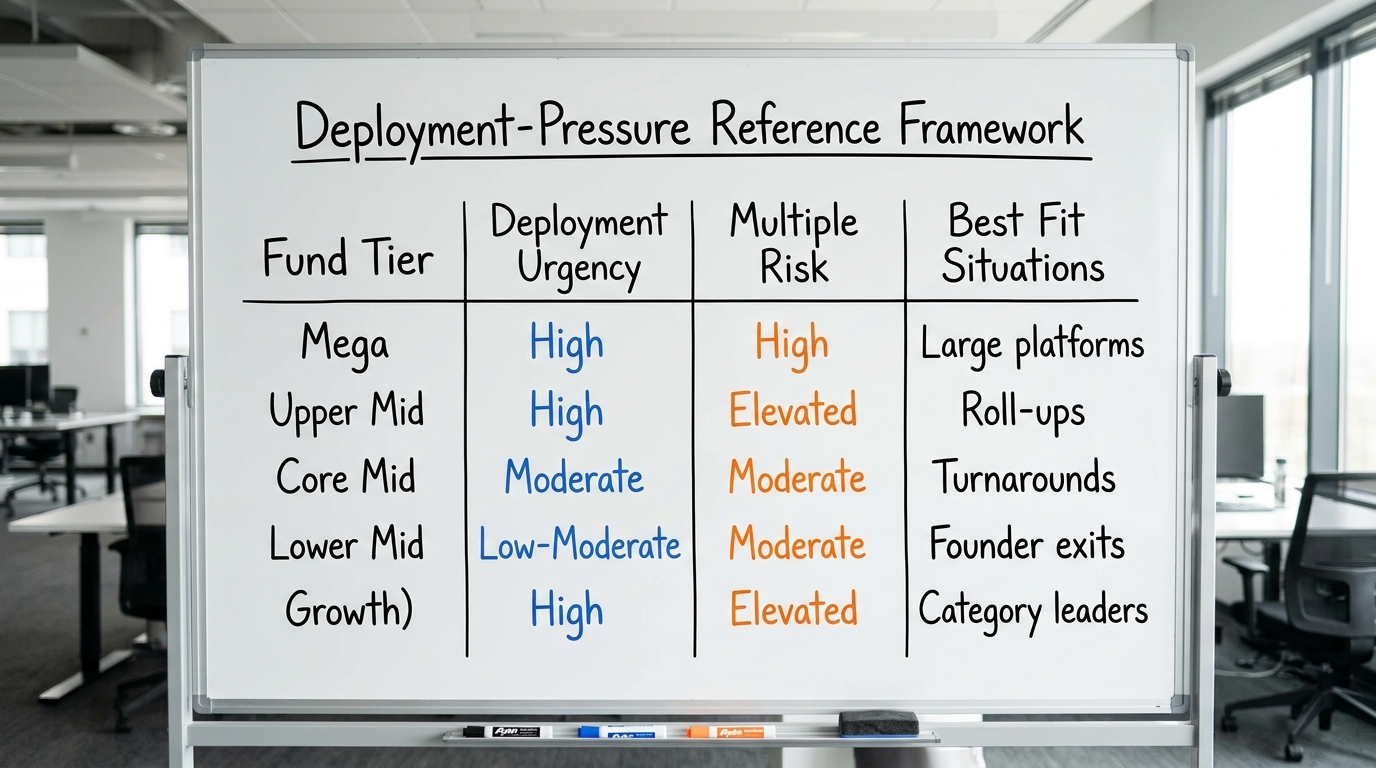
The following table provides a reference framework for evaluating deployment pressure by fund tier and its implications for entry multiples, process dynamics, and situation fit. This is not investment advice but a structural reference for operators and boards assessing sponsor behavior.
| Fund Tier (AUM) | Typical Deployment Window Remaining | Entry-Multiple Risk | Process Competition Intensity | Situation Fit |
|---|---|---|---|---|
| Mega-fund ($10B+) | 2-3 years (2021-2022 vintages) | High: will pay premium for platform-scale assets | Intense for $500M+ EV targets | Large platforms, public-to-privates, corporate carve-outs |
| Upper mid-market ($2B-$10B) | 2-3 years (2021-2022 vintages) | Elevated: spillover from mega-fund competition | High for $200M-$500M EV | Platforms with roll-up potential, founder transitions |
| Core mid-market ($500M-$2B) | 2-4 years (mixed vintages) | Moderate: competition varies by sector | Moderate to high | Growth-oriented platforms, operational turnarounds |
| Lower mid-market ($100M-$500M) | 3-4 years (2020-2022 vintages) | Moderate: fragmented target market provides options | Moderate | Founder-owned businesses, family transitions, niche leaders |
| Growth equity ($500M+) | 2-3 years (2021-2022 vintages) | Elevated for quality growth assets | Intense for $100M+ revenue, 20%+ growth | Category leaders, expansion-stage technology, healthcare IT |
| Sector-specialist funds | Varies by vintage | Variable: expertise enables differentiated underwriting | Intense within sector, advantaged in complexity | Sector-specific carve-outs, regulatory-complex situations |
Summary and checklist for operators
The $2.6 trillion private equity dry-powder overhang is not a passive statistic. It is an active force shaping entry multiples, process dynamics, hold periods, and strategic options for portfolio companies and acquisition targets. For operators navigating this environment, the following checklist summarizes key considerations:
- Understand vintage pressure: Identify which fund vintages are approaching investment-period expiration. These sponsors face the most acute deployment pressure.
- Calibrate entry-multiple expectations: Quality assets in capital-absorptive sectors will command premiums. Assets outside sponsor mandates may see muted demand.
- Assess process dynamics: Expect compressed timelines and exclusivity requests from sponsors with deployment pressure. Prepare accordingly.
- Evaluate sector-specific concentration: Some sectors face more intense deployment pressure than others. Understand where your company or target sits.
- Consider debt-market interactions: Higher debt costs constrain leverage, but dry powder compensates with equity. Understand the financing mix for any transaction.
- Distinguish discipline from desperation: Not all sponsor interest reflects deployment pressure. Top-tier sponsors maintain underwriting discipline regardless of capital availability.
- Prepare for unsolicited interest: Boards should establish protocols for evaluating inbound approaches, which may increase as sponsors seek proprietary opportunities.
- Time strategic decisions deliberately: The current environment favors sellers of quality assets. Evaluate whether conditions support exit, recapitalization, or hold.
The dry-powder overhang will persist through at least 2025, given the 2021-2022 fundraising cycle. Operators who understand its implications can make more informed decisions about capital deployment, exit timing, and sponsor engagement.
Subscribe to the Growth Shuttle research briefing for the quarterly capital-deployment outlook, and download the Dry Powder Deployment-Pressure Reference Table.


