A portfolio company misses covenant. The lender group fragments. Management turnover accelerates. Suddenly, what traded at 8x EBITDA eighteen months ago is available at 3.5x, and your deal team is deciding whether this represents genuine mispricing or the early innings of a collapse that still has further to fall.
This is the core tension in distressed private equity: the same conditions that create buying opportunities also create permanent capital destruction. The difference between the two outcomes rarely lives in the headline metrics. It lives in operational detail, in control dynamics, in whether the business model itself is impaired or merely the balance sheet.
For SME operators and mid-market investors, understanding how to evaluate special situations investing opportunities matters more during down-cycles than at any other time. Capital availability tightens. Competitive bidding thins. And the distance between a transformative acquisition and a catastrophic one narrows to a few underwriting assumptions that turn out to be wrong.
This guide walks through how experienced operators distinguish genuine distressed opportunity from value traps, what operational signals matter most, and how to structure an approach that protects downside while capturing real mispricing. We will build toward a usable distressed-opportunity screen you can apply to live situations.
A distressed price is not a distressed business
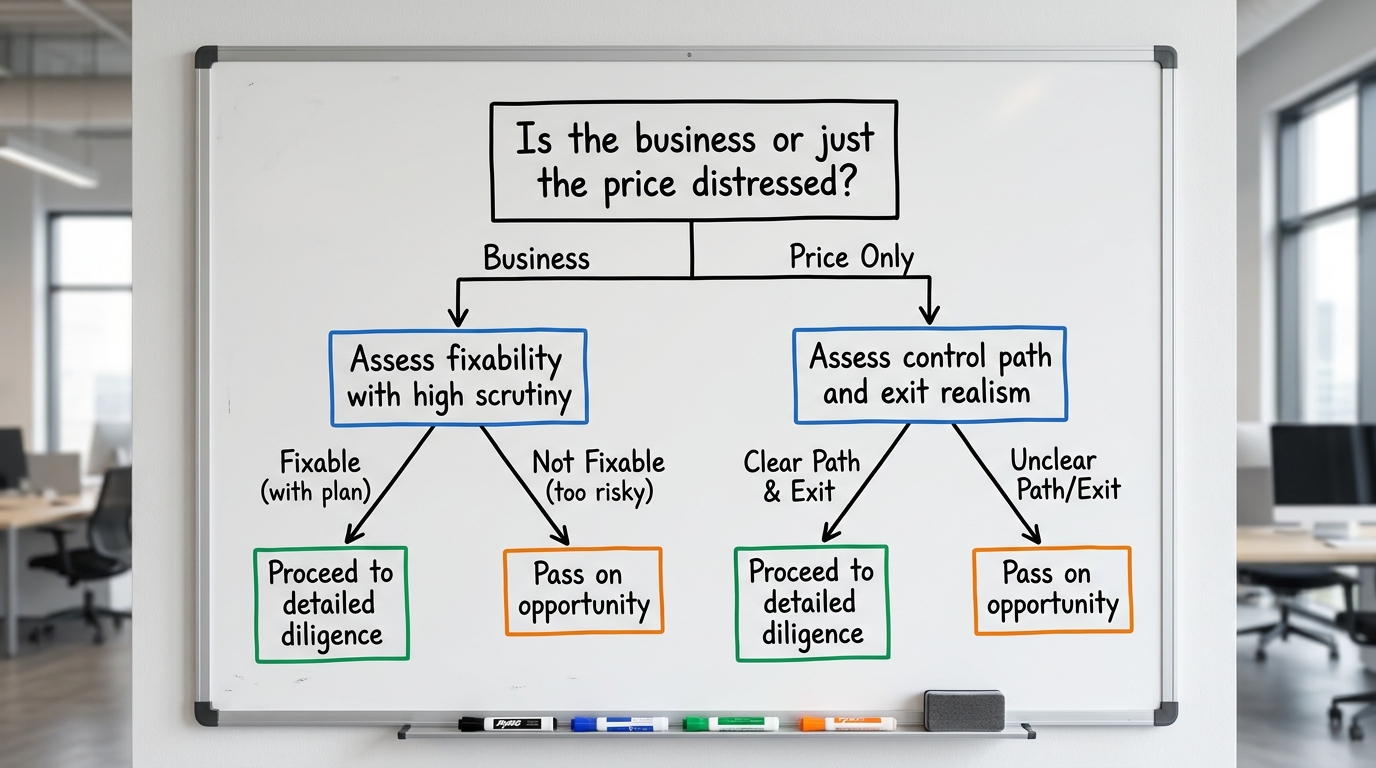
The first discipline in distressed investing is separating price distress from business distress. They often appear together, but they are not the same phenomenon, and conflating them is how capital gets destroyed.
Price distress occurs when external conditions, whether market dislocation, sector rotation, or liquidity crises, push valuations below intrinsic value. The business continues to generate cash, serve customers, and operate within its competitive position. The balance sheet may be stressed, but the operating model remains intact.
Business distress is different. Here, the underlying enterprise is impaired. Customers are leaving. Unit economics have deteriorated. The competitive position has eroded. A lower price reflects a lower enterprise value, not a market inefficiency.
According to Bain's 2024 Global Private Equity Report, roughly 40% of deals that entered restructuring between 2020 and 2023 involved businesses where the core operating model was fundamentally challenged, not merely overleveraged. These were not buying opportunities at any price.
How to Distinguish the Two
The distinction requires looking past topline financial metrics and into operational fundamentals:
- Customer retention rates: Has the business maintained its customer base, or is churn accelerating?
- Gross margin trajectory: Are margins stable, or has competitive pressure or input cost inflation structurally eroded them?
- Competitive position: Is the business losing share because of temporary factors (management distraction, underinvestment) or permanent ones (substitution, obsolescence)?
- Working capital dynamics: Is the business generating or consuming cash at the operating level, independent of financing structure?
A company trading at 3x EBITDA because lenders are forcing a sale is not the same as a company trading at 3x because its addressable market is shrinking 15% annually. Both look like "distressed private equity" opportunities. Only one actually is.
What turns a down cycle into a buying window
Down cycles create buying windows through specific mechanisms, not through generalized "market fear." Understanding these mechanisms helps operators identify when conditions favor buyers versus when they merely look favorable.
Liquidity Constraints on Existing Owners
The most reliable source of genuine mispricing is when existing owners face liquidity constraints unrelated to the asset's quality. A fund approaching end-of-life that needs to exit. A corporate parent divesting non-core assets to shore up the balance sheet. A founder facing personal financial pressure.
These situations create what Harvard Business Review has called "motivated sellers," where the timeline or structure of a transaction matters more to the seller than maximizing price. For buyers with patient capital and operational capability, these moments represent genuine edge.
Lender Fatigue and Portfolio Management
Banks and direct lenders managing large portfolios of stressed credits face their own constraints. Regulatory capital requirements, portfolio concentration limits, and internal risk ratings create pressure to resolve situations, sometimes below recovery value. Understanding private credit trends helps operators anticipate when and where these pressures are likely to create opportunity.
Sector-Specific Dislocation
Some sectors experience temporary dislocation that creates buying windows. Energy services in 2015-2016. Retail in 2020. Commercial real estate in 2023-2024. The key question is whether the dislocation is cyclical (recovery likely) or structural (permanent impairment).
McKinsey's private markets research notes that the best-performing distressed vintages occur when operators enter sectors at cyclical troughs while maintaining conviction that end-market demand will recover. Getting this judgment wrong is how "buying the dip" becomes "catching a falling knife."
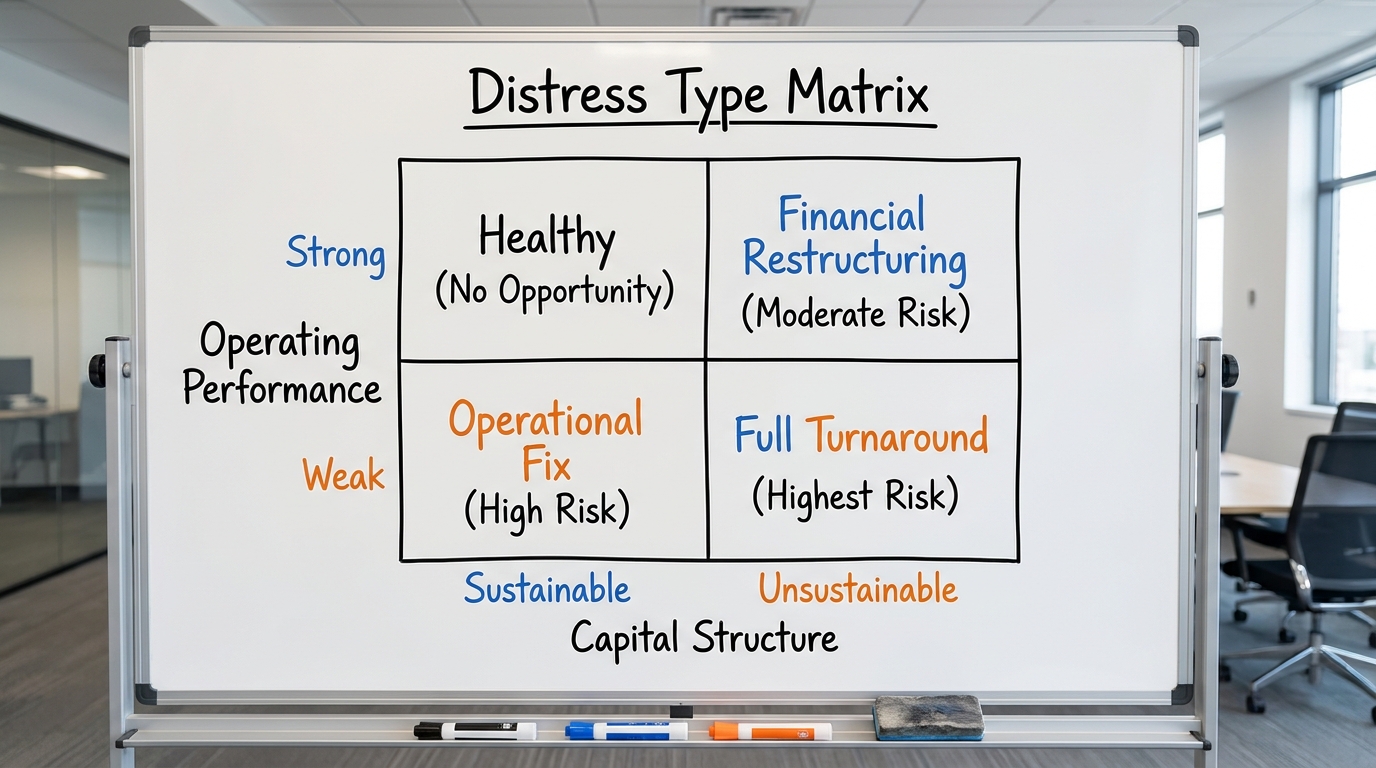
Balance-sheet stress versus operational impairment
One of the most important distinctions in turnaround investing is between businesses that need operational transformation and those that merely need financial restructuring. The skill sets, timelines, and risk profiles are fundamentally different.
Balance-Sheet-Only Distress
Some businesses have healthy operations trapped under unsustainable capital structures. The company generates cash, serves customers effectively, and maintains competitive position, but debt service consumes available liquidity. The path to value creation runs through balance sheet repair: debt-for-equity swaps, new capital injections, or negotiated haircuts with existing creditors.
These situations can be attractive because the operational risk is lower. The business already works. The challenge is financial engineering and stakeholder management rather than business transformation.
Operational Distress Requiring Transformation
Other businesses are distressed because operations have deteriorated. Cost structures are misaligned. Revenue has declined. Customer relationships have eroded. Management capability is insufficient. These require genuine turnaround work: new leadership, cost restructuring, go-to-market changes, and often significant capital investment before the business can stabilize.
The difference in execution risk is substantial. According to BCG's analysis of private equity turnarounds, operational transformations have roughly 60% success rates when led by experienced operators, compared to 80%+ for pure financial restructurings where operations are intact.
Assessing Fixability
The fixability question requires honest assessment of several factors:
- Root cause clarity: Do you understand why the business is underperforming? Vague diagnoses lead to vague remedies.
- Reversibility: Are the problems reversible with execution, or do they reflect permanent market changes?
- Capability match: Does your team have relevant experience turning around similar businesses?
- Time and capital: Do you have sufficient runway to execute the transformation before cash runs out?
Understanding private equity value creation in performing companies is necessary but not sufficient background for distressed situations. Turnarounds involve higher variance outcomes and require comfort with ambiguity that growth-oriented investing does not.
Control structures and the path to value realization
In performing deals, control is typically straightforward. You buy majority equity, appoint the board, and govern the business. In special situations private equity, control is often contested, conditional, or achieved through non-traditional structures.
Entry Points in the Capital Structure
Distressed opportunities can be accessed at multiple points:
- Equity purchases: Buying existing equity at discount, typically when a sale process is underway or creditors have taken control.
- Debt purchases: Acquiring debt instruments at discount with the intention of converting to equity through restructuring or enforcement.
- DIP financing: Providing debtor-in-possession financing during formal restructuring, often with equity warrants or conversion rights.
- Section 363 sales: Acquiring assets through court-supervised processes that provide certain liability protections.
Each entry point carries different risk-reward profiles and control dynamics. Debt purchases may offer downside protection but uncertain conversion timing. Equity purchases provide immediate control but absorb first loss. DIP financing offers structural seniority but requires working within court supervision.
Control Dynamics Matter
The path to value realization depends heavily on control. Questions to assess:
- Who controls the timeline? Can you execute your operational plan, or are you subject to court schedules, creditor votes, or seller processes?
- What decisions require consent? In complex restructurings, operational changes may require creditor or court approval.
- Who are your partners? In debt-for-equity situations, you may emerge with co-investors you did not choose.
- What legacy liabilities follow the asset? Understanding what transfers and what stays behind is essential.
A compelling private equity investment thesis in distressed situations must account for control dynamics explicitly. "We will fix operations" is not a thesis if you do not control the operational decisions.
Signals that separate opportunity from value traps
Experienced distressed investors develop pattern recognition for signals that distinguish genuine opportunity from situations that look cheap but will get cheaper.
Positive Signals
Customer stickiness despite operational problems. When customers remain loyal despite service degradation, it suggests the underlying value proposition is strong. Fix execution, and revenue recovers.
Identifiable, fixable operational problems. Clear root causes with known remedies. The business is not performing well, but the reasons are specific and addressable.
Motivated sellers with clean processes. Sellers who need liquidity but are running professional processes. Not chaotic situations where information quality is poor.
Defensible market position. Even in distress, the business occupies a position that would be expensive to replicate. Customer relationships, geographic coverage, technical capability, or regulatory licenses that represent real barriers.
Negative Signals
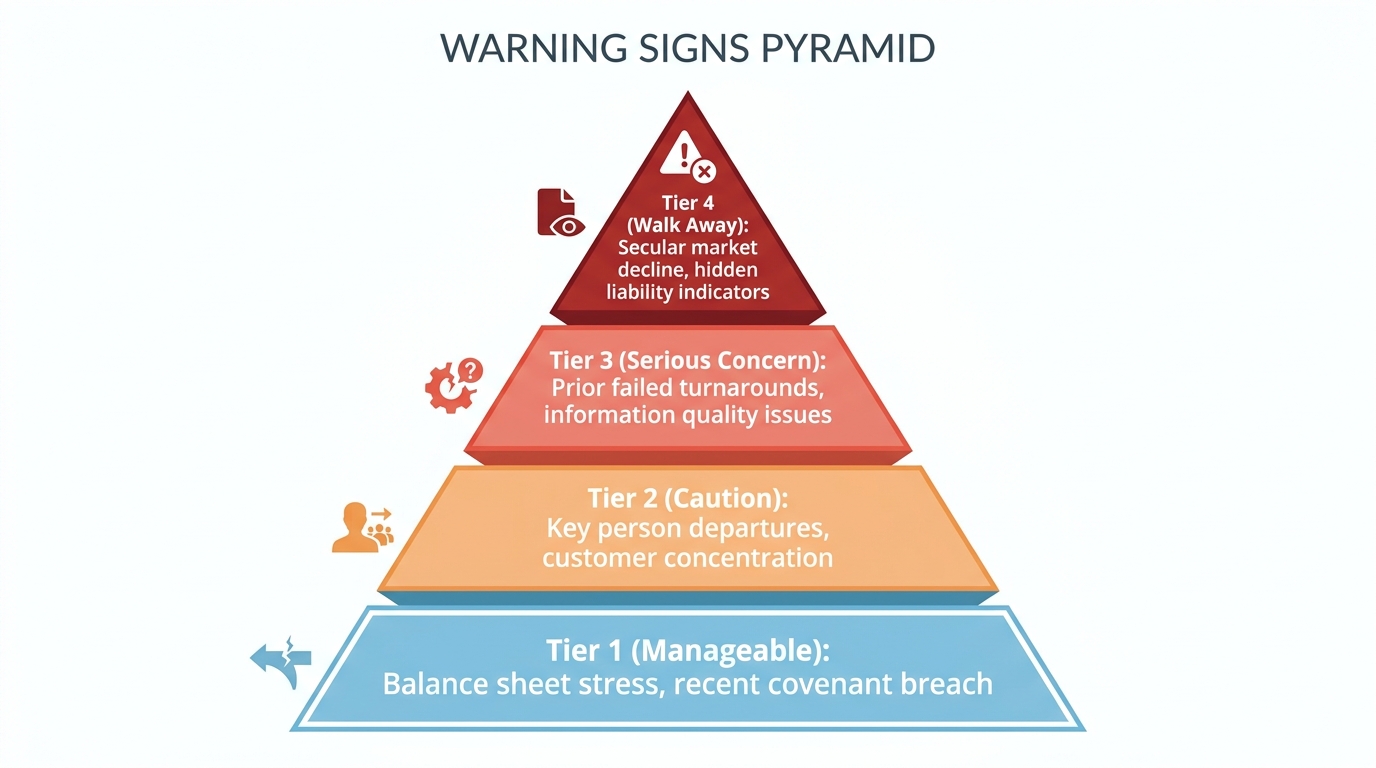
Key person departures accelerating. When talented people with options are leaving, it often signals they see something in the business trajectory that is not apparent in financials yet.
Customer concentration in declining accounts. A business dependent on one or two large customers who are themselves struggling compounds the risk.
Secular decline in addressable market. Some businesses are distressed because their market is shrinking. No operational fix addresses a demand problem.
Information quality deteriorating. When you cannot get clean financials, when management cannot answer basic questions, when data systems are unreliable, the operational problems are likely worse than they appear.
Prior failed turnaround attempts. One failed turnaround might indicate bad execution. Two or three suggest the problem is harder than it looks.
Common failure modes in catching a falling knife
The allure of distressed pricing creates systematic overconfidence. Every deal team believes they can execute the turnaround that prior owners could not. The history of distressed investing includes as many disasters as successes.
Common Failure Modes
Underestimating operational complexity. From the outside, fixes look simpler than they are. Once inside, you discover interdependencies, capability gaps, and cultural resistance that slow everything down.
Insufficient liquidity runway. Turnarounds take longer than projected. The most common failure mode is running out of cash before the operational improvements flow through to financials. McKinsey research suggests turnarounds take 40-60% longer than initial plans anticipate.
Wrong diagnosis. You enter believing the problem is operational, but it is actually market structure. Or you believe it is a cost problem, but it is actually revenue. Wrong diagnosis means wrong remedies.
Management capability gaps. Existing management may have caused the problems. New management takes time to find and longer to become effective. The gap between "we need new leadership" and "new leadership is delivering results" is often 18-24 months.
Hidden liabilities. In distressed situations, surprises tend to be negative. Environmental liabilities, pension obligations, litigation exposure, customer commitments that are not on the balance sheet.
Honest Self-Assessment
Before pursuing distressed opportunities, operators should ask themselves hard questions:
- Do we have relevant turnaround experience, or are we extrapolating from growth situations?
- Can we withstand total loss on this investment without fund-level consequences?
- Do we have the management bench to insert operating leadership if needed?
- Are we intellectually honest about downside scenarios, or are we anchoring on optimistic cases?
Accessing private equity market intelligence on distressed deal outcomes can help calibrate expectations against actual historical performance.
Underwriting and operating expectations post-close
Underwriting distressed situations requires different assumptions than performing deals. Optimism is a liability. Conservatism is a discipline.
Underwriting Adjustments
Revenue assumptions. Plan for revenue declines to continue or accelerate during the transition period. New ownership creates uncertainty. Customers may pause. Competitors may attack.
Cost timing. Assume cost reductions take longer than planned. Severance, contract terminations, facility rationalization all have timing dependencies that extend past initial estimates.
Working capital. Distressed businesses often have working capital tied up in slow-moving inventory, stretched payables that need normalization, or receivables that will not collect. Model the working capital investment required to stabilize operations.
Capital expenditure catch-up. Distressed businesses typically have deferred maintenance and capital expenditure. The cash that was not spent before you arrive will need to be spent after.
Contingency buffers. Build explicit contingency into liquidity models. The standard approach is 20-30% buffer on operating losses and 50%+ buffer on projected timelines.
Operating Model Post-Close
The first 100 days in a distressed situation look different than in a performing acquisition:
- Cash control: Immediate centralization of cash management. Daily or weekly cash reporting. Clear authority over expenditures above threshold amounts.
- Stakeholder communication: Proactive outreach to customers, suppliers, and employees. Uncertainty drives defection. Communication reduces uncertainty.
- Quick wins: Identify and execute visible improvements that demonstrate new ownership capability. Credibility with stakeholders is earned, not assumed.
- Diagnostic depth: The first 30 days should confirm or challenge pre-close diagnosis. If reality differs materially from underwriting, the plan needs revision.
Building a disciplined approach to private equity deal flow in distressed situations helps operators see multiple opportunities, reducing the pressure to force conviction on marginal deals.
The distressed-opportunity screen
The following table provides a structured framework for evaluating distressed opportunities. Each dimension should be assessed explicitly, with clear evidence rather than assumption.
| Dimension | Key Question | Positive Indicator | Negative Indicator | Evidence Required |
|---|---|---|---|---|
| Price vs. Business Distress | Is the low price driven by market conditions or fundamental business impairment? | Core operations healthy; distress from overleveraging or forced seller | Customer loss, margin erosion, competitive position weakening | Trailing 12-month customer retention; gross margin trend; market share data |
| Root Cause Clarity | Do you understand specifically why the business is underperforming? | Clear, identifiable operational or financial cause | Multiple overlapping problems; vague "market conditions" explanation | Management interviews; operational data; third-party assessment |
| Fixability Assessment | Are the problems reversible with execution you can deliver? | Known remedies; capability match; adequate runway | Structural market decline; capability gaps; insufficient liquidity | Comparable turnaround examples; team capability assessment; liquidity model |
| Control Path | Will you have the authority to execute your operational plan? | Clear majority control; minimal consent requirements; clean process | Contested control; court dependencies; co-investor complexity | Transaction structure review; stakeholder map; consent requirements |
| Information Quality | Can you underwrite the business with confidence? | Clean financials; responsive management; functioning systems | Data gaps; management evasion; system unreliability | Due diligence findings; management session notes; system assessment |
| Liquidity Runway | Do you have sufficient capital to execute the transformation? | 18+ months runway at conservative burn; contingency reserves | Tight liquidity; no buffer; dependent on early improvement | Cash flow model with scenarios; sensitivity analysis; reserve allocation |
| Exit Realism | Is there a credible path to value realization? | Clear buyer universe; reasonable timeline; multiple exit options | No natural buyers; extended hold required; single exit path | Buyer identification; comparable exits; advisor input |
| Downside Tolerance | Can you absorb total loss without fund or portfolio consequences? | Position sizing appropriate; diversification adequate | Concentrated exposure; portfolio-level implications of loss | Portfolio construction review; loss scenario modeling |
Each dimension should receive a clear rating (Green / Yellow / Red) based on evidence, not intuition. A single Red rating warrants serious reconsideration. Multiple Yellow ratings compound to material risk.
Timing, cycle position, and patience
Distressed opportunities are not evenly distributed across economic cycles. Understanding where you are in the cycle shapes both opportunity availability and competitive dynamics.
Early Cycle
In the early stages of a downturn, distress is emerging but sellers often remain in denial about valuations. Bid-ask spreads are wide. Opportunities exist but are hard to close.
Mid-Cycle
As distress matures, motivation increases. Lenders become more willing to take losses. Sellers become more realistic. Deal flow increases and bid-ask spreads narrow. This is typically the most productive period for distressed investing.
Late Cycle
As recovery begins, competition for distressed assets intensifies. Other investors, seeing success stories, enter the market. Pricing becomes less attractive. Selectivity becomes more important.
According to Preqin data on private equity performance, the best-performing distressed vintages are those deployed 12-24 months into a downturn, after denial has faded but before recovery has made opportunities obvious to everyone.
Building capability for special situations
For SME operators and mid-market investors interested in distressed opportunities, capability building is a prerequisite to deployment.
Sourcing Relationships
Distressed deal flow is relationship-driven. Restructuring advisors, workout bankers, and distressed-focused attorneys see opportunities early. Building these relationships before you need them is essential.
Operating Capability
Distressed situations often require rapid insertion of operating leadership. Having a bench of experienced turnaround operators who can deploy quickly is a competitive advantage.
Capital Structure
Patient capital matters. Distressed strategies require longer hold periods and tolerance for interim volatility. Fund structures with short hold mandates are poorly suited to turnaround work.
Decision Discipline
The greatest risk in distressed investing is deploying capital into marginal opportunities because good ones are scarce. Maintaining discipline to pass on deals that do not meet clear criteria is essential.
Summary checklist for distressed opportunity evaluation
Before committing capital to any distressed situation, confirm:
- ☐ Distress is in the price, not the core business model
- ☐ Root cause of underperformance is clearly identified and understood
- ☐ Remedies are known and within your capability to execute
- ☐ Control path is clear, with authority to implement operational changes
- ☐ Information quality supports confident underwriting
- ☐ Liquidity runway is adequate with conservative assumptions and contingency
- ☐ Exit path is credible with identifiable buyer universe
- ☐ Position sizing allows for total loss without portfolio consequences
- ☐ Team has relevant turnaround experience (not just growth investing background)
- ☐ Key stakeholders (customers, suppliers, employees) show willingness to support new ownership
Distressed private equity offers genuine opportunity for operators who can distinguish real mispricing from value destruction, who have relevant operational capability, and who maintain underwriting discipline. The margin for error is lower than in performing deals, but the returns to skill are correspondingly higher.
The screen and checklist provided here are starting points for rigorous evaluation, not substitutes for judgment. Every distressed situation has idiosyncratic features that require careful analysis. The common thread is that success depends on honest assessment of both the opportunity and your own capability to capture it.
Subscribe to the Growth Shuttle research briefing for the special-situations briefing, and download the Distressed-Opportunity Screen.


